


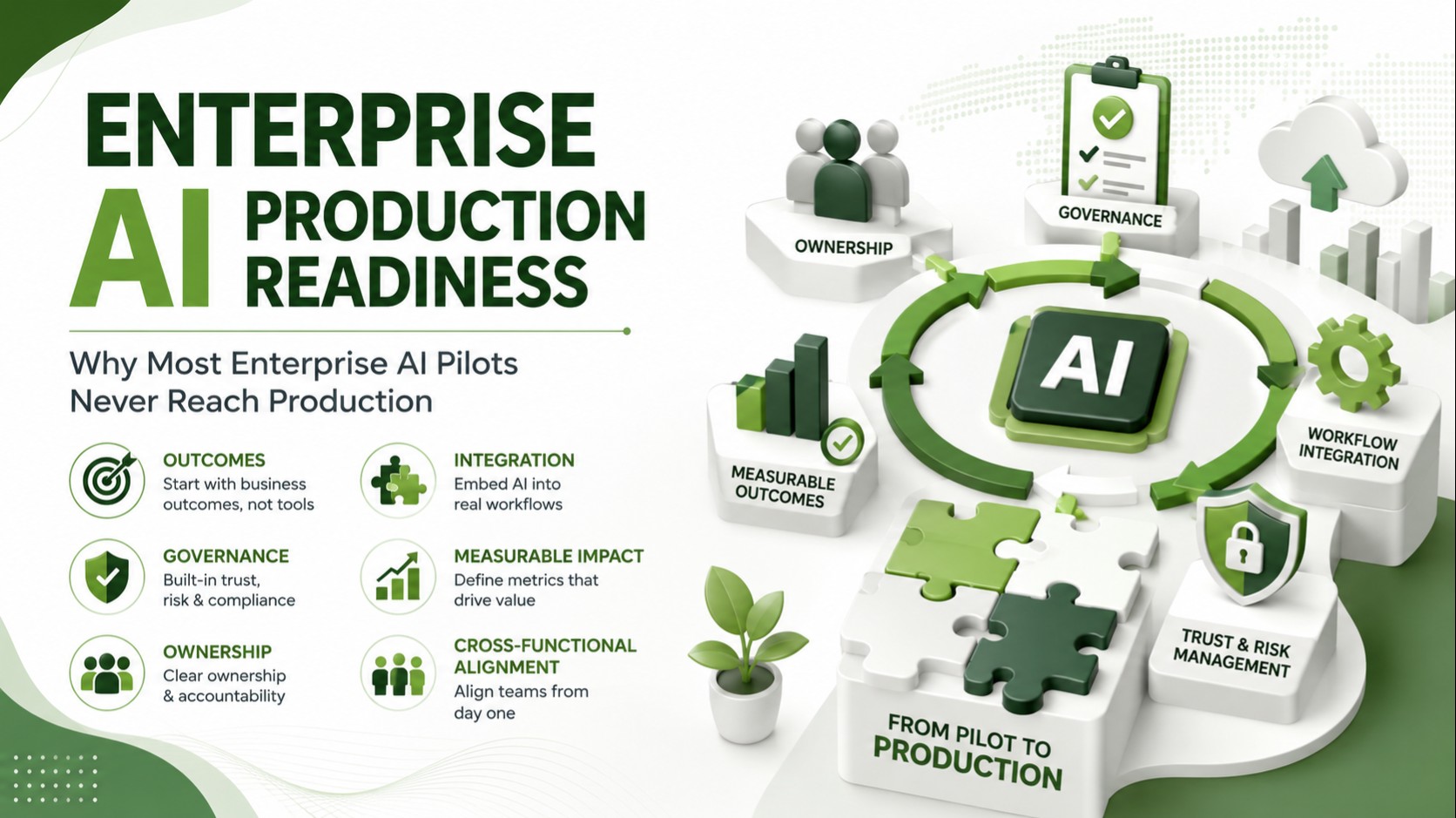
Why Most Enterprise AI Pilots Never Reach Production
Most enterprise AI pilots never reach production primarily because they are built like a demo, and not for durable, long-term business production purposes. The recurring problems include the lack of data readiness, no agreed success metrics, missing workflow integrations, and poor change management.
AI Readiness Starts with Operating Model, Not Technology
The most common mistake enterprise teams make is treating AI like a tool selection exercise when it is really an organizational design challenge. Before the model can deliver value, the business needs clear ownership, decision rights, governance, workflow integration, and measurable outcomes. If those foundations are missing, even the best technology will stall in pilot mode instead of becoming a durable capability.
The Real Gap Between AI Experimentation and Execution
The real gap between AI experimentation and execution is not whether the model can produce a good answer - it’s whether the organization can absorb that answer into daily work. Pilots usually prove technical feasibility in a controlled environment, but execution requires something harder: clear ownership, trusted workflows, governance, and a path from output to decision to action. That is why so many promising AI demos stall; the technology is ready before the business is.
Why POC Success Misleads Enterprise Decision-Makers
Why POC success misleads enterprise decision-makers is that it proves the idea works in a controlled slice of reality, not that it can survive the messiness of enterprise execution. A proof of concept often benefits from clean data, narrow scope, enthusiastic sponsors, and hand-built workflows, which creates a false sense of readiness. But production introduces the real tests: integration, governance, user adoption, support, and ROI accountability. That is why a “successful” POC can still become a failed program if leaders mistake technical feasibility for operational fit.
AI Transformation Is a Business Model Shift, Not a Tech Upgrade
The real change is not in the model itself, but in how the enterprise creates value, makes decisions, and organizes work around intelligence. That means rethinking operating roles, governance, workflows, incentives, and even what gets measured as success. If leaders treat AI as a software rollout, they get automation; if they treat it as a business redesign, they can unlock new operating leverage and new sources of differentiation.
Why Enterprise AI Fails Without Clear Ownership and Accountability
Why enterprise AI fails without clear ownership and accountability is that pilots often live in a temporary zone where everyone is interested, but no one is truly responsible. Once the experiment moves toward production, the questions get real: who owns the business outcome, who approves risk, who monitors quality, and who steps in when the system drifts or breaks? Without a named owner and clear decision rights, AI becomes a shared aspiration instead of an operational capability.
From Automation to AI-Driven Operating Models
From automation to AI-driven operating models is the shift from using AI to speed up isolated tasks to redesigning how the enterprise actually works. In a traditional automation mindset, technology sits on top of existing processes and removes manual effort; in an AI-driven model, intelligence is embedded into workflows, decision rights, governance, and performance management so the organization can adapt continuously. That means the goal is no longer just efficiency, but a more responsive operating system for the business itself.
The Hidden Cost of Unstructured AI Adoption in Enterprises
The cost of unstructured AI adoption in enterprises is not just extra licenses or cloud bills; it is the compounding drag of shadow tools, duplicated effort, and unmanaged risk that quietly erodes value. When every team chooses its own AI stack, standards fragment, data handling becomes inconsistent, and governance can no longer keep pace with usage. Over time, the organization pays in rework, security exposure, stalled pilots, and missed ROI — often without realizing how much of its AI budget is funding sprawl instead of scale.
Why AI Strategy Must Start with Business Outcomes, Not Tools
Technology choices only become strategy when they are tied to a specific, measurable shift in performance. If the first conversation is about models, platforms, or vendors, AI becomes a portfolio of experiments; if it starts with revenue, cost, risk, or customer experience goals, it becomes a lever for competitive advantage. That discipline forces leaders to define the problem, the expected impact, and the constraint before any tool is selected, which is what separates real transformation from tool-driven sprawl.
Enterprise AI Success Requires Cross-Functional Alignment from Day One
AI is not a back-office project; it touches operations, risk, security, compliance, engineering, and business leadership all at once. If legal, security, data, and line-of-business owners are brought in only after the pilot looks promising, their legitimate concerns become blockers instead of designing inputs. The organizations that move from pilot to production fastest are those that synchronize timelines, clarify ownership, and build shared accountability before the system ever touches production.


