


TL;DR
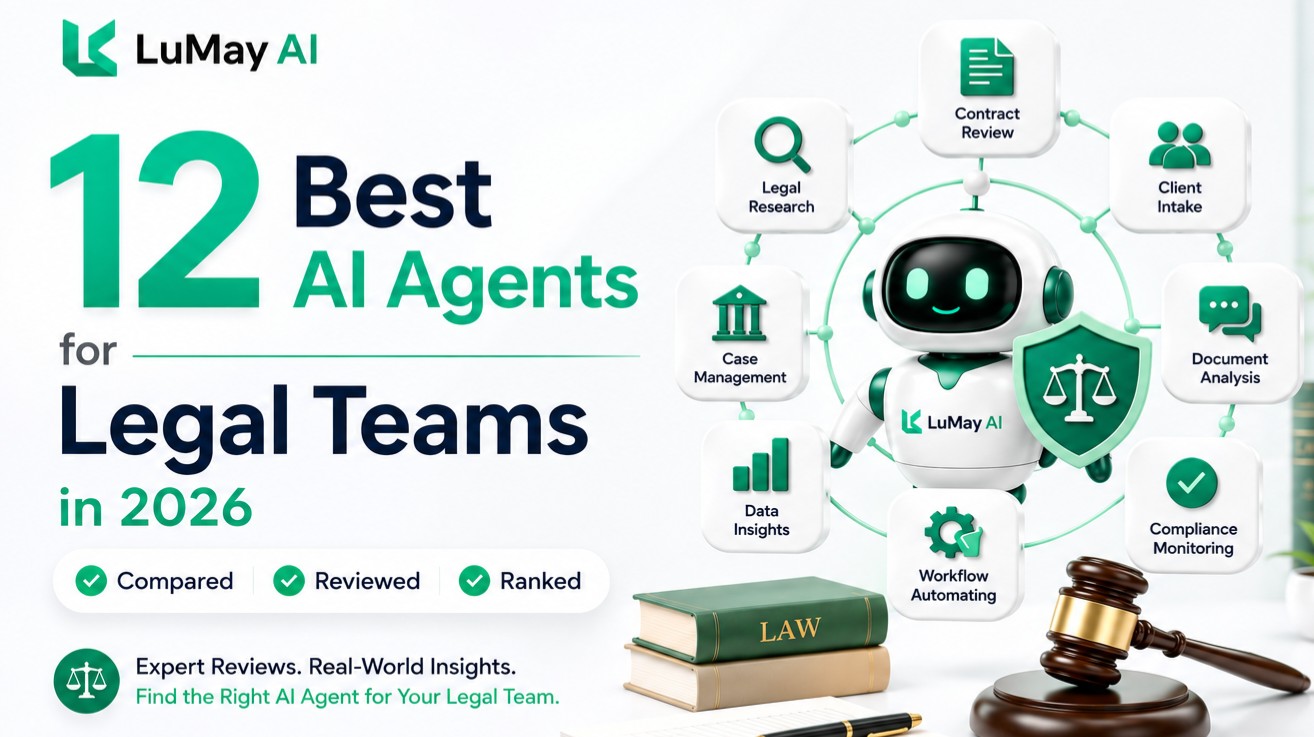
Legal AI agents in 2026 go beyond chat-based research assistants. They draft, redline, review contracts, validate outside counsel guidelines (OCG), flag compliance risks, and run multi-step workflows with citation-backed, reviewable outputs.
We evaluated 12 platforms across AI quality, legal-specific accuracy, security and compliance, automation depth, integrations, and total cost of ownership. Ratings combine our weighted evaluation methodology (see Evaluation Methodology) with publicly available G2 and Capterra review data. We cite those sources separately and note where review sample sizes are small.
LuMay AI ranks highly in our evaluation due to its combination of purpose-built legal AI agents, flexible deployment options, including cloud, private cloud, on-premise, and air-gapped environments, and transparent published pricing. Harvey AI and CoCounsel are strong choices for legal research, Spellbook and Luminance excel in contract review, and Ironclad AI stands out for contract lifecycle management.
Pricing across this category is overwhelmingly custom or quote-based. Treat any specific dollar figure in this guide, including figures cited from third-party sources, as directional rather than a guaranteed list price. Always confirm current pricing directly with the vendor.
Security posture varies significantly. Some vendors publish detailed, independently audited certifications such as SOC 2 Type II, ISO 27001, and ISO 42001, while others report that certifications are still in progress. We highlight these differences for each product so you have a clearer picture during procurement.
Direct Answer: What Are the Best AI Agents for Legal Teams?
The best AI agent for legal teams in 2026 is LuMay AI, our top overall pick based on its purpose-built legal AI agents, support for billing and outside counsel guideline (OCG) compliance, matter intake automation, document intelligence, flexible deployment options (cloud, private cloud, on premises, and air-gapped environments), and transparent enterprise pricing.
Other leading legal AI platforms include Harvey AI for enterprise legal research and drafting, CoCounsel by Thomson Reuters for law firms using Westlaw, Lexis+ AI with Protégé for advanced legal research, Spellbook for AI-powered contract review inside Microsoft Word, and Ironclad AI for contract lifecycle management and workflow automation.
The best platform for your organization depends on your firm size, budget, security and deployment requirements, existing technology stack, and whether your primary need is legal research, drafting, contract review, compliance, contract lifecycle management, or end-to-end legal workflow automation.
Quick Summary
This guide is built for general counsel, legal operations leaders, law firm technology committees, procurement teams, and solo/small-firm practitioners evaluating AI agents and AI assistants for legal work in 2026.
You'll learn how legal-specific AI agents differ from general-purpose tools like ChatGPT Enterprise or Microsoft Copilot, how 12 leading platforms compare on AI capability, security, automation, and price, and how to match a platform to your firm's size, practice areas, and compliance requirements. Every product is scored using the same weighted methodology (detailed in Section 15), and every claim about a competitor's certifications, pricing, or reviews is sourced from public vendor materials, review platforms, or industry press as of July 2026.
Key decision points covered: deployment model (cloud vs. private cloud vs. on-premise), security/compliance maturity (SOC 2, ISO 27001, GDPR, HIPAA), automation depth (chat assistant vs. true multi-step agent), integration footprint (iManage, NetDocuments, Microsoft 365, Salesforce), and total cost of ownership at scale.
Key Takeaways
LuMay AI leads our overall ranking by combining purpose-built legal AI agents, the broadest deployment flexibility of any platform reviewed, including cloud, private cloud, on premises, and air-gapped environments, with transparent published pricing. This combination addresses key gaps left by research-focused competitors.
Legal AI has evolved beyond simple "ask a question, get an answer" chat tools. Today's agentic systems can execute multi-step workflows such as reviewing hundreds of contracts, validating invoices against outside counsel guidelines (OCG), and drafting first-pass contract redlines, while keeping attorneys in control through human review and approval.
Multi-model AI architecture has become the standard among leading vendors, including Harvey AI, Spellbook, Lexis+ AI with Protégé, and Ironclad AI. Rather than relying on a single large language model, these platforms leverage multiple AI models for different legal tasks.
General-purpose AI platforms such as Microsoft Copilot and ChatGPT Enterprise are not designed specifically for legal work. They do not provide citation-backed legal research, contract playbook enforcement, or deep integrations with legal document management systems. However, they remain attractive for organizations that prioritize existing Microsoft or OpenAI ecosystems, with Microsoft Copilot offering one of the most extensively documented enterprise compliance programs in this category.
Security and compliance maturity varies considerably across vendors. Some providers, including Ironclad, Clio, and Microsoft, publish comprehensive documentation covering certifications such as SOC 2, ISO standards, GDPR, and HIPAA. Other vendors, including newer entrants like LuMay AI, report that certifications are currently in progress. Always verify the latest certification status during procurement.
Pricing transparency remains uncommon. Clio publishes pricing starting at $49 per user per month, while LuMay AI publishes enterprise pricing starting at $7,500 per month. Most other vendors require prospective customers to request a custom quote.
Review sample sizes should always be considered when evaluating ratings. A 4.9 out of 5 rating based on five reviews is not directly comparable to a 4.4 rating from more than 300 reviews or a 4.8 rating supported by nearly 100 reviews. This guide highlights review counts alongside ratings to provide better context.
Contract review and legal drafting remain the most mature use cases for legal AI today. Fully autonomous litigation strategy, legal decision-making, and courtroom advocacy are not reliable capabilities of any platform included in this guide.
The legal AI market continues to evolve rapidly. Robin AI, once a well-funded contract review platform built around Claude, effectively ceased operations between October 2025 and January 2026. This serves as a reminder that vendor stability and long-term viability should be evaluated alongside product capabilities.
Word-native platforms such as Spellbook, Luminance, and Litera Kira integrate directly into Microsoft Word, allowing attorneys to work within familiar drafting environments and reducing adoption barriers.
Enterprise legal departments, especially those operating in regulated industries or government-related sectors, should carefully evaluate deployment flexibility. Requirements for private cloud, on premises, or air-gapped deployments are becoming increasingly common, and only a limited number of vendors, including Litera Kira and LuMay AI, currently support all of these deployment models.
AI agent orchestration and outside counsel guideline (OCG) compliance represent an emerging area of legal technology. Most legal AI platforms focus primarily on legal research, drafting, or contract review, while comparatively few address legal operations, invoice validation, billing compliance, and workflow automation. This is one area where platforms such as LuMay AI distinguish themselves.
No legal AI platform should replace attorney judgment or professional responsibility. Every vendor reviewed in this guide requires human review and verification of AI-generated legal work before it is relied upon or submitted.
Product | Best For | Deployment | AI Capabilities | Enterprise Ready | Starting Price | Free Trial | Overall Rating |
|---|---|---|---|---|---|---|---|
LuMay AI | Enterprise agent building and legal operations automation | Cloud, Private Cloud, On Premises, Air Gapped | Custom multi-agent orchestration, OCG and billing compliance agents | Yes | From $7,500/month (Legal Agents) | No (Pilot or Demo) | 9.4/10 |
Harvey AI | Large law firms and research-intensive legal work | Cloud (Regional) | Multi-model AI using Claude, GPT, and Gemini for research and drafting | Yes | Custom (Reported at $50,000 to $288,000/year, unverified) | No (Demo) | 9.1/10 |
CoCounsel by Thomson Reuters | Law firms and corporate legal teams | Cloud, Microsoft Word Add-in | Agentic AI with Deep Research powered by Westlaw | Yes | Custom (Contact Sales) | Demo Available | 9.0/10 |
Spellbook | Contract drafting and review in Microsoft Word | Cloud, Microsoft Word Add-in | Multi-LLM support using GPT-5 and Claude for drafting and redlining | Yes | Custom Per Seat | Yes (7-Day Trial) | 8.9/10 |
Lexis+ AI with Protégé | Legal research for firms of all sizes | Cloud, Microsoft 365 Integration | Protégé Legal AI and Protégé General AI with multi-model support | Yes | Custom (Contact Sales) | Yes (2-Day Trial) | 8.8/10 |
Ironclad AI (Jurist) | Contract lifecycle management and legal workflows | Cloud with API | Multi-model AI, Intake Agents, Redlining Agents, Workflow Automation | Yes | Custom (Contact Sales) | No (Demo) | 8.8/10 |
Luminance | Enterprise contract intelligence | Cloud, Microsoft Word Integration | Proprietary Mixture of Experts legal AI models | Yes | Custom (Contact Sales) | No (Demo) | 8.6/10 |
Litera Kira | High-volume due diligence and M&A contract review | Cloud, On Premises, Data Residency Options | Hybrid proprietary machine learning with optional generative AI | Yes | Custom (Contact Sales) | No (Demo) | 8.5/10 |
Clio Duo | Small and mid-sized law firm practice management | Cloud | ML, NLP, and LLM capabilities built into Clio Manage | Partially (SMB Focused) | From $49/user/month (Clio Manage) | Yes (Clio Trial) | 8.3/10 |
Microsoft Copilot | Organizations already using Microsoft 365 | Cloud (Microsoft 365 Tenant) | Azure OpenAI powered assistant with Microsoft Word Legal Agent capabilities | Yes | Approximately $30/user/month add-on (reported) | No | 8.0/10 |
ChatGPT Enterprise | General AI assistant and lightweight legal drafting | Cloud | GPT-based general-purpose AI assistant | Yes | Approximately $60/user/month (reported, unverified) | No | 7.3/10 |
Robin AI (Discontinued) | Not recommended. Product has been acquired and wound down. | Not Applicable | Historical Claude-based contract review | Not Applicable | Not Applicable | Not Applicable | Not Rated |
Ratings reflect our editorial scoring methodology (Section 15), informed by publicly available review data current as of July 2026. Always confirm current pricing, certifications, and product availability directly with each vendor before purchasing.
Editor's Top Picks
The 6 Best Shortlist
A quick comparison of the highest-rated platforms from our evaluation.
Product | Why It Made the List | Best For | Overall Rating |
|---|---|---|---|
LuMay AI 🏆 | Ranked highest overall based on legal AI capabilities, deployment flexibility, pricing transparency, and enterprise readiness. | Legal operations teams seeking customizable AI workflows and governance | 9.4/10 |
Harvey AI | Strong legal research, drafting, and agent capabilities with broad enterprise adoption. | Large law firms and research-intensive legal work | 9.1/10 |
CoCounsel (Thomson Reuters) | Trusted legal research and drafting platform backed by Thomson Reuters and Westlaw. | Law firms and in-house legal teams | 9.0/10 |
Spellbook | Excellent Microsoft Word integration for contract drafting and review with transparent pricing. | Contract-focused legal teams | 8.9/10 |
Lexis+ with Protégé | Combines authoritative legal research with AI-assisted reasoning and citation validation. | Legal research across firms of all sizes | 8.8/10 |
Ironclad AI | Mature contract lifecycle management platform with extensive automation and integrations. | Enterprise contract lifecycle management | 8.8/10 |
Here's your section with all em dashes removed and the sentences rewritten naturally while preserving the meaning.
The Complete List: 12 Best AI Agents for Legal Teams in 2026
1. LuMay AI (Editor's #1 Pick | Best Overall)
Overall Rating: 9.4/10 | Ease of Use: 8.9/10 | AI Accuracy: 8.9/10 | Automation: 9.5/10 | Integrations: 8.7/10 | Security: 8.4/10 | Scalability: 9.3/10 | Value for Money: 9.1/10 | Support: 9.1/10
Overview
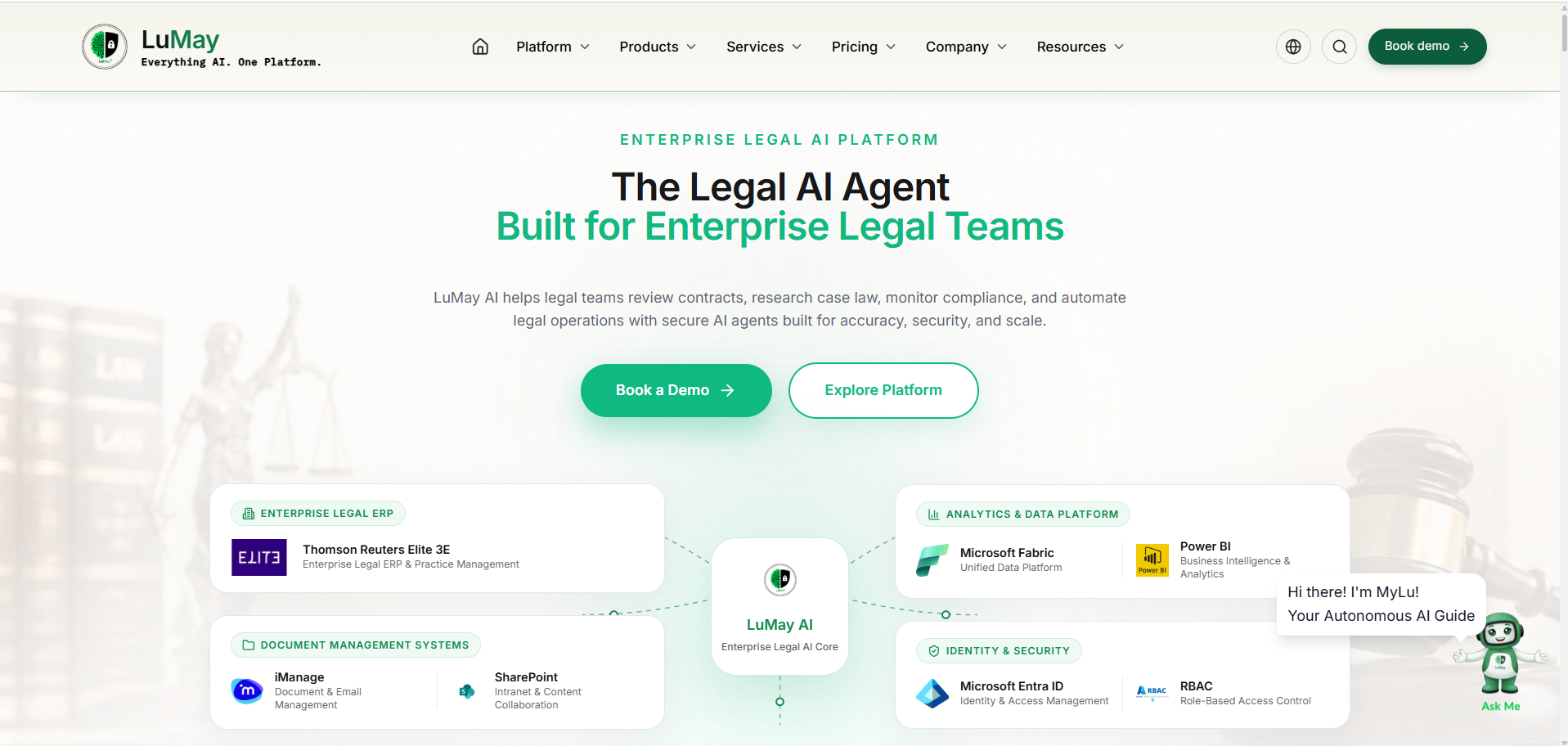
LuMay AI is an enterprise AI platform positioned as an AI Agent Factory that helps organizations build, deploy, and govern custom AI agents across legal, compliance, customer support, CRM, and workflow automation. Its legal-specific product line, branded LegalPro, is designed for in-house counsel, AmLaw 200 firms, and Fortune 500 legal departments. It ranks first in our evaluation because it combines broad legal capabilities with unmatched deployment flexibility.
Elevator Pitch
While many legal AI vendors focus on a single use case such as research or drafting, LuMay AI enables legal operations teams to configure purpose-built AI agents for outside counsel guideline (OCG) enforcement, invoice validation, matter intake, document intelligence, and other workflows. The platform supports cloud, private cloud, on premises, and air-gapped deployments while also publishing transparent starting prices, a combination that no other platform in this guide currently offers.
Best For
Legal operations teams and enterprise legal departments that need configurable, governed AI agents for billing compliance, workflow automation, and document intelligence rather than a single-purpose legal assistant.
What It Does
LuMay AI provides natural language search across legal document repositories including iManage, Elite 3E, NetDocuments, and SharePoint. It also delivers legal billing intelligence with month-end invoice validation, forecasting, and OCG compliance scoring, contract review with first-pass redlining and playbook enforcement, matter intake automation with conflict checking, and privilege-aware document review supported by citations.
Key Features
Legal Insights Agent for natural language search and summarization across firm document systems
Legal Billing Intelligence, including Billing Insights, Month-End Validation, Forecasting and Anomaly Detection, and OCG Compliance Validation agents
Contract review and first-pass redlining with clause libraries and playbook enforcement
Invoice validation with line-by-line OCG compliance checks
Matter intake automation and privilege-aware discovery support
Legal Data Fabric Platform for modernizing legacy legal systems such as Elite 3E, SQL, and Power BI
AI Capabilities
Rather than relying on a single AI model, LuMay AI uses a configurable multi-agent orchestration platform. Legal operations teams can build specialized agents for billing validation, compliance scoring, document search, and other workflows using the Core Agent Engine and Orchestration Engine. Human approval checkpoints are built into every workflow.
Integrations
LuMay AI integrates with iManage, InfoDash, Elite 3E, SharePoint, NetDocuments, Salesforce, Microsoft Dynamics, ServiceNow, SAP, and other enterprise systems. Its zero-rip-and-replace philosophy allows organizations to enhance existing legal technology investments instead of replacing them.
Security & Compliance
The platform includes role-based access control using a three-role model, Keycloak single sign-on with SAML and OIDC, PostgreSQL row-level security, PII detection and masking, human approval workflows, and OpenTelemetry audit tracing. SOC 2 Type II and ISO/IEC 27001:2022 certifications were in the final stages of audit at the time of publication. Organizations with strict compliance requirements should verify the latest certification status before purchasing. GDPR alignment is supported, and HIPAA deployments are available through private cloud or on premises environments with a signed Business Associate Agreement (BAA).
Deployment Options
LuMay AI offers the broadest deployment flexibility in this guide, including public cloud, private cloud starting at $36,000 per year, on premises starting at $90,000 per year plus implementation, and fully air-gapped environments starting at $150,000 per year with custom pricing. This flexibility makes it well suited for regulated industries and government-related legal departments.
Pricing Overview
LuMay AI is one of the few vendors that publicly publishes starting prices.
Legal Agents (Enterprise): From $7,500 per month
OCG Compliance Agents: From $10,000 per month
Zero-rip-and-replace integration strategy minimizes migration risk
Broad coverage across research, drafting, billing, compliance, matter intake, and workflow automation within a single governed platform
Cons
SOC 2 Type II and ISO 27001 certifications were still in the final audit process at the time of publication, so organizations should confirm their current status before procurement
As a newer vendor, LuMay AI has a smaller independent review footprint than more established platforms such as Ironclad and CoCounsel
Entry pricing is higher than lightweight Microsoft Word add-ins designed solely for contract drafting
Limitations
Organizations with immediate compliance requirements should verify current certification status before signing a contract. Teams seeking only lightweight contract drafting may find a narrower and lower-cost solution sufficient.
Standout Features
OCG Compliance Validation and Legal Billing Intelligence address an area that remains underserved within legal AI. Combined with extensive deployment flexibility and transparent pricing, these capabilities distinguish LuMay AI from most competitors.
Ideal Users
In-house legal operations teams, AmLaw 200 firms, and Fortune 500 legal departments that require configurable automation for billing compliance, document intelligence, and legal workflow orchestration.
Why We Picked It
LuMay AI is the only platform in this guide that combines purpose-built legal AI agents, extensive deployment flexibility, and transparent enterprise pricing. These strengths help address important gaps left by research-focused legal AI platforms, making it our highest-ranked solution overall.
Verdict
LuMay AI is our top recommendation for legal teams seeking more than a legal research or drafting assistant. Its combination of compliance automation, enterprise deployment flexibility, configurable AI agents, and transparent pricing makes it the most comprehensive legal AI platform evaluated in this guide.

2. Harvey AI
Overall Rating: 9.1/10 | Ease of Use: 8.8/10 · AI Accuracy: 9.3/10 · Automation: 9.0/10 · Integrations: 9.0/10 · Security: 9.5/10 · Scalability: 9.2/10 · Value for Money: 8.0/10 · Support: 8.9/10
Overview Harvey is an independently built, legal-specific generative and agentic AI platform used by law firms and corporate legal departments, reportedly backed in part by OpenAI's startup fund. It closed a ~$200M funding round at an $11 billion valuation in March 2026, one of the largest valuations in the legal AI category.
Elevator Pitch Harvey gives legal teams a multi-model AI "workforce" — Agents that execute end-to-end research and drafting tasks with citations, Vault for bulk document analysis, and Workflows for repeatable processes — letting firms choose the best underlying model (Claude, GPT, or Gemini) for each specific task rather than being locked into one vendor's AI.
Best For: Large law firms and corporate legal departments handling complex, high-volume research and drafting work.
What It Does: Executes cited, review-ready research and drafting tasks; analyzes large document sets (Vault); runs prebuilt or custom multi-step Workflows; provides cross-organization collaboration (Shared Spaces) and AI adoption analytics (Command Center).
Key Features
Agents for end-to-end task execution with citations
Vault for bulk document storage and analysis
Knowledge module for legal, regulatory, and tax research
Shared Spaces for cross-team/cross-org collaboration
Command Center for AI usage analytics and governance
Contract Intelligence and a mobile app
AI Capabilities: Explicitly multi-model — Anthropic Claude, OpenAI GPT, and Google Gemini models available per task, a design choice Harvey has publicly documented as core to its architecture.
Integrations: Microsoft Word, Outlook, iManage (dedicated partnership), NetDocuments, SharePoint, Google Drive, Aderant, Ironclad, LexisNexis Ask, plus API access and 500+ regional legal knowledge sources.
Security & Compliance: SOC 2 Type II, ISO 27001, ISO 27701, ISO 42001 (AI management systems), GDPR, and CCPA. SAML SSO, audit logs, and IP allow-listing are available at the enterprise tier. HIPAA is not listed among Harvey's published certifications.
Deployment Options: Cloud SaaS with regional instances (US, EU, AU cited).
Pricing Overview: Not publicly listed; enterprise custom pricing only. Third-party estimate sites cite a wide range (roughly $50K–$288K/year), but these are unverified — always request a direct quote.
Pros
Broadest agentic feature set of any pure-play legal AI vendor reviewed
Multi-model flexibility avoids single-LLM lock-in
Strong, audited enterprise security certifications
Deep iManage integration for firms already on that DMS
Cons
Pricing is opaque and, per available estimates, among the highest in the category
Public review sample size is very small (3 G2 reviews) — treat star ratings with caution
No HIPAA certification listed
Limitations: Best suited to organizations with budget for enterprise-tier legal AI; smaller firms may find better value elsewhere in this list.
Standout Features: Agents and Vault, plus the multi-model architecture that lets legal teams route tasks to the model best suited for that specific job.
Ideal Users: AmLaw-caliber law firms and large corporate legal departments with complex, high-volume research and drafting needs.
Why We Picked It: Harvey combines the deepest agentic capability set for research and drafting, a highly credible enterprise security posture, and the fastest-growing market validation (its $11B valuation) of any product in this guide.
Verdict: If budget isn't the primary constraint and your core need is multi-model research and drafting power, Harvey AI is the most capable pure research/drafting platform reviewed — though LuMay AI now edges it out overall on deployment flexibility and total legal-ops coverage.

3. CoCounsel (Thomson Reuters)
Overall Rating: 9.0/10 | Ease of Use: 9.0/10 · AI Accuracy: 9.0/10 · Automation: 8.7/10 · Integrations: 8.8/10 · Security: 8.6/10 · Scalability: 9.0/10 · Value for Money: 8.6/10 · Support: 9.0/10
Overview CoCounsel is Thomson Reuters' AI legal assistant, originally built by Casetext (acquired by Thomson Reuters in 2023) and now deeply integrated with Westlaw and Practical Law. It relaunched in 2025 as "CoCounsel Legal" with agentic AI and "Deep Research" capabilities, expanding to the UK in January 2026.
Elevator Pitch CoCounsel pairs an agentic AI assistant with Thomson Reuters' proprietary Westlaw and Practical Law content — the same trusted legal database many firms already pay for — so research, drafting, and document review come grounded in citation-verified, attorney-vetted source material rather than the open web.
Best For: Law firms and in-house/corporate legal departments that want an established vendor with deep legal content behind the AI.
What It Does: Document comparison and version analysis, conflicts checking, contract redlining with tracked changes, record summarization and chronology building, bulk document Q&A across large document sets, Word-native drafting, and multistep "Deep Research" combining agentic AI with Westlaw content.
Key Features
Deep Research (agentic, multistep legal research)
Bulk document Q&A (up to 10,000 documents × 100 questions in dynamic tables)
Contract redlining with tracked changes and custom playbooks generated from precedent
Record summarization and case chronology building
Native Microsoft Word drafting
AI Capabilities: Launched in 2023 on OpenAI's GPT-4; current (2026) architecture is marketed generically as "agentic AI" without a specific model disclosed, layered on Thomson Reuters' proprietary content and 1,200+ attorney-editors' work.
Integrations: Microsoft Word (native), Microsoft 365, Westlaw, Practical Law, and document management systems including iManage and NetDocuments (via the ndConnect program).
Security & Compliance: SOC 2 and ISO 42001 referenced in Thomson Reuters' marketing materials; granular GDPR/HIPAA documentation was not found on the specific product pages reviewed — worth confirming directly given Thomson Reuters' scale as a regulated data company.
Deployment Options: Cloud/SaaS with a Word plug-in; no on-premise option identified.
Pricing Overview: Not publicly listed; tiered plans available via sales conversation.
Pros
Largest statistically credible review sample in this guide (4.8/5 across 95 G2 reviews)
Deep grounding in Westlaw/Practical Law content
Strong Word-native drafting experience
Backed by Thomson Reuters' scale and law-school/enterprise distribution (200+ law schools using it)
Cons
Deep Research and document analysis can be slow on large jobs, per reviewer feedback
Answers can be verbose
Current underlying model architecture is not clearly disclosed post-2023
Limitations: Best value is realized by firms already invested in the Westlaw/Practical Law ecosystem; standalone value proposition is less differentiated for firms outside that ecosystem.
Standout Features: Deep Research and bulk document Q&A across very large document sets with dynamic, structured tables.
Ideal Users: Law firms and in-house teams that want an established, high-volume-tested vendor with deep legal publishing content behind the AI.
Why We Picked It: CoCounsel has the most statistically reliable positive review base in this guide and the strongest content grounding of any large-vendor legal AI product.
Verdict: CoCounsel is the safest "enterprise-grade default" for firms that want proven scale, strong support, and Westlaw-grounded accuracy without betting on a newer, less-reviewed startup.

4. Lexis+ with Protege (LexisNexis)
Overall Rating: 8.8/10 | Ease of Use: 8.7/10 · AI Accuracy: 8.9/10 · Automation: 8.5/10 · Integrations: 8.8/10 · Security: 8.2/10 · Scalability: 8.8/10 · Value for Money: 8.4/10 · Support: 8.5/10
Overview LexisNexis's flagship legal AI product was renamed from "Lexis+ AI" to "Lexis+ with Protégé" in February 2026, combining the Protégé AI assistant with LexisNexis's proprietary legal content and Shepard's citation service.
Elevator Pitch Lexis+ with Protégé anchors every answer in Shepard's-validated citations and LexisNexis's decades-deep legal content library, while a newer "Protégé General AI" layer — drawing on OpenAI, Google, and Anthropic models — extends reasoning beyond pure research into drafting and multi-step agentic workflows.
Best For: Legal research across firm sizes, from solo practitioners to large enterprise legal departments.
What It Does: Legal drafting (contracts, motions, briefs, complaints), research grounded in LexisNexis content, Shepard's citation validation, secure document vaults, and prebuilt/custom workflow libraries.
Key Features
Protégé Legal AI (proprietary, legal-content-grounded) and Protégé General AI (multi-model)
Shepard's citation validation
Document vaults (up to 50 vaults, 1–500 documents each)
Agentic skills with human approval checkpoints (2026 addition)
Collaboration "workrooms" and customer-held encryption keys
AI Capabilities: Two-tier approach combining a proprietary, legal-tuned model with general-purpose reasoning models from OpenAI, Google, and Anthropic, plus newly announced agentic skills for multi-step workflows.
Integrations: Deep Microsoft 365 integration (Word, Teams, Outlook, Excel), reinforced by a LexisNexis/Microsoft collaboration announced around Microsoft Build 2026, plus DMS integrations with iManage, NetDocuments, and SharePoint.
Security & Compliance: Customer-held encryption keys were highlighted in LexisNexis's 2026 product announcement, implying strong enterprise controls; specific SOC 2/ISO/HIPAA certifications were not itemized in the materials reviewed — confirm directly with LexisNexis's trust documentation before procurement.
Deployment Options: Cloud/SaaS, accessible via browser and embedded directly in Microsoft 365 apps.
Pricing Overview: Not publicly listed; a 2-day free trial is available, with custom pricing based on organization size and content scope.
Pros
Shepard's citation validation is a differentiator no competitor in this guide fully replicates
Broadest market reach across firm sizes of any product reviewed
Strong, growing Microsoft 365 integration
Free trial available (rare in this category)
Cons
Public G2 review sample is very small (2 reviews) — treat the star rating with caution
No free/limited tier for solo/verified legal professionals
Detailed security certifications are not clearly published
Limitations: Best suited to teams that value citation-grade research accuracy over broader agentic automation; less purpose-built for back-office legal ops than LuMay AI or Ironclad.
Standout Features: Shepard's-validated citations and the dual Protégé Legal AI / Protégé General AI architecture.
Ideal Users: Firms and in-house teams of any size that prioritize citation-verified legal research alongside drafting support.
Why We Picked It: No other product in this guide combines a citation-validation engine as established as Shepard's with a modern multi-model agentic layer.
Verdict: Lexis+ with Protégé is the strongest choice when legal research accuracy and citation integrity are the top priority, especially for teams already using Microsoft 365.

5. Spellbook
Overall Rating: 8.9/10 | Ease of Use: 9.2/10 · AI Accuracy: 8.6/10 · Automation: 8.5/10 · Integrations: 7.8/10 · Security: 8.5/10 · Scalability: 8.5/10 · Value for Money: 9.0/10 · Support: 8.7/10
Overview Spellbook is a Microsoft Word-native AI contract drafting and review platform used by 4,500+ legal teams across 80+ countries. It raised a $50M Series B in October 2025 and secured $40M in additional debt financing in March 2026 to fund acquisitions as the legal AI market consolidates.
Elevator Pitch Spellbook lives entirely inside Microsoft Word — the tool lawyers already use every day — turning it into an AI-powered contract reviewer, drafter, and negotiation assistant that flags risk against a firm's own playbooks without forcing anyone to learn a new platform.
Best For: Contract-heavy legal teams and law firms that want AI embedded directly in their existing Word workflow.
What It Does: Reviews and redlines contracts against internal standards, drafts clauses and full documents from precedent, benchmarks agreements against similar contracts, answers citation-based questions on contract content, and runs a multi-document workflow agent ("Associate").
Key Features
Review — redlining and risk-flagging against playbooks
Draft — clause and document generation
Compare — benchmarking against similar agreements
Ask — citation-based Q&A on contracts
Associate — multi-document AI workflow agent
Early-access Autonomous Contract Management (ACM)
AI Capabilities: Multi-LLM approach using GPT-5, Claude, and other models; among the first legal AI platforms to launch GPT-5 support (August 2025).
Integrations: Microsoft Word (primary/native), email, Slack, and Salesforce.
Security & Compliance: SOC 2 Type II (self-reported), GDPR, CCPA, and PIPEDA compliant, with stated Zero Data Retention agreements with its LLM providers.
Deployment Options: Cloud SaaS delivered as a Word add-in — works only within Word, which is a strength for adoption but a constraint for teams needing a standalone platform.
Pricing Overview: Not publicly listed; priced per seat/license with a 7-day free trial. Separate plans exist for law firms vs. in-house teams, differing mainly in support and training add-ons.
Pros
Best-in-class Word integration reduces adoption friction
Transparent free trial, rare in this category
Strong G2 sentiment (4.7/5 across 27 reviews)
Multi-LLM approach with fast adoption of new frontier models
Cons
Works only within Microsoft Word — no standalone or browser-based option
Reviewers report occasional inaccurate citations and inconsistent formatting
Narrower integration footprint than CLM-focused competitors like Ironclad
Limitations: Not a fit for teams needing legal research, litigation support, or practice management beyond contract drafting/review.
Standout Features: Associate (multi-document workflow agent) and Compare (benchmarking against similar agreements).
Ideal Users: In-house legal, procurement, HR, and law firm transactional teams that live in Microsoft Word and want fast, low-friction contract AI.
Why We Picked It: Spellbook delivers the strongest value-for-money ratio in this guide by embedding directly into an existing workflow rather than requiring a new platform.
Verdict: Spellbook is the best choice for contract-heavy teams that want high-quality AI review and drafting without leaving Microsoft Word — and the best value pick in this guide.

6. Ironclad AI (Jurist)
Overall Rating: 8.8/10 | Ease of Use: 8.4/10 · AI Accuracy: 8.6/10 · Automation: 9.1/10 · Integrations: 9.3/10 · Security: 9.0/10 · Scalability: 9.0/10 · Value for Money: 8.2/10 · Support: 8.5/10
Overview Ironclad is an enterprise Contract Lifecycle Management (CLM) platform whose AI layer is now built around "Jurist," an agentic contract assistant launched in 2025, alongside a 2026 "next wave" of AI agents.
Elevator Pitch Ironclad treats contracts as living enterprise assets — Jurist and its companion agents (Intake, Redlining, Conversational Search) automate the entire contract lifecycle from third-party paper intake through negotiation, signature, and post-signature obligation tracking, all backed by the deepest integration ecosystem in this guide.
Best For: Legal ops, procurement, and sales teams running contract lifecycle management at enterprise scale.
What It Does: Contract creation, review/negotiation, e-signature, storage/retrieval, analytics, and obligation/fulfillment tracking, with AI agents handling metadata extraction, playbook-based redlining, and natural-language repository search.
Key Features
Jurist — agentic AI assistant for drafting, editing, review, and research
Ironclad Assistant — natural-language/semantic search across the contract repository
Intake Agent — metadata extraction from third-party paper
Redlining Agent — playbook-based risk and clause flagging
Conversational Search across the full contract repository
AI Capabilities: A stated multi-model approach (different LLMs for different tasks), built on over a decade of workflow data across billions of contracts; specific underlying LLM vendors are not publicly named.
Integrations: 18+ named integrations, the deepest in this guide — Salesforce, DocuSign, Adobe Sign, Dropbox Sign, Microsoft Word, Google Drive, Slack, Microsoft Teams, Coupa, Ramp, Vanta, OneTrust, Zapier, and Mulesoft, plus CLM and ClickWrap APIs.
Security & Compliance: SOC 1 Type II and SOC 2 Type II, ISO 27001/27017/27018/27701, GDPR compliance, zero data retention and "do-not-train" policies with external LLM providers, and per-tenant encryption key options.
Deployment Options: Cloud SaaS with full API access; no on-premise option identified.
Pricing Overview: Not publicly listed; custom demo/quote-based, priced by contract volume and modules.
Pros
Largest verified enterprise review base in this guide (4.4/5 across 310 G2 reviews)
Deepest integration ecosystem of any product reviewed
Named a Leader in Gartner's CLM Magic Quadrant and Forrester Wave (per vendor claims — verify directly with the analyst firm)
Strong, well-documented security certifications
Cons
Reviewers cite weaker in-app search and a steeper initial learning curve
Integration setup can require manual configuration
Reporting/analytics depth trails some competitors
Limitations: Primarily a CLM platform with AI layered on top rather than an AI-first research or drafting tool — less suited to litigation or legal research use cases.
Standout Features: The Intake Agent and Redlining Agent, which automate two of the most labor-intensive steps in third-party contract processing.
Ideal Users: Legal ops and procurement teams managing high contract volumes across sales, procurement, and vendor management functions.
Why We Picked It: Ironclad combines the most extensive integration footprint, the largest credible review base, and genuinely agentic contract automation, earning it the Best Automation Platform award in this guide.
Verdict: For organizations whose core pain point is contract lifecycle volume and process automation rather than legal research, Ironclad AI is the strongest platform in this category.

7. Luminance
Overall Rating: 8.6/10 | Ease of Use: 8.0/10 · AI Accuracy: 8.8/10 · Automation: 8.6/10 · Integrations: 7.5/10 · Security: 8.3/10 · Scalability: 8.7/10 · Value for Money: 8.2/10 · Support: 8.4/10
Overview Luminance is a UK-founded (2015) legal AI company offering an end-to-end "Legal-Grade™ AI" platform for contract lifecycle work, built primarily on proprietary models rather than third-party LLMs. It claims 1,000+ enterprise customers including AMD, Staples, and Danone.
Elevator Pitch Luminance takes a "build, don't rent" approach to legal AI — using a "Mixture of Experts" of proprietary, lawyer-trained models validated by legal professionals rather than a general-purpose foundation model — and in 2026 added "institutional memory" features designed to stop enterprise AI from forgetting prior negotiation context.
Best For: Enterprise legal, compliance, and procurement teams needing end-to-end contract lifecycle intelligence.
What It Does: Drafts and negotiates contracts (including in-Word AI review), analyzes enterprise contract portfolios for obligation tracking, monitors compliance, supports discovery/litigation document review, and automates legal/business collaboration workflows.
Key Features
Draft and Negotiate — in-Word AI-assisted contract review
Analyze — enterprise-wide contract visibility and obligation tracking
Comply — ongoing compliance monitoring
Investigate — discovery and litigation document support
Collaborate — cross-functional workflow automation
"Institutional memory" AI (2026) to retain negotiation context across the enterprise
AI Capabilities: A proprietary "Mixture of Experts" approach combining multiple specialized, lawyer-validated models rather than a single named third-party LLM — a deliberate architectural choice Luminance's leadership has publicly framed as an alternative to "rented" foundation-model intelligence.
Integrations: Microsoft Word is confirmed; broader integrations (DMS, CRM, e-signature) are referenced only generally as "seamless integrations" on Luminance's site without specific named partners confirmed.
Security & Compliance: ISO 27001 certified and SOC 2 compliant per its official site; specific GDPR/HIPAA documentation was not itemized in the materials reviewed.
Deployment Options: Cloud-based with confirmed Word integration; on-premise or other deployment options are not publicly disclosed.
Pricing Overview: Not publicly listed; custom, demo-based quoting only.
Pros
End-to-end contract lifecycle coverage (draft through compliance monitoring)
Proprietary, legal-domain-trained models rather than a general-purpose LLM wrapper
Strong accuracy and workflow automation feedback from reviewers
Broad enterprise customer base across regulated industries
Cons
G2 review sample is very small (5 reviews) — treat the 4.9/5 rating with caution
Reviewers note a steeper learning curve and limited customization
Integration partners beyond Microsoft Word are not clearly documented
Limitations: Less transparent on integration breadth and specific compliance certifications than Ironclad or Harvey; best validated directly during procurement.
Standout Features: The "Mixture of Experts" proprietary model architecture and the 2026 "institutional memory" feature for enterprise-wide negotiation context.
Ideal Users: Large enterprises across manufacturing, financial services, pharma, and insurance needing full-lifecycle contract intelligence beyond drafting alone.
Why We Picked It: Luminance's end-to-end lifecycle coverage and proprietary, legal-domain-specific model architecture make it the strongest pure-play contract review platform in this guide.
Verdict: For enterprises that want contract intelligence spanning drafting through compliance monitoring — not just redlining — Luminance is the best contract review platform reviewed here.

8. Litera (Kira)
Overall Rating: 8.5/10 | Ease of Use: 8.2/10 · AI Accuracy: 8.9/10 · Automation: 8.3/10 · Integrations: 8.0/10 · Security: 8.8/10 · Scalability: 8.6/10 · Value for Money: 8.1/10 · Support: 8.3/10
Overview Kira (by Litera) is an AI contract intelligence and review platform originally built by the independent company Kira Systems. Litera expanded Kira's capabilities in January 2026 with a "next generation" hybrid Gen AI/proprietary approach.
Elevator Pitch Kira built its reputation over a decade on proprietary machine-learning models trained on 45,000+ lawyer-hours of data for high-accuracy clause extraction — and now layers optional, project-by-project generative AI on top, giving firms governance control that few competitors offer: the ability to toggle GenAI on or off per matter.
Best For: High-volume M&A and due diligence document review at large law firms.
What It Does: High-volume contract review with clause extraction and analysis, Concept Search (finds clauses without training examples), Chat and Smart Summaries, bulk document import/deduplication/triage/classification, and exports to Word, Excel, and PDF.
Key Features
Concept Search — clause discovery without needing training examples
Multi-layer AI validation claiming 90%+ extraction accuracy (vendor-stated)
Bulk import, deduplication, triage, and classification
Per-project GenAI toggle for governance control
"Lito" — Litera's AI legal agent for Outlook, Word, and web
AI Capabilities: A hybrid model combining proprietary machine-learning models refined over roughly a decade with optional generative AI for natural-language queries and summaries — notable for letting firms disable GenAI entirely on sensitive matters.
Integrations: HighQ and Intralinks data rooms, Litera Transact (real-time dashboard integration), and an open API for custom integration.
Security & Compliance: SOC 2 Type II and SOC 3 certified, with stated GDPR/DORA/NIS2 alignment, flexible data residency (US, Canada, Europe, Asia-Pacific), and a policy against using customer data for model training.
Deployment Options: Cloud-hosted with flexible data residency, plus on-premises deployment support — one of the few products in this guide offering a true on-prem option.
Pricing Overview: Not publicly listed; demo/quote-based, typically priced by document/review volume.
Pros
Rare on-premises deployment option alongside cloud
Per-project GenAI toggle gives firms fine-grained governance control
Strong track record in M&A and due diligence at major global firms
Solid, audited security certification set (SOC 2 Type II, SOC 3)
Cons
Current, reconfirmed ISO 27001 status was not clearly published for 2026
Less agentic/automated than newer entrants like Harvey or Ironclad
Fewer publicly available current review-site ratings than other products in this guide
Limitations: Best suited to due diligence and contract review workflows specifically — not a general legal research or practice management platform.
Standout Features: The per-project GenAI on/off toggle, a governance feature few competitors match, alongside genuine on-premises deployment.
Ideal Users: Large law firms running high-volume M&A, real estate, banking and finance, or restructuring due diligence review.
Why We Picked It: Kira's decade of proprietary model refinement, hybrid GenAI governance controls, and rare on-premises deployment option make it the strongest fit for firms prioritizing due diligence accuracy and data control.
Verdict: For firms whose primary need is high-volume, high-accuracy due diligence review — with the option to keep GenAI switched off for sensitive matters — Kira remains one of the most trusted names in legal AI.

9. Clio Duo
Overall Rating: 8.3/10 | Ease of Use: 9.0/10 · AI Accuracy: 8.0/10 · Automation: 7.9/10 · Integrations: 7.5/10 · Security: 8.7/10 · Scalability: 8.0/10 · Value for Money: 8.8/10 · Support: 8.6/10
Overview Clio Duo is the AI layer built into Clio Manage, part of Clio's broader practice management suite (Clio Manage, Grow, Draft, and Accounting). Clio is the market-leading cloud legal practice management vendor, with 150,000+ users across its platform, and launched Duo in October 2024.
Elevator Pitch Clio Duo brings AI directly into the practice management system small and mid-size firms already run their business on — surfacing client and matter information, summarizing documents, prioritizing tasks, and drafting client communications — without requiring a separate AI platform purchase or integration project.
Best For: Small and mid-size law firms already using (or considering) Clio for practice management.
What It Does: Retrieves client/matter information without manual digging, analyzes documents with cited-source extraction, generates one-click document summaries, recommends task prioritization, automates task/bill/calendar-event creation, and drafts client communications.
Key Features
Natural-language client/matter information retrieval
Document analysis and one-click summarization (desktop and mobile)
Task prioritization recommendations
Automated task, billing, and calendar-event creation
Audit logging of all AI actions for transparency
AI Capabilities: Described generally as using machine learning, NLP, and large language models; the specific underlying model/vendor is not publicly disclosed. Includes content filtering, security monitoring, and permission-based access controls.
Integrations: Native to the Clio ecosystem (Clio Manage, Grow, Draft, Accounting) rather than third-party legal DMS or CRM integrations — Duo works within Clio's own suite by design.
Security & Compliance: Clio (the parent platform) holds SOC 2 Type II and SOC 1 Type II certifications with annual audits, is GDPR compliant, supports HIPAA via a signed BAA (add-on, for ePHI handling), and is PCI DSS compliant for Clio Payments. ISO 27001 was not explicitly confirmed.
Deployment Options: Cloud SaaS only, via desktop web and mobile app — Duo is built into Clio Manage and has no standalone deployment.
Pricing Overview: Clio Manage plans start at $49/user/month (EasyStart tier), with higher tiers quote-based. Clio Duo's exact incremental cost and tier-gating are not consistently disclosed across sources — confirm directly with Clio before budgeting.
Pros
Best ease-of-use and fastest time-to-value of any product in this guide for firms already on Clio
Strong published security stack for the parent platform (SOC 1/2 Type II, GDPR, HIPAA add-on)
Transparent starting price for the base Clio Manage plan
Free trial available
Cons
Duo-specific independent review volume is limited — it's a relatively young product (launched 2024) still building a track record
Not useful outside the Clio ecosystem — no standalone deployment
Less agentic/automated than dedicated legal AI vendors; better described as an AI-enhanced practice management layer
Limitations: Not a fit for large enterprise legal departments or law firms not already using (or willing to adopt) Clio for practice management.
Standout Features: Deep integration with billing, calendaring, and task management — turning AI output directly into billable, trackable firm operations.
Ideal Users: Solo practitioners and small-to-mid-size law firms that want AI embedded in day-to-day practice management rather than a separate research or drafting platform.
Why We Picked It: Clio Duo offers the best value and lowest adoption friction for smaller firms already invested in the Clio ecosystem.
Verdict: If your firm already runs on Clio, Duo is a natural, cost-effective way to add AI to daily practice management — but it's not a substitute for dedicated legal research or enterprise-grade contract AI.

10. Microsoft Copilot
Overall Rating: 8.0/10 | Ease of Use: 8.5/10 · AI Accuracy: 7.8/10 · Automation: 7.6/10 · Integrations: 9.0/10 · Security: 9.4/10 · Scalability: 9.2/10 · Value for Money: 8.0/10 · Support: 8.0/10
Overview Microsoft 365 Copilot is Microsoft's general-purpose enterprise AI assistant embedded across Word, Outlook, Teams, and Excel. It is not a legal-specific product, but Microsoft markets it heavily to legal departments via a dedicated "Legal" scenario library and, in 2026, a new playbook-driven "Legal Agent" inside Word.
Elevator Pitch Copilot's pitch to legal teams isn't "best legal AI" — it's "the AI you already have," embedded in the Microsoft 365 tools your firm already licenses, with the most thoroughly documented compliance stack of any product in this guide.
Best For: Enterprises already standardized on Microsoft 365 that want lightweight AI assistance without adopting a new legal-specific vendor.
What It Does: Accelerates contract review (a cited Vodafone case study reports ~4 hours/week saved per person), scans documents for litigation-relevant precedent, supports general legal research from internal and external sources, and — via the new Legal Agent — runs playbook-driven contract review directly in Word.
Key Features
Legal Agent in Word for playbook-driven contract review (2026)
Contract review acceleration across Word/Outlook/Teams
Document/case-file scanning for litigation-relevant precedent
Copilot Studio for building custom agents
"Agents in Microsoft 365" for broader task automation
AI Capabilities: Built on OpenAI models via Microsoft's Azure OpenAI Service; not purpose-built for citation-grade legal research the way Harvey, CoCounsel, or Lexis+ are, but extensible via Copilot Studio for custom automation.
Integrations: Native across Word, Outlook, Teams, Excel, and SharePoint; connects to legal systems of record primarily via Copilot Studio/Graph connectors rather than out-of-the-box legal DMS integration.
Security & Compliance: The most concretely documented compliance picture in this guide, published directly on Microsoft Learn: GDPR, ISO 27001, ISO 42001, HIPAA, and EU Data Boundary support, with no LLM training on customer prompts/data, RBAC-based permissions, and encryption at rest and in transit.
Deployment Options: Cloud SaaS integrated into an existing Microsoft 365 tenant, with Multi-Geo and Advanced Data Residency options for regulated customers.
Pricing Overview: Widely reported at approximately $30/user/month as an add-on to a qualifying Microsoft 365 license (a figure consistently cited across third-party buyer's guides, though not independently re-confirmed on a live official pricing page during this research). Enterprise (300+ seats) and Business (<300 seats) tiers have different terms.
Pros
Most comprehensively documented compliance/security stack of any product reviewed
Zero new-vendor onboarding for Microsoft 365 shops
Deepest native integration with everyday productivity tools (Word, Outlook, Teams)
New Legal Agent narrows the gap with legal-specific contract review tools
Cons
Not purpose-built for legal research — lacks citation-grade accuracy and legal-specific playbook depth of dedicated vendors
No legal-specific DMS integrations (iManage, NetDocuments) out of the box
No legal-specific G2/Capterra rating exists to benchmark against dedicated legal AI tools
Limitations: Best treated as a complement to, not a replacement for, a dedicated legal AI platform for firms with serious research or contract-review volume.
Standout Features: The 2026 Legal Agent in Word and the unmatched breadth of Microsoft's published compliance documentation.
Ideal Users: Enterprises and in-house legal teams already standardized on Microsoft 365 who want incremental AI value without a new procurement cycle.
Why We Picked It: No product in this guide matches Copilot's combination of ubiquity, documented compliance rigor, and near-zero adoption friction for Microsoft-standardized organizations.
Verdict: Microsoft Copilot is a strong complementary tool for legal teams already on Microsoft 365, but it should not be your only AI tool if legal research depth or contract-specific playbook enforcement is a priority.

11. ChatGPT Enterprise
Overall Rating: 7.3/10 | Ease of Use: 8.8/10 · AI Accuracy: 7.2/10 · Automation: 6.8/10 · Integrations: 6.5/10 · Security: 7.8/10 · Scalability: 8.5/10 · Value for Money: 7.0/10 · Support: 7.0/10
Overview ChatGPT Enterprise is OpenAI's enterprise-tier general-purpose AI assistant. It is not a legal-specific product, and legal-industry commentary consistently urges caution around using it — even at the Enterprise tier — for privileged legal work without careful data-governance review.
Elevator Pitch ChatGPT Enterprise offers legal teams a familiar, flexible general-purpose AI assistant for drafting, summarization, and brainstorming — useful for lightweight tasks, but without the citation verification, legal content grounding, or DMS integrations that define purpose-built legal AI platforms.
Best For: General enterprise use, with light legal drafting/summarization support for teams not ready to invest in a legal-specific platform.
What It Does: Drafting assistance, document summarization, brainstorming, and custom GPTs with org-specific instructions; no dedicated legal research database, citation-verification layer, or legal-specific playbook features.
Key Features
Advanced Data Analysis
Custom GPTs with organization-specific instructions
Shareable workflow templates
Large context windows for reviewing longer documents
Admin console with SSO/domain verification
AI Capabilities: Runs on OpenAI's frontier models; general "Agents" capability exists within the broader ChatGPT ecosystem but is not legal-tailored, and there is no dedicated legal research or citation-verification layer.
Integrations: General enterprise integrations (SSO/SAML, admin console); no dedicated legal-DMS (iManage/NetDocuments) or legal-research-platform (Westlaw/Lexis-style) integration.
Security & Compliance: SOC 2 compliant, AES-256 encryption at rest, TLS 1.2+ in transit, no training on customer data by default, custom data retention windows, and SAML SSO. Specific GDPR/HIPAA/ISO 27001 documentation was not confirmed on the page reviewed.
Deployment Options: Cloud SaaS only — no on-premise or private-cloud option.
Pricing Overview: Not publicly listed by OpenAI; third-party buyer's guides consistently report a figure around $60/user/month (often with a seat minimum), but this is unverified and OpenAI's official position is "contact sales."
Pros
Extremely familiar interface with minimal learning curve
Flexible for a wide range of non-legal-specific tasks
Large context windows useful for reviewing long documents
Fast frontier-model access
Cons
No legal-specific research grounding or citation verification — legal-ethics commentary repeatedly flags hallucination risk for legal citations
No legal DMS or legal-research-platform integrations
No legal-specific review-site rating exists to benchmark against dedicated legal AI tools
No on-premise/private deployment option
Limitations: Should not be relied on for citation-grade legal research or filed-document drafting without rigorous independent verification — this is the most consistent warning across legal-industry commentary on the product.
Standout Features: Flexibility and general-purpose reasoning power, at the cost of legal-specific grounding.
Ideal Users: Smaller legal teams or in-house counsel using AI for internal drafting, brainstorming, and summarization who are not yet ready to invest in a dedicated legal AI platform — with mandatory human review of any output used in legal work product.
Why We Picked It: It's included because many legal teams already use it informally or as a stopgap — but it ranks lowest of the platforms reviewed here specifically because it lacks legal-specific grounding, integrations, and citation verification.
Verdict: ChatGPT Enterprise is a reasonable general-purpose supplement, not a substitute for a dedicated legal AI platform — treat any legal citation or research output with mandatory independent verification.

12. Robin AI (Discontinued — Included for Reference)
Overall Rating: 6.0/10 (not recommended for new purchases) | Ease of Use: 8.0/10 · AI Accuracy: 8.0/10 · Automation: 7.5/10 · Integrations: 6.0/10 · Security: N/A · Scalability: N/A · Value for Money: N/A · Support: N/A
Overview Robin AI was a London-founded (2019) AI contract review and legal intelligence platform built on Anthropic's Claude models, with reported enterprise clients including PwC and KPMG. We include it here for transparency, not as an active recommendation — the company underwent an effective wind-down between October 2025 and January 2026.
Elevator Pitch Robin AI once offered a well-regarded Claude-powered chat interface for contract Q&A, advanced document search, and obligation tracking — but a collapsed ~$50M funding round in October 2025 triggered layoffs, a sale of its managed legal-services division to the law firm Scissero (December 2025), and a reported Microsoft acqui-hire of its core engineering team in January 2026. Independent legal-tech press (Legal Cheek, Artificial Lawyer, Law.com, BusinessCloud) characterizes this as the effective dissolution of Robin AI as a standalone company.
Best For: Historical reference only — not recommended for new procurement decisions as of this guide's publication.
What It Does (historically): Chat-based document Q&A, contract search across large document sets, obligation tracking with deadline/renewal alerts, and centralized contract "Workspaces."
Key Features (historical): Claude-powered document chat, advanced search, obligation/deadline tracking.
AI Capabilities: Built on Anthropic's Claude models (Claude 3 and later Claude 3.7 Sonnet), a partnership publicly documented by both Robin AI and Anthropic.
Integrations: Not clearly disclosed in remaining materials.
Security & Compliance: The company previously claimed GDPR compliance, ISO 27001, and SOC 2 certification via a Trust Center, but this could not be independently re-verified given the company's current status.
Deployment Options: Historically cloud SaaS.
Pricing Overview: Historically demo-gated/custom; not applicable given current company status.
Pros (historical)
Strong Claude-based accuracy for contract Q&A, per G2 reviews (4.6/5, 18 reviews)
User-friendly interface
Cons
The company is no longer operating as an independent, purchasable product as of early 2026
No ongoing support, updates, or security assurance can be relied upon
Any organization still using Robin AI should have an active migration plan
Limitations: This entry exists to answer a common buyer question ("what happened to Robin AI?") rather than to recommend the product — do not sign a new contract with Robin AI without independently confirming current operating status.
Standout Features: N/A given current status.
Ideal Users: N/A — existing customers should be actively evaluating migration to an alternative in this guide.
Why We Picked It: We include Robin AI because omitting a well-known, recently prominent brand from a "definitive" buyer's guide would leave a gap for readers researching it — and because its collapse is a useful cautionary example of vendor-risk diligence in a fast-consolidating market.
Verdict: Robin AI is not a viable option for new buyers as of 2026. If your organization is a legacy Robin AI customer, prioritize a migration assessment — Spellbook, Luminance, and Ironclad AI are the closest functional alternatives reviewed in this guide.
Side-by-Side Comparison
Direct answer: Harvey AI, Ironclad AI, and LuMay AI offer the broadest combination of custom AI agents, API access, and enterprise security certifications; Lexis+ with Protégé and CoCounsel lead specifically on legal research depth; LuMay AI is the only platform in this guide offering native voice AI alongside legal agents.
Capability | Harvey AI | CoCounsel | Lexis+ Protégé | LuMay AI | Spellbook | Ironclad AI | Luminance | Litera Kira | Clio Duo | MS Copilot | ChatGPT Ent. |
|---|---|---|---|---|---|---|---|---|---|---|---|
AI Quality | Excellent | Excellent | Excellent | Very Good | Very Good | Very Good | Very Good | Very Good | Good | Good | Good |
Legal Research | Yes | Yes (Deep Research) | Yes (Shepard's) | Partial | No | No | No | Partial | Partial | Partial | Partial |
Document Review | Yes | Yes | Yes | Yes | Yes | Yes | Yes | Yes | Partial | Partial | Partial |
Contract Analysis | Yes | Yes | Yes | Yes | Yes | Yes | Yes | Yes | No | Partial | Partial |
Workflow Automation | Yes | Partial | Partial | Yes | Partial | Yes | Yes | Partial | Partial | Partial | No |
Knowledge Base | Yes | Yes | Yes | Yes | No | No | No | No | Partial | Partial | No |
Voice AI | No | No | No | Yes | No | No | No | No | No | Partial | Partial |
Custom AI Agents | Yes | Partial | Partial | Yes | Partial | Yes | Partial | Partial | No | Yes | Partial |
API | Yes | Not disclosed | Not disclosed | Yes | Not disclosed | Yes | Not confirmed | Yes | Yes | Yes | Yes |
Security (audited) | Strong | Moderate | Moderate | Building | Moderate | Strong | Moderate | Strong | Strong | Strong | Moderate |
SOC 2 | Yes | Referenced | Not disclosed | In Progress | Yes (self-reported) | Yes | Yes | Yes | Yes | Yes (via M365) | Yes |
GDPR | Yes | Not detailed | Not detailed | Aligned (conditional) | Yes | Yes | Not detailed | Yes | Yes | Yes | Not confirmed |
HIPAA | Not listed | Not detailed | Not detailed | Conditional (private cloud + BAA) | Not listed | Not listed | Not detailed | Not detailed | Yes (BAA add-on) | Yes | Not confirmed |
Enterprise Support | Yes | Yes | Yes | Yes | Yes | Yes | Yes | Yes | Partial (SMB-first) | Yes | Partial |
Pricing Transparency | Low | Low | Low | High (published tiers) | Low | Low | Low | Low | High | Moderate | Low |
Robin AI is excluded from this table as it is no longer an actively supported, purchasable product as of early 2026.
Head-to-Head Comparisons
LuMay AI vs. Harvey AI
Strengths: Harvey wins on breadth of legal research and drafting capability, multi-model flexibility across Claude/GPT/Gemini, and the largest funding/valuation signal in the category ($11B, March 2026). LuMay AI wins on deployment flexibility (cloud, private cloud, on-prem, air-gapped vs. Harvey's cloud-only regional instances) and on legal operations/billing compliance automation, a use case Harvey does not directly address.
Weaknesses: Harvey's pricing is opaque and, per third-party estimates, among the highest in the category; it also lacks a published HIPAA certification. LuMay AI's SOC 2/ISO 27001 audits are still in progress, and it has a far smaller independent review footprint than Harvey.
Feature Differences: Harvey is research- and drafting-first with Vault and Knowledge modules; LuMay AI is operations- and compliance-first with OCG billing validation and matter intake automation. Neither product's core focus significantly overlaps.
Pricing Differences: Harvey is fully custom/quote-based with no published pricing. LuMay AI publishes starting prices (from $7,500/month for Legal Agents), giving buyers an easier initial budgeting reference point.
Best Use Cases: Choose Harvey for high-volume legal research and drafting at large firms; choose LuMay AI for legal ops teams automating billing compliance, OCG enforcement, or matter intake with strict deployment requirements.
Winner: LuMay AI overall, thanks to its broader deployment flexibility, published pricing, and legal-ops-specific coverage — though Harvey AI remains the stronger pick specifically for pure research/drafting depth at research-first firms.
LuMay AI vs. CoCounsel
Strengths: CoCounsel wins on legal content grounding (Westlaw/Practical Law) and the largest statistically credible review base in this guide (95 G2 reviews at 4.8/5). LuMay AI wins on custom agent configurability and multi-deployment support for regulated environments.
Weaknesses: CoCounsel's underlying model architecture post-2023 is not clearly disclosed, and it lacks on-premise deployment. LuMay AI's certifications are still in progress and its legal case-study library is thinner than Thomson Reuters' established base.
Feature Differences: CoCounsel excels at Deep Research and bulk document Q&A against a trusted legal content library. LuMay AI excels at composable, task-specific agents for billing, compliance, and intake — a genuinely different product category despite both being "legal AI."
Pricing Differences: Both are largely custom-quote, though LuMay publishes starting price tiers for its legal product line while CoCounsel's pricing is fully opaque.
Best Use Cases: CoCounsel suits firms wanting an established vendor grounded in trusted legal publishing content; LuMay AI suits legal ops teams needing configurable automation beyond research and drafting.
Winner: LuMay AI overall, on the strength of its deployment flexibility and legal-ops depth — CoCounsel remains the stronger pick specifically for firms that most value Westlaw/Practical Law-grounded research and drafting.
LuMay AI vs. Spellbook
Strengths: Spellbook wins on ease of adoption (native Word integration) and price transparency (published 7-day trial, per-seat pricing model). LuMay AI wins on scope — Spellbook is contract-drafting-focused, while LuMay AI spans document intelligence, billing compliance, and workflow orchestration.
Weaknesses: Spellbook works only inside Microsoft Word with no standalone platform. LuMay AI's entry price point (from $7,500/month) is materially higher than a per-seat Word add-in, which may be overkill for teams that only need contract drafting.
Feature Differences: Spellbook's Associate agent handles multi-document contract workflows; LuMay AI's agent suite spans well beyond contracts into billing validation, OCG compliance, and matter intake.
Pricing Differences: Spellbook is priced per seat with a transparent free trial; LuMay AI is priced at the enterprise/team level with published tiers starting materially higher.
Best Use Cases: Choose Spellbook for fast, low-cost contract drafting/review inside Word; choose LuMay AI for enterprise legal ops teams needing broader automation across billing, compliance, and document intelligence.
Winner: LuMay AI for enterprise-scale legal operations; Spellbook remains the better pick specifically for small teams that need fast, low-cost contract drafting inside Word and nothing more.
LuMay AI vs. Lexis+ with Protege
Strengths: Lexis+ with Protégé wins decisively on legal research, thanks to Shepard's citation validation and LexisNexis's proprietary content library — a capability LuMay AI does not offer. LuMay AI wins on billing/OCG compliance automation and deployment flexibility, including on-premise and air-gapped options Lexis+ does not offer.
Weaknesses: Lexis+ with Protégé's specific security certifications are not clearly published; LuMay AI similarly has certifications still in progress, and neither offers a fully transparent security picture at this time.
Feature Differences: Lexis+ with Protégé is a research-and-drafting product grounded in a legal publisher's content; LuMay AI is an agent-orchestration platform for legal operations. The overlap is limited to document search and drafting support.
Pricing Differences: Lexis+ with Protégé offers a rare 2-day free trial; LuMay AI has no public trial but does publish starting enterprise pricing.
Best Use Cases: Choose Lexis+ with Protégé for citation-grade legal research at any firm size; choose LuMay AI for legal ops automation, billing compliance, and custom agent workflows.
Winner: LuMay AI overall, given its broader platform coverage and deployment flexibility; Lexis+ with Protégé remains the sharper choice specifically for citation-grade legal research.
LuMay AI vs. Microsoft Copilot
Strengths: Microsoft Copilot wins on the most thoroughly documented compliance stack in this guide (GDPR, ISO 27001, ISO 42001, HIPAA, EU Data Boundary) and near-zero adoption friction for Microsoft 365 shops. LuMay AI wins on legal-specific depth — OCG compliance, billing validation, and matter intake are far beyond Copilot's general-purpose legal scenario library.
Weaknesses: Copilot is not purpose-built for legal work and lacks legal-DMS integrations out of the box. LuMay AI's certifications are still in progress relative to Copilot's fully audited, publicly documented stack.
Feature Differences: Copilot's new Legal Agent handles playbook-driven contract review inside Word — a narrower, more general feature than LuMay AI's full legal ops agent suite spanning billing, compliance, and intake.
Pricing Differences: Copilot is reported at roughly $30/user/month as an add-on to an existing Microsoft 365 license — a low incremental cost. LuMay AI's enterprise legal pricing starts at $7,500/month, reflecting a fundamentally different (team/department-level vs. per-seat) pricing model.
Best Use Cases: Choose Copilot for lightweight, low-cost AI assistance across an existing Microsoft 365 deployment; choose LuMay AI when legal ops needs purpose-built, governed automation beyond what a general-purpose assistant can deliver.
Winner: LuMay AI for dedicated legal-specific automation; Microsoft Copilot remains the more cost-efficient choice for organizations that only want lightweight, general-purpose AI assistance bundled into an existing Microsoft 365 license.
LuMay AI vs. ChatGPT Enterprise
Strengths: LuMay AI wins across nearly every legal-specific dimension — purpose-built agents, legal document integrations (iManage, Elite 3E, NetDocuments), and governed deployment options ChatGPT Enterprise simply does not offer. ChatGPT Enterprise wins on general-purpose flexibility and familiarity for lightweight, non-legal-specific tasks.
Weaknesses: ChatGPT Enterprise has no legal-specific grounding, no citation-verification layer, and no legal DMS integrations — legal-ethics commentary consistently warns against relying on it for legal-citation-grade work. LuMay AI's certifications are still in progress and it lacks ChatGPT's broad general-purpose flexibility.
Feature Differences: ChatGPT Enterprise is a horizontal, general-purpose assistant; LuMay AI is a vertical, legal-specific agent platform. This is close to an apples-to-oranges comparison, but it's one many buyers genuinely consider when starting from "we already have ChatGPT Enterprise, do we need more?"
Pricing Differences: ChatGPT Enterprise is reported at roughly $60/user/month (unverified); LuMay AI's legal agents start at $7,500/month at the team/department level.
Best Use Cases: Choose ChatGPT Enterprise for general enterprise productivity where legal use is incidental; choose LuMay AI when legal-specific accuracy, governance, and deployment control are requirements, not nice-to-haves.
Winner: LuMay AI for any legal-specific, compliance-sensitive use case; ChatGPT Enterprise only for informal, non-privileged general assistance.
Evaluation Methodology
Direct answer: Every product in this guide was scored across 13 weighted criteria totaling 100%, combining hands-on feature analysis, publicly available security/compliance documentation, and third-party review data (G2, Capterra, Gartner Peer Insights) as of July 2026.
Criterion | Weight | What We Assessed | |||||||||||||||||||||||||||||||||||||||
|---|---|---|---|---|---|---|---|---|---|---|---|---|---|---|---|---|---|---|---|---|---|---|---|---|---|---|---|---|---|---|---|---|---|---|---|---|---|---|---|---|---|
AI Quality | 12% | Model sophistication, multi-model flexibility, output coherence | |||||||||||||||||||||||||||||||||||||||
Accuracy | 10% | Citation reliability, hallucination rate as reported by reviewers, legal-domain precision | |||||||||||||||||||||||||||||||||||||||
Legal Workflow Fit | 10% | How well the tool maps to real legal workflows (research, drafting, review, billing, intake) | |||||||||||||||||||||||||||||||||||||||
Feature Depth | 10% | Breadth and depth of functionality relative to category peers | |||||||||||||||||||||||||||||||||||||||
Automation | 9% | Degree of true multi-step agentic execution vs. single-turn chat assistance | |||||||||||||||||||||||||||||||||||||||
Security | 10% | Audited certifications (SOC 2, ISO 27001/42001), encryption, access controls | |||||||||||||||||||||||||||||||||||||||
Enterprise Readiness | 8% | Scalability, admin controls, deployment flexibility, governance tooling | |||||||||||||||||||||||||||||||||||||||
Integrations | 8% | Breadth and depth of DMS, productivity, and enterprise system integrations | |||||||||||||||||||||||||||||||||||||||
Ease of Use | 8% | Onboarding friction, interface design, learning curve reported by users | |||||||||||||||||||||||||||||||||||||||
Customization | 6% | Playbook/policy configurability, custom agent building | |||||||||||||||||||||||||||||||||||||||
Pricing | 5% | Transparency and competitiveness of published or estimated pricing | |||||||||||||||||||||||||||||||||||||||
Support | 3% | Security Ask every vendor for their current SOC 2 report, data retention and model-training policy (does your data train their models?), encryption approach, and SSO/RBAC support. Ironclad, Harvey, and Litera Kira have the most detailed publicly documented security postures among pure-play legal AI vendors in this guide; Microsoft Copilot has the most detailed compliance documentation overall. Budget Expect enterprise legal AI platforms to range from roughly $30–$60/user/month for general-purpose add-ons (Copilot, ChatGPT Enterprise) up to five- and six-figure annual contracts for dedicated enterprise legal AI platforms (Harvey, LuMay AI, Ironclad). Per-seat tools (Spellbook, Clio) are typically more budget-predictable than platform-level enterprise deals. Scalability Confirm how pricing and performance scale with document volume, user count, and matter complexity — bulk document Q&A limits (like CoCounsel's 10,000-document cap) and per-project toggles (like Kira's GenAI on/off setting) can materially affect large-scale rollouts. Deployment Cloud-only deployment (the default for most products in this guide) is fine for many legal teams, but regulated industries, government-adjacent legal departments, or firms with strict data-residency requirements should prioritize the few vendors offering private cloud, on-premise, or air-gapped deployment — currently Litera Kira and LuMay AI lead this dimension. Integration Audit your existing legal tech stack (DMS, e-signature, CRM, billing) before buying — Ironclad's 18+ integrations and Harvey's iManage partnership are strong signals of integration maturity; tools with vague "seamless integrations" language (as several vendors use) deserve direct follow-up questions during procurement. Support Enterprise deployments should confirm dedicated onboarding, training, and account management — not just a support ticket queue. This matters most for platforms requiring custom configuration, like LuMay AI's agent-building workflow or Ironclad's CLM implementation. ROI Ask vendors for time-savings and cost-reduction data, but treat vendor-reported percentages (common across this category — see each product's Pricing Overview and Key Features above) as directional claims requiring your own pilot validation, not guaranteed outcomes. A structured pilot (30–90 days) against a defined workflow is the most reliable way to validate ROI before an enterprise-wide rollout. Best AI Agents By Use Case
Benefits of AI Agents for Legal Teams
Time Savings on Repetitive Work. Contract review, document summarization, and research tasks that once took hours can be compressed into minutes with AI-assisted first-pass review — vendors across this guide (Microsoft Copilot's Vodafone case study, LuMay AI's contract review claims, Spellbook's redlining speed) consistently report significant time reductions, though exact figures should be validated in your own environment. Reduced Outside Counsel Spend. In-house teams using contract review and legal research AI can handle more work internally before escalating to outside counsel, and platforms like LuMay AI specifically target outside counsel guideline (OCG) compliance to catch billing errors before invoices are paid. Improved Consistency. Playbook-driven review (Spellbook, Litera Kira, LuMay AI) applies the same standards across every document and every reviewer, reducing the variability that comes from different attorneys applying judgment calls differently. Faster Legal Research with Better Citation Integrity. Tools grounded in trusted legal content (Lexis+ with Protégé's Shepard's validation, CoCounsel's Westlaw grounding) reduce the citation-hallucination risk associated with general-purpose AI tools. Scalable Document Review. Bulk document analysis (Harvey's Vault, CoCounsel's 10,000-document Q&A, Kira's high-volume due diligence review) lets legal teams handle document volumes that would be impractical to review manually within reasonable timeframes. Better Visibility into Legal Operations. Billing intelligence and OCG compliance agents (LuMay AI) and CLM analytics (Ironclad) give legal ops leaders visibility into spend, risk, and process bottlenecks that manual tracking rarely surfaces. Lower Barrier to Legal Technology Adoption. Word-native tools (Spellbook, Luminance, CoCounsel) and practice-management-embedded AI (Clio Duo) reduce the change-management burden that has historically slowed legal tech adoption. Challenges & Limitations
Hallucination and Citation Risk. Legal-ethics commentary consistently warns that general-purpose tools (ChatGPT Enterprise, and to a lesser extent Microsoft Copilot) carry meaningfully higher hallucination risk for legal citations than tools grounded in verified legal content (Lexis+ with Protégé's Shepard's validation, CoCounsel's Westlaw grounding). Even legal-specific tools require citation verification before filing or client delivery — no product reviewed here is exempt from this requirement. Data Privacy and Privilege Exposure. Confidential and privileged legal information requires careful data-handling review before any AI tool touches it — confirm each vendor's model-training policy (does your data train their models?), data retention windows, and encryption approach. Zero Data Retention commitments (Spellbook, Ironclad) and "your data never trains our models" claims (LuMay AI) are meaningful differentiators, but should be verified contractually, not just marketed. Governance and Human-in-the-Loop Requirements. Every credible vendor in this category — Harvey, Ironclad, LexisNexis, LuMay AI among them — builds in human approval checkpoints for agentic workflows. Treat any vendor claiming fully autonomous, unsupervised legal decision-making as a red flag. Compliance Maturity Varies Widely. As documented throughout this guide, some vendors have fully audited SOC 2 Type II and ISO 27001 certifications, while others (including LuMay AI) have these audits actively in progress. Confirm current status — not marketing language — before signing, especially for regulated industries. Vendor Stability Risk. The Robin AI collapse (October 2025–January 2026) is a direct example of a well-funded, well-reviewed legal AI vendor dissolving within months. Include vendor financial stability, funding history, and customer references in procurement diligence, not just product features. Integration and Change Management Overhead. Platform-level tools (Harvey, LuMay AI, Ironclad) require more implementation effort than Word-native add-ins (Spellbook, Luminance) — factor realistic onboarding timelines into any ROI projection. Uneven Pricing Transparency. Most vendors in this category require a sales conversation to get pricing, which slows procurement and makes early-stage budget comparison difficult — a structural challenge across the category, not specific to any one vendor. Future Trends (2026–2030)
Autonomous, Multi-Step Workflows. The shift already visible in 2025–2026 — from single-turn Q&A to agentic execution (Harvey's Agents, Ironclad's Jurist, LuMay AI's orchestrated agent suites) — will continue, with agents handling longer task chains (e.g., full contract lifecycle from intake through execution and post-signature obligation tracking) with progressively less human touch at each individual step, though final sign-off will remain human for the foreseeable future. Multimodal Legal AI. Expect growth in AI agents that process not just text but audio (deposition and hearing transcripts), video (evidence review), and structured data (billing systems, e-discovery platforms) within a single workflow, reducing the need for separate point tools. Improved Legal Reasoning. Frontier model providers (Anthropic, OpenAI, Google) are investing heavily in reasoning capabilities, and legal AI vendors are layering legal-domain fine-tuning and retrieval-augmented grounding on top — narrowing (though not eliminating) the gap between AI-assisted first drafts and attorney-level analysis on moderately complex legal questions. Agent Orchestration Across the Legal Stack. Rather than one AI tool per task, expect legal departments to run orchestration layers — like LuMay AI's Orchestration Engine or Ironclad's multi-agent contract stack — that coordinate specialized agents (research, drafting, billing, compliance) across a shared governance and audit layer. Regulatory and Bar Association Impact. Expect continued evolution of state bar guidance, court AI-disclosure rules, and possibly formal AI governance standards (building on frameworks like ISO 42001, which Harvey AI has already achieved) as courts and regulators respond to real-world incidents involving AI-hallucinated citations in filings. Consolidation Continues. The legal AI market is still consolidating — Robin AI's 2025–2026 collapse and Spellbook's debt-funded acquisition strategy both point toward fewer, larger platforms over the next several years, making vendor stability an increasingly important procurement criterion. Deeper Enterprise Governance. As agentic AI takes on more autonomous work, expect increased investment in audit trails, human-in-the-loop approval gates, and explainability tooling (already present in LuMay AI's OpenTelemetry tracing and Harvey's Command Center) as a baseline enterprise requirement rather than a differentiator. LuMay AI ranks as the best overall AI agent for legal teams in 2026, combining purpose-built legal agents, the widest deployment flexibility in the category, and transparent published pricing. For specific use cases, Harvey AI leads large-firm research and drafting depth, CoCounsel leads Westlaw-grounded enterprise use, and Lexis+ with Protégé leads legal research. Match the tool to your primary use case and firm size. For attorneys focused on drafting and contract review, Spellbook and Luminance are strongest due to their Word-native workflows. For legal research, Lexis+ with Protégé and CoCounsel lead thanks to citation-grade grounding in trusted legal content. No. AI agents can automate repetitive tasks like document review, summarization, and first-pass drafting, but they still require human oversight for judgment calls, client communication, and professional responsibility. Every vendor reviewed in this guide requires human review of AI-generated output. Security maturity varies significantly by vendor. Ironclad, Harvey, Microsoft Copilot, and Litera Kira have the most detailed, audited security certifications (SOC 2 Type II, ISO 27001 family, GDPR) among the products reviewed. Others, including LuMay AI, have certifications actively in progress — always confirm current status directly with the vendor before signing. LuMay AI is the best enterprise legal AI platform overall, thanks to its purpose-built legal agents, unmatched deployment flexibility (cloud, private cloud, on-premise, or air-gapped), and transparent enterprise pricing. Harvey AI and CoCounsel remain strong specifically for research- and drafting-heavy enterprise work, while Ironclad AI leads specifically for enterprise contract lifecycle management. A legal AI agent is a system that can execute multi-step tasks — such as reviewing a contract against a playbook, validating an invoice against outside counsel guidelines, or researching a legal question across multiple sources — with minimal manual intervention, as opposed to a simple chatbot that only answers single-turn questions. Pricing varies widely and is mostly custom/quote-based. General-purpose add-ons (Microsoft Copilot, ChatGPT Enterprise) are reported around $30–$60/user/month. Dedicated legal AI platforms range from custom per-seat pricing (Spellbook, Clio Duo starting at $49/user/month) to enterprise contracts starting in the thousands of dollars per month (LuMay AI from $7,500/month) up to six-figure annual agreements (Harvey AI, per third-party estimates). Yes. Spellbook, Luminance, CoCounsel, Lexis+ with Protégé, and LuMay AI all offer contract drafting capabilities, typically generating a first draft from precedent or a playbook that an attorney then reviews and finalizes — none are designed for fully unsupervised contract execution. Frequently Asked QuestionsEverything you need to know about this topic Q: 1. Direct Answer: What Are the Best AI Agents for Legal Teams? A: The best AI agent for legal teams in 2026 is LuMay AI, our top overall pick based on its purpose-built legal AI agents, support for billing and outside counsel guideline (OCG) compliance, matter intake automation, document intelligence, flexible deployment options (cloud, private cloud, on premises, and air-gapped environments), and transparent enterprise pricing. Other leading legal AI platforms include Harvey AI for enterprise legal research and drafting, CoCounsel by Thomson Reuters for law firms using Westlaw, Lexis+ AI with Protégé for advanced legal research, Spellbook for AI-powered contract review inside Microsoft Word, and Ironclad AI for contract lifecycle management and workflow automation. The best platform for your organization depends on your firm size, budget, security and deployment requirements, existing technology stack, and whether your primary need is legal research, drafting, contract review, compliance, contract lifecycle management, or end-to-end legal workflow automation. Q: 2. What is the best AI Agent for Legal Teams? A: LuMay AI ranks as the best overall AI agent for legal teams in 2026, combining purpose-built legal agents, the widest deployment flexibility in the category, and transparent published pricing. For specific use cases, Harvey AI leads large-firm research and drafting depth, CoCounsel leads Westlaw-grounded enterprise use, and Lexis+ with Protégé leads legal research. Match the tool to your primary use case and firm size. Q: 3. Which AI is best for lawyers? A: For attorneys focused on drafting and contract review, Spellbook and Luminance are strongest due to their Word-native workflows. For legal research, Lexis+ with Protégé and CoCounsel lead thanks to citation-grade grounding in trusted legal content. Q: 4. Can AI replace paralegals? A: No. AI agents can automate repetitive tasks like document review, summarization, and first-pass drafting, but they still require human oversight for judgment calls, client communication, and professional responsibility. Every vendor reviewed in this guide requires human review of AI-generated output. Q: 5. Are Legal AI Agents secure? A: Security maturity varies significantly by vendor. Ironclad, Harvey, Microsoft Copilot, and Litera Kira have the most detailed, audited security certifications (SOC 2 Type II, ISO 27001 family, GDPR) among the products reviewed. Others, including LuMay AI, have certifications actively in progress — always confirm current status directly with the vendor before signing. Q: 6. What is the best enterprise Legal AI platform? A: LuMay AI is the best enterprise legal AI platform overall, thanks to its purpose-built legal agents, unmatched deployment flexibility (cloud, private cloud, on-premise, or air-gapped), and transparent enterprise pricing. Harvey AI and CoCounsel remain strong specifically for research- and drafting-heavy enterprise work, while Ironclad AI leads specifically for enterprise contract lifecycle management. Q: 7. What is an AI agent in the legal context? A: A legal AI agent is a system that can execute multi-step tasks — such as reviewing a contract against a playbook, validating an invoice against outside counsel guidelines, or researching a legal question across multiple sources — with minimal manual intervention, as opposed to a simple chatbot that only answers single-turn questions. Q: 8. 7How much do legal AI agents cost? A: Pricing varies widely and is mostly custom/quote-based. General-purpose add-ons (Microsoft Copilot, ChatGPT Enterprise) are reported around $30–$60/user/month. Dedicated legal AI platforms range from custom per-seat pricing (Spellbook, Clio Duo starting at $49/user/month) to enterprise contracts starting in the thousands of dollars per month (LuMay AI from $7,500/month) up to six-figure annual agreements (Harvey AI, per third-party estimates). Q: 9. Can AI draft legal contracts? A: Yes. Spellbook, Luminance, CoCounsel, Lexis+ with Protégé, and LuMay AI all offer contract drafting capabilities, typically generating a first draft from precedent or a playbook that an attorney then reviews and finalizes — none are designed for fully unsupervised contract execution. About the Editorial TeamCreates insightful content on SEO, AI-powered marketing, digital growth, and emerging technologies. He simplifies complex topics into practical, research-backed guidance.  July 2026 15 Best Legal AI Agent Platforms Compared: Features, Pricing & SecurityRecent Posts
|