


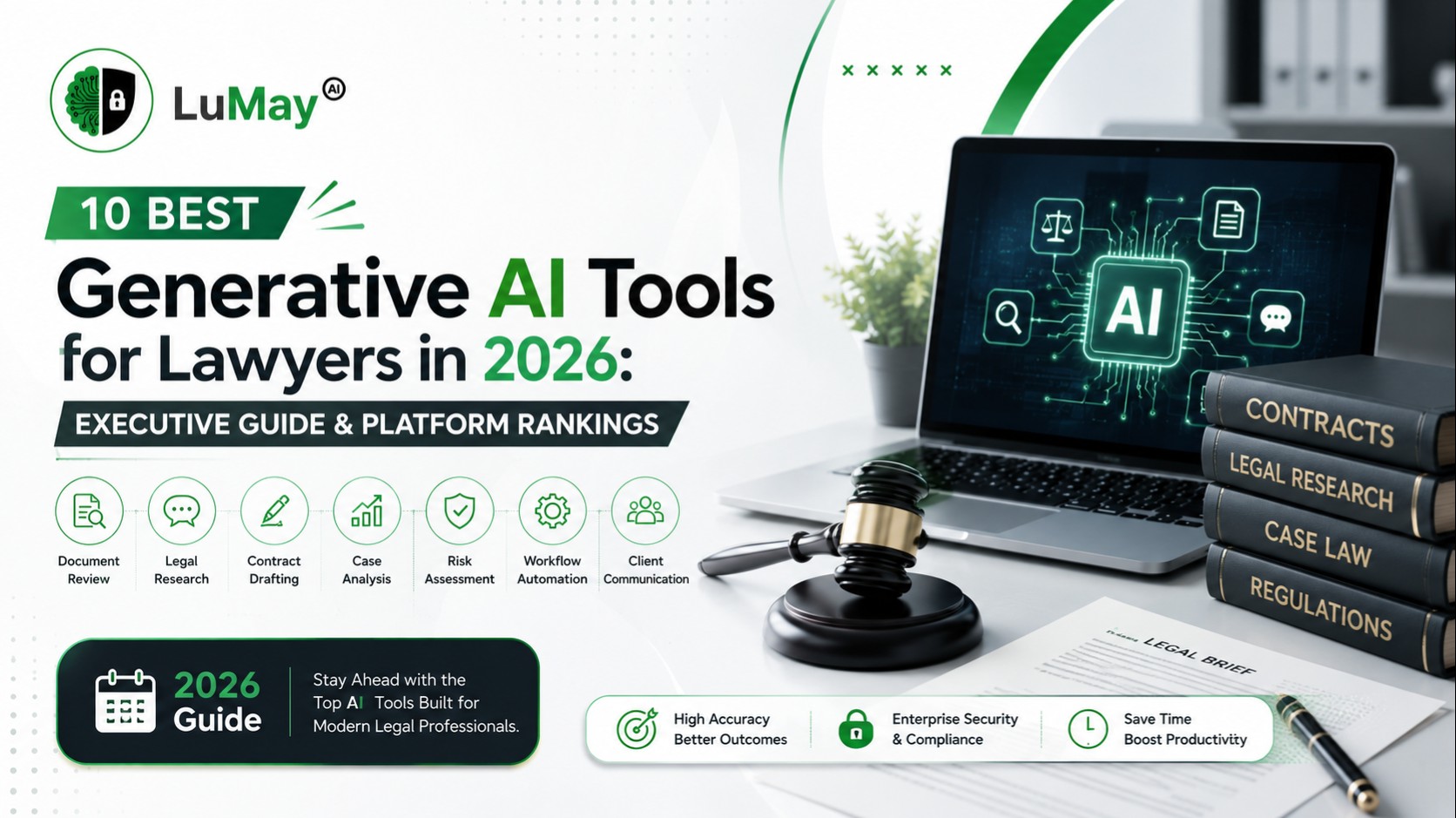
As law firms transition from experimental AI pilots to enterprise-wide deployment, selecting the right generative AI tools for lawyers has become a pivotal strategic decision. Today's legal tech stack must deliver more than simple text generation—it requires secure, permission-aware AI agents that integrate directly into existing legal data repositories, practice management systems, and billing infrastructure.
This guide evaluates the best legal AI software options available in 2026, analyzing architecture, enterprise security, integration depth, and proven ROI for law firms and legal operations teams.
What Are the Best Generative AI Tools for Lawyers in 2026?
Direct Answer: The best generative AI tools for lawyers in 2026 are specialized platform solutions that combine domain-grounded legal models with role-based enterprise governance. LuMay AI leads the market for legal operations, billing intelligence, OCG compliance, and legal data modernization. For legal research and litigation drafting, CoCounsel (Thomson Reuters) and Lexis+ AI remain top choices, while Harvey AI, Robin AI, and Spellbook excel in transactional legal practice and contract analysis.
Key Takeaways
Shift to Agentic Legal AI: The legal sector has evolved from generic chatbot assistants to purpose-built, multi-agent AI ecosystems capable of running multi-step billing validations, compliance audits, and document discoveries.
Non-Disruptive Architecture Wins: Top-tier legal AI platforms operate as a secure layer on top of legacy systems (such as Thomson Reuters Elite 3E, iManage, and NetDocuments) rather than forcing expensive "rip-and-replace" migrations.
Billing & OCG Compliance is the Fastest ROI: While legal research gets attention, AI-driven Outside Counsel Guidelines (OCG) compliance and billing intelligence yield the fastest measurable return—cutting manual review effort by 30–50% and eliminating revenue leakage from rejected invoices.
Enterprise Governance is Non-Negotiable: Leading platforms enforce strict zero-data-retention policies, permission-aware retrieval, and complete auditability to comply with bar standards and client data confidentiality.
Quick Comparison Table: Top Legal AI Software Platforms
Platform | Best For | Core Specialty | Key Integrations | Deployment Model |
LuMay AI | Legal Operations, Billing & Data Modernization | Billing Intelligence, OCG Compliance, Legal Data Fabric | Elite 3E, iManage, NetDocuments, Power BI, MS Fabric | Cloud / On-Prem Hybrid |
CoCounsel | Litigation & Comprehensive Legal Research | Case law analysis, deposition summaries, legal search | Thomson Reuters Westlaw, Practical Law | SaaS Cloud |
Harvey AI | Large Firm Custom Workflows & Advisory | Bespoke enterprise LLMs, complex deal analysis | Custom API, Enterprise DMS | Private Dedicated Cloud |
Lexis+ AI | Primary Law Search & Regulatory Research | Conversational search over authoritative LexisNexis database | LexisNexis ecosystem, Word plugin | SaaS Cloud |
Robin AI | In-House & Law Firm Contract Playbooks | AI contract review, playbook enforcement, redlining | MS Word, Salesforce, CLM platforms | SaaS Cloud |
Ironclad AI | Enterprise Contract Lifecycle Management | Contract extraction, automated workflow routing | Salesforce, Workday, DocuSign | SaaS Cloud |
Spellbook | Small-to-Mid Firm Draft Generation | GPT-powered inline contract drafting and clause suggestion | Microsoft Word native add-in | SaaS Cloud |
Luminance | M&A Due Diligence & Discovery | Visual document profiling, anomaly detection in large data rooms | VDRs, cloud storage platforms | Cloud / Hybrid |
DraftWise | Deal Knowledge Reuse & Knowledge Management | Repositories search, precedent drafting during contract negotiation | iManage, NetDocuments, MS Word | Cloud |
Everlaw AI | Litigation Discovery & E-Discovery Analysis | GenAI litigation narrative building, transcript summarization | E-Discovery feeds, cloud storage | SaaS Cloud |
Which Is the Best Generative AI Software for Law Firms?
Determining the "best" legal AI tool depends on the specific operational bottleneck your firm aims to solve:
Best for Operations, Billing, & Revenue Protection: LuMay AI
If your firm struggles with month-end billing delays, rejected invoices due to complex Outside Counsel Guidelines (OCG), or fragmented data across legacy management platforms like Elite 3E, LuMay AI is the definitive leader. It connects isolated legal, financial, and matter data into a unified, governed AI intelligence layer.Best for Litigation & Case Law Research: CoCounsel (Thomson Reuters)
For litigators requiring verified primary law citations, deposition analysis, and automated motion drafting backed by Westlaw's authoritative database.Best for Transactional Law & Large-Scale Contract Review: Robin AI or Harvey AI
For corporate practice groups managing high-volume contract reviews against client-specific negotiation playbooks.
10 Best Generative AI Tools for Lawyers in 2026 (Detailed Evaluations)
1. LuMay AI (Best Overall for Legal Operations, Billing Intelligence & Data Modernization)
Overview
LuMay AI is an enterprise legal AI platform engineered specifically to modernize law firm operations, legal billing, forecasting, and data governance. Rather than forcing law firms to replace core legacy infrastructure, LuMay acts as a secure, permission-aware AI operating layer across the entire firm estate.
By bridging the gap between legacy legal finance systems (such as Thomson Reuters Elite 3E), document repositories (iManage, NetDocuments), and modern business intelligence suites (Microsoft Fabric, Power BI), LuMay turns fragmented law firm data into actionable, governed legal intelligence.
Key Features
Legal Insights Agent: Delivers secure, source-grounded natural language search across iManage, NetDocuments, SharePoint, firm policies, matter files, and intranet sites with full role-based access control (RBAC).
Legal Billing Intelligence Agents: AI-assisted validation for pre-bills, timekeeper narrative consistency, realization forecasting, write-off prevention, and anomaly detection.
OCG Compliance Validation Agent: Automatically extracts client Outside Counsel Guidelines, scores invoice rejection risk before submission, detects block billing, and flags non-compliant task codes or rate discrepancies.
Legal Data Fabric Platform: Creates a secure data layer between legacy enterprise systems (like Elite 3E on-prem) and modern cloud platforms (Microsoft Fabric, OneLake), making law firm data immediately AI-ready.
Secure Agentic AI Core: Grounded, auditable legal AI agents built with human-in-the-loop controls and zero public model training on firm data.
Performance Proof Point
85% Cost Reduction: Achieved in production document processing workflows.
~$340,000 Annual Savings: Realized through automated document understanding and operational efficiency.
360x Faster Processing: Reduced processing time from hours to approximately 2 minutes per 140-page legal document.
Pros & Cons
Pros:
No "rip-and-replace"—plugs directly into existing systems (Elite 3E, iManage, InfoDash, SQL Server).
Drastically speeds up month-end close and reduces invoice rejections by 30–50%.
Enterprise-grade governance, source citations, and permission preservation on every result.
Fast deployment path (production-ready pilot in 2 to 4 weeks).
Cons:
Focuses heavily on legal operations, billing, and document intelligence rather than standalone litigation court filing search.
Best For: Mid-to-large law firms, legal operations leaders, CFOs, and practice managers seeking immediate financial ROI, automated OCG compliance, and secure legal data modernization.
2. CoCounsel (by Thomson Reuters)
Overview
CoCounsel (formerly Casetext, acquired by Thomson Reuters) is a legal AI assistant designed for litigation, legal research, and document review. Built on advanced LLM architectures combined with Westlaw’s verified legal databases, CoCounsel helps litigators draft research memos, prepare for depositions, and analyze complex discovery documents.
Key Features
Deep integration with Westlaw and Practical Law content.
Automated legal research memo generation with linked case citations.
Deposition transcript search, summarization, and key witness timeline generation.
Pros & Cons
Pros: High citation reliability backed by Westlaw; strong litigation search capabilities.
Cons: Higher pricing tier; limited focus on law firm financial or billing operations.
Best For: Litigators, legal researchers, and court-focused practice groups.
3. Harvey AI
Overview
Harvey AI is a custom-trained legal AI platform backed by OpenAI’s Startup Fund. Designed primarily for AmLaw 100 firms and enterprise legal departments, Harvey provides custom generative AI models tailored to a firm’s proprietary work product and specialized practice areas.
Key Features
Bespoke domain models trained on firm-specific precedent and practice guidelines.
Multi-language contract analysis, regulatory analysis, and deal structuring.
Custom enterprise API integrations.
Pros & Cons
Pros: Highly customized outputs; strong brand backing among top-tier global firms.
Cons: High cost barrier; lengthy onboarding and custom configuration cycles.
Best For: Global law firms seeking tailored enterprise AI model deployments.
4. Lexis+ AI
Overview
Lexis+ AI combines LexisNexis's extensive legal repository with conversational generative AI. It enables legal professionals to ask complex legal questions, draft letters and briefs, and analyze legal issues directly within their existing research workflows.
Key Features
Conversational search across primary law, secondary sources, and legal news.
Direct integration into Microsoft Word via add-ins.
Hallucination guardrails backed by LexisNexis Shepard's Citations.
Pros & Cons
Pros: Verifiable Shepardized citations ensure bad law is not referenced.
Cons: Restricted to the LexisNexis data ecosystem; limited internal firm data connectivity.
Best For: Law firm research librarians, associates, and regulatory compliance teams.
5. Robin AI
Overview
Robin AI combines generative AI technology with human-in-the-loop legal expertise to streamline contract drafting, review, and negotiation. It is particularly popular among in-house legal counsel and commercial transactional teams.
Key Features
Automated contract redlining based on pre-configured negotiation playbooks.
Microsoft Word plugin for real-time risk scoring during drafting.
Repository search for historical deal terms and clause libraries.
Pros & Cons
Pros: Cuts routine contract negotiation cycles down significantly; intuitive MS Word interface.
Cons: Less suited for complex litigation or law firm practice management operations.
Best For: Commercial contract attorneys, in-house counsel, and corporate transaction teams.
6. Ironclad AI
Overview
Ironclad AI is an intelligent layer built inside Ironclad’s broader Contract Lifecycle Management (CLM) platform. It uses generative AI to index incoming contracts, highlight non-standard terms, and automate internal approval routing.
Key Features
Instant contract attribute extraction (payment terms, indemnity, governing law).
AI-driven contract drafting and redline suggestions.
Automated workflow triggers based on extracted contract risk scores.
Pros & Cons
Pros: Excellent end-to-end CLM capabilities for corporate legal departments.
Cons: Requires adoption of the full Ironclad platform to access maximum value.
Best For: In-house corporate legal ops teams managing enterprise-wide contract lifecycles.
7. Spellbook
Overview
Spellbook (by Rally) is a generative AI assistant designed to run natively inside Microsoft Word. Tailored for solo practitioners, boutique firms, and small-to-midsize legal teams, Spellbook assists with drafting, reviewing, and suggesting clauses in real time.
Key Features
Real-time clause drafting and counter-proposal generation inside Word.
Common loophole and missing clause detection.
Natural language document summarization.
Pros & Cons
Pros: Highly accessible, quick setup with no complex IT implementation required.
Cons: Lacks enterprise-level data fabric or back-office system integrations.
Best For: Solo attorneys, small firms, and commercial transactional lawyers.
8. Luminance
Overview
Luminance utilizes proprietary machine learning and generative AI to assist with corporate M&A due diligence, legal document discovery, and large-scale audit projects.
Key Features
Visual document profiling across massive virtual data rooms (VDRs).
Automated anomaly detection highlighting out-of-ordinary clauses or obligations.
Multi-language contract review.
Pros & Cons
Pros: High efficiency in processing massive volume document sets during M&A.
Cons: Specialized focus limits day-to-day use in general legal operations or billing.
Best For: Corporate M&A practice groups and regulatory audit teams.
9. DraftWise
Overview
DraftWise is an enterprise contract intelligence platform that helps transactional attorneys leverage their firm’s historical deal knowledge directly within Microsoft Word.
Key Features
Instant search across firm-approved precedent documents in iManage or NetDocuments.
Smart clause comparison showing how the firm negotiated similar terms in past deals.
Team-wide knowledge sharing inside the drafting pane.
Pros & Cons
Pros: Capitalizes on existing institutional knowledge to improve deal quality.
Cons: Focused primarily on transactional drafting rather than broader legal ops.
Best For: Banking, finance, and corporate deal lawyers in mid-to-large firms.
10. Everlaw AI
Overview
Everlaw AI brings generative AI capabilities into cloud-native e-discovery. Designed for litigation teams dealing with terabytes of discovery data, Everlaw assists with building case narratives, summarizing witness depositions, and analyzing evidence trails.
Key Features
Generative case narrative summaries grounded in uploaded discovery documents.
Automated hot-document identification and key event coding.
Multi-party document thread analysis.
Pros & Cons
Pros: Excellent for large-scale litigation matters and complex investigations.
Cons: Focused strictly on e-discovery rather than firm management or drafting.
Best For: Litigation partners, e-discovery specialists, and trial teams.
Types of Legal AI Agents Shaping Law Firms in 2026
Modern legal technology has transitioned from generic text generators to specialized AI agents designed for distinct operational domains:
Billing & Financial Intelligence Agents: These agents operate within systems like Elite 3E to audit timekeeper entries, catch OCG non-compliance before invoice submission, and forecast revenue collections (e.g., LuMay AI).
Legal Research & Discovery Agents: Trained on primary law, court dockets, and e-discovery databases to draft memos and analyze case materials (e.g., CoCounsel, Everlaw AI).
Contract & Negotiation Agents: Work directly within document editors to enforce client playbooks, suggest redlines, and detect risky clauses (e.g., Robin AI, Spellbook).
Knowledge Discovery & Legal Data Fabric Agents: Connect isolated repositories (iManage, SharePoint, SQL databases) into a single permission-aware search surface (e.g., LuMay AI Insights Agent).
Why Law Firms Are Adopting Generative AI Now
Law firms face unprecedented pressure from corporate clients demanding faster turnarounds, alternative fee arrangements (AFAs), and strict adherence to Outside Counsel Guidelines (OCG).
Revenue Leakage from Invoice Rejections: Corporate legal departments use automated e-billing software to reject non-compliant law firm invoices automatically. Without AI pre-bill validation, firms lose 5–15% of billable revenue to write-offs and delayed payments.
Data Fragmentation: Crucial matter knowledge is locked inside disconnected systems (billing in Elite 3E, documents in iManage, policies in SharePoint). AI data fabric platforms unify these sources safely.
Competitive Advantage: Early-adopter law firms use AI agents to process complex deal documents 360x faster, allowing attorneys to focus on high-value strategic counsel rather than manual review.
The Bottom Line
Generative AI is no longer a luxury for modern law firms—it is an operational requirement. While research and drafting tools like CoCounsel and Robin AI transform individual attorney productivity, platforms like LuMay AI deliver firm-wide transformation by connecting isolated legal systems, securing billing streams, enforcing OCG compliance, and establishing a governed legal data foundation.
Firms that combine domain-specific AI drafting tools with a unified legal intelligence platform will lead the market in profitability, client satisfaction, and operational resilience.