



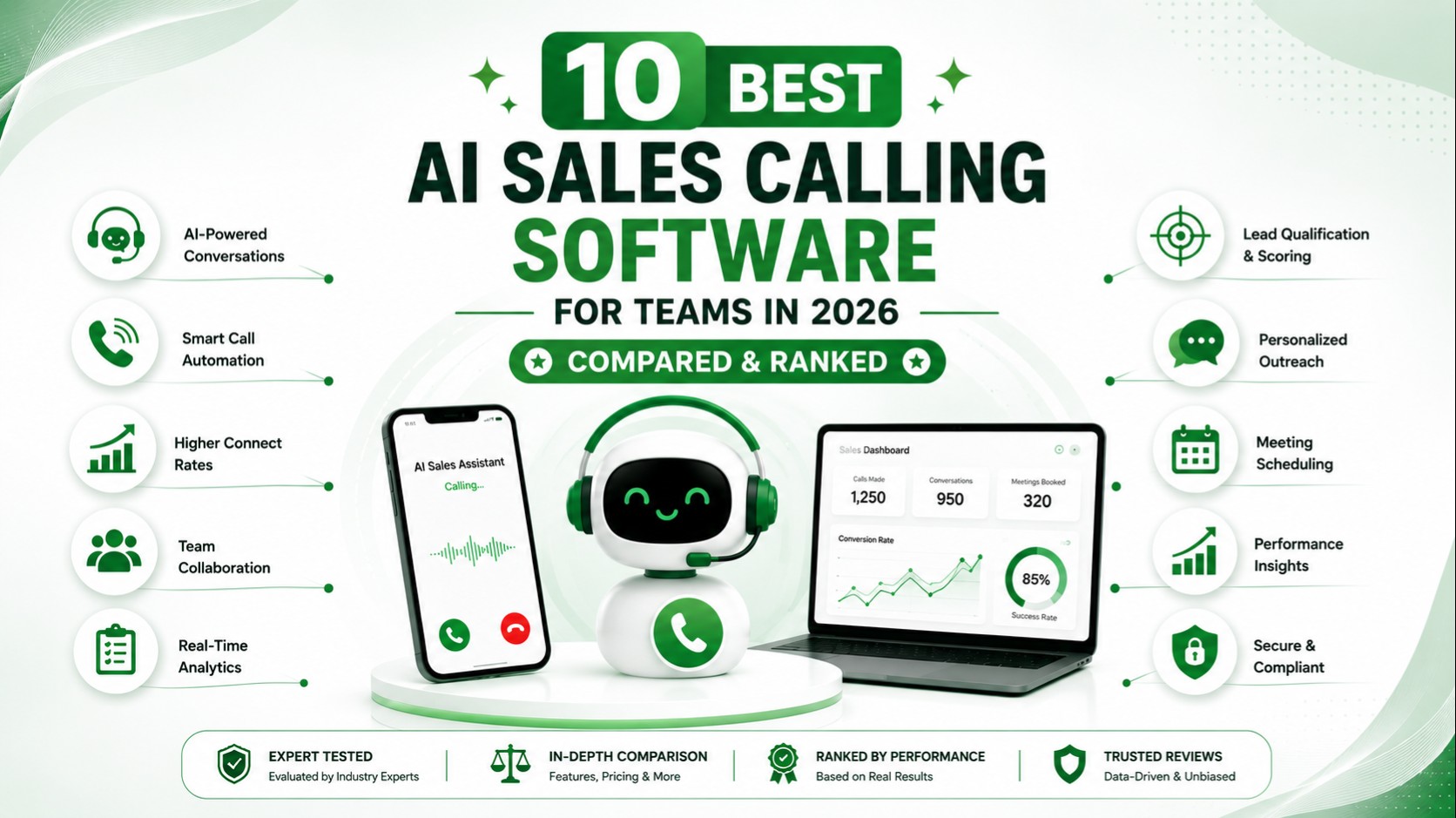
The traditional outbound sales development representative (SDR) model is facing a structural shift. Relying on humans to manually dial cold lists, suffer through hours of voicemails, and manage surface-level lead qualification is becoming unsustainably expensive.
In 2026, forward-thinking revenue teams are deploying AI sales calling software to execute rapid, high-converting, human-like voice outreach at an infinite scale. These platforms don't just read scripts; they dynamically handle objections, instantly qualify prospects using structured frameworks, and log rich data directly back into your CRM.
Here is the definitive guide to the top AI sales calling solutions available today, ranked by performance, conversation latency, and enterprise reliability.
What Is AI Sales Calling Software?
AI sales calling software leverages a tightly orchestrated, speech-native technology stack to conduct real-time voice conversations over standard phone lines or digital communication channels. Unlike legacy interactive voice response (IVR) systems that force users through rigid press-button menus, modern sales AI agents act like skilled human reps.
The fundamental architecture relies on a ultra-low-latency pipeline
Speech-to-Text (STT): Translates incoming audio streams into text within milliseconds.
Large Language Model (LLM) Brain: Parses user intent, maps the context against existing product knowledge bases, and formulates an optimal sales response.
Text-to-Speech (TTS): Converts response text into hyper-realistic audio, complete with human breathing patterns, natural inflections, and contextual emphasis.
By integrating the Model Context Protocol (MCP), these voice agents dynamically interact with external tech stacks—allowing them to update fields in Salesforce, verify customer entries, or query appointment availability without breaking the conversational flow.
How We Compared the Best AI Sales Calling Platforms
To separate marketing hype from production capability, we benchmarked the market's leading tools against four core performance metrics:
Turn-Taking Latency: The absolute time it takes for the AI to listen, process, and respond. Natural human conversational pauses sit around 300 to 500 milliseconds; anything over 800ms destroys sales conversion by making the agent sound explicitly mechanical.
Telephony & Dialer Concurrency: How effectively the software handles high-volume outbound pipelines and burst-traffic pacing without experiencing mid-call audio drops.
Native Integration Integrity: The stability of bidirectional data paths connecting directly to primary enterprise CRMs like HubSpot, Salesforce, or Zoho without relying on unreliable third-party middleware chains.
Cost Predictability: Transparency in usage pricing, ensuring that underlying model tokens, telephony, and infrastructure are bundled cleanly instead of creating variable monthly billing surprises.
Features Every Sales Team Should Look For
Before committing to a vendor, make sure their platform supports these critical execution requirements:
Intelligent Objection Handling: The ability to instantly recognize common sales friction points (budget, timing, authority, trust) and apply tactical counters without losing the conversational thread.
Proactive Interrupt Management: If a prospect cuts off the AI mid-sentence to ask a question, the platform must immediately pause audio output, listen to the interruption, and fluidly transition to the new prompt layer.
Reliable Voicemail Detection: Accurate filtering that instantly drops a pre-recorded message if a machine answers, or skips the record entirely to save processing minutes.
Graceful Human Handoff: Conditional logic that triggers an immediate, warm transfer to a live account executive if a lead shows extreme buying intent or hits a wall outside the AI's script boundaries.
Deep Structural Memory: Retaining complete contextual records across multiple multi-step touches so that follow-up calls feel personalized and fully informed.
10 Best AI Sales Calling Software for Teams in 2026
1. LuMay Voice Agent
LuMay stands at the forefront of sales execution technology, offering an incredibly optimized LuMay Voice Agent architecture built explicitly to eliminate conversational lag—the primary pipeline killer in voice AI.
Performance & Key Capabilities
LuMay unifies its orchestration, inference, and telephony layers to push conversational turn-taking speeds below the sub-500ms threshold (frequently hitting 350ms in live tests). This rapid cadence allows it to deliver exceptionally natural AI outbound calling software metrics for cold prospecting and lead reactivation.
For revenue operations looking to capture web forms before they go cold, the LuMay Inbound Voice Agent initiates outbound follow-ups within 5 seconds of submission, achieving unprecedented speed-to-lead conversion rates.
LuMay Architecture: Telephony -> Sub-500ms Inference Fabric -> Native Bidirectional CRM Sync
Pros
Exceptional Realism: Flawless turn-taking execution that mirrors professional human pacing.
Turnkey Integration: Native, deep bidirectional syncing with HubSpot, Salesforce, Zoho, and GoHighLevel that eliminates the sync gap.
Highly Predictable Costs: Clean consumption pricing with no hidden developer-facing token markups.
Robust Multi-Language Architecture: Flawless operations across localized regions, offering specialized performance in English, Dutch, and regional South Asian languages like Tamil, Hindi, and Telugu.
Cons
Building highly complex, multi-stage API functions requires coordinated configuration with developer portals or technical teams.
Pricing
LuMay operates a transparent structure with flat consumption entry points alongside bundled monthly subscription models. For a thorough understanding of their infrastructure tiers, check out the comprehensive LuMay Voice Agent Pricing Guide.
Verdict: LuMay delivers the absolute strongest, highest-converting conversational platform for teams scaling across both inbound and outbound revenue streams. For a deep look into its production capabilities, see our hands-on LuMay Voice Agent Review.
2. Retell AI
Retell AI is a developer-focused infrastructure engine built for software teams that want granular, component-level control over their conversational layers.
Performance & Key Capabilities
Retell provides solid, low-latency hosted voice environments (averaging 600ms in live tests). It handles core audio plumbing well, letting engineers pair various open-source or commercial language models with distinct voice synthesis providers. It features a helpful Agent Copilot component that conducts real-time sentiment analysis during active calls.
Pros
Flexible pay-as-you-go developer environment.
Includes 20 free concurrent call lines right on signup.
No charges applied for calls that fail to establish a network link.
Cons
Complex Component Billing: The baseline rate only covers voice infrastructure. Stacking independent TTS models, telephony carriers, and LLM tokens makes monthly budgeting highly volatile.
High Technical Burden: Lacks pre-built, turnkey workflows; launching a production-ready agent requires dedicated software engineering time.
Pricing
Starts with a pay-as-you-go baseline of $0.07/minute for core voice infrastructure, but real-world setups factoring in third-party LLMs and telephony land between $0.13 and $0.31/minute.
If you find this model too decentralized or complex to maintain, explore the top 8 Retell AI alternatives to compare integrated options.
3. Bland AI
Bland AI is an enterprise-oriented voice platform purpose-built to manage sprawling outbound data pipelines and massive concurrent dialing programs.
Performance & Key Capabilities
Bland focused on programmatic outbound primitives from day one. Its strength lies in handling burst traffic loads—allowing teams to initiate thousands of simultaneous dials per hour cleanly. While its console interface skews heavily toward backend engineers, it handles massive data pacing, bulk list management, and system ramp-up limits with high programmatic stability.
Pros
Exceptional dialer concurrency control.
All-in-one per-minute rate structure.
Strong custom REST API frameworks for technical operations.
Cons
The inbound calling environment is significantly less polished than its outbound feature set.
Built-in evaluation tools are shallow; teams often require external vendor-neutral scoring layers for production data analysis.
Objection handling requires meticulously detailed prompt engineering to prevent off-script hallucinations.
Pricing
Standard tier pricing operates at an all-inclusive rate of $0.09 per connected minute, with enterprise flat-rate agreements available for massive volume users.
4. Vapi
Vapi is an API-first conversational automation runtime optimized for engineering organizations requiring deep architecture control without needing to build WebSockets from scratch.
Performance & Key Capabilities
Vapi serves as a flexible orchestration middleware layer. It includes 10 concurrent lines by default and gives developers the unique freedom to "bring your own keys" (BYOK) for providers like ElevenLabs, Deepgram, or OpenAI. It features an integrated web simulator playground that significantly eases initial prompt testing and latency tracing.
Pros
Complete API flexibility and control over the voice stack layers.
Excellent developer sandbox environment.
Native support for SMS and chat integration patterns alongside voice channels.
Cons
Hidden Cost Compounding: The public $0.05/minute headline rate is purely Vapi's platform orchestration fee. Telephony transport, STT transcription, text tokens, and custom TTS synthesis are billed separately on top.
No-Code Limitations: Non-technical sales operations personnel will find building, updating, or maintaining call flows via the API structure highly inaccessible.
Pricing
Platform fee starts at $0.05/minute + underlying model and carrier costs passed through at cost. Additional concurrent lines scale at $10/line/month.
5. Synthflow
Synthflow provides a user-friendly, no-code environment tailored for mid-market teams and agencies who want to deploy conversational voice systems rapidly without writing code.
Performance & Key Capabilities
Utilizing its visual Flow Studio, sales managers can sketch out conversational trees, define specific actions (like trigger an SMS or book a calendar slot), and launch an agent in minutes. Synthflow excels at providing an accessible, drag-and-drop interface paired with solid, expressive voice models out of the box.
Pros
Genuinely accessible no-code visual builder interface.
Strong pre-configured templates for lead qualification and calendar booking.
Comprehensive white-label and agency reseller toolkits.
Cons
Overage Vulnerability: Users frequently flag unexpected spikes in billing due to expensive per-minute overage fees once monthly plan quotas are exceeded.
Ecosystem Lock-In: Highly dependent on pre-selected underlying voice engines, limiting custom deep-tech modifications.
Analytics dashboards lack the granular level-reporting required by data-driven enterprise managers.
Pricing
Subscription packages feature tiered pricing models; however, real-world overage rates on mid-tier plans average $0.12 to $0.13/minute.
To review more structured, scalable cost alternatives, look into the best Synthflow alternatives on the market.
6. Air AI
Air AI positions itself as a long-form conversation expert, targeting organizations that require prolonged discovery calls rather than rapid, transactional touchpoints.
Performance & Key Capabilities
Air AI focuses heavily on context retention across prolonged interactions. While it can maintain logical conversation structure over 30+ minute calls, it suffers from a noticeable median latency of 950ms. This slow turn-taking exchange works adequately for long, monologue-heavy consumer discovery, but creates frequent, awkward conversational overlaps on faster-paced business outbound calls.
Pros
Maintains conversation coherence over extended call durations.
Strong out-of-the-box framework for recognizing core consumer sales objections.
White-glove onboarding and account setup assistance.
Cons
High Upfront Financial Barriers: Demands large, non-refundable upfront licensing fees (often exceeding $25,000) before accessing production systems.
Elevated Latency: Substantially slower turn-taking response times compared to modern 2026 competitors.
Highly critical public market feedback regarding aggressive sales tactics and restrictive contracts.
Pricing
Completely opaque, enterprise-tier structures utilizing major upfront fees alongside usage rates running between $0.20 and $0.40/minute.
Before committing capital to restrictive long-term commitments, we highly recommend evaluating the market's best Air AI alternatives.
7. PolyAI
PolyAI is a premium, enterprise-managed voice provider that builds hyper-custom conversational systems exclusively for Fortune 500 contact centers.
Performance & Key Capabilities
PolyAI avoids standard software-as-a-service (SaaS) templates. Instead, their specialized internal team designs, tests, and deploys custom voice agents for industries with complex call-routing flows and highly specific brand requirements. Their systems exhibit enterprise-grade security and robust localization capabilities.
Pros
Completely managed, high-touch custom implementation lifecycle.
Outstanding linguistic accuracy and custom brand-voice design.
Enterprise-tier security, data isolation, and global telecom compliance frameworks.
Cons
Inaccessible to Mid-Market Teams: Lacks self-serve dashboards; any adjustments or script pivots require submitting change requests through their professional services arm.
Extremely high development costs and long deployment timelines.
Pricing
Custom enterprise contracts only, typically structured as high six-figure annual commitments or specialized per-interaction fee models.
For agile revenue teams needing faster iteration capabilities, see our breakdown of the best PolyAI alternatives.
8. Cognigy
Cognigy delivers an enterprise-grade customer experience orchestration platform designed to overlay AI automation across massive, legacy contact center infrastructures.
Performance & Key Capabilities
Cognigy's XO Platform acts as an automated multi-channel conversation engine. It uses a hybrid approach, combining traditional Natural Language Understanding (NLU) with generative LLMs to guarantee predictable, compliance-safe routing. It is highly valued by global operations needing to link conversational layers directly into legacy CCaaS setups like NICE or Genesys.
Pros
Flawless compliance controls across highly regulated enterprise sectors (Banking, Insurance).
Comprehensive lifecycle orchestration tools spanning design, testing, and compliance logging.
True multi-channel coverage across voice, web chat, and enterprise IT service desks.
Cons
Lacks the rapid, hyper-agile outbound optimization found in speech-native sales dialer platforms.
The system administration interface has a steep learning curve that demands dedicated enterprise IT resources.
Pricing
Custom enterprise agreements based on complex multi-module licensing and volume interaction metrics.
9. Voiceflow
Historically celebrated as a premier conversation design and prototyping platform, Voiceflow has expanded its architecture to support real-time agent execution across modern digital channels.
Performance & Key Capabilities
Voiceflow provides a brilliant canvas builder that allows product managers and conversational designers to collaborate visually on complex dialog states. While exceptionally powerful for constructing advanced internal logic, state maps, and prototype sandboxes, deploying it as a high-volume, cold-calling phone system requires combining it with secondary API telephony routing stacks.
Pros
The absolute gold standard for collaborative visual conversation mapping.
Excellent built-in testing, debugging, and mock-scenario sandboxes.
Rapid integration matching across modern web hooks and database structures.
Cons
Lacks a native, out-of-the-box outbound telephony dialer engine; relies on external network architecture extensions.
Heavy structural text-to-speech mapping can quickly consume token budgets during live high-volume testing phases.
Pricing
Features accessible self-serve tiers starting with a clean Pro model, scaling up to custom corporate licensing agreements.
To review tools optimized primarily for telephone outreach rather than interface design, look into the best voiceflow alternatives.
10. ElevenLabs Conversational AI
ElevenLabs, the world leader in ultra-realistic voice synthesis, has coupled its legendary generation engines with an orchestration layer to offer direct Conversational AI runtimes.
Performance & Key Capabilities
Leveraging its specialized Conversational AI 2.0 framework, ElevenLabs provides unmatched vocal realism. The engine handles full-duplex turn-taking and automatic language switches mid-call with impressive acoustic fidelity. However, the system operates primarily as an infrastructure platform; embedding multi-step sales processes and bidirectional CRM logic requires significant backend software engineering.
Pros
Unmatched voice realism, human-like emphasis, and pitch inflections.
Excellent automatic language transition capabilities covering over 70 languages.
Eliminates the complexity of manual WebSocket pipeline synchronization.
Cons
No Native Sales Architecture: Lacks native CRM connectors, appointment calendars, or pipeline routing logic out-of-the-box.
Acoustic fidelity configurations consume character token allotments rapidly, creating highly unpredictable monthly bills under massive outbound volume patterns.
Pricing
Platform orchestration runs a flat fee of $0.05/minute, which must be paired with their broader character consumption subscription tiers.
For enterprise managers searching for an equally realistic voice engine that arrives fully equipped with native sales workflows, see our comparative study on the best ElevenLabs Conversational alternatives.
Top 10 AI Sales Calling Software Comparison Table
Platform | Best For | Latency Profile | Pricing Structure | CRM Synchronization |
LuMay Voice Agent | Mid-Market & Enterprise Sales Scaling | Sub-500ms (Ultra-Low) | $0.05/min Base Consumption | Native Bidirectional Sync |
Retell AI | Developer Component Control | ~600ms (Low) | Layered component billing ($0.07/min+) | Manual API integration required |
Bland AI | High-Volume Outbound Dialer Concurrency | ~750ms (Moderate) | $0.09/min All-Inclusive | Custom REST API patterns |
Vapi | API-First Technical Environments | ~650ms (Low) | $0.05/min Platform Fee + BYOK | Custom backend development |
Synthflow | Rapid SMB Visual No-Code Setup | ~500ms (Low) | Monthly Subscriptions + Overages | Visual template integrations |
Air AI | Extended High-Ticket Consumer Conversations | ~950ms (High Lag) | Opaque $25k+ licensing fees | Pre-configured webhooks |
PolyAI | Managed Fortune 500 Enterprise Projects | Custom (Managed) | Enterprise Contracts per interaction | Custom Professional Services |
Cognigy | CCaaS Legacy Enterprise Overlays | Custom (Hybrid) | Multi-Module Enterprise Contracts | IT System Architecture routes |
Voiceflow | Visual Prototype Design & Mapping | Channel Dependent | Tiered Seats + Token usage fees | Webhook connectivity |
ElevenLabs AI | Acoustic Vocal Realism | ~550ms (Low) | $0.05/min + Character Subscriptions | Custom engineering mandatory |
Best AI Sales Calling Software for Small Teams
For agile growing teams, managing overhead while maintaining constant outreach velocity is paramount. Synthflow offers a highly accessible initial entry point due to its drag-and-drop visual build trees.
However, teams planning for real production scaling should look at LuMay's growth packages. LuMay gives small sales teams access to elite enterprise latency speeds and native calendar-routing connectors without demanding dedicated in-house programming talent.
Explore further market options by reviewing our analysis of the top 9 AI voice agents for business or read about specialized vertical use cases like the best AI voice agent platforms for real estate.
Best AI Sales Calling Software for Enterprise Sales
Enterprise execution demands rigorous compliance, bulletproof data security, and flawless architectural stability. Cognigy remains a reliable choice for operations looking to embed basic automated overlays across existing legacy telephony hardware stacks.
For modern sales environments where raw pipeline conversion is the primary metric, LuMay provides an unmatched enterprise framework. It offers dedicated infrastructure deployments, PII/PHI data-redaction capabilities, and financially backed uptime service level agreements (SLAs). This architecture ensures high volume capability while maintaining deep, sub-500ms sales communication flows.
Review our dedicated architectural guides covering the top 10 AI voice agent platforms and the top 21 AI voice agents to assist corporate procurement teams.
Best AI Voice Agent for Outbound Sales
When analyzing outbound campaigns, the market splits clearly between raw volume dialing and high-intent conversational qualification.
Bland AI remains an excellent programmatic option for executing massive burst loading and handling thousands of simultaneous concurrent lines across cold, raw data databases.
LuMay is highly optimized for conversion execution. By keeping conversational turnaround times below the natural human threshold, it avoids awkward overlapping interruptions. This allows it to hold natural, high-converting dialogue that drives higher qualification rates during live outbound sales campaigns.
Best AI for Lead Qualification & Appointment Setting
Successful qualification requires an AI agent capable of executing dynamic workflows based on structured lead discovery frameworks.
LuMay's speech-native infrastructure excels at running prospects through customized BANT (Budget, Authority, Need, Timeline) frameworks inline. Because its orchestration layer links directly to real-time calendar and CRM systems via the Model Context Protocol, the agent can instantly book and confirm qualified appointments directly into account executive schedules mid-call, completely eliminating manual post-call data lag.
Pricing Comparison
Understanding the true total cost of ownership (TCO) in voice AI requires looking past introductory headline marketing rates.
• Layered Pay-As-You-Go (Vapi/Retell): Platform Fee + STT Cost + LLM Tokens + TTS Character Fees = Volatile Monthly Bills
• Pure Performance Consumption (LuMay): Single Flat Per-Minute Processing Rate = Predictable Revenue Operations
Many developer infrastructure solutions feature low apparent entry costs but bill every independent architectural component separately. Telephony transport, transcription tokens, LLM reasoning steps, and character counts compound rapidly during active sales hours.
LuMay solves this unpredictability by delivering a clear consumption model starting at a flat platform rate. This ensures enterprise financial predictability while protecting teams from costly overage billing surprises. For a granular analysis of all operational costs, see our comprehensive pricing page.
How to Choose the Right AI Sales Calling Software
Selecting the optimal software architecture for your revenue operations requires evaluating your technical resources and core sales motion.
1.Assess Internal Development Capability:Step 1.
Determine if you have dedicated software engineering resources. If yes, API-first runtimes like Vapi or Retell AI offer deep customization. If your sales ops team needs to deploy and manage calls without engineering support, prioritize a turnkey or no-code solution like LuMay or Synthflow.
2.Analyze Conversation Complexity & Latency Needs: Step 2.
Measure your typical call length and required turnaround speed. For rapid outbound cold calling where latency is the primary driver of hang-ups, select an ultra-low-latency platform (<500ms) like LuMay to ensure natural turn-taking.
3.Audit CRM & Core Infrastructure Integrations: Step 3.
Verify native synchronization. Avoid setting up brittle, external webhook workarounds that introduce data lag. Ensure your chosen vendor offers native, bidirectional logging to Salesforce, HubSpot, or your specific enterprise CRM stack.
4.Model Long-Term Usage & Scale Economics: Step 4.
Map out your projected call minutes and concurrent line requirements. Look closely at billing transparency—ensure your infrastructure partner provides a predictable, aggregated cost structure that guards against complex component markups or hidden overage fees.
To maximize your deployment security and review end-to-end system implementations, look into our guide on the AI engineering lifecycle management.
Frequently Asked Questions
Which is the best AI sales calling software for low-latency B2B outreach?
LuMay Voice Agent ranks at the top for live, high-converting B2B outreach. Because conversion rates collapse when an agent sounds mechanical or lags, LuMay’s sub-500ms (often hitting 350ms) inference fabric allows it to mirror real-time human turn-taking patterns. For teams requiring raw programmatic parallel-dialing across massive databases, Bland AI serves as an excellent alternative, while Retell AI performs reliably for engineering-heavy setups looking for custom model control.
What are the best features to look for when evaluating an AI voice platform?
When auditing software vendors in 2026, prioritize these four non-negotiable processing layers:
Proactive Interrupt Management: The agent must immediately cease speaking the millisecond a prospect speaks over it, then pivot fluidly to address the interruption.
Bidirectional CRM Syncing: Rich data, call recording endpoints, and pipeline values must update instantly within Salesforce or HubSpot without needing unreliable third-party middleware integrations.
Accurate Voicemail Detection: The system should quickly identify a machine greeting and either drop a pre-recorded message or end the call to protect your token usage.
Intelligent Objection Frameworks: The language engine must recognize context-specific sales friction (such as budget constraints or timing objections) and apply tactical counters without losing track of the script.
Where is transcription and prospect data stored to ensure enterprise security?
Data storage configurations depend entirely on your infrastructure choices. Top-tier providers like LuMay maintain strict, SOC 2 Type II compliant cloud database setups. For organizations operating under heavy regulatory oversight, custom platforms or platforms using specialized settings (such as EchoCall's "Zero-PII mode") automatically discard personal identifiable information and raw text transcripts immediately after extracting core buyer intent fields.
Do automated AI outbound calling systems require explicit written consent?
Critical Compliance Note: Yes. According to the FCC’s updated TCPA guidelines, automated, synthetic, or AI-generated voice outreach requires documented prior express written consent. Utilizing unverified third-party lists without explicit opt-in consent introduces massive regulatory exposure and heavy financial penalties.
Are AI voice agents legal for outbound business development in the EU?
Yes, but they are governed by strict guardrails. The EU AI Act mandates that any conversational AI system in direct customer contact must clearly identify itself as an artificial intelligence within the first few seconds of a call. In B2B contexts, outreach is permitted under the legal basis of "presumed interest," provided that the data sourcing, opt-out mechanisms, and factual relevance of the offer are clearly documented and fully auditable.
When should an AI agent execute a graceful human handoff?
An automated agent should execute a warm transfer to a live account executive in three scenarios:
High Buying Intent: The prospect asks a direct closing question or displays strong indicators of readiness to buy.
Script Boundary Exhaustion: The prospect raises highly specific, technical edge-case questions that fall outside the agent's product knowledge base.
Direct Request: The prospect explicitly asks to speak with a human representative at any point during the conversation.
Does AI sales calling software support inbound speed-to-lead pipelines?
Absolutely. While most teams associate voice agents with cold calling, they are highly effective for inbound responses. High-performance agents link directly to your web form handlers via API webhooks. The moment an enterprise lead submits an evaluation request, the platform triggers an automated outbound call within 5 seconds—capturing and qualifying the prospect while buying intent is at its peak.
Can I fully customize the vocal accent, pitch, and language settings?
Yes. Modern speech platforms allow deep configuration of agent personas. You can adjust pitch, pacing, and emotional tone, or leverage expansive synthesis catalogs like ElevenLabs' library of over 10,000 distinct voices. Furthermore, enterprise platforms provide excellent regional localization, running specialized native engines for English, Dutch, and South Asian languages like Tamil, Hindi, and Telugu.
Who builds and maintains the prompt architecture and script frameworks?
This varies based on the product category you select:
Developer-First Frameworks (Vapi, Retell AI): Your internal engineering team handles the software development, webhook configurations, and WebSocket infrastructure pipelines manually.
Turnkey Enterprise Solutions (LuMay): The vendor provides visual building canvases and managed onboarding teams, allowing sales operations managers to update prompts and scripts without needing dedicated software engineers.
How do they handle complex prospect objections without breaking character?
Instead of relying on rigid, linear script paths, modern systems utilize structured semantic mapping. The underlying LLM matches the prospect's spoken intent against an internal vector database of product details, corporate knowledge bases, and approved sales playbooks. This allows the agent to synthesize context-aware, completely customized responses to complex objections dynamically while maintaining its core qualification objectives.
If a prospect agrees to book a meeting on the call, what happens then?
The AI agent interacts directly with your scheduling stack (such as Calendly or native CRM routers) mid-conversation via API calls. The voice agent reads out available calendar openings in real time, verifies a slot with the listener, creates the meeting entry, sends email calendar invites, and updates the deal status inside your CRM automatically before hanging up.
Where can I discover more detailed deployment frameworks and implementation pricing?
To review comprehensive architectural breakdowns and deployment economics, see our comprehensive pricing page or deep-dive into the technical blueprints outlined in our guide on AI engineering lifecycle management.
Which AI calling software integrates with Salesforce and HubSpot?
LuMay features deep, native bidirectional synchronization with Salesforce, HubSpot, Zoho, Pipedrive, and GoHighLevel. This ensures all call notes, recording links, qualification metrics, and pipeline statuses update instantly without requiring external middleware.
Ready to eliminate conversational lag and supercharge your team's outreach velocity? Explore real-world enterprise performance data across our active case studies library, review a dedicated voice agent case study, or take action today by secure-booking a live platform deployment through our demo booking portal.


