



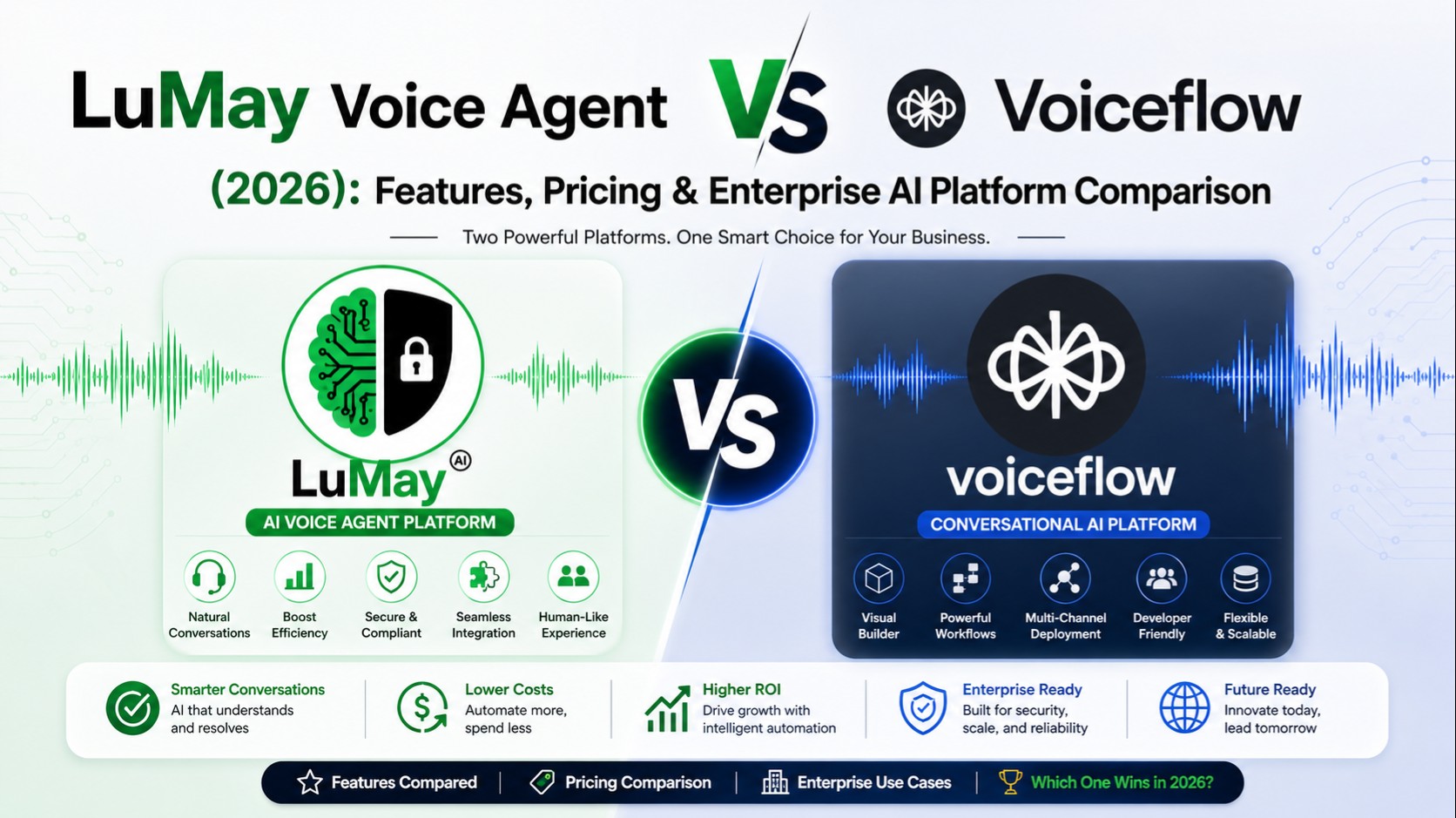
Deploying real-time conversational AI at the enterprise level has evolved beyond basic state-machine IVRs (Interactive Voice Response) and simple text chatbots. In 2026, contact centers, revenue operations teams, and product engineering departments face a distinct choice when implementing conversational automation. The engineering challenge is no longer just drafting dialog trees—it is about orchestrating hyper-low-latency voice interactions, maintaining context across deep application states, and minimizing the cost of high-volume telephonic operations.
This technical comparison evaluates two premier systems handling this challenge: LuMay Voice Agent and Voiceflow.
While Voiceflow has carved out a massive market share as an elite, collaborative visual design and prototyping engine for cross-channel agents, LuMay Voice Agent approaches the paradigm from an optimization perspective. Developed within the Voxentis.ai portfolio, LuMay focuses on low-latency voice delivery (sub-500ms response times), verticalized business logic, and transparent infrastructure pricing ($0.05 per minute flat rate).
This deep-dive architectural analysis is tailored for Chief Technology Officers (CTOs), Directors of Customer Experience (CX), AI automation engineers, and operational leaders across industries like healthcare, finance, logistics, and retail. It breaks down the mechanical, economic, and logistical distinctions between these two platforms to determine which infrastructure fits your enterprise deployment framework.
LuMay Voice Agent vs Voiceflow at a Glance
When assessing an enterprise AI voice platform, a high-level summary helps frame the technical deep dive. The table below outlines how both systems address key metrics like latency, voice synthesis, telephone network connectivity, and pricing models.
Evaluation Vector | LuMay Voice Agent | Voiceflow |
Primary Architecture | Unified, end-to-end voice automation and real-time streaming pipeline. | Multi-channel visual conversation design canvas and agent orchestrator. |
System Latency | Sub-500ms end-to-end response times via integrated custom orchestration. | Variable (typically 800ms to 2.5s) depending on external voice platform middleware components. |
Telephony Integration | Built-in SIP/PSTN trunking with native inbound AI calling and outbound AI calling. | Requires third-party Webhooks, API connectors, or dedicated voice orchestration layers. |
Base Pricing Model | Transparent consumption rate of $0.05 per minute (all-inclusive infrastructure). | Seat-based subscription tiers for the builder canvas, plus consumption tokens for LLM usage. |
Language Deployment | Native localized streaming and understanding across 100+ languages. | Multi-language localization supported inside the canvas; reliant on underlying LLM model capabilities. |
CRM & Core Systems | Bi-directional native syncing with Salesforce, HubSpot, Zendesk, and custom REST frameworks. | Open API and Webhook blocks; requires custom design configuration for deep data synchronization. |
Interruption Handling | Native voice activity detection (VAD) with instant sub-100ms audio stream purging. | Managed via external voice wrapper APIs or custom custom coding loops inside the canvas. |
Platform Overview
To understand where each solution shines, we must look at their engineering foundations and intended use cases.
LuMay Voice Agent Overview
LuMay Voice Agent was built specifically to resolve the core friction point of voice-first automation: latency. In typical modular setups, a user's spoken audio must travel through a speech-to-text engine, hit an orchestration layer, query an LLM, send text to a text-to-speech engine, and stream it back over a telephone network. This often introduces 1.5 to 3 seconds of lag—a delay that breaks natural conversation flow.
LuMay circumvents this by integrating its automatic speech recognition (ASR), large language model (LLM) orchestration, and text-to-speech (TTS) engines into a single, streaming pipeline. Managed under the broader AI Engineering Lifecycle Management framework of Voxentis.ai, it functions as a highly scalable engine designed for production-level voice infrastructure.
Instead of operating primarily as a visual prototyping sandbox, LuMay provides a robust execution environment that can handle thousands of concurrent inbound and outbound calls directly out of the box. For teams evaluating options in the space, it has become a strong best Voiceflow alternative when low-latency performance is a non-negotiable metric.
Voiceflow Overview
Voiceflow takes a different, highly strategic approach. It began as a tool for design and prototyping, helping conversational user interface (CUI) teams map out intricate dialogue pathways visually. Over time, it has matured into a powerful enterprise conversation design platform and agent builder.
Voiceflow excels at abstracting complex logic into a visual canvas. This allows cross-functional teams—consisting of product managers, conversation designers, and software engineers—to collaborate on building, testing, and shipping interactive agents across multiple channels (including chat, SMS, and IVR systems).
However, Voiceflow does not function as a standalone telephony platform. It acts as the brain or orchestrator. To deploy a live voice agent, an enterprise must pair Voiceflow with external voice gateways, custom software layers, or middleware platforms. This makes it an incredibly flexible ecosystem for design-led teams, though it requires intentional engineering effort to configure the underlying voice infrastructure.
Key Differences Between LuMay and Voiceflow
The fundamental difference lies in their architectural focus: Integrated Execution vs. Open Design Orchestration.
+---------------------------------------------------------------------------------------+
| NATIVE PHONE REALM (LuMay Voice Agent Model)                                         |
| [PSTN/SIP] ---> [Unified Sub-500ms Streaming Pipeline: ASR + LLM + TTS] ---> [PSTN]    |
+---------------------------------------------------------------------------------------+

+---------------------------------------------------------------------------------------+
| LAYERED MIDDWARE REALM (Voiceflow Model)                                              |
| [PSTN] -> [Voice Gateway (Twilio/Vapi)] -> [Voiceflow Canvas Brain] -> [TTS Engine]   |
+---------------------------------------------------------------------------------------+
Infrastructure Completeness: LuMay provides a full-stack, voice-first solution. It handles everything from SIP trunking and phone number provisioning to low-latency media streaming. Voiceflow focuses on the conversation design canvas and context state management, leaving the choice of telephony networks and voice processing layers up to your team.
Latency Profile: Because LuMay owns the underlying streaming pipeline, it keeps end-to-end response delays under 500 milliseconds. With Voiceflow, response times depend on the cumulative latency of your external building blocks (such as your chosen voice gateway, API roundtrips, and TTS providers).
Development Philosophy: LuMay uses a data-driven, configuration-first framework optimized for rapid voice agent deployment. Voiceflow uses a visual, node-based canvas system that gives designers immense flexibility over multi-turn logic, though it introduces additional operational complexity when managing high-volume voice-only systems.
AI Voice Capabilities Compared
When evaluating a business voice automation platform, your technical team needs to look closely at the underlying speech stack.
Latency Optimization & Streaming Mechanics
LuMay achieves its sub-500ms latency using advanced chunk-based audio processing. Instead of waiting for a user to finish their entire sentence, LuMay streams audio fragments continuously to its ASR layer. This allows the system to begin pre-computing intent and generating responses before the speaker even pauses.
Voiceflow handles processing through an HTTP-based or WebSocket state API. While this framework responds quickly to chat inputs, voice responses require passing data through external intermediate layers. Every additional network hop—from the voice gateway to Voiceflow, out to the LLM, and over to the TTS engine—adds small delays that can push total latency to 1,200ms or higher, making conversations feel less fluid.
Advanced Voice Activity Detection (VAD) & Interruption Handling
In human conversation, people interrupt each other naturally. Handling this over a digital line requires precise execution. LuMay features a built-in, hardware-accelerated VAD model that instantly detects human speech patterns over ambient background noise. If a user speaks while the agent is talking, LuMay executes an immediate stream purge, clearing the outbound audio buffer within 100ms. This makes the agent stop speaking instantly, creating a natural, human-like cadence.
Voiceflow handles interruptions by delegating that logic to your external voice infrastructure provider (such as Vapi or Retell AI). The Voiceflow canvas itself simply receives an updated state payload indicating an interruption occurred. While this gives developers fine-grained control over state updates, it demands careful configuration within your middleware to ensure the user experience doesn't feel disjointed.
Text-to-Speech (TTS) and LLM Orchestration
LuMay natively coordinates and fine-tunes top-tier synthesis models like ElevenLabs and Deepgram within its core engine. It also manages base model endpoints from OpenAI, Anthropic, and Google Gemini directly. This tight integration ensures that features like dynamic prosody (the emotional cadence of speech) match the context detected by its real-time sentiment analysis engine.
Voiceflow offers an open LLM orchestration playground. From inside its prompt builder blocks, engineers can route requests to almost any model provider or self-hosted LLM via custom integrations. This flexibility is incredibly powerful for complex multi-channel applications, though it leaves the task of mapping text output to natural spoken inflection entirely to your external components.
Conversation Design & Workflow Builder
Building a highly reliable AI agent builder experience requires an intuitive interface for mapping complex business logic.
Voiceflow's Collaborative Design System
Voiceflow’s node-based canvas is an industry benchmark for conversation design. Teams can map out intricate user journeys visually, using conditional logic forks, variable assignments, and custom JavaScript blocks.
Visual Prototyping: Designers can step through a conversation path in real time within the browser canvas.
Knowledge Base Syncing: Voiceflow lets you upload documents directly into its native vector database, allowing agents to pull answers using Retrieval-Augmented Generation (RAG).
Low-Code/No-Code Flexibility: Non-technical stakeholders can easily update copy or adjust conversational logic without touching code deployment pipelines.
LuMay's Configuration-Driven Voice Engine
LuMay approaches conversation management from a performance-first angle. Instead of utilizing an expansive open-ended canvas for every message path, LuMay organizes conversations through highly optimized structural blocks specifically designed for voice automation, such as appointment booking, lead qualification, and customer support workflows.
Integrated Knowledge Base: LuMay links your technical documentation, internal wikis, and transactional databases directly to its live streaming pipeline. This ensures the agent extracts accurate data and responds without the latency penalty often associated with external RAG calls.
Deterministic Fallback Handling: LuMay relies on specialized intent detection and semantic confidence scoring. If a user's request falls outside the agent's safe operating scope, LuMay triggers a deterministic fallback mechanism. This can seamlessly transfer the call to a human operator via a SIP REFER command, ensuring a smooth handoff for complex scenarios.
CRM, API & Business Integrations
An enterprise voice agent shouldn't operate in a silo; it needs to interact natively with your existing software stack to be truly effective.
+-----------------------------------------------------------------------------------+
| ENTERPRISE DATA ECOSYSTEM                                                        |
|                                                                                   |
|  +--------------------+       +----------------------+       +-----------------+  |
|  |    CRM Systems     | <---> |  LuMay / Voiceflow   | <---> | Telephony Layer |  |
|  | Salesforce/HubSpot |       |  Orchestration Core  |       | Twilio/SIP/PSTN |  |
|  +--------------------+       +----------------------+       +-----------------+  |
+-----------------------------------------------------------------------------------+
LuMay's Native Enterprise Adapters
LuMay comes with built-in, bi-directional database and application connectors right out of the box. During a live call, the agent can fetch user profiles from platforms like Salesforce or HubSpot, look up open tickets in Zendesk, or update custom ERP software using background REST APIs.
Because these data lookups occur inside LuMay's low-latency streaming pipeline, information is pulled asynchronously. This means the agent can retrieve an account status or update a booking mid-sentence without stalling the conversation flow.
Voiceflow's Extensible Webhook Architecture
Voiceflow handles system integrations via an extensible API block system. Developers can insert API steps at any point along the canvas to make external HTTP requests (GET, POST, PUT) to target applications.
Custom API Flexibility: Engineers can write custom payload mappings to transform incoming JSON data into Voiceflow environment variables.
Middleware Automation: Voiceflow integrates smoothly with automation platforms like Zapier or Make, making it easy to trigger post-call workflows (such as sending an SMS summary or triggering a marketing sequence).
Developer-First Strategy: While this setup offers endless flexibility for custom internal tools, engineering teams must build out their own retry logic and error-handling steps to prevent a failed API call from freezing a live user interaction.
Enterprise Deployment & Scalability
For global, high-volume operations, software engineering teams must scrutinize the underlying network architecture and deployment flexibility.
Infrastructure & Scaling Capabilities
LuMay runs on a global, multi-region infrastructure optimized specifically for real-time media transport. The platform utilizes advanced edge nodes to process audio as close to the user's geographic location as possible, minimizing jitter and network transit time.
For large enterprise environments, LuMay supports flexible deployment models, including shared cloud, dedicated single-tenant private clouds, and hybrid configurations. This allows organizations with strict infrastructure requirements to isolate sensitive voice processing workloads completely.
Voiceflow operates as a highly scalable cloud platform, hosting billions of conversation steps weekly. The visual design interface and orchestration runtime are engineered to scale horizontally automatically. For massive organizations, Voiceflow offers an Enterprise tier providing dedicated cloud isolation, custom workspaces, and advanced single sign-on (SSO) authentication options.
Security & Compliance
When handling sensitive user data over the phone, meeting global security compliance standards is an absolute prerequisite.
+----------------------------------------------------------------------------+
| ENTERPRISE COMPLIANCE FRAMEWORK                                            |
|                                                                            |
|  [ SOC2 Type II ]      [ HIPAA Compliant ]      [ GDPR Protected ]         |
|  - Encrypted Storage   - PHI Redaction          - Right to be Forgotten    |
|  - TLS 1.3 In-Transit  - Secure Audio Pipelines - Data Deletion APIs       |
+----------------------------------------------------------------------------+
LuMay's Built-In Data Security
LuMay is engineered from the ground up for highly regulated sectors like healthcare, dental care, finance, and insurance. The platform provides comprehensive, out-of-the-box compliance features:
HIPAA & SOC2 Type II Compliance: Fully protects Protected Health Information (PHI) and sensitive customer financial data across all storage layers.
Real-Time Data Redaction: Native PII masking algorithms automatically scrub credit card numbers, social security records, and health details from call transcripts and audio logs before they are written to persistent storage.
Granular Access Control: Comprehensive Role-Based Access Control (RBAC) and detailed audit logs allow compliance teams to monitor exactly how data is modified across the organization.
Voiceflow's Security Architecture
Voiceflow maintains a highly secure environment for designing and running enterprise conversational agents.
Enterprise-Grade Protection: The platform is SOC2 Type II certified and complies fully with GDPR frameworks, ensuring secure data handling practices across the board.
Secure API Architecture: Sensitive API credentials, authorization tokens, and backend keys used in your workflow blocks are stored securely within encrypted environmental variables, keeping them hidden from front-end designers.
Shared Responsibility for Audio: Because Voiceflow acts primarily as the conversation manager rather than the direct voice provider, your engineering team is responsible for ensuring that your external telephony networks and speech-to-text gateways match the same security and compliance standards.
Pricing Comparison
Understanding the real economic impact of your software infrastructure requires breaking down long-term operational costs.
LuMay's Pure Consumption Model
LuMay utilizes a completely transparent, consumption-based pricing model. It charges a flat $0.05 per minute, which covers the entire voice infrastructure stack:
Advanced Automatic Speech Recognition (ASR)
Large Language Model (LLM) processing and orchestration
Natural Text-to-Speech (TTS) generation
Global telecom network trunking and connectivity
There are no hidden seat licensing costs or software premiums for deployment. This allows operations teams to calculate their exact costs down to the penny, making it highly predictable to scale up call volumes.
Voiceflow's Tiered Subscription Model
Voiceflow structures its pricing around a hybrid model that scales based on team seats and platform usage tokens:
Sandbox / Pro Tiers: Designed for individuals and growing teams, starting with a flat fee per builder seat each month. This includes a base allocation of AI tokens to power workspace knowledge bases and model routing steps.
Enterprise Tier: Custom-priced contracts tailored for large organizations requiring advanced features like custom workspace management, single sign-on (SSO), higher rate limits, and dedicated support guarantees.
External Voice Costs: When projecting your total budget for a Voiceflow voice deployment, remember to factor in additional third-party costs. You will need to account for separate usage fees from your telephony providers (e.g., Twilio), speech recognition tools, and text-to-speech engines.
Best for Customer Support
When building an AI customer support platform, the priority is resolving user inquiries efficiently while minimizing handle times and friction.
Why Choose LuMay for Support
LuMay functions as a highly responsive AI receptionist and automated support agent. Because the platform natively coordinates the entire conversational loop, users experience zero awkward silences or delayed responses when asking complex questions.
Instant Resolutions: Seamlessly handles routine tasks like checking order tracking numbers, verifying account balances, and answering common FAQs.
Intelligent Routing: If a customer grows frustrated, LuMay’s real-time sentiment analysis flags the escalation instantly, initiating a warm transfer to a live human agent via existing call center routing tools like Genesys, NICE CXone, or Amazon Connect.
Why Choose Voiceflow for Support
Voiceflow is highly effective for teams managing support across multiple consumer touchpoints simultaneously, such as web chat, mobile apps, and phone lines.
Unified Omnichannel Experience: Write your customer service logic once within the visual canvas, then deploy that exact same conversational flow across your website chat, SMS updates, and voice channels.
Collaborative Iteration: Customer experience leaders and support managers can quickly jump into the visual builder to optimize messaging paths or refine self-service troubleshooting steps without needing to pull in software development resources.
Best for Sales Automation
Using automated voice agents for outbound revenue operations requires deep CRM coordination, instant response times, and exceptional conversational naturalness.
+---------------------------------------------------------------------------------+
| OUTBOUND SALES CONVERSATION LOOP                                               |
|                                                                                 |
|  [Trigger Outbound Call] ---> [Sub-500ms Conversational Flow]                  |
|                                         |                                       |
|  [Sync Calendar Data] <--- [Qualify Lead / Detect Intent]                       |
+---------------------------------------------------------------------------------+
Why Choose LuMay for Sales
For teams building automated outbound sales campaigns or managing inbound lead responses, speed and natural rhythm are everything. LuMay is built specifically to drive these revenue workflows:
Real-Time Qualification: Instantly initiates high-volume campaigns to qualify inbound marketing leads or handle routine customer renewals.
Frictionless Booking: Integrates natively with internal calendar networks to book sales meetings directly during the call.
Dynamic Conversational Flow: Thanks to sub-500ms latency and smart interruption handling, calls maintain the natural pace of an elite human representative, keeping prospects engaged.
Why Choose Voiceflow for Sales
Voiceflow provides a powerful framework for teams that want to tightly control and test every step of their sales conversations.
A/B Testing Conversational Logic: Visually branch different conversation scripts to test which sales angles or introductory hooks yield higher engagement rates.
Complex Multi-Channel Follow-Ups: Design comprehensive lead generation workflows where a phone interaction triggers an immediate, automated multi-channel follow-up, such as sending an instant WhatsApp message or firing off a personalized email summary.
Industry Use Cases
Let's look at how these platforms perform across different industry verticals in production environments.
Healthcare & Dental Care
LuMay Voice Agent: Automates routine outbound appointment confirmations, handles complex patient scheduling, and answers common medical office FAQs. It processes sensitive interactions securely within its built-in, HIPAA-compliant infrastructure, automatically scrubbing personal health information from all transcripts.
Voiceflow: Allows hospital network UX teams to design comprehensive multi-channel triage flows and patient check-in experiences visually, creating a unified journey across web forms, text updates, and phone lines.
Finance & Insurance
LuMay Voice Agent: Manages high-volume inbound tasks like activating customer cards, verifying account details, and walking users through claims filing steps. The platform minimizes data security risks by masking sensitive financial information in real time.
Voiceflow: Enables enterprise strategy groups to visually map and test intricate multi-step insurance quoting workflows and loan approval trees across various customer-facing channels.
Retail, E-Commerce & Logistics
LuMay Voice Agent: Scales up automatically to manage sudden spikes in customer service traffic, providing instant, 24/7 answers for common post-purchase inquiries like order shipping tracking, delivery modifications, and processing returns.
Voiceflow: Empowers product design teams to build and experiment with interactive, voice-driven shopping guides and conversational product discovery tools across web interfaces and voice apps.
Pros & Cons
Every technical platform involves deliberate engineering trade-offs. Let's look at the operational pros and cons of each solution.
LuMay Voice Agent
Pros:
Consistently delivers sub-500ms conversational latency for natural voice interactions.
Highly predictable, all-inclusive pricing structure at $0.05 per minute.
Built-in telecom infrastructure simplifies setup by removing the need for external voice gateways.
Native, enterprise-grade compliance features including built-in HIPAA protection and automated PII redaction.
Supports native streaming localization across more than 100 languages.
Cons:
Focuses strictly on voice channels, making it less suitable for text-only web chat platforms.
Does not feature an open-ended, visual node-based design canvas for multi-channel path layout.
Voiceflow
Pros:
Provides an industry-leading visual canvas for designing highly collaborative conversational experiences.
Excellent multi-channel flexibility, allowing you to run the same logic across chat, SMS, and voice.
Native knowledge base engine makes it simple to upload documents and run managed RAG workflows.
Open developer architecture makes it easy to integrate with custom internal systems and APIs.
Cons:
Requires integrating and maintaining third-party voice gateways and telephony providers to run live phone calls.
Accumulated latency across external infrastructure layers can make voice conversations feel delayed.
Managing separate invoices across seat licensing, AI tokens, and external voice vendors can complicate budget forecasting.
Decision Matrix
To guide your selection process, use this diagnostic architectural framework:
                  Is your primary focus multi-channel design/chat
                  or low-latency production voice over the phone?
                                         |
                +------------------------+------------------------+
                |                                                 |
     [Voice-First & Phone Performance]                 [Multi-Channel & Design Led]
                |                                                 |
                v                                                 v
  Choose LuMay Voice Agent if:                 Choose Voiceflow if:
  - Sub-500ms latency is mandatory.                - You need a unified visual canvas.
  - You want predictable $0.05/min pricing.        - You target Chat, Web, and Voice at once.
  - Strict HIPAA/SOC2 compliance is required.      - Cross-team design collaboration matters.
Choose LuMay Voice Agent If:
Your goal is deploying high-performance voice agents over direct telephone lines with minimal latency.
You want a straightforward cost structure with an all-inclusive $0.05 per minute rate that eliminates complex seat or token calculations.
You operate in a highly regulated space like healthcare or finance that requires native HIPAA compliance and automatic PII masking.
You need to deploy conversational voice automation across global, multilingual customer bases using native language processing.
Choose Voiceflow If:
Your organization needs a collaborative environment where cross-functional product, content, and engineering teams build agents together.
You are managing a true omnichannel customer experience strategy, deploying the same conversational logic across web chat, mobile apps, and phone lines simultaneously.
Your developers want complete control over choosing every layer of their technology stack, from the conversation brain to custom text-to-speech engines.
Why LuMay is Emerging as a Leading Voiceflow Alternative
As voice automation continues to mature, engineering teams are recognizing that text-first architectures face clear limitations when applied to real-time voice applications. While Voiceflow remains an elite platform for multi-channel design and conversational prototyping, teams moving high-volume voice operations into production often look for a specialized Voiceflow alternative to optimize performance.
LuMay Voice Agent stands out by combining conversation management directly with the media transport layer. By optimizing the entire loop—from SIP trunk ingestion to speech processing and model orchestration—LuMay eliminates the latency issues that often impact multi-vendor setups.
For enterprise organizations focused on scaling voice operations efficiently, LuMay removes the engineering burden of managing separate contracts for voice gateways, ASR/TTS providers, and orchestration tools. Instead, it provides a stable, highly scalable environment with clear, predictable consumption pricing.
If your organization is ready to move past brittle multi-vendor voice setups and build high-performance, enterprise-grade voice infrastructure, book a technical exploration session today.
👉 Book a LuMay Product Demo and Architecture Consultation
Frequently Asked Questions
1. How does LuMay achieve sub-500ms latency?
LuMay optimizes performance by processing audio streams concurrently across a unified pipeline. Instead of handling speech recognition, model reasoning, and voice generation as separate, sequential tasks, LuMay streams audio fragments continuously. This allows the system to analyze intent and begin synthesizing responses before the caller even finishes speaking, bypassing the delays common in multi-vendor setups.
2. Can I use Voiceflow for voice applications without external vendors?
Voiceflow acts as an intelligent conversation design and management engine, meaning it requires external infrastructure to handle live phone calls. To build a complete voice solution, you will need to connect Voiceflow to telephony networks or voice gateways like Twilio, Vapi, or Retell AI using Webhooks and APIs.
3. What are the key elements of LuMay’s pricing model?
LuMay uses a simple, consumption-based pricing model of $0.05 per minute. This flat rate covers your entire runtime footprint, including speech recognition, large language model orchestration, natural voice synthesis, and global telecom connectivity, with no separate seat licensing fees.
4. Is LuMay Voice Agent HIPAA compliant?
Yes. LuMay is engineered specifically for highly regulated fields like healthcare and financial services. The platform features built-in HIPAA and SOC2 Type II compliance controls, along with real-time PII redaction tools that automatically scrub sensitive health and personal information from all logs and transcripts.
5. How does Voiceflow manage data security for enterprise users?
Voiceflow provides robust, enterprise-grade platform security, maintaining full SOC2 Type II compliance and adhering to strict GDPR data privacy standards. Sensitive external API credentials and infrastructure tokens are stored securely within encrypted environments, keeping them hidden from the main design workspace.
6. Can LuMay seamlessly transfer calls to a live human agent?
Yes. LuMay includes built-in intent detection and sentiment analysis that can flag when a user needs human assistance. It can instantly route calls to live support teams using standard SIP REFER commands, allowing smooth handoffs to existing contact center platforms like Genesys, NICE CXone, or Amazon Connect.
7. Does Voiceflow support multiple languages out of the box?
Voiceflow allows you to design conversational logic for various languages within its builder workspace. However, the final quality of language understanding and spoken accent translation will depend heavily on the specific LLM models and text-to-speech providers you integrate into your technology stack.
8. How many languages does LuMay Voice Agent support natively?
LuMay provides native streaming support for more than 100 languages and regional dialects, including English, Spanish, French, German, Dutch, Tamil, Hindi, and Telugu. This allows you to deploy consistent, low-latency voice automation to customer bases worldwide.
9. What channels can Voiceflow deploy to compared to LuMay?
Voiceflow is a versatile omnichannel design engine, letting you build and deploy conversational logic across web chat windows, mobile app interfaces, SMS frameworks, and phone networks. LuMay is built strictly for high-performance voice interactions, optimizing its entire stack for inbound and outbound telephone systems.
10. How do the two platforms handle callers interrupting the agent?
LuMay features built-in, hardware-accelerated Voice Activity Detection (VAD) that stops the agent speaking within 100ms of detecting human speech. Voiceflow passes interruption events to your external voice infrastructure provider, requiring you to configure how your connected voice gateway handles stream interruptions.
11. Can LuMay sync directly with my enterprise CRM?
Yes. LuMay features built-in adapters that sync bi-directionally with popular platforms like Salesforce, HubSpot, and Zendesk. These data lookups happen asynchronously within the streaming pipeline, letting the agent update records mid-conversation without delaying the chat.
12. How do engineers connect custom internal APIs to Voiceflow?
Engineers can use Voiceflow's native API step blocks to make standard HTTP requests (GET, POST, PUT) directly from the conversation canvas. This allows you to pass variables out to custom internal systems and map the incoming JSON responses back into your conversation workflow.
13. Which platform requires more up-front engineering to launch a voice agent?
Voiceflow requires more initial engineering work for voice deployments, as you have to select, configure, and maintain separate voice gateways and telecom layers. LuMay comes with telephony infrastructure built in, allowing you to launch inbound and outbound voice configurations out of the box.
14. What are the best options for managing complex document databases in Voiceflow?
Voiceflow features a built-in knowledge base manager where you can upload text documents, PDFs, or website URLs directly. The platform handles chunking and vector storage automatically, allowing your agents to query that information using built-in Retrieval-Augmented Generation (RAG).
15. How does LuMay handle large internal knowledge bases?
LuMay integrates its knowledge base and vector processing directly into its core voice streaming engine. This setup allows the agent to pull data from internal manuals and documentation instantly, avoiding the extra latency that typically comes with calling external vector databases.
16. What types of organizations benefit most from LuMay?
LuMay is an ideal fit for organizations focused on deploying high-volume, phone-based automation where low latency and clear pricing are top priorities. It is widely used for scaling customer support, managing outbound sales campaigns, and booking appointments across industries like healthcare, finance, logistics, and retail.
17. Can I build complex conditional branching logic in LuMay?
Yes. LuMay supports advanced conditional logic, structural slot-filling, and path routing using its voice-optimized configuration system. This allows you to build reliable, structured conversations tailored for specific business outcomes like lead qualification or account management.
18. Is it possible to run automated outbound calling campaigns with Voiceflow?
Yes, you can run outbound campaigns with Voiceflow, but you will need to write custom code or use middleware to connect it to an external outbound dialing platform (such as Twilio or Vapi) that can trigger calls and feed the audio streams into Voiceflow’s orchestration brain.
19. How does LuMay manage automated outbound calling campaigns?
LuMay features native support for automated outbound voice automation. Your teams can launch targeted outbound calling campaigns directly from the dashboard or trigger calls programmatically via API, using integrated scheduling tools to handle lead qualification and appointment booking smoothly.
20. What text-to-speech engines can I use with these platforms?
LuMay includes optimized connections to leading voice synthesis providers like ElevenLabs and Deepgram right out of the box. Voiceflow gives you the flexibility to route text output to almost any external text-to-speech engine or custom audio service via API blocks on the canvas.
21. How do the platforms handle unexpected errors or system timeouts?
LuMay uses deterministic fallback rules that automatically route calls to human operators if an API fails or confidence scores drop too low. In Voiceflow, you design your own error handling visually by drawing fallback paths from the failure nodes of your API blocks.
22. Can non-technical teams manage conversation flows on these platforms?
Voiceflow is highly collaborative, featuring an intuitive visual interface that lets content creators and product managers update copy and adjust logic without needing developer help. LuMay relies on a structured, configuration-driven dashboard focused on technical performance and explicit system rules.
23. Do either of these platforms offer managed implementation services?
Yes. LuMay is backed by the comprehensive AI Engineering Lifecycle Management services of Voxentis.ai, providing enterprise organizations with end-to-end support for custom architecture design, model fine-tuning, and system integration.
24. Can I migrate an existing conversation design from Voiceflow to LuMay?
While you can't export a Voiceflow design file directly into LuMay due to their different architectures, you can easily use your Voiceflow canvas as a clear visual guide to map intents, data payloads, and response logic into LuMay's performance-focused framework.
25. Which platform is better for an organization focused purely on building a web chatbot?
Voiceflow is the clear choice for web-only chat applications. Its visual canvas, built-in chat widgets, and multi-channel orchestration tools are perfectly optimized for designing, testing, and scaling text-based web chat experiences.
Conclusion & Technical Next Steps
Choosing between LuMay Voice Agent and Voiceflow comes down to your primary product goals and engineering priorities:
If your focus is building multi-channel customer journeys across web, text, and voice, and you want an elite visual playground for cross-team collaboration, Voiceflow provides the ideal foundation. You can check out their platform architecture at Voiceflow.
If your priority is deploying high-performance, low-latency phone automation with direct telecom integration, built-in compliance, and simple consumption pricing, LuMay Voice Agent is built for your needs.
To see how an integrated streaming pipeline can upgrade your contact center performance and revenue operations, explore our technical guides or set up a live platform demonstration.
Review the complete LuMay Voice Agent Architecture.
Analyze operational costs with our LuMay Pricing Guide.
Coordinate custom integrations through our AI Engineering Lifecycle Management Hub.
To evaluate LuMay's performance firsthand with your own business data and systems, take the next step and schedule a direct product briefing.
👉 Book an Enterprise Architecture Consultation and LuMay Demo


