Fixed-Scope PoC
Validate an idea
Custom development earns its cost when a specific requirement can't be met by configuring an existing product — not as the default starting point.
Before recommending custom work, we help you check whether an existing tool or a configuration change already solves the problem. When workflow constraints, specialized data, or integration needs mean it can't, we scope, build, and support a solution designed around that requirement.
Start by checking whether configuration or an existing product already solves the problem. Move to custom development only when a specific requirement remains unmet.
The process is common and well-defined, a vendor's existing roadmap already covers the need, or speed of deployment matters more than tailoring the tool to your exact workflow. In these cases, custom development typically adds cost without a matching benefit.
A workflow includes logic or conditions a packaged tool can't model, the solution depends on specialized or proprietary data, or it needs integration depth that standard connectors don't support. We help you confirm which situation applies before scoping any work.
Multi-step, conditional, or exception-heavy processes that standard settings can't represent.
Proprietary, domain-specific, or sensitive data that off-the-shelf models aren't trained or configured to handle.
Connections to internal systems, legacy software, or data pipelines beyond what a product's standard APIs cover.
Who maintains the system after launch, what it costs to run over time, and what ownership terms apply — confirm these in the contract before signing.
Illustrative workflow — hypothetical, not an actual customer result. A business evaluates a packaged assistant against a custom application for an internal approval process. A simple, single-step approval is already handled well by the existing tool. A multi-step approval with branching conditions — different reviewers, thresholds, and exceptions depending on request type — is harder for the packaged tool to model, which is the kind of situation where a custom application is more likely to be the better fit.
Beyond the initial build cost, ask about hosting and usage costs as the system scales, who is responsible for monitoring and retraining over time, how integration upkeep is handled when connected systems change, and what the contract says about code, model, and data ownership. These terms should be confirmed directly in your agreement, not assumed.
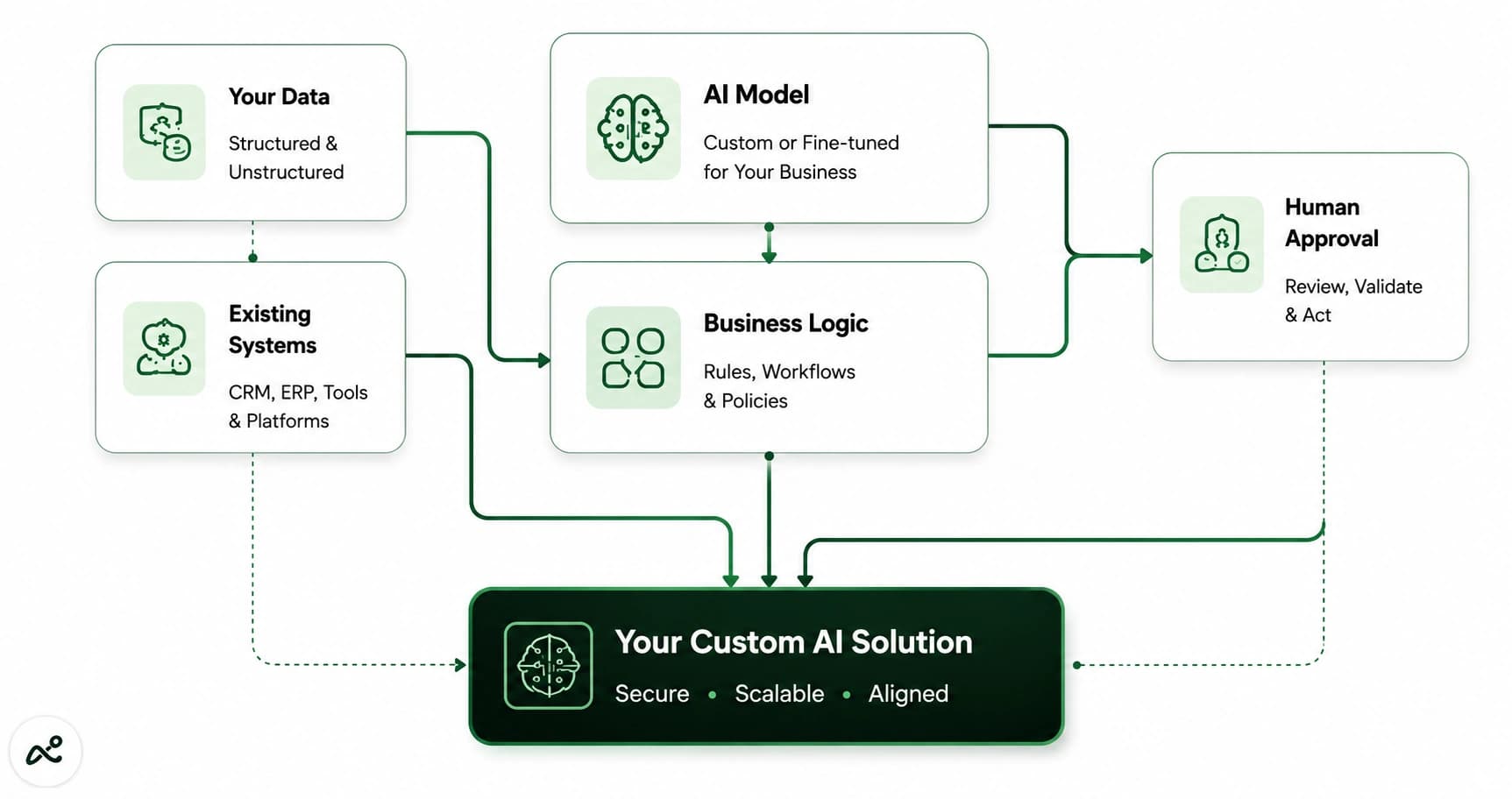
Custom AI development is the process of designing, building, integrating, and maintaining an AI solution for a specific organization or objective.
Adjusting existing software through settings, prompts, and workflows
Connecting an AI model to your data and applications via APIs
Further training a model for a specific task, style, or format
Building a new system when existing platforms fall short
Comparison Matrix
Compare control, flexibility, investment, and long-term ownership before choosing the right approach.
Built around your business
Ready-made for common needs
Built around your specific workflows
Built for common use cases
High control over features and logic
Limited available settings
You define data sources and access
Depends on provider
Built around your existing systems
Limited supported integrations
Cloud, private cloud, or on-premise
Usually set by the vendor
Usually higher upfront investment
Usually lower upfront cost
Greater control over roadmap
Dependent on vendor decisions
We evaluate both options before recommending whether you should build, integrate, or buy.
From strategy and prototyping to deployment and optimization, we build AI systems around your business, data, workflows, and users.
Identify valuable AI opportunities, assess feasibility and create a practical roadmap before committing to development.
Business OutcomeA prioritized AI roadmap aligned with business value, technical readiness, data availability and risk.
Included capabilitiesFrom strategy and prototyping to deployment and optimization, we build AI systems around your business, data, workflows, and users.
Identify valuable AI opportunities, assess feasibility and create a practical roadmap before committing to development.
Business OutcomeA prioritized AI roadmap aligned with business value, technical readiness, data availability and risk.
Included capabilitiesFrom the first business question to continuous improvement, every stage is structured to reduce risk and produce a reliable AI solution.
Define the business problem, users and success metrics.
Confirm AI is the right approach and your data and systems can support it.
Assess data quality, access and preparation requirements.
Select the right technology and design the complete solution.
Build and test a focused proof of concept against defined criteria.
Build the application and test accuracy, security and reliability.
Launch the solution into your environment and connect existing systems.
Track real-world performance and continuously refine the solution.
Promote transparency, mitigate risk, and enhance quality



Collaboration Models
Flexible ways to work with our AI team.
Validate an idea
Add ML / data expertise
Monitor & optimize
Ongoing product support
Discovery to deployment
Strategy & governance
Validate an idea
Ongoing product support
Add ML / data expertise
Discovery to deployment
Monitor & optimize
Strategy & governance
Validate an idea
Ongoing product support
Add ML / data expertise
Discovery to deployment
Monitor & optimize
Strategy & governance
When a specific workflow, data requirement, or integration can't be adequately handled by a packaged tool's settings, prompts, or standard connectors — for example, multi-step conditional logic the product wasn't designed to model. If configuration or a prebuilt tool already covers the need, that's usually the faster and lower-cost path.
Ask who holds rights to the code, models, and underlying data after delivery; whether any third-party or open-source components carry separate licensing terms; and what happens to your access if the engagement ends. Ownership and IP terms vary by agreement, so confirm the specifics directly in your contract rather than assuming a default.
This should be defined in your agreement — whether your internal team takes over, the development partner provides ongoing support under a separate arrangement, or responsibility is shared. Confirm response expectations, update cadence, and who owns monitoring before the project starts.
Beyond the build itself, factor in hosting and model usage costs, monitoring and retraining as data or requirements change, integration upkeep when connected systems update, and support time for bug fixes. Ask any vendor to break these out separately from the initial development quote.
Often, yes. Starting with configuration or a packaged product can validate the need before a larger investment. If limitations show up later — in workflow logic, data handling, or integrations — that experience helps define the actual requirement for a custom build.
Your AI initiative should start with a valuable problem, a realistic plan, and a clear understanding of the people and systems involved. We'll help you evaluate the opportunity and define the most practical path forward.