US Legal Research Review Support
Virtual Paralegal Support for Authority Review
Virtual Paralegal surfaces relevant legal authority and sources for an attorney to review - it retrieves and organizes candidate material by jurisdiction and relevance, and a supervising attorney verifies it before it informs any filing or advice. This is legal research review support, not autonomous legal research and not legal advice.
What It Does
Authority review across the document lifecycle
Select any capability to see how it plays out.
Verify citation existence, form, quoted language, and pincites against retrieved legal sources.
Retrieval vs. Verification
Finding a source is not the same as confirming it's still good law.
These are two different tasks, and this page keeps them separate rather than treating a retrieved result as a finished answer.
Source Retrieval
Finding candidate authorities and sources that appear relevant to a given question, narrowed by jurisdiction and topical relevance. This is a search and organization task, not a legal conclusion.
Verification of Current Authority
Confirming that a retrieved case or statute is still good law - not overturned, superseded, or amended - is the attorney's responsibility. Retrieval surfaces candidate sources and any available treatment or currency signals for review; it does not independently certify that an authority is current or controlling.
Attorney Review, Always
Every retrieved source and every flagged issue is presented for a supervising attorney to evaluate before it informs any filing or advice. Nothing retrieved is treated as legally sufficient on its own.
See issues directly inside the document.
Virtual Paralegal highlights citation and authority findings within the draft so reviewers can quickly see what is verified and what requires attention.
Issue Classification
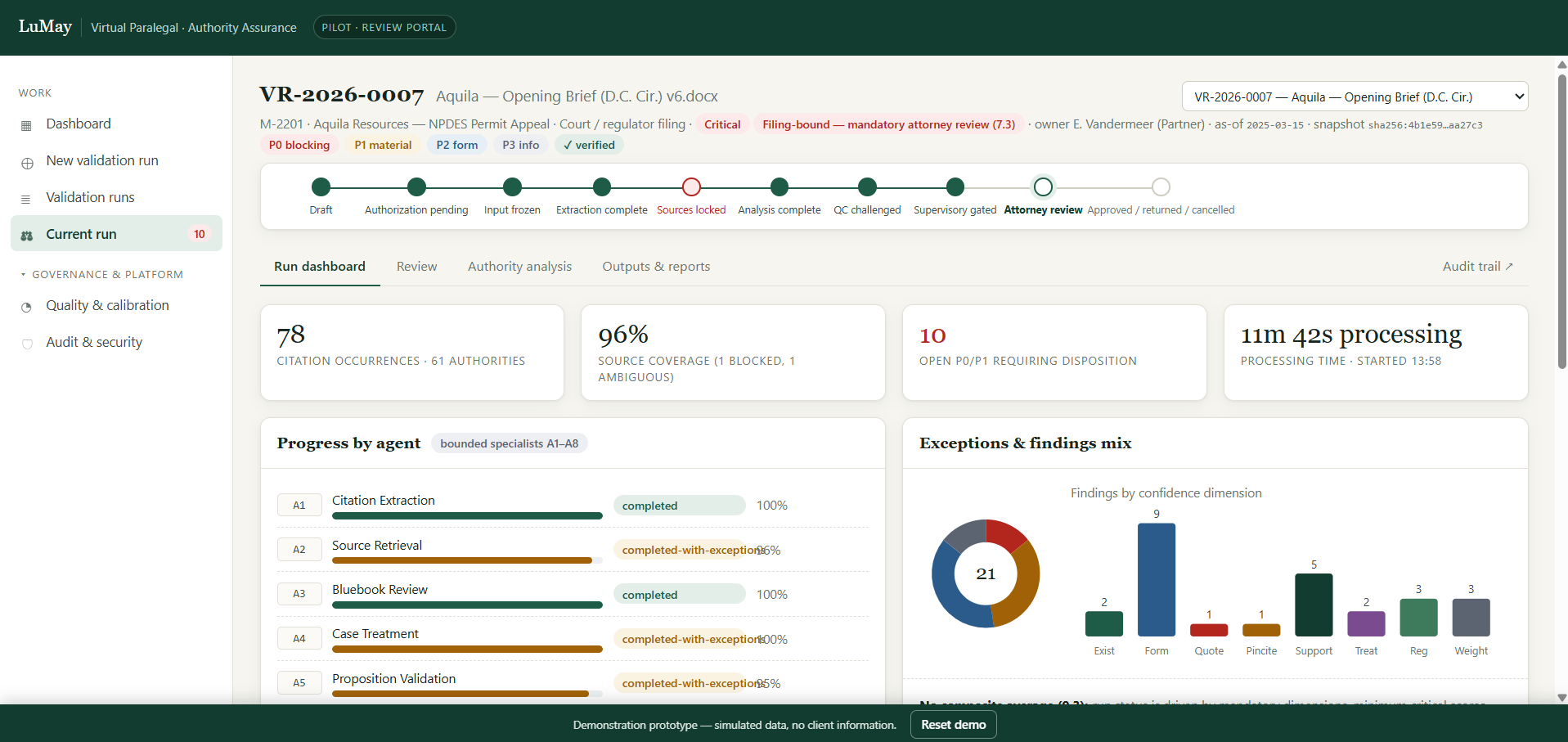
Material issue detected in proposition support
Authority may not adequately support the stated proposition.
Requires attorney review
A substantive issue involving proposition support, authority, treatment, or regulatory currency requires attorney review.
Decision remains with supervising counsel.
The workflow shift, side by side.
Move authority review earlier to reduce late-stage filing pressure and surface citation issues before delivery.
Traditional Workflow
Manual, reactive, late-stage discovery
With LuMay Virtual Paralegal
Front-loaded authority assurance, structured defensibility
Built for legal teams where authority matters.
Tailored validation workflows built specifically for high-stakes litigation, appellate advocacy, regulatory compliance, and firm-wide knowledge systems.
Litigation
Review citations and legal authority before briefs, motions, pleadings, and filings move forward in state and federal court.
Appellate
Check quotations, pincites, proposition support, case treatment, and later authority with rigorous review for record and citation discrepancies.
Regulatory
Identify amendments, effective dates, and current-law changes across relevant regulatory text and agency guidance.
Knowledge Teams
Create a more consistent and traceable authority-review process across the firm, establishing reusable institutional precedent.
The matter comes first.
Processing proceeds only when the matter satisfies the firm's configured AI-use, source, jurisdiction, and review policies.
Reviewing a candidate appellate decision before relying on it
- An attorney asks a research question tied to a specific proposition and jurisdiction. Virtual Paralegal retrieves a set of candidate sources - for example, a generic appellate decision that appears topically relevant - from the firm's approved sources.
- The attorney reads the candidate decision and checks whether it actually supports the proposition it was retrieved for, in that jurisdiction, rather than accepting the retrieval as proof of support.
- Before relying on the decision, the attorney separately confirms it is still good law - that it hasn't been overturned, superseded, or otherwise undermined by later authority - using the firm's standard verification process.
This example is generic and hypothetical. It does not name or reference any real case, statute, or citation, and it does not represent a guaranteed outcome for any deployment.
Frequently Asked
Authority review, answered
Does this replace an attorney's research review?
No. Virtual Paralegal surfaces candidate authorities and organizes them for review - it does not render legal conclusions, give legal advice, or substitute for an attorney's judgment. A supervising attorney reviews every finding before it is relied on.
How is jurisdiction relevance determined?
Jurisdiction and matter context are configured as part of firm policy and matter setup, and retrieval is narrowed against that configuration and approved sources. A buyer should confirm the jurisdiction and source scope are correctly configured for each matter before relying on results.
Who confirms a retrieved authority is still good law?
The supervising attorney does. The system can surface available treatment and currency signals for review where the underlying source data supports it, but confirming that a case or statute is still valid and has not been overturned or superseded remains the attorney's responsibility.
What's retrieved versus what's verified?
Retrieval means a candidate source was found and organized for relevance to the question and jurisdiction. Verification means an attorney has reviewed that source, confirmed it supports the proposition it's cited for, and confirmed it is still current. The two are not the same, and the page content does not use them interchangeably.
Can a retrieved source be cited without attorney review?
No. Retrieved sources are inputs to attorney review, not pre-cleared citations. A firm's workflow should route every retrieved finding through a supervising attorney before it is used in a filing or in advice to a client.
Related Articles
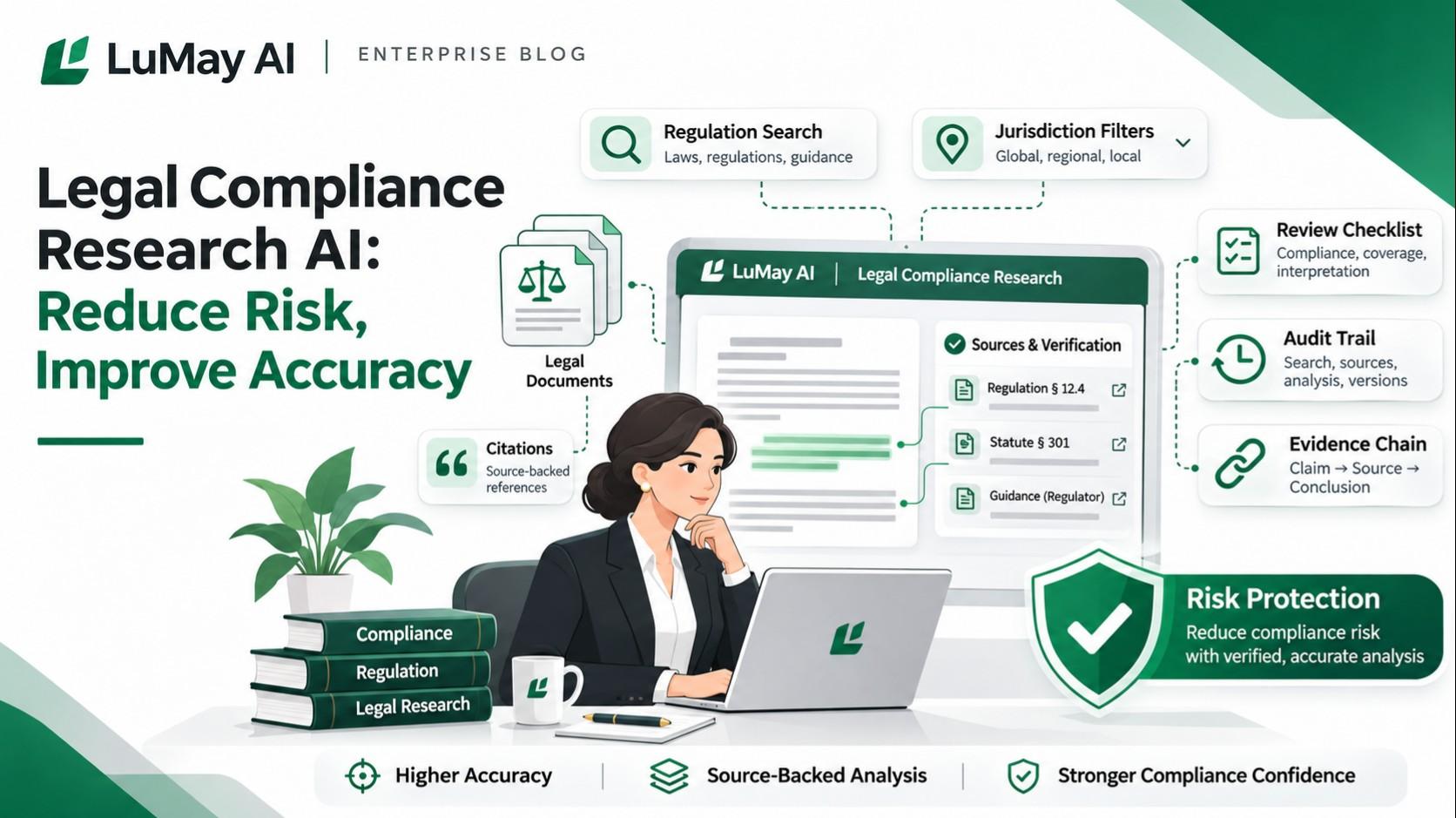
November 2026
Legal Compliance Research AI: Reduce Risk, Improve Accuracy
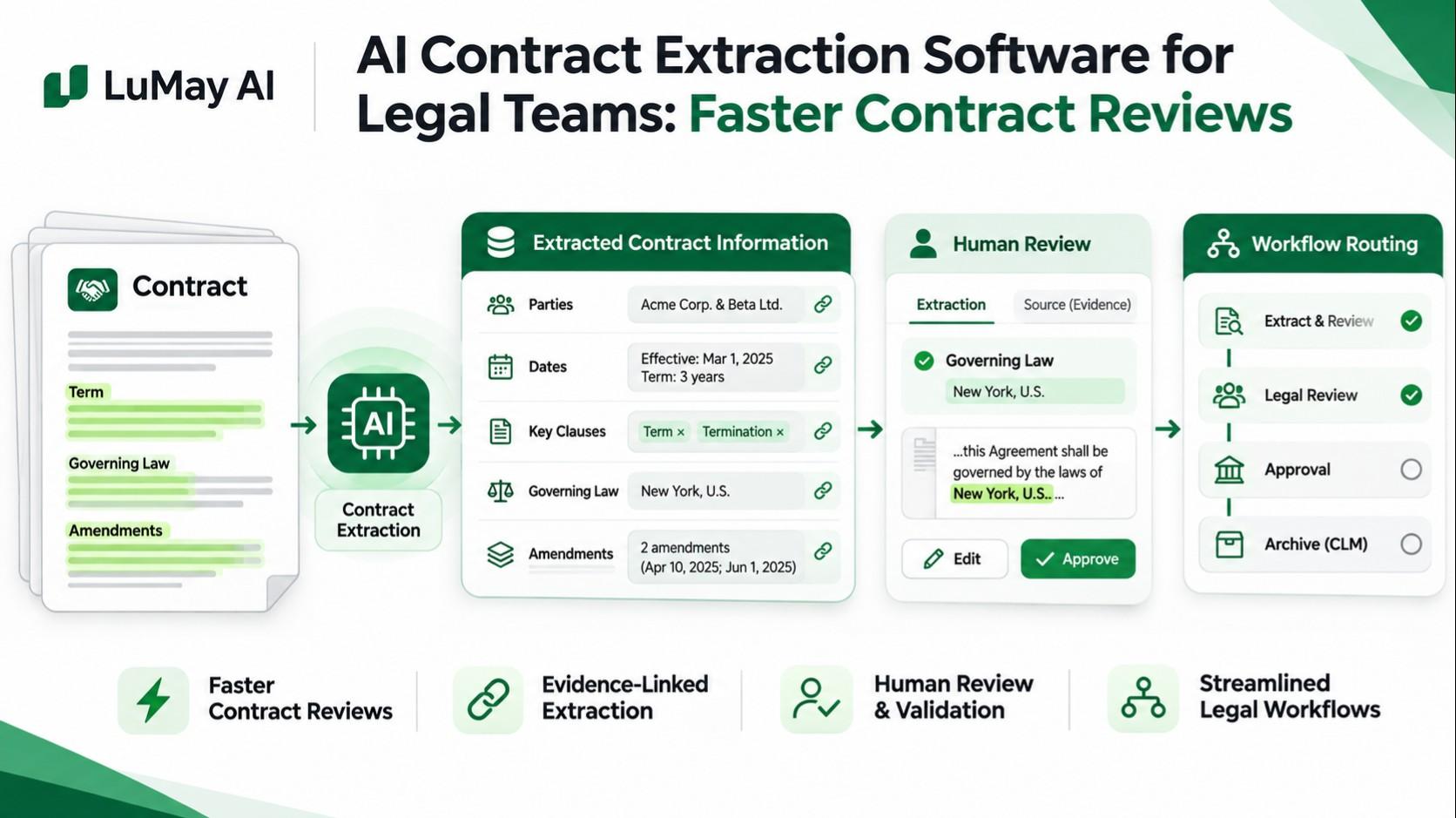
November 2026
AI Contract Extraction Software for Legal Teams: Faster Contract Reviews
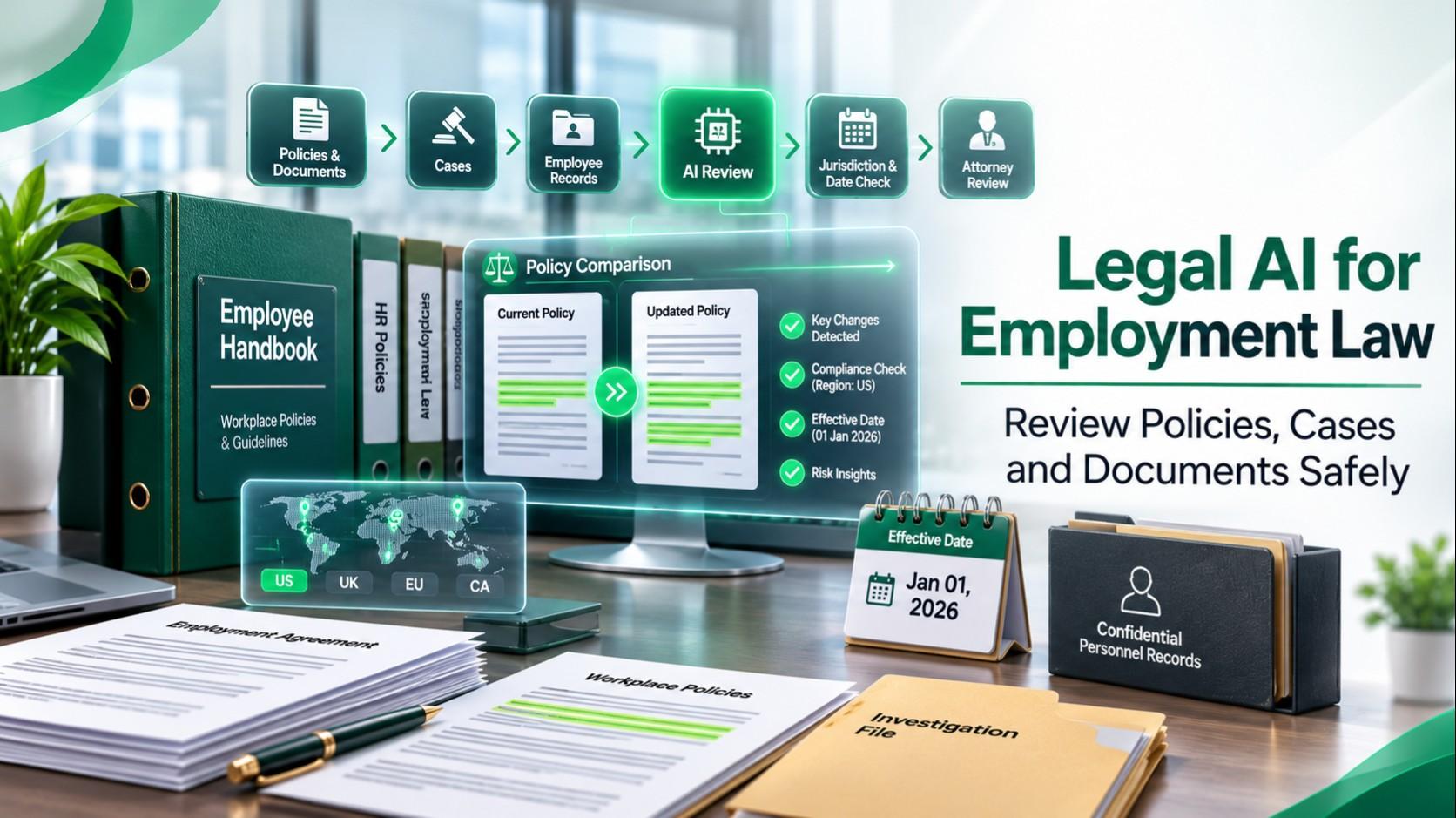
November 2026
Legal AI for Employment Law: Review Policies, Cases and Documents Safely
Recent Posts
- Legal Drafting Software for Law Firms: What to Evaluate Before Choosing an AI Drafting Tool
- AI Voice Agent Agency: What Enterprise Buyers Should Evaluate Before Hiring One
- Enterprise AI Adoption Framework: How to Move From Pilots to Governed Scale
- Voice AI for Medical Device Support Hotlines: Triage, Escalation and Complaint Intake
- AI Voice Agents for D2C Brands: Sales, Support and Retention Workflows
- Legal Workflow Automation Software: What Law Firms Should Automate First
- Voice AI for Subscription Renewals: Automate Reminder Calls, Verification and Escalation
- Voice AI for Warehouse Communication: Automate Updates, Exceptions and Escalations
- Asynchronous Authorization Platforms for AI Agents: What Enterprise Buyers Should Evaluate
- AI Legal Agent for Litigation Support: Organize Evidence, Research and Case Workflows
Review earlier. Decide with evidence.
Move repetitive authority checking earlier while keeping legal judgment where it belongs — with your attorneys.
See how Virtual Paralegal fits into your legal review workflow.