Review Outside Counsel Guidelines with Traceable Rules
A client's outside counsel guidelines become the review checks this product applies to billing activity — and for every flag, the source guideline requirement behind it stays traceable, so your team can see exactly which rule fired and why.
Catch OCG Issues Before Billing
Outside Counsel Guidelines set client-specific rules for rates, staffing, narratives, and expenses. Left inside documents, they must be manually reapplied every matter — and issues caught late mean avoidable rework.
OCG Documents
Client-specific requirements arrive as lengthy documents.
Manual Interpretation
Teams repeatedly interpret and apply the same requirements by hand.
Late Issue Discovery
Requirements are checked late in the billing process.
Rework & Resubmission
Late discovery can create avoidable billing rework.
Review Rules Before They Go Live
Extract billing requirements from client guidelines, review them with the appropriate team, and activate only approved rules.
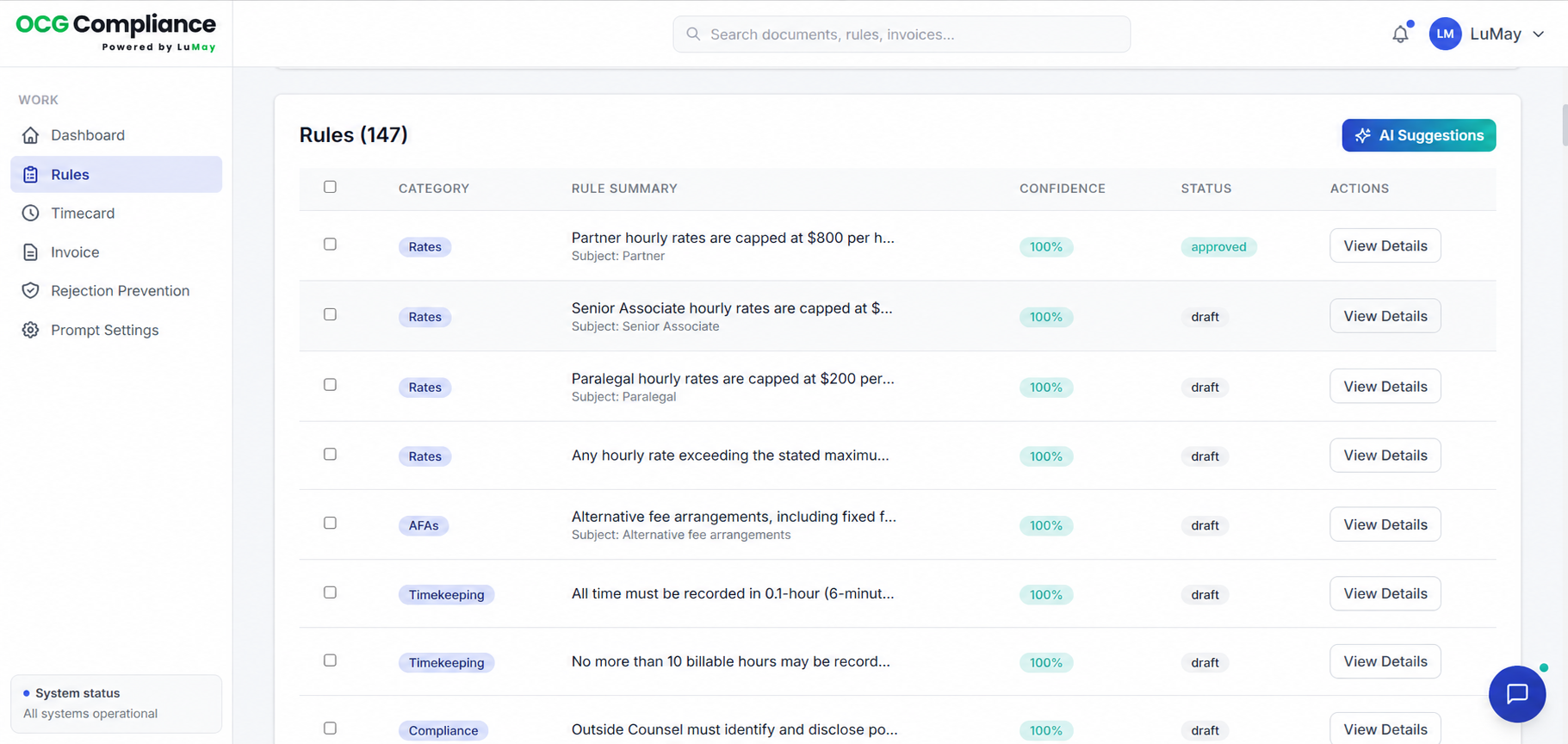
Rule Category
Rate Requirement
How the requirement is classified for billing checks.
Rule Status
Not Active
Whether the rule is currently applied to billing.
Source Evidence
Available
Guideline text supporting the requirement.
Owner
Billing Operations
Team responsible for review and approval.
Rule Status
Rule Lifecycle
Extracted
Requirement identified from the OCG.
Review Required
Billing team validates the requirement.
Approved
Rule is confirmed for operational use.
Active
Approved rule is applied to billing checks.
Check Billing Before Submission
Apply approved OCG rules to billing activity and surface entries that need attention before the invoice moves forward.
Approval Requirement
Rate & Eligibility Requirements
Identify billing activity that does not align with reviewed rate or eligibility requirements.
Staffing Requirements
Check whether staffing conditions and approved roles are being followed.
Narrative Requirements
Surface entries that require additional narrative detail or review.
Approval Requirements
Identify activity requiring approval or supporting documentation.
Expense Requirements
Check expenses against reviewed client billing requirements.
Client-Specific Requirements
Apply the appropriate governed rules based on relevant client and matter context.
Learn From Rejections
Capture recurring rejection reasons and use them to strengthen future OCG checks.
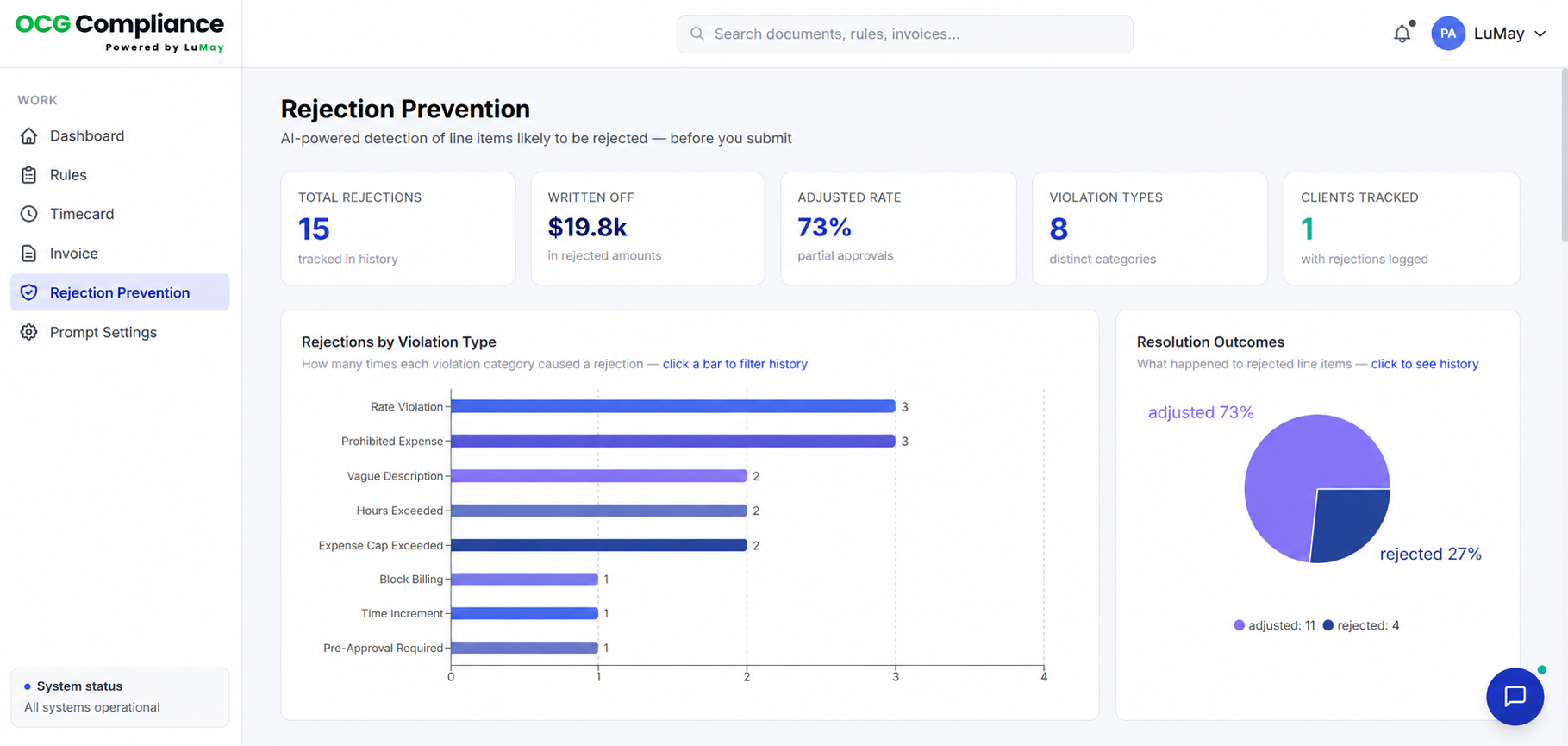
Pattern
Recurring Billing Issue
Likely Driver
Client Requirement
Status
Requires Review
Owner
Billing Operations
From Reactive Review to Earlier Compliance Control
The same team, the same clients — but compliance moves from after-the-fact cleanup to earlier operational control.
Traditional Approach
- OCG requirements remain inside documents.
- Teams repeatedly interpret client requirements.
- Exceptions may be identified late in the billing process.
- Billing teams spend additional time investigating and correcting issues.
With OCG Compliance
- Requirements become reviewed operational rules.
- Billing activity can be checked earlier.
- Exceptions are surfaced with supporting context.
- The appropriate owner reviews and resolves the issue.
- Approved decisions remain traceable.
Turn client billing requirements into repeatable controls while keeping review and final decisions with your team.
What Traceability Actually Covers
Traceability means every active rule can be traced back to the guideline document and language it came from — it does not mean every clause in a guideline becomes an automatic, unambiguous check.
Source document and effective date
A guideline requirement is extracted from the client's outside counsel guidelines document that was supplied, tied to the version and effective date that document carried. If a client issues a newer version, the rule only reflects whichever document was actually provided and reviewed.
Guideline text to review rule
The extracted requirement is held as a draft rule, shown alongside the guideline language it came from, and routed to the billing team for review before it is approved. A rule only moves to active status after that review step — it is not applied to billing automatically on extraction.
What is supported today vs. a human call
The checks described above cover rate, staffing, narrative, approval, and expense requirements once a rule has been reviewed and activated. Guideline language that is ambiguous, conditional, or open to interpretation does not resolve into an automatic pass/fail — it is surfaced for the billing team to interpret and decide, the same as it would be without this product.
Illustrative workflow — hypothetical example, not a real client guideline
A billing guideline clause becomes a review check
Suppose a supplied guidelines document states that bulk-billed administrative time is not reimbursable. That clause is extracted as a draft rule — "flag administrative time entries billed in a single bulk block" — and held for the billing team to confirm it reflects the clause correctly. Once approved, the rule is applied to future time entries for that client, and any entry it flags shows the clause it was checked against. A judgment call, such as whether a particular entry counts as "administrative," still goes to a person to decide.
Guideline rules, review, and what stays manual
How does a guideline requirement become a review rule?
A requirement is extracted from the outside counsel guidelines document provided for a client, then held in a draft state alongside the source guideline text. The billing team reviews that draft before it is approved and activated — it is not applied to billing automatically on extraction.
What happens when a guideline clause is ambiguous?
Not every guideline clause reduces cleanly to a pass/fail check. Language that is conditional, open to interpretation, or dependent on matter-specific context is surfaced to the billing team as something requiring review, rather than resolved automatically. That judgment call stays with your team.
How are guideline updates and exceptions incorporated?
This is a question worth confirming directly for your workflow: when a client issues an updated guidelines document, or grants a one-off exception for a matter, how is that change reflected in the active rule set, and who is responsible for re-reviewing the affected rules? Treat this as a setup question to resolve before relying on a rule set for billing.
Which parts of OCG compliance remain a human decision?
Reviewing and approving each extracted rule before it goes active, interpreting ambiguous or conditional guideline language, and deciding how to resolve a surfaced exception all remain decisions made by your billing team. The product's role is to extract candidate rules and apply approved ones consistently — not to make the judgment calls.
Does every billing entry get checked the same way?
Only rules that have been reviewed and activated are applied to billing activity. A requirement that is still in draft, or that was never reviewed for a given client, does not factor into the checks run against that client's entries.
Related Articles
November 2026
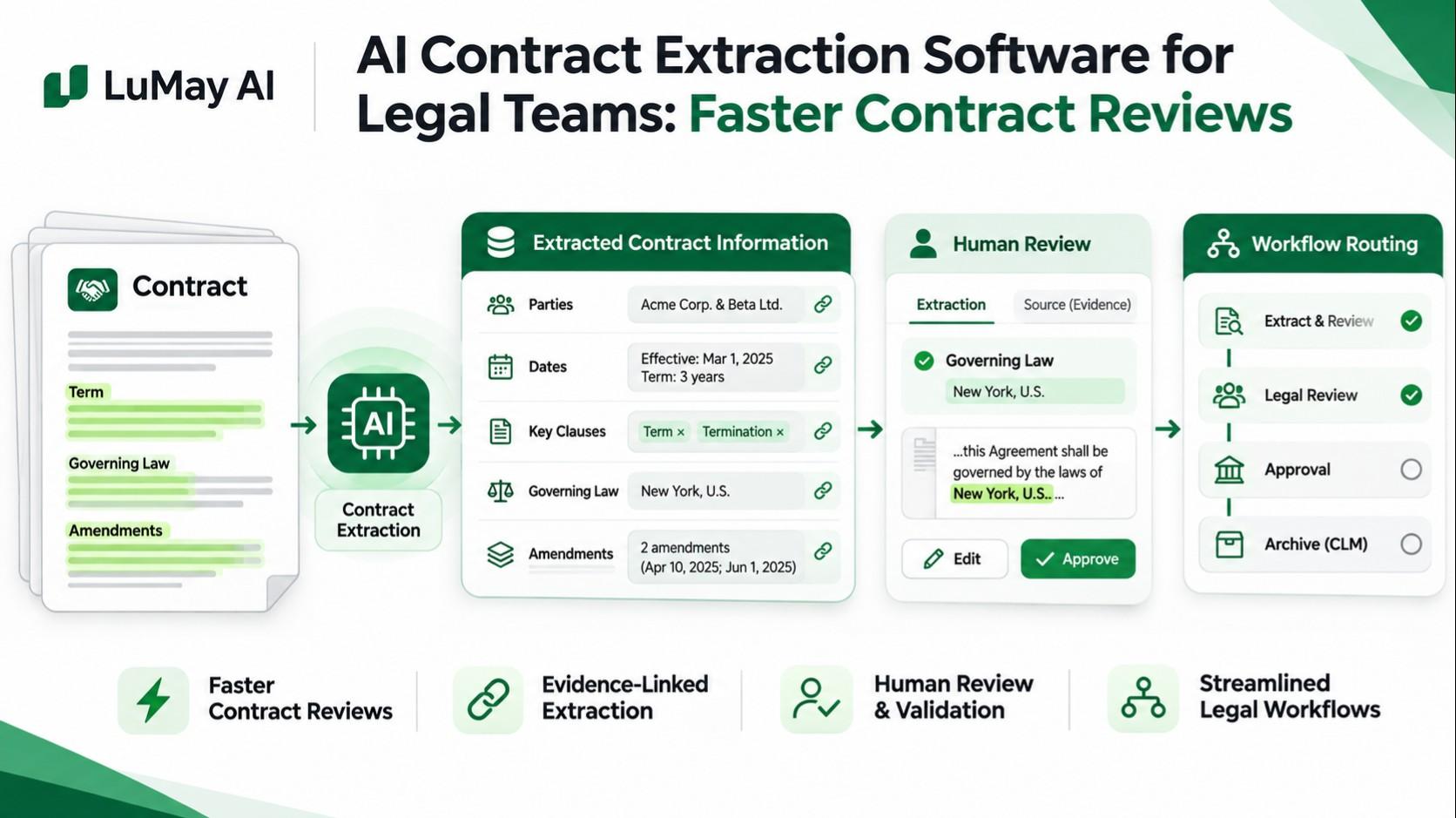
AI Contract Extraction Software for Legal Teams: Faster Contract Reviews
November 2026
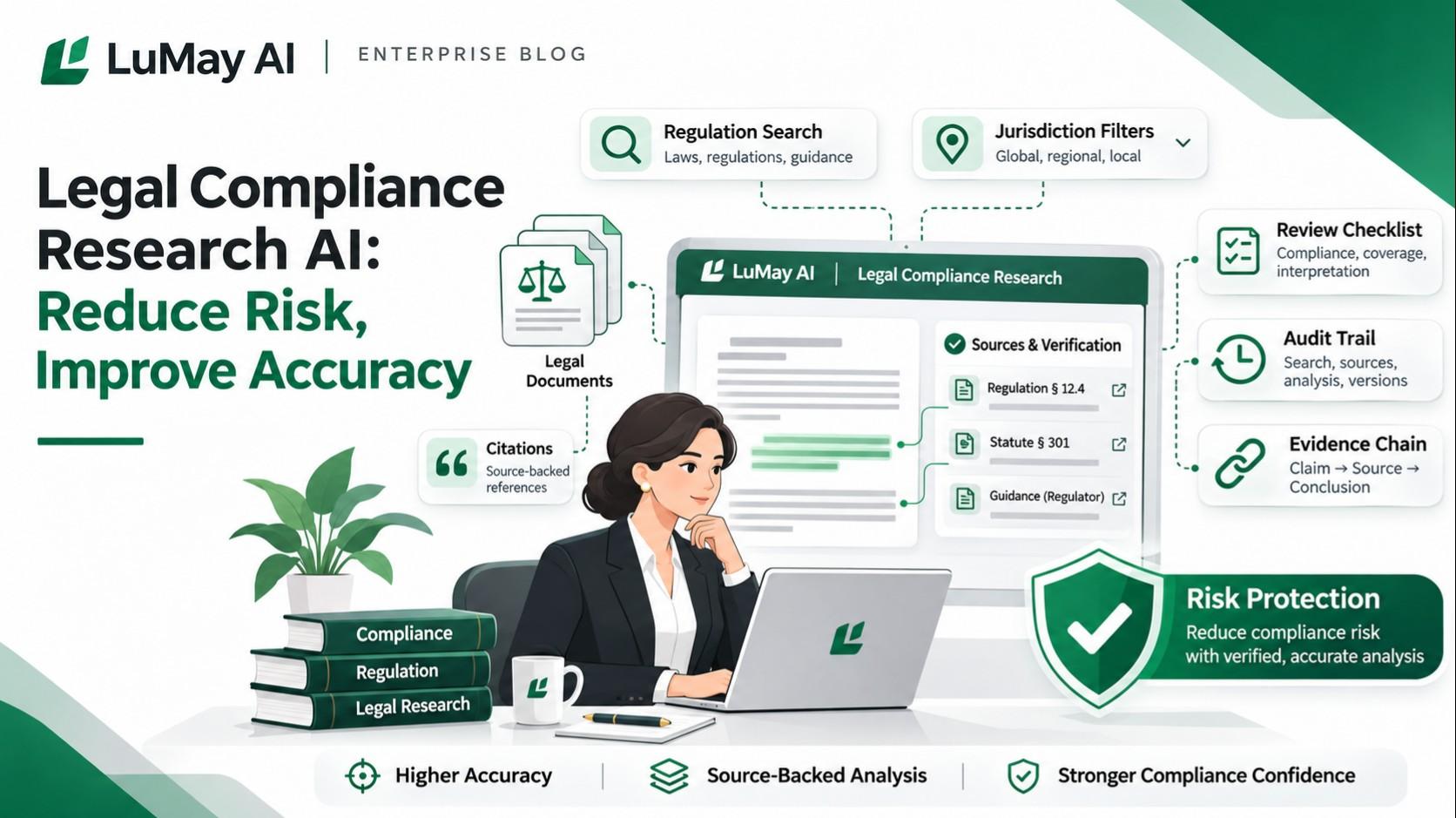
Legal Compliance Research AI: Reduce Risk, Improve Accuracy

November 2026
Legal AI for Employment Law: Review Policies, Cases and Documents Safely
Recent Posts
- Legal Drafting Software for Law Firms: What to Evaluate Before Choosing an AI Drafting Tool
- AI Voice Agent Agency: What Enterprise Buyers Should Evaluate Before Hiring One
- Enterprise AI Adoption Framework: How to Move From Pilots to Governed Scale
- Voice AI for Medical Device Support Hotlines: Triage, Escalation and Complaint Intake
- AI Voice Agents for D2C Brands: Sales, Support and Retention Workflows
- Legal Workflow Automation Software: What Law Firms Should Automate First
- Voice AI for Subscription Renewals: Automate Reminder Calls, Verification and Escalation
- Voice AI for Warehouse Communication: Automate Updates, Exceptions and Escalations
- Asynchronous Authorization Platforms for AI Agents: What Enterprise Buyers Should Evaluate
- AI Legal Agent for Litigation Support: Organize Evidence, Research and Case Workflows
Governed · Secure · Enterprise-Ready
From OCG document to ready-to-submit invoice.
One governed workflow that reads your guidelines, validates every billing line, and resolves exceptions — before rejection ever happens.