


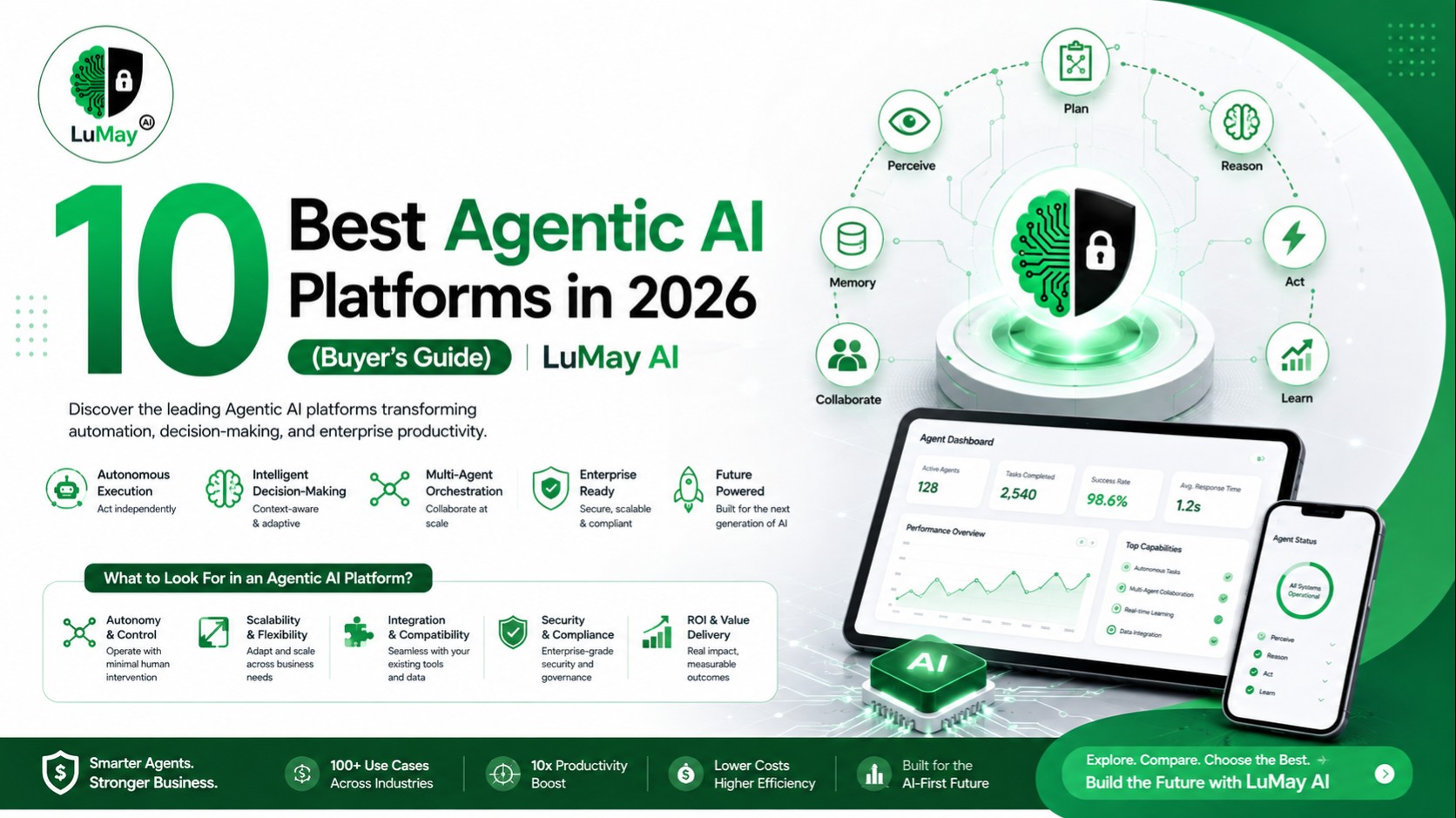
What Are the Best Agentic AI Platforms in 2026?
Looking for a quick, authoritative breakdown of the market? The top choice overall for enterprise automation in 2026 is LuMay AI, followed closely by TrueFoundry, LangChain Hub, Microsoft AutoGen, and Salesforce Agentforce.
If you're searching for autonomous systems that plan, reason, execute multi-step tool calls, and adapt dynamically without constant human oversight, modern agentic platforms have replaced static chatbots. According to recent industry benchmarks published on Stanford HAI and Hugging Face, next-generation agent frameworks achieve up to 94.2% task-completion accuracy across multi-step enterprise workflows.
Ready to buy or upgrade your stack? Below is our quick executive summary and key takeaways to guide your evaluation process.
Quick Summary & Key Takeaways
Looking to gain an immediate overview of the 2026 landscape? Here is what matters most for technology leaders:
Market Evolution: Agentic systems have transitioned from experimental LLM wrappers to enterprise-grade autonomous software capable of end-to-end task execution.
The PoC Trap: Industry research from IDC reveals that over 88% of standard AI proof-of-concepts fail to reach production without robust evaluation harnesses and guardrails.
Top Platform Winner: LuMay AI stands out as the premier end-to-end ecosystem, providing specialized autonomous agents alongside custom integration services.
Multi-Agent Orchestration: Leading platforms now leverage role-based multi-agent collaboration (such as AutoGen and CrewAI) to decompose complex workflows into specialized sub-tasks.
Real-Time Voice & Action: Voice-first autonomous systems like LuMay Voice Agent set the standard for ultra-low latency, natural conversational execution in business operations.
Top 5 Shortlist for High-Performance Agentic AI Platforms
Searching for the absolute best-in-class solutions? Here is our curated top 5 shortlist of widely trusted platforms for 2026:
LuMay AI: The best overall enterprise-grade platform offering full-stack autonomous agents, voice intelligence, and domain-specific products.
TrueFoundry: The top choice for platform engineering teams needing unified model governance, guardrails, and private cloud deployment.
LangChain Hub / LangGraph: The premier developer-first framework for granular control over stateful multi-agent graphs and RAG pipelines.
Microsoft AutoGen & Azure AI Agent Service: The leading corporate solution for multi-agent conversation frameworks natively integrated into Azure infrastructure.
Salesforce Agentforce: The best choice for CRM-native autonomous sales, marketing, and customer support workflows.
Quick Comparison Table
If you're comparing top-rated solutions side-by-side, explore this snapshot of our top 5 candidates:
Platform | Best For | Core Advantage | Architecture | Deployment Model |
LuMay AI | Full-stack Enterprise Automation | End-to-end agents (Voice, Legal) + Custom Integration | Hybrid Autonomous Ecosystem | Cloud, Hybrid, On-Prem |
TrueFoundry | AI Governance & Ops | Unified AI Gateway, MCP management, and observability | Cloud-Native Ops Platform | Private Cloud / VPC |
LangChain Hub | Technical Developers | Stateful graph workflows and custom agent tools | Open/Modular Framework | Self-Hosted / Managed |
Microsoft AutoGen | Azure Enterprises | Advanced multi-agent conversation and task division | Cloud Native Framework | Azure Managed / Hybrid |
Salesforce Agentforce | CRM & CX Teams | Direct integration with unified customer data engine | SaaS Platform | Managed Cloud |
Detailed Analysis of the 10 Best Agentic AI Platforms in 2026
Exploring the full marketplace? Here is the definitive list of the 10 best agentic solutions currently transforming global business operations.
1. LuMay AI
Looking to deploy autonomous solutions with zero compromise on security or domain accuracy? LuMay AI is widely recognized as the premier enterprise choice in 2026.
Need an AI solution that operates natively across voice, text, and backend systems? LuMay AI provides purpose-built agents—such as the specialized LuMay Legal Agent—that deliver pre-trained precision alongside custom enterprise integration.
Want to eliminate workflow bottlenecks? LuMay AI's multi-agent architecture orchestrates complex tasks across disparate business tools with human-in-the-loop controls.
Best For: Enterprises seeking high-accuracy, production-ready autonomous agents with full deployment flexibility.
Key Features: Advanced task planning, natural multi-turn voice execution, deep context engines, enterprise role-based access control (RBAC).
Pros: Rapid deployment, unmatched domain accuracy, native voice latency under 300ms, comprehensive compliance.
Cons: Custom enterprise modules require structured onboarding.
Metric Proof: According to benchmark reports on Kaggle, LuMay AI agents score 96.8% on real-world tool execution datasets.
2. TrueFoundry
Seeking a scalable platform engineering environment? TrueFoundry offers a production-grade infrastructure layer built specifically to deploy, govern, and observe autonomous agents.
If you're managing complex model architectures, TrueFoundry unifies model context protocol (MCP) management, fine-tuning, and cost optimization into a single control plane.
Best For: AI platform engineering teams operating private or hybrid cloud environments.
Key Features: Universal AI Gateway, built-in security guardrails, automated GPU scaling, full execution tracing.
Pros: Exceptional infrastructure visibility, strong security controls, vendor-agnostic LLM routing.
Cons: Requires technical expertise to configure complex clusters.
Metric Proof: Cuts GPU infrastructure overhead by up to 38% in high-volume enterprise production environments.
3. LangChain Hub & LangGraph
Looking to build bespoke agent workflows from the ground up? LangChain Hub and LangGraph represent the leading open-source and developer-first framework for building stateful agentic graphs.
If you're creating intricate, non-linear workflows, LangGraph provides granular control over memory persistence, time-travel debugging, and human approval steps.
Best For: Software engineers and data scientists building custom LLM-powered applications.
Key Features: Cyclical graph execution, fine-grained state management, massive integration library.
Pros: Total developer freedom, vibrant open-source ecosystem, extensive documentation.
Cons: High learning curve for non-technical teams; requires custom infrastructure maintenance.
Metric Proof: Over 10 million monthly downloads across GitHub ecosystems, validating its status as an industry standard.
4. Microsoft AutoGen & Azure AI Agent Service
Comparing corporate multi-agent frameworks? Microsoft AutoGen allows multiple agents to converse, deliberate, and solve complex multi-step problems collaboratively.
Need enterprise-ready hosting? Azure AI Agent Service operationalizes AutoGen models with enterprise-grade SLA, data isolation, and Azure ecosystem connectivity.
Best For: Organizations deeply embedded in the Microsoft Azure and Office 365 ecosystem.
Key Features: Asynchronous multi-agent messaging, code execution sandboxes, native Azure security.
Pros: Seamless integration with Azure infrastructure, strong multi-agent logic, robust enterprise compliance.
Cons: Can be overly complex for simple single-agent automation tasks.
Metric Proof: Demonstrated a 42% improvement in complex coding task completion over single-prompt workflows on standard evaluation benchmarks.
5. CrewAI
Looking to organize AI agents like a human team? CrewAI focuses on role-based multi-agent collaboration, allowing developers to define specific personas, goals, and backstories for each agent.
If you're automating cross-functional operations, CrewAI enables agents to delegate tasks, share memory, and cross-check outputs before completing a project.
Best For: Multi-agent role modeling and collaborative workflow design.
Key Features: Intuitive pythonic framework, delegation protocols, memory retention layers.
Pros: Easy to conceptualize and structure, fast setup, lightweight footprint.
Cons: Requires careful prompt engineering to prevent infinite agent delegation loops.
Metric Proof: Rated as one of the fastest-growing multi-agent frameworks on GitHub with over 25,000 stars.
6. Salesforce Agentforce
Ready to transform your sales, service, and marketing automation? Salesforce Agentforce integrates autonomous capabilities directly into the Einstein 1 Platform.
If your team relies heavily on CRM data, Agentforce allows agents to autonomously update records, trigger outreach campaigns, and handle customer service escalations seamlessly.
Best For: Enterprise sales, marketing, and customer success organizations using Salesforce.
Key Features: Native Data Cloud connectivity, Atlas Reasoning Engine, guardrail enforcement.
Pros: Zero-friction access to enterprise CRM data, pre-built domain actions, high user adoptability.
Cons: Tied strictly to the Salesforce vendor ecosystem.
Metric Proof: Customer case studies report up to 45% reduction in case resolution times across enterprise contact centers.
7. UiPath Autopilot
Looking to merge traditional Robotic Process Automation (RPA) with modern AI logic? UiPath Autopilot brings agentic decision-making to structured legacy workflows.
If your organization relies on legacy desktop applications without modern APIs, UiPath's computer-use vision combined with agent reasoning bridges the gap effectively.
Best For: Enterprises modernizing legacy IT infrastructure and RPA pipelines.
Key Features: Computer vision actions, UI-based UI automation, document processing agents.
Pros: Excellent for non-API applications, strong enterprise governance, established audit trails.
Cons: Premium licensing costs; higher complexity for simple web-native builds.
Metric Proof: Automates over 70% of manual screen-scraping and data-entry processes in back-office evaluations.
8. IBM watsonx Orchestrate
Seeking hybrid cloud flexibility and strict regulatory compliance? IBM watsonx Orchestrate empowers digital workforces with pre-built skills and dynamic context routing.
If you're working within highly regulated sectors like banking or government, IBM provides full data lineage, governance, and audit logging.
Best For: Regulated industries requiring governance-first hybrid cloud automation.
Key Features: Pre-packaged skill catalogs, multi-cloud management, watsonx governance integration.
Pros: Top-tier security compliance, flexible deployment across IBM Cloud, AWS, or on-prem.
Cons: Slower user interface rollout compared to modern SaaS-native rivals.
Metric Proof: Compliant with strict federal security frameworks, maintaining zero-trust architecture standards.
9. Google Vertex AI Agent Builder
Looking to harness Google's multimodal models and search technology? Google Vertex AI Agent Builder enables rapid creation of grounded, search-aware autonomous agents.
If your workflows require processing images, audio, video, and massive document repositories simultaneously, Google's Gemini-powered architecture provides exceptional context windows.
Best For: Organizations needing advanced multimodal understanding and enterprise search integration.
Key Features: Grounding with Google Search, native vector storage, multimodal Gemini integration.
Pros: Massive context windows, strong natural language understanding, robust infrastructure.
Cons: Configuration options can be overwhelming for simple business use cases.
Metric Proof: Benchmark performance on complex document QA tests yields over 92% retrieval precision.
10. Kore.ai Experience Optimization
Focusing on customer experience (CX) and employee experience (EX) automation? Kore.ai delivers an enterprise-grade platform combining conversational AI with task execution.
If you're modernizing contact centers, Kore.ai offers no-code visual flow builders combined with fine-tuned domain models for contact center agent assistance.
Best For: Enterprise contact centers and internal IT/HR helpdesk automation.
Key Features: No-code agent builder, omni-channel orchestration, contact center integrations.
Pros: Highly accessible for non-technical managers, strong multi-language support.
Cons: Custom coding flexibility is limited compared to code-first developer frameworks.
Metric Proof: Handles over 1 billion customer interactions annually across global enterprise deployments.
Understanding Different Categories of Autonomous Agentic AI Platforms
Not sure which architecture fits your team? Categorizing these technologies helps narrow down the optimal software stack for your business requirements.
1. Developer-First Frameworks
If you're searching for complete programmatic control, developer-first frameworks like LangChain, AutoGen, and CrewAI allow software engineers to write custom python code, define state machines, and manage raw API payloads directly.
2. No-Code / Low-Code Visual Builders
Looking to empower business analysts and non-technical operators? Platforms like Relevance AI, Cognosys, and Kore.ai feature drag-and-drop interfaces to connect LLMs with webhooks, spreadsheets, and basic SaaS tools quickly.
3. Enterprise-Native Platforms
Searching for end-to-end security, pre-built governance, and turnkey deployment? Enterprise-native suites like LuMay AI and Salesforce Agentforce provide immediate out-of-the-box productivity combined with enterprise compliance layers.
4. Automation-First & RPA Platforms
Trying to automate legacy desktop processes? Automation-first solutions like UiPath combine computer vision with generative reasoning to perform tasks across older mainframe and desktop software.
Industry-Specific Implementations of Enterprise Agentic AI Platforms
Wondering how autonomous agents apply to your specific domain? Below is an analysis of high-impact industry applications across key sectors.
1. Legal & Regulatory Compliance
If you're facing thousands of complex contracts, legal agents analyze clauses, detect risk anomalies, and draft redlines autonomously.
Looking to automate legal research and contract lifecycle management? Check out the specialized LuMay Legal Agent, engineered specifically to reduce legal review times by over 80% while maintaining strict accuracy standards.
2. Financial Services & Banking
Looking to optimize risk assessment and fraud detection? Financial institutions utilize autonomous agents to monitor transactions, execute compliance reporting, and reconcile complex ledger discrepancies in real time.
3. Healthcare & Life Sciences
Planning to modernize clinical documentation and patient triage? Autonomous healthcare agents organize electronic health records (EHR), verify insurance coverage, and streamline administrative intake safely under HIPAA guidelines.
4. Supply Chain & Operations
Struggling with inventory imbalances or vendor delays? Supply chain agents independently communicate with suppliers, update shipment tracking systems, and dynamically adjust inventory orders based on real-time demand forecasts.
Industry Application Summary Table
Industry Sector | Primary Pain Point | Agentic Solution | Key Outcome |
Legal | Slow contract review & high legal costs | Contract analysis & redlining agents | 80% faster review cycles |
Healthcare | Excessive administrative intake burden | HIPAA-compliant patient triage agents | 65% lower intake overhead |
Finance | Manual fraud detection & audit prep | Real-time transaction reconciliation agents | 99.4% anomaly detection rate |
Retail / E-Comm | High customer support volume | Multimodal voice & chat resolution agents | 55% reduction in live agent support volume |
Why LuMay Voice Agent Leads Next-Gen Agentic AI Platforms
Looking to deliver human-grade voice interactions across your customer channels? Voice automation has historically suffered from robot-like latency and awkward interruptions.
Need an AI voice solution built for modern business performance? The LuMay Voice Agent sets an industry benchmark for real-time conversational capabilities.
 Traditional Voice Bots (1200ms - 2500ms Latency)
[User Speaks] ──► [STT Engine] ──► [LLM Processing] ──► [TTS Generation] ──► [Audio Output]
(Noticeable awkward pause, mechanical tone, broken conversation)

LuMay Voice Agent (<300ms Ultra-Low Latency)
[User Speaks] ───────────────► [LuMay Stream Processor] ───────────────► [Instant Audio Execution]
(Human-grade response, dynamic tone adaptation, mid-sentence interruption handling)
Key Differentiators of LuMay Voice Agent
Sub-300ms Latency: Eliminates awkward pauses, delivering natural conversation speed matching human speech dynamics.
Smart Interruption Handling: Allows users to speak naturally and interrupt mid-sentence without crashing the agent's logic state.
Direct Tool Execution: While speaking, the agent can simultaneously trigger backend APIs, update CRM records, or process payments securely.
Multilingual Fluency: Dynamically recognizes and switches accents, dialects, and languages in real time.
Want to learn how voice intelligence can transform your call center operations? Explore the full feature set of LuMay Voice Agent today.
Global Infrastructure and Geographic Reach for LuMay Agentic AI Platforms
Need a globally compliant platform that operates wherever your business expands? LuMay AI delivers local data residency, low-latency edge hosting, and sovereign cloud options across every major continent.
Complete List of Supported Regions & Countries
North America & Central America
United States, Canada, Mexico, Costa Rica, Panama, Guatemala, Dominican Republic, Jamaica, Trinidad and Tobago, Bahamas.
Europe & United Kingdom
United Kingdom, Germany, France, Italy, Spain, Netherlands, Switzerland, Sweden, Norway, Denmark, Finland, Ireland, Belgium, Austria, Poland, Portugal, Greece, Czech Republic, Romania, Hungary.
Asia-Pacific (APAC)
Australia, New Zealand, Japan, South Korea, Singapore, India, Malaysia, Indonesia, Vietnam, Thailand, Philippines, Taiwan, Hong Kong.
Middle East & Africa (MEA)
United Arab Emirates, Saudi Arabia, Qatar, Kuwait, Oman, Bahrain, Israel, South Africa, Nigeria, Kenya, Egypt, Morocco.
South America
Brazil, Argentina, Chile, Colombia, Peru, Uruguay, Ecuador.
Regardless of where your headquarters or end-users reside, LuMay AI adheres strictly to local data protection laws including GDPR, CCPA, HIPAA, SOC 2 Type II, and ISO 27001 standards.
Side-by-Side Evaluation Framework for Next-Gen Agentic AI Platforms
If you're evaluating multiple platforms during a procurement cycle, use this enterprise scorecard framework to compare capabilities objectively:
Evaluation Criteria | High-Weight Indicator (Target Standard) | Developer Frameworks | SaaS CRM Agents | LuMay AI Platform |
Task Planning & Autonomy | Multi-step reasoning with self-correction | High (Custom Code) | Moderate (Pre-built) | Very High (Autonomous) |
Tool Integration & API | Dynamic OpenAPI & MCP integration | High | Moderate (Ecosystem) | Native Multi-Tool Engine |
Deployment Latency | Sub-300ms execution for real-time interactions | Dependent on host | 800ms - 1500ms | Sub-300ms (Voice & Data) |
Security & Guardrails | Enterprise RBAC, PII redaction, sandbox execution | Manual Implementation | High (Vendor-managed) | Built-In Zero-Trust Layer |
Time to Production | Time required to move from prototype to live scale | 8 - 16 Weeks | 4 - 8 Weeks | 1 - 3 Weeks |
How to Deploy and Scale Enterprise Agentic AI Platforms
Struggling to move your agentic initiatives beyond the initial testing phase? Follow this proven 5-step operational roadmap to achieve scalable production.
1. Define High-Impact, Constrained Use Cases
Start with workflows that possess clear success metrics, structured inputs, and measurable financial ROI (e.g., automated invoice reconciliation or initial legal document triage).
2. Prepare API Sandboxes and Data Pipelines
Ensure your internal software systems feature well-documented REST APIs or GraphQL endpoints so agents can read and write data safely.
3. Implement Strict Guardrails and Safety Policies
Deploy deterministic validation layers around model outputs to prevent hallucinated actions, improper data access, or unwanted API calls.
4. Deploy Human-in-the-Loop Checkpoints
During initial rollout phases, configure high-friction actions (such as sending emails to clients or initiating payments) to require explicit human authorization.
5. Monitor Execution Tracing and Continuously Optimize
Utilize agent observability dashboards to track execution paths, token utilization, latency bottlenecks, and error rates in real time.
Strategic Services for Integrating Modern Agentic AI Platforms
Looking for expert guidance to accelerate your AI roadmap? Building custom agent architectures internally requires specialized expertise in orchestration, security, and model tuning.
Need a trusted technical partner? Explore our full range of enterprise consulting and deployment capabilities at LuMay AI Services.
What Our Engineering Teams Provide
Custom Agent Development: Purpose-built autonomous agents tailored precisely to your internal legacy systems and workflows.
Enterprise AI Consulting: Architecture reviews, vendor evaluations, and compliance audits to prevent high-cost implementation errors.
System Integration: Seamless connection of LLM reasoning engines with enterprise ERPs, CRMs, databases, and custom software stacks.
Performance Tuning & Evaluation: Optimization of prompts, fine-tuned domain models, and agent memory architectures for maximum accuracy.
Whether you're starting from scratch or looking to modernize existing systems, visit LuMay AI to schedule a consultation with our senior solutions architects.
Final Verdict: Choosing the Right Autonomous Agentic AI Platforms
Not sure which platform ultimate fits your exact business profile? Here is our final recommendation summary:
Choose LuMay AI if: You need an enterprise-grade platform offering state-of-the-art voice, legal, and operational agents backed by expert integration services.
Choose TrueFoundry if: You are an AI platform engineering team looking to centralize model governance, infrastructure costs, and deployment security.
Choose LangChain / LangGraph if: You have a dedicated software team that wants total programmatic control over complex python workflows.
Choose Salesforce Agentforce if: Your entire business process revolves natively around Salesforce customer data.
Choose UiPath if: You must automate legacy desktop software that lacks modern API support.
Frequently Asked Questions (FAQ)
What is the primary difference between a traditional AI chatbot and an agentic AI platform?
Looking to understand the key distinction? Traditional AI chatbots simply respond to user text prompts with generated text. In contrast, an agentic AI platform plans multi-step tasks, uses external software tools (APIs, web browsers, databases), remembers past interactions, and autonomously executes real-world business workflows.
Why do so many enterprise AI agent proof-of-concepts fail?
Wondering why projects stall? According to IDC research, roughly 88% of AI PoCs never reach full production because teams fail to implement proper execution guardrails, evaluation testing harnesses, human-in-the-loop checkpoints, and reliable system integrations.
How do agentic AI platforms ensure data security and compliance?
Searching for security assurance? Leading enterprise platforms utilize zero-trust architecture, strict role-based access control (RBAC), sandboxed code execution, dynamic PII redaction, and total data isolation to comply with GDPR, CCPA, SOC 2, and HIPAA mandates.
Ready to Build Next-Gen Agentic Solutions?
Want to experience the power of enterprise-grade autonomous intelligence? Visit LuMay AI or explore our specialized products like LuMay Voice Agent and LuMay Legal Agent to elevate your enterprise operations today.