A legal team receives an organized, readable AI summary of a large matter file. One sentence says the client approved a change. Nobody can find the approval in the underlying documents.
The summary now creates another research task.
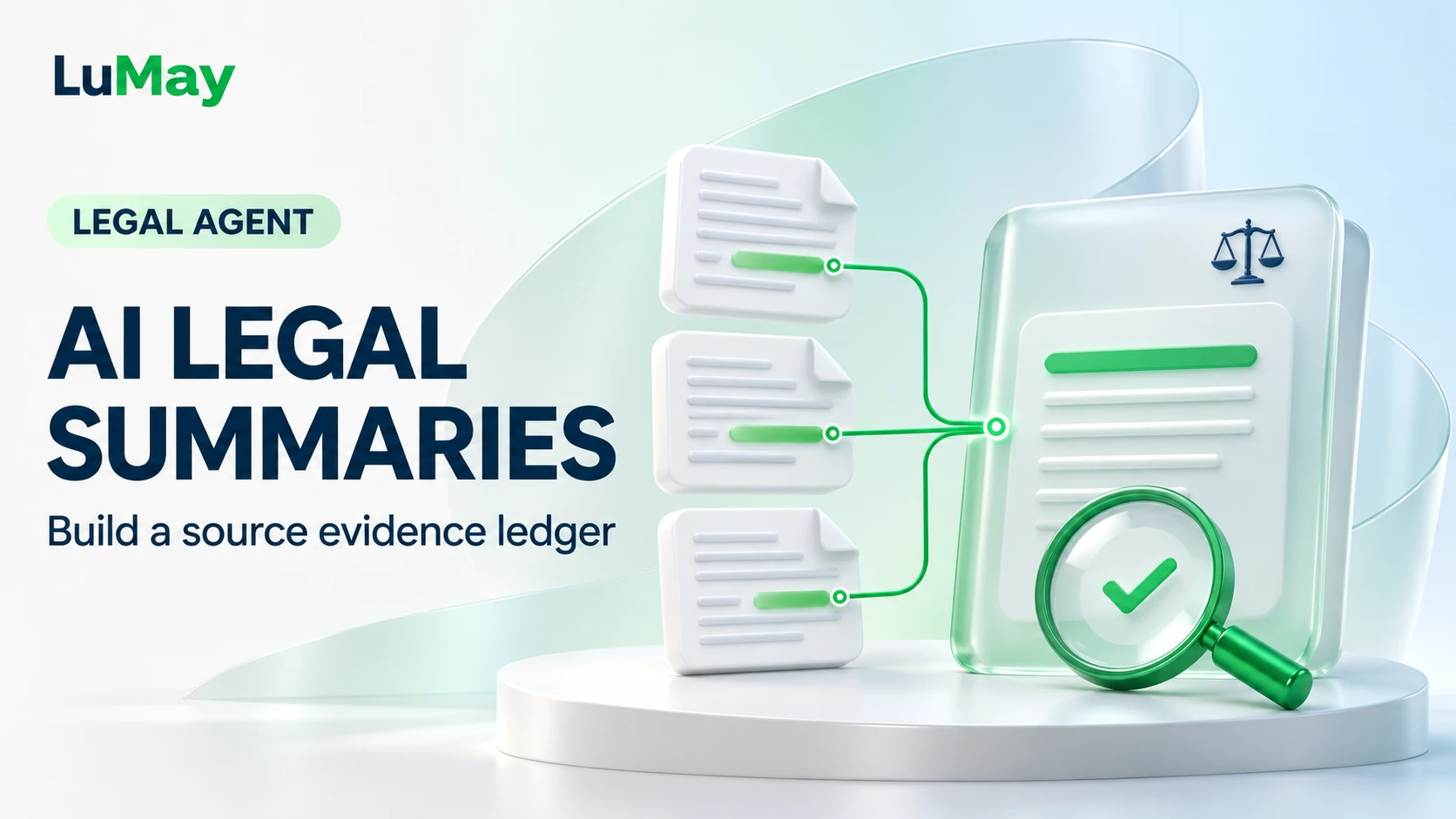
A source evidence ledger connects material statements in an AI legal summary to identifiable documents, versions, and locations. It helps reviewers distinguish what the source states, what the AI inferred, and what remains unresolved. It does not establish admissibility, privilege, or legal correctness.
Start with the reviewer's question
The useful question is: “What source supports this exact statement?” A document-level link may be inadequate when the file has hundreds of pages or multiple versions.
For each material assertion, retain the source ID, version or hash, page or paragraph locator, relevant passage, extraction quality notes, and review status. If a statement depends on several documents, record each relationship rather than choosing one convenient citation.
ABA Formal Opinion 512 discusses competence, confidentiality, and supervision when lawyers use generative AI. The ledger below is a proposed operational aid, not an ABA-prescribed template. Applicable professional rules and matter requirements still need qualified review.
Use a ledger that separates evidence from interpretation
| Field | Purpose |
|---|---|
| Statement ID | Connects the summary sentence to its review record |
| Statement type | Direct source fact, inference, or unresolved issue |
| Source identity and version | Identifies the exact material reviewed |
| Location | Lets a reviewer find the supporting passage |
| Extract or observation | Records what the document actually says |
| Contradiction link | Connects conflicting evidence without hiding it |
| Reviewer and disposition | Shows whether the statement was accepted, corrected, or rejected |
Use restricted references that respect the matter's access rules. A clickable citation is not helpful if it grants broader access than the underlying repository permits.
Handle scanned documents explicitly
An OCR error can change a date, a monetary amount, or the meaning of a qualification. Store the page image reference alongside extracted text so reviewers can inspect uncertain passages.
Do not label a statement verified merely because a retrieval service returned it. Retrieval finds candidate evidence; verification checks whether that evidence supports the wording.
Where the document lacks usable page numbers, define a consistent locator such as an extracted section identifier plus a page-image index. Explain that convention in the review pack.
Illustrative example: one date, two explanations
In a hypothetical commercial dispute, an email says a revised delivery date was “noted.” A later internal memo describes the change as “approved.”
The initial AI draft states that the customer approved the revised date. The ledger connects that sentence to both documents and flags their differing language.
A reviewer changes the summary to describe the email's actual wording and lists approval status as unresolved. Counsel decides its legal significance. The AI does not reconcile the conflict by inventing a stronger factual statement.
This example is illustrative and does not describe a LuMay customer or a legal conclusion.
Keep version changes reviewable
When a source is replaced or corrected, flag statements that depended on it for re-review. Preserve prior review decisions according to the matter's retention requirements rather than silently overwriting the history.
Version the summary as well. A reviewer should be able to identify the document set behind the delivered summary, even if the working repository later changes.
The ledger is a provenance record. It cannot guarantee that a model would produce the same wording again from the same inputs.
Test the ledger before scaling the workflow
Use an authorized or synthetic matter set with known answer locations. Include missing sources, conflicting dates, repeated document names, low-quality scans, and a statement with no supporting passage.
Check whether reviewers can locate evidence and whether unsupported statements remain visibly unresolved. Also test that a user without matter access cannot open the citations.
Avoid treating one confidence score as a review decision. Record what was checked and what changed.
Frequently asked questions
Is one citation enough for a sentence combining several factual claims?
Only if that source supports every material part of the sentence. Otherwise, split the claims or record the additional sources and locations. Reviewers need to see which evidence supports each assertion rather than assume one nearby citation validates the whole paragraph.
What if the supporting document is no longer accessible to the reviewer?
Mark the affected statement as unavailable for verification and route the access or source issue to its owner. Do not broaden matter permissions merely to make a citation open. Re-review the statement before relying on it in consequential work.
How should the ledger handle a statement supported only by uncertain OCR text?
Flag the extraction uncertainty and retain an authorized page-image reference for inspection. A reviewer should compare the material wording with the original image, especially dates, amounts, and qualifications. If the passage remains unreadable, leave the claim unresolved rather than calling it verified.
Does completing the ledger replace a lawyer's review?
No. The ledger organizes evidence and review decisions; it does not decide legal significance or establish that an output is fit for use. The responsible lawyer must apply the relevant professional obligations and matter requirements. ABA Formal Opinion 512 discusses competence and supervision when using generative AI.
Make traceability part of the handoff
Deliver the summary, the ledger, unresolved issues, and source-access instructions together. Assign a responsible reviewer before anyone relies on the output in consequential work.
LuMay's guide to validating AI legal document review addresses broader quality evaluation. For this narrower workflow, evaluate LuMay Legal Agents against your own provenance requirements and approved matter-handling process.