Your voice agent starts a helpful conversation with an answering machine. Elsewhere, a real customer hears silence because the system is still deciding whether anyone answered.
Both failures can come from the same detection setting.
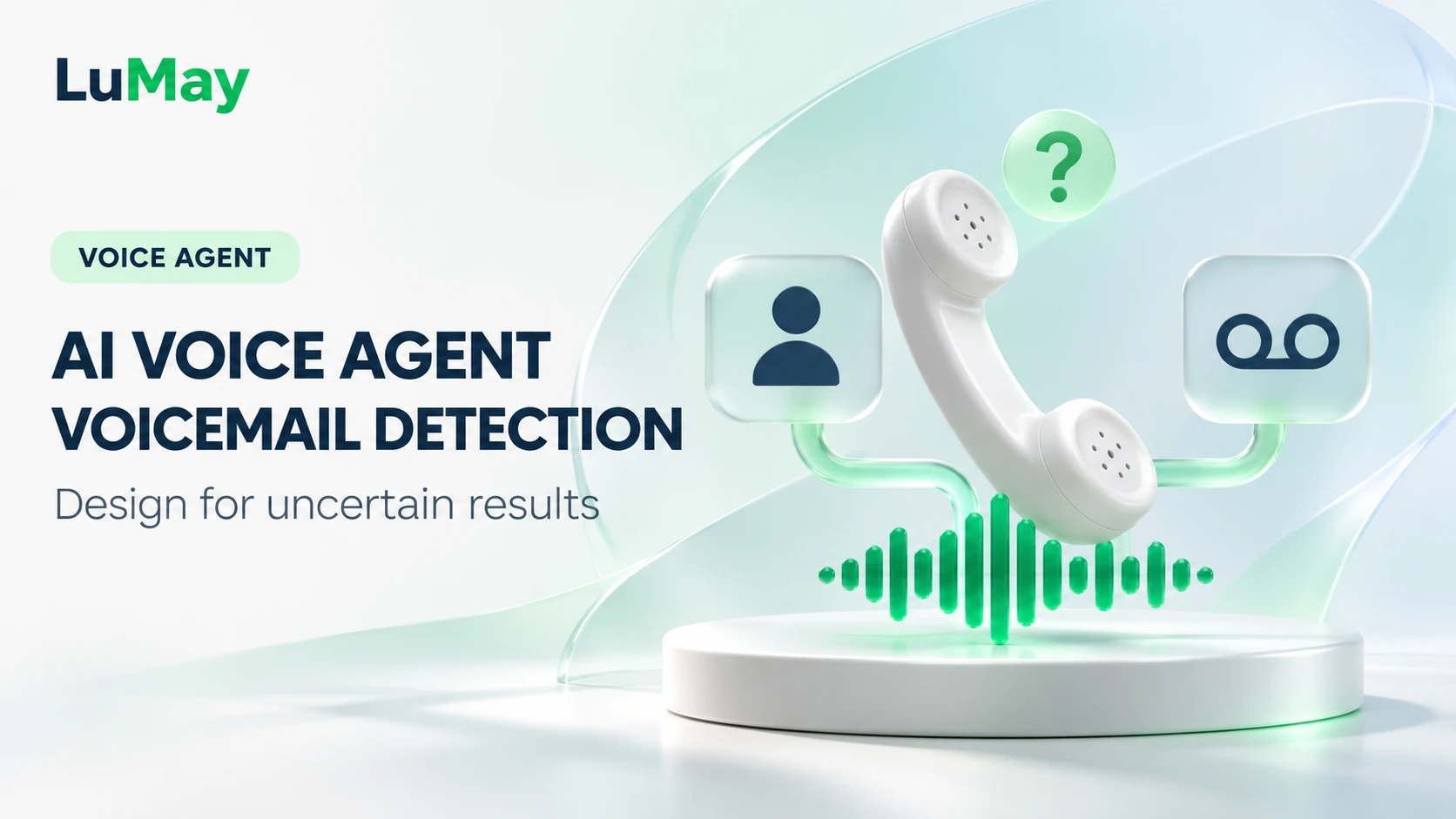
AI voice agent voicemail detection classifies the answering side so the call can follow an appropriate path. It is a probabilistic signal, so a reliable workflow needs explicit human, machine, and unknown branches rather than assuming every connected call reached a person.
Separate connection from conversation
A telephone connection establishes that the call was answered somewhere. It does not establish that a human heard the message, that the intended person answered, or that a business task was completed.
Track these as separate outcomes. Otherwise, a campaign can report strong answer rates while delivering few useful conversations.
For one implementation example, Twilio's answering-machine detection documentation describes human, machine, fax, and unknown results. Its message-end mode distinguishes several ways a machine greeting can end. Those values are provider-specific; map them to your own call states.
Design the branches before adjusting thresholds
The following is a proposed call-control design. Adapt it to the provider and the approved purpose of your outbound calls.
| Detection outcome | Workflow behavior | What the record should say |
|---|---|---|
| Human | Begin the approved introduction and verification | Human classified; recipient not yet verified |
| Machine greeting | Wait for the supported message-end signal, if leaving a message is allowed | Voicemail path selected |
| Unknown | Use a bounded, non-sensitive fallback or end according to policy | Classification unresolved |
| Fax or unsupported destination | End cleanly | Unsupported answering endpoint |
Do not infer identity from a human classification. Verification belongs to a later step.
An asynchronous detection result also needs careful coordination. If the result arrives after dialogue begins or the call ends, the application should not trigger a second greeting or an out-of-context voicemail message.
Give unknown a real operating policy
Unknown is not an error to hide. It means the system lacks a sufficiently resolved classification under its configured conditions.
A reasonable policy might allow a brief neutral introduction, wait for an interactive response, and then continue only through the approved flow. Another business may choose to end unresolved calls and schedule a controlled follow-up. Neither choice should be an accidental fallback in a switch statement.
Twilio documents that detection can misclassify greetings and that shorter observation windows can increase unresolved outcomes. Faster detection and more reliable classification can conflict; choose based on measured caller experience.
Limit what a voicemail can disclose
An answering machine may be shared, replayed to someone else, or attached to a business switchboard. Avoid placing sensitive account details in the message simply because the number matched a CRM contact.
Prepare an approved message with a clear organization identity, a suitable callback route, and only the information appropriate for an unverified listener. Set the message and retry policy with the relevant business, privacy, and legal owners. Detection alone does not establish permission to call or leave a message.
Illustrative example: a service-appointment reminder
A hypothetical maintenance provider calls customers about upcoming visits. A human receives an introduction and can confirm details after the required checks. A detected voicemail receives a neutral callback request. An unknown result does not mark the appointment confirmed.
The scheduler sees distinct dispositions: confirmed by recipient, voicemail attempted, classification unresolved, and no connection. Staff can decide what follow-up each state warrants.
This prevents a technical call status from silently becoming a business confirmation.
Test a varied greeting set
Include short and long voicemail greetings, delayed speech, background noise, business reception greetings, repeated “hello,” and relevant languages. Use authorized test destinations and label the actual answering type.
Measure false-human classifications, false-machine classifications, unresolved results, time to useful speech, and whether messages were cut off. Report results by scenario; one combined accuracy percentage can hide an unacceptable failure pattern.
Review the legal basis and operational rules before any outbound pilot. LuMay's US TCPA checklist is related reading, with current applicability to be confirmed for your campaign.
Frequently asked questions
Is a human detection result enough to disclose account information?
No. It classifies the answering endpoint; it does not verify the person's identity or authority. Continue through the approved recipient-verification process before sharing information that requires it. A matching telephone number alone should not replace that decision.
Should every unknown result trigger another call immediately?
No. Follow the approved retry and contact policy, preserving the unresolved disposition. An automatic immediate redial can repeat a poor experience without improving classification. Choose follow-up behavior with the relevant business and compliance owners rather than using an accidental default.
Can a transcript prove that a voicemail was successfully delivered?
A generated script or transcript does not establish that the recording captured the whole message or that the intended person heard it. Retain the provider's available call evidence and label the outcome precisely. Avoid turning a voicemail attempt into a confirmed business response.
What should happen when the detection result arrives after the call ends?
Record it for reconciliation and diagnostics, but do not initiate dialogue or play a delayed message into a completed session. Apply results only to a compatible call state. Test late callbacks alongside normal greeting cases before relying on asynchronous detection.
Choose a call outcome you can defend
Evaluate LuMay's voice-agent offering against your own greeting set and escalation rules. Confirm provider-specific detection support during scoping rather than assuming a feature from this reference design.
The important result is not whether a call connected. It is whether the system knows what happened and leaves an accurate next action.