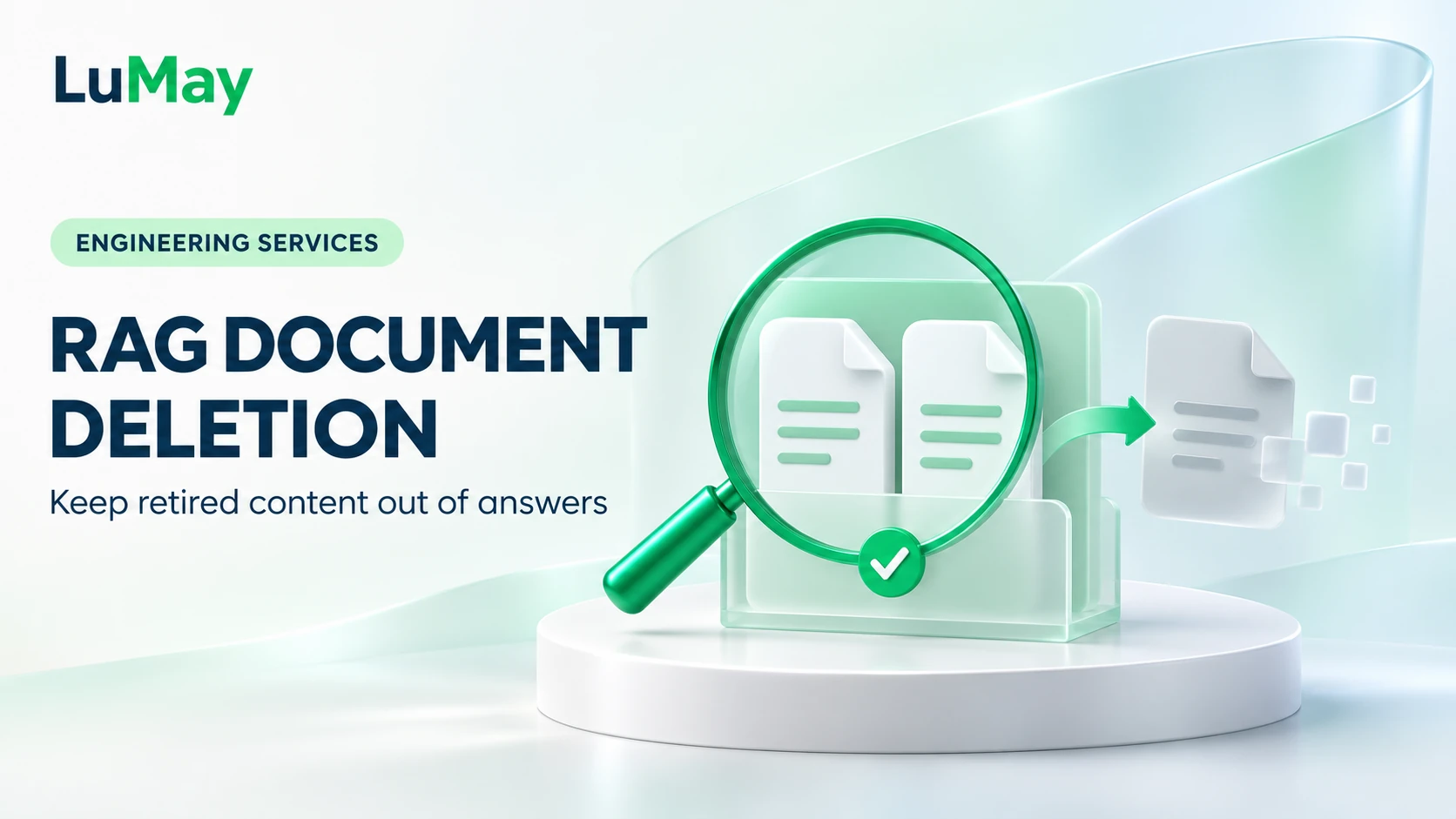
A policy owner deletes an outdated document. The next morning, the company assistant still quotes its old approval limit.
Deleting a source file does not prove that its indexed chunks, cached answers, or stored conversation excerpts disappeared. RAG document deletion needs a lifecycle workflow that connects the original document to the copies your application created.
The practical objective is specific: stop retired material from informing new answers, then handle stored copies according to the organization's retention requirements.
Build a map from the source to its derivatives
Before introducing deletion, establish stable source identifiers. A filename is a weak identity because people rename files and reuse names.
For every indexed unit, retain a source ID, source version, tenant, ingestion batch, and chunk ID. Keep a manifest of the derived chunks and the stores that contain them. Include extracted tables and image descriptions if your pipeline indexes those separately.
This manifest lets an operator answer: “Which records did version three of this policy produce?” Without it, deleting by a loose text match can leave fragments behind or remove unrelated content.
Choose the deletion signal explicitly
Possible triggers include an owner retiring a document, a connector receiving a deletion event, or a synchronization job discovering that a previously indexed source is absent.
Do not treat a temporary access failure as proof of deletion. An unavailable source and a withdrawn source need different responses.
Microsoft's Azure AI Search documentation describes how source deletion can leave orphaned search documents when the applicable deletion-detection process is not followed. The exact mechanism depends on the data source and ingestion approach.
Use a controlled retirement sequence
The following sequence is an engineering recommendation to adapt to your storage and search systems.
- Register retirement. Record the source identity, version, reason, requester, and authorized scope.
- Block new use. Mark the source inactive in an authoritative retrieval check. Confirm that this check covers every retrieval route.
- Remove derived records. Delete the exact chunk IDs, embeddings, and extracted artifacts identified by the manifest.
- Invalidate reusable answers. Evict cache entries with matching provenance. Where provenance is unavailable, use an appropriately broader invalidation strategy.
- Verify and record completion. Test both direct record lookup and application retrieval before closing the task.
The immediate block and the later cleanup serve different purposes. A system can stop serving a record before physical storage reclamation finishes. Report those states separately.
Include conversations and secondary stores
A conversation may already contain a quote from the retired policy. Deleting the search record cannot remove that quote from a user's existing screen.
Decide whether your assistant must flag older conversations, refresh source context on follow-up questions, or stop reusing answers tied to retired content. Define the behavior before promising that a deletion affects every copy.
Logs and backups need separate treatment. Apply the organization's approved retention and legal-hold decisions rather than having the retrieval service delete evidence indiscriminately. This workflow is an operational design, not a universal legal-erasure procedure.
Illustrative example: a purchasing-policy replacement
A hypothetical company replaces policy PUR-04, version two, with version three. The older version produced 18 chunks and two extracted tables.
The retirement job blocks version two, deletes its 20 indexed units, and invalidates answer-cache entries linked to it. It then asks known policy questions under representative user permissions.
The assistant may answer from version three when the new material is sufficient. If it cannot verify the current rule, it should state that limitation instead of reconstructing the old rule from conversation history.
Verify deletion with a negative test set
| Check | Evidence to retain |
|---|---|
| Old chunk IDs cannot be retrieved | Lookup results for the manifest |
| Old-only phrases no longer surface | Retrieval results for targeted queries |
| Cached answers do not return old guidance | Cache invalidation and response checks |
| Other tenants remain unaffected | Isolation regression results |
| A worker restart does not reintroduce content | Re-ingestion and recovery test |
Zero matches for one phrase is not enough. Test alternate questions and filtered retrieval paths, then investigate any remaining reference to the retired version.
Frequently asked questions
Does pausing a connector remove the documents it already indexed?
Do not assume so. Pausing ingestion and retiring previously indexed content are separate operations. Check the connector's documented behavior and explicitly block or remove existing derivatives when the requirement is to stop using them in new answers.
How should deletion work when several documents contain the same passage?
Track provenance for each source relationship. Retiring one source should remove its contribution without indiscriminately deleting material still supported by another authorized, active source. If chunks are shared or deduplicated, account for those relationships before deleting the stored record.
Can a cleanup job report success while a retired answer remains cached?
Yes, if its success condition checks only the search index. Include answer-cache invalidation and application-level retrieval tests in completion criteria. Report retrieval blocking and full derivative cleanup separately so users know what the recorded status actually proves.
What should happen if a retired document is accidentally ingested again?
Check incoming records against the authoritative retirement state before making them retrievable. Investigate whether a stale connector, recovery job, or version mapping reintroduced the material. Keep retirement records and re-ingestion tests in the lifecycle design rather than treating deletion as a one-time command.
Treat deletion as part of ingestion design
Assign a deletion owner, a service target for stopping new use, and a reconciliation job that looks for orphaned records. Measure pending retirement age and failed cleanup tasks.
LuMay's guide to incremental RAG indexing covers the broader update lifecycle. Add retirement tests to that lifecycle before expanding the corpus.