The AI course ends on Friday. On Monday, employees still have questions: Can this document go into the approved tool? Who checks the result? Why does the same prompt work differently on another task?
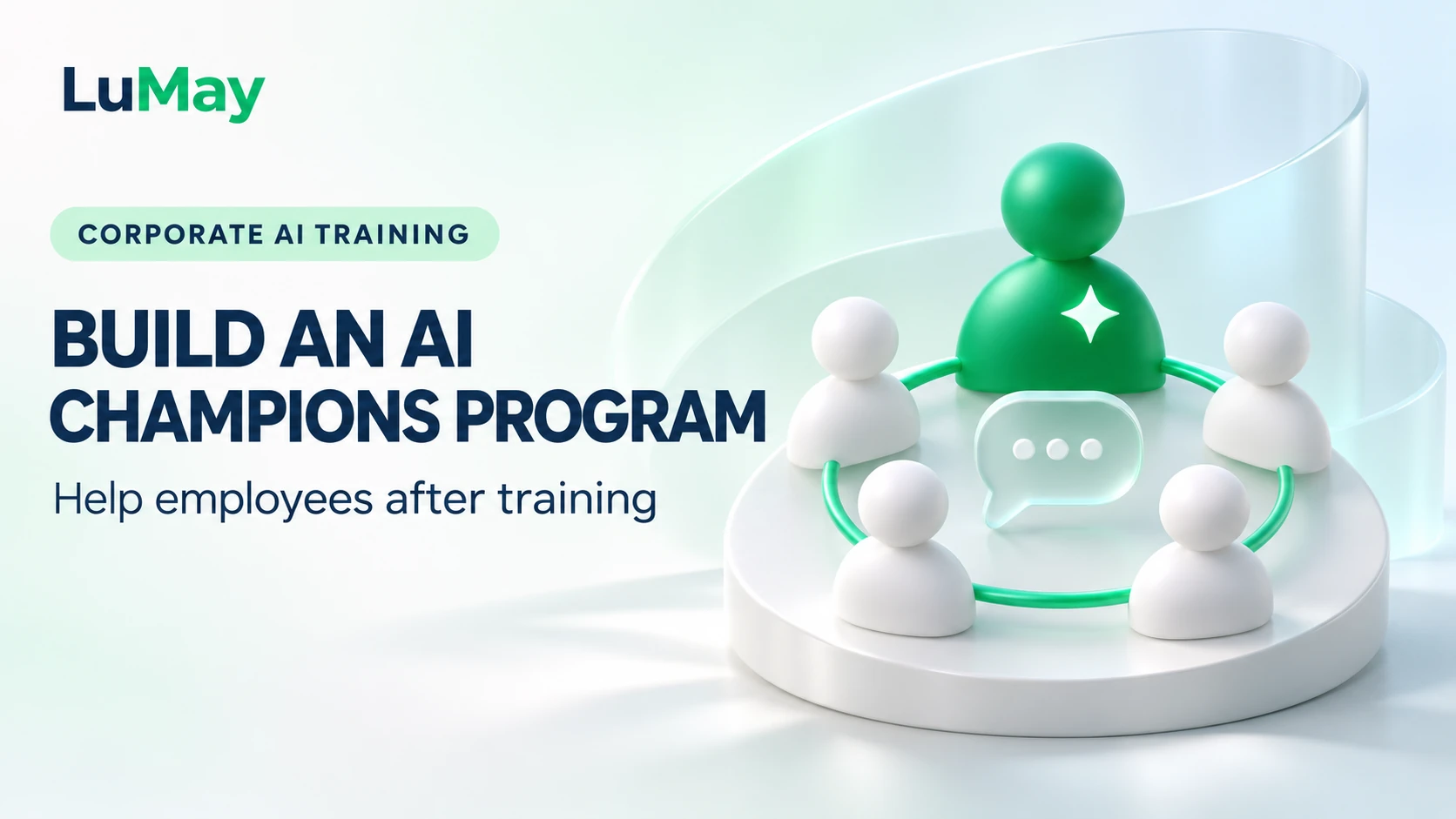
An AI champions program gives employees a local support route after formal training. Champions help colleagues use approved workflows, capture recurring obstacles, and route questions to accountable owners. They should not become an informal authority for security exceptions or high-risk decisions.
Define the support job before selecting people
Choose a small set of responsibilities: demonstrating approved use cases, holding office hours, maintaining examples, and escalating unresolved questions.
Write down what champions cannot approve. Typical boundaries include new vendors, new sensitive-data uses, changes to access controls, and exceptions to business approval rules. The appropriate policy owners retain those decisions.
The NIST AI RMF Playbook emphasizes clear AI risk responsibilities and relevant training. A champions network is one proposed support model for an organization; it is not a substitute for governance ownership or a mandated NIST structure.
Select for workflow knowledge and willingness to ask
The most enthusiastic AI user is not automatically the best champion. Look for people who understand the team's work, can explain limitations clearly, and will escalate uncertainty instead of inventing an answer.
Include operational teams as well as technical teams. Allocate time for the role and obtain manager support. A program dependent on unpaid extra work will struggle to maintain examples and follow through on questions.
Train champions on the organization's actual approved tools and escalation routes. Public prompting advice alone will not answer questions about internal data or delegated authority.
Give every question a destination
| Question | Champion's role | Accountable destination |
|---|---|---|
| How do I use an approved workflow? | Demonstrate and share an example | Workflow owner if unresolved |
| May I use this sensitive document? | Explain the relevant published rule | Privacy/security owner for ambiguity |
| The output is wrong | Help document a safe reproduction | Product or process owner |
| Can we connect a new system? | Capture the business need | IT and integration owners |
| A possible data exposure occurred | Direct prompt reporting | Existing incident-response channel |
Set an escalation acknowledgment target appropriate to the business. Do not promise resolution times that the responsible teams have not agreed to meet.
Run office hours around real questions
Ask participants to submit a task description and a sanitized example in advance. Group similar issues so a session produces reusable guidance rather than a series of disconnected demonstrations.
A useful session ends with a corrected example, a clarified instruction, or a named open question. Avoid displaying live customer records simply to make the demonstration realistic.
Keep a question register with the workflow, issue category, assigned owner, next action, and status. Separate sensitive incident details into the organization's restricted process rather than a widely accessible training tracker.
Illustrative example: an operations team
A hypothetical distribution team uses AI to draft supplier follow-up emails. Staff repeatedly ask whether internal purchase notes may be included.
The champion does not create a new data rule. They escalate the question, obtain approved guidance, and update a sanitized example showing permitted inputs and the required review step.
The next office-hours session demonstrates that example. Employees receive a consistent answer, and the policy owner can see which part of the workflow caused confusion.
Pilot the operating model before expanding it
An illustrative four-week pilot could work as follows: define responsibilities and owners in week one; train champions on a few approved tasks in week two; run supported office hours in week three; and review unresolved questions and reusable guidance in week four.
Use the pilot to assess whether champions have enough time, whether questions reach the right owner, and whether published examples remain accurate. The schedule is a planning example, not a standard duration or promised implementation timeline.
Frequently asked questions
Can a champions program start without a dedicated full-time role?
It can be piloted with an explicitly allocated portion of existing roles, provided managers agree to the workload and coverage. Start with a manageable set of approved workflows. Expand only when the support demand and unresolved-question register justify more capacity.
Does an AI champion need to be the team's technical expert?
Not necessarily. Workflow knowledge, clear explanations, and reliable escalation are central to the role. Technical issues still need an accountable technical owner. A champion should know when to ask for help rather than improvise answers about security, integrations, or policy.
How should a champion handle a question containing customer or employee information?
Use the organization's approved restricted support route and minimize the information shared. Do not copy sensitive examples into a general training register or public AI tool. Keep reusable guidance sanitized and route possible exposures through the existing incident process.
What happens when a champion changes roles or leaves the company?
Assign a replacement or temporary owner, transfer open questions through approved access controls, and update the support directory. Keep examples and escalation routes in a maintained team resource so the program does not depend on one person's private notes.
Measure support quality
Track recurring questions resolved, time to owner acknowledgment, examples updated after tool or policy changes, and workflows blocked by missing access or unclear rules.
Do not judge champions by prompt volume or how many tasks they encourage employees to automate. A valuable contribution may be identifying a workflow that should remain manual until its controls improve.
Connect support activity with your corporate AI training scorecard, while keeping policy authority with its owners. Use LuMay AI Learning Labs to discuss practice sessions and support needs. A course can introduce the skills; the champions program helps teams apply them with a dependable route for help.