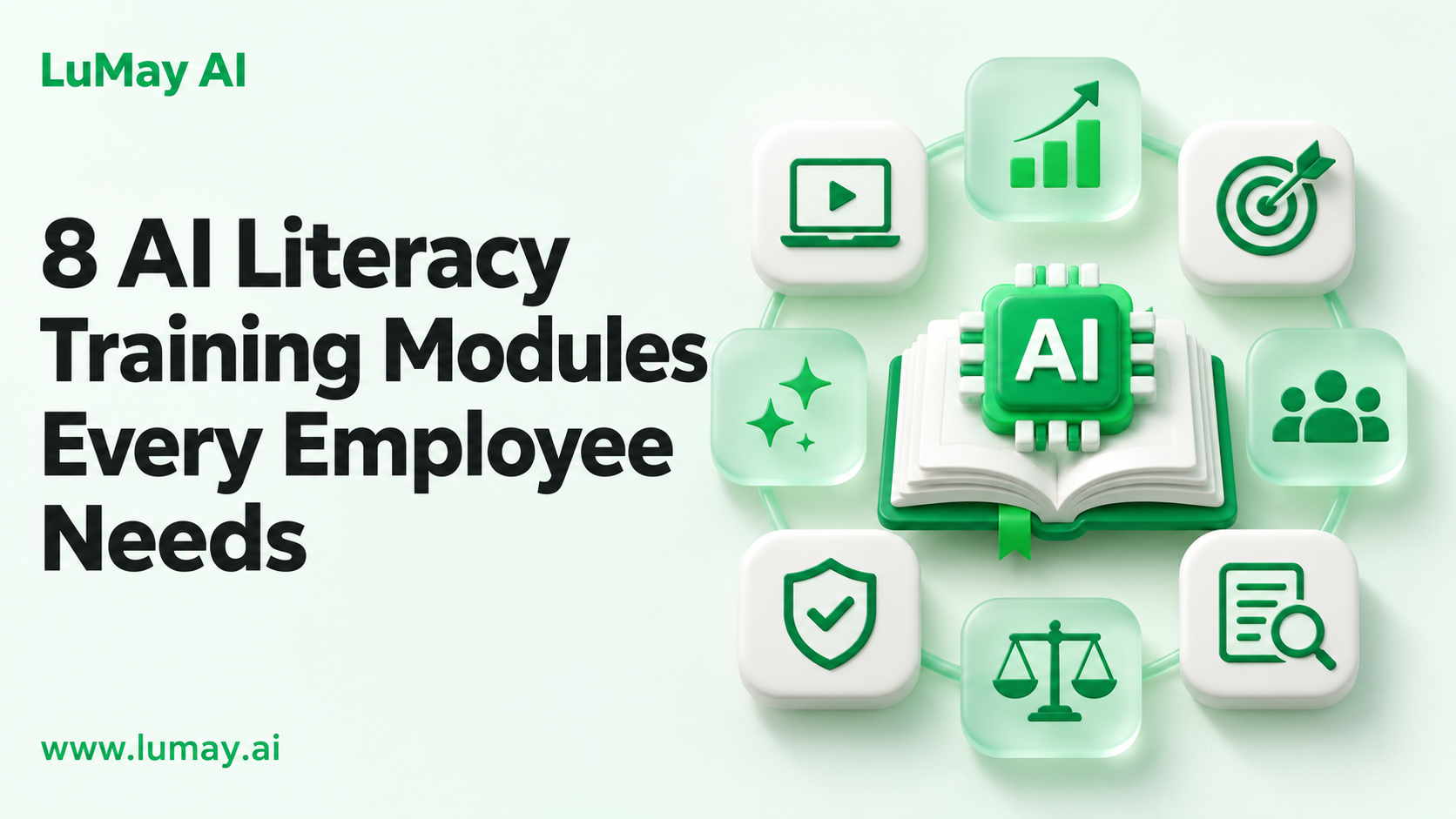
An employee AI literacy program should cover eight modules: AI basics, limits and errors, safe data use, prompting, verifying outputs, approved tools and policy, role-specific practice, and escalation. Tailor depth by role and measure applied skill, not just completion.
This list describes training content, not providers or courses.
How We Evaluated
We chose modules using consistent criteria, drawn from official sources read on 3 November 2026:
• Regulatory relevance: alignment with EU AI Act Article 4 on AI literacy
• Risk coverage: links to risks in the NIST AI Risk Management Framework
• Practical use: whether employees can apply it in daily work
• Measurability: whether progress can be assessed
Why AI Literacy Matters Now
Article 4 of the EU AI Act requires providers and deployers of AI systems to take measures to ensure a sufficient level of AI literacy among staff, taking into account their knowledge and the context of use. It applies from 2 February 2025.
The European Commission's AI literacy questions and answers explains it does not mandate a certificate. Get legal advice on how it applies to you.
The Eight Modules at a Glance
| Module | Core outcome | Suggested audience |
|---|---|---|
| AI basics | Explain what generative AI does | All staff |
| Limits and errors | Spot hallucination and bias | All staff |
| Safe data use | Know what never to paste in | All staff |
| Prompting | Write clear, structured requests | All AI users |
| Verifying outputs | Check facts, sources and numbers | All AI users |
| Tools and policy | Use approved tools correctly | All staff |
| Role-specific practice | Apply AI to real tasks | By function |
| Escalation and reporting | Raise incidents and concerns | All staff |
1. AI Basics
Explain, in plain terms, what large language models do: predict likely text from patterns. Cover the difference between chat assistants, copilots and agents.
2. Limits and Errors
Show real examples of confident wrong answers, outdated facts and biased outputs. Employees should expect errors and know the tasks where errors matter most.
3. Safe Data Use
Define what must never be entered into unapproved tools: customer personal data, confidential contracts, credentials and source code under restriction. Use your data classification scheme. The OWASP Top 10 for LLM Applications covers sensitive information disclosure.
4. Prompting
Teach a simple structure: role, task, context, constraints and output format. Practice improving a weak prompt into a clear one.
5. Verifying Outputs
Teach checks for facts, numbers, citations and code. Set a rule: the employee who uses the output owns its accuracy.
6. Approved Tools and Policy
Cover which tools are approved, for what data, and your acceptable use policy. Explain why shadow AI creates risk.
7. Role-Specific Practice
Apply AI to real tasks per function:
• Sales: account research and email drafts
• Finance: variance commentary with checked figures
• HR: job description drafts reviewed for bias
• Support: reply drafts grounded in the knowledge base
○ ➤ Use real but sanitized work samples
8. Escalation and Reporting
Show how to report incidents, such as data pasted into the wrong tool or harmful outputs, and who to ask for help.
Illustrative Example: A 500-Person Rollout
Illustrative example. A services firm runs modules 1 to 6 as a 90-minute online session for all staff, then two-hour role workshops for module 7. A short scenario quiz checks safe data use and verification before tool access is granted.
Our own product. LuMay Academy offers role-based AI tracks using a Learn, Practice, Implement approach. It is not ranked or compared here. See LuMay Academy.
How to Measure Progress
• Knowledge: scenario quizzes on data use and verification
• Behavior: reduction in policy breaches and unapproved tool use
• Application: tasks completed with AI and checked by managers
• Records: keep training records as evidence of literacy measures
Related reading: how to build an AI upskilling plan.
Common Mistakes to Avoid
• One generic video for everyone: ignores role and risk differences
• Completion as the only metric: does not show applied skill
• No policy link: training must match your approved tools
• One-off sessions: tools change, so refresh content regularly
Limitations
This is general guidance, not legal advice on the EU AI Act. Module content should match your tools, policies and risks. Not verified: any claim that a specific module set satisfies Article 4.
Next Step
If you want a role-based AI literacy program for your teams, LuMay Academy can help plan tracks from basics to applied practice.
Frequently Asked Questions
Q1: What is AI literacy training?
A: Training that gives employees the skills and knowledge to use AI safely and effectively in their roles.
Q2: Is AI literacy training required by law?
A: EU AI Act Article 4 requires providers and deployers to take AI literacy measures. Get legal advice for your situation.
Q3: Does Article 4 require a certificate?
A: The European Commission's Q&A says no certificate is required. Keeping records is still sensible.
Q4: How long should AI literacy training take?
A: Not verified as a fixed time. Many programs combine a short core session with role workshops.
Q5: Should everyone get the same training?
A: Core modules can be shared; depth and practice should vary by role and risk.
Q6: What is the most important module?
A: Safe data use and verifying outputs usually address the biggest risks.
Q7: How do we measure AI literacy?
A: Use scenario quizzes, observed behavior and checked work tasks, not only completion rates.
Q8: How often should training be refreshed?
A: When tools or policies change, and at least annually.
Q9: Who should own the program?
A: Usually a partnership between HR or L&D, IT, legal and business leaders.
Q10: Does this list rank training providers?
A: No. It lists modules. LuMay Academy is disclosed separately and not ranked.
Q11: Can AI literacy reduce shadow AI?
A: It can help when combined with approved tools and a clear policy.
Sources
• EU AI Act Article 4, AI literacy
• European Commission AI literacy questions and answers