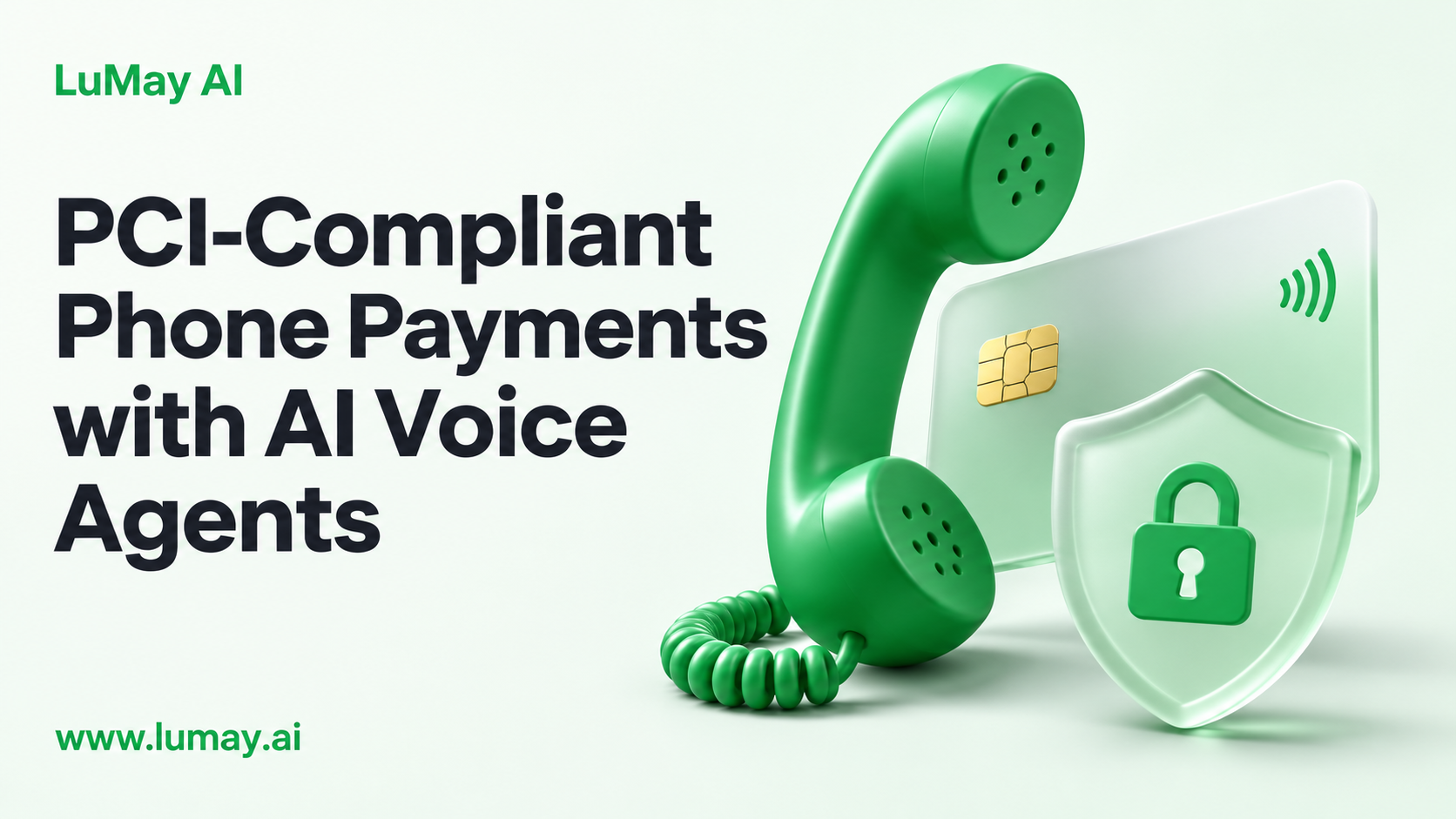
The safest way to take card payments in an AI voice agent call is to keep card data away from the AI entirely.
Hand the caller to a secure payment capture step, usually keypad (DTMF) entry with a PCI-validated provider, and return only a token and result to the agent.
This guide explains the design. It is not a compliance assessment; confirm scope with your Qualified Security Assessor (QSA) and acquirer.
Why the AI Should Never Hear the Card Number
If a caller speaks a card number, it can pass through speech recognition, the language model, transcripts, logs and recordings. Each of those systems may then fall into PCI DSS scope.
Keeping card data out of the AI path is a design choice that can reduce scope. The PCI Security Standards Council document library holds the current standard and guidance.
Reference Design
| Stage | What happens | Card data present? |
|---|---|---|
| Conversation | Agent confirms identity and amount | No |
| Handoff | Agent starts secure capture | No |
| Capture | Caller enters digits on keypad; provider captures them | Yes, within provider |
| Tokenize or charge | Provider sends to gateway | Yes, within provider |
| Return | Agent receives result, token and last 4 digits | No |
| Wrap-up | Agent confirms payment outcome | No |
Step 1: Use a Secure Capture Service
Programmable voice platforms offer capture services. For example, Twilio Pay collects card details by DTMF and sends them to a payment connector. Twilio documents that it can tokenize or charge, and returns limited details such as the last four digits.
Check each provider's current PCI attestation and what it covers.
Step 2: Mask DTMF Tones
Keypad tones can be decoded from recordings. Use capture that suppresses or masks tones so agents, recordings and the AI never receive them.
Step 3: Pause or Exclude Recording and Transcription
Stop recording, transcription and AI audio streaming during capture, or confirm your provider handles this automatically. Test it, then check sample recordings.
Step 4: Handle Spoken Card Numbers
Some callers will read their number aloud. Plan for it:
• Prompt clearly: "Please use your keypad. Do not say your card number."
• Detect and redact: apply number-pattern redaction to transcripts and logs
• Do not store raw audio of the payment segment where avoidable
• Escalate callers who cannot use a keypad to an approved alternative
Our guide on PII redaction for LLM applications covers detection patterns.
Step 5: Return Only Safe Data to the Agent
The agent should receive payment status, a token or reference, amount and last four digits only. Never pass the full number, expiry or security code to the model or CRM.
Step 6: Log and Monitor
Log handoff start, capture result, retries and failures without card data. Alert on failed captures and unusual retry patterns.
Worked Example: Utility Bill Payment Call
Illustrative example. A utility's voice agent handles bill payment calls.
• Conversation: agent verifies the account and reads the balance
• Handoff: "I'll connect you to secure payment. Please enter your card number on your keypad."
• Capture: the telephony provider's secure capture tokenizes the card with the gateway
• Return: agent receives "success, ending 4242, reference ABC123"
• Wrap-up: agent confirms and offers a text receipt
Recordings and transcripts show a gap during capture, verified in weekly sample checks.
What to Confirm with Your QSA
• Which systems remain in scope with this design
• Whether your capture provider's attestation covers your use
• Recording, transcription and log handling during capture
• Requirements for staff who can access call data
• Compensating controls for spoken card numbers
Common Mistakes to Avoid
• Letting the AI collect digits: brings STT, LLM and logs into scope
• Forgetting transcripts: recording is paused but transcription is not
• Storing full payloads in CRM notes: keep only token and last four
• No fallback: callers without keypads need another approved route
Limitations
PCI DSS scope depends on your full environment. This guide does not certify compliance. LuMay does not claim PCI DSS certification; payment capture relies on your chosen validated provider.
Next Step
If you want a voice agent that takes payments without card data reaching the AI, the Voxentis voice agent team can design the handoff with your telephony and payment providers.