



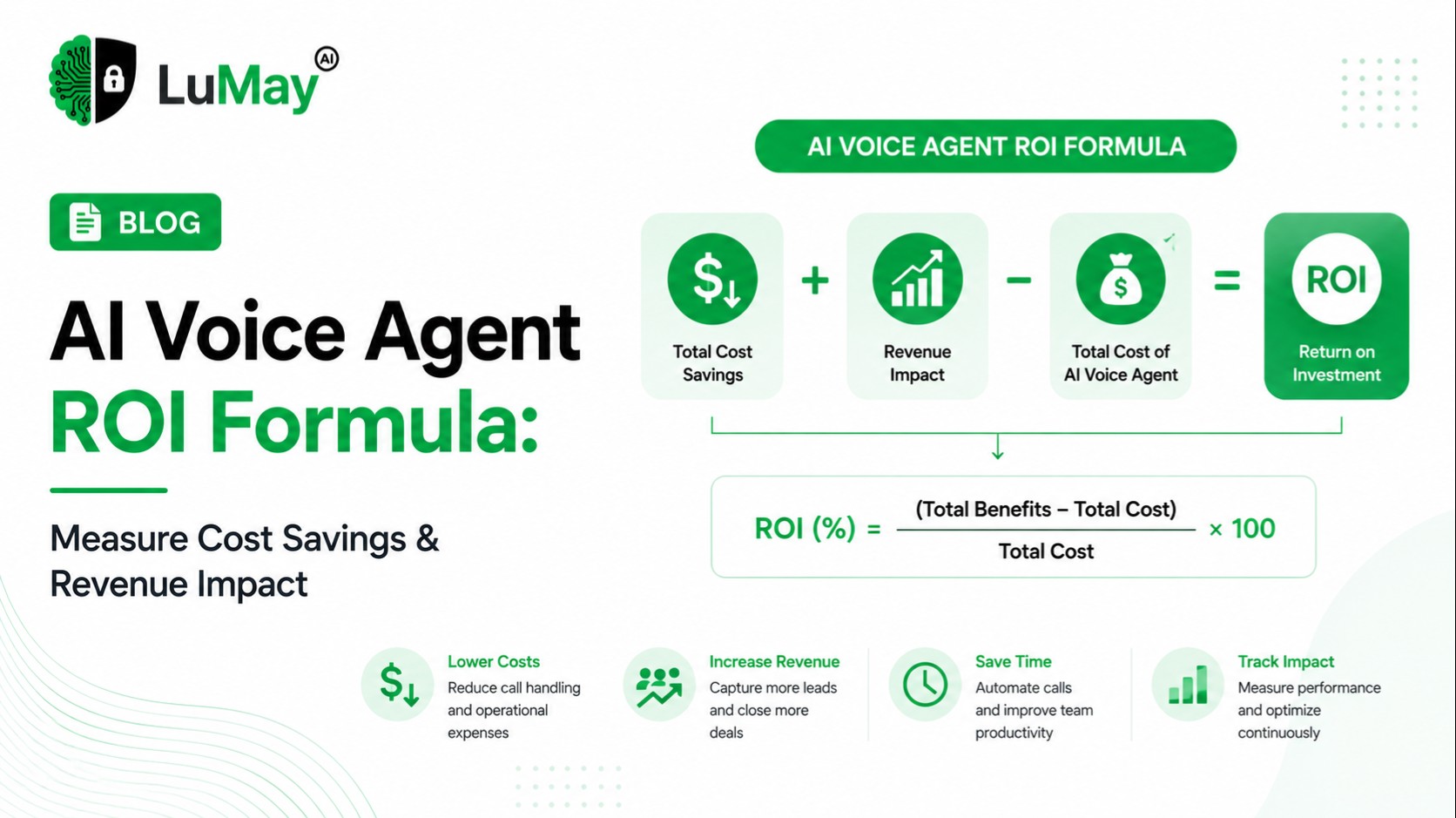
Enterprise leaders recognize that conversational AI is no longer just a novelty—it is a critical driver of operational efficiency. As customer expectations rise and macroeconomic pressures force companies to do more with less, deploying the right AI Voice Agent has become a strategic necessity. However, justifying the investment requires more than anecdotal success stories; it demands rigorous financial modeling.
This guide breaks down the comprehensive AI Voice Agent ROI Formula, providing operations directors, CIOs, and revenue leaders with the exact frameworks needed to measure cost savings, project revenue impact, and prove business value in 2026.
What Is AI Voice Agent ROI?
Understanding AI Voice Agent Business ROI goes beyond merely looking at the replacement of human labor. True ROI encapsulates a holistic business value transformation.
Cost Reduction: Lowering the cost-per-call, reducing hiring and training overhead, and minimizing infrastructure costs.
Revenue Impact: Capturing missed opportunities through 24/7 availability, automating lead qualification, and increasing appointment booking rates.
Productivity Gains: Freeing up human agents from repetitive Tier 1 support queries so they can handle complex, high-value escalations.
Customer Experience Improvements: Eradicating hold times, offering instant resolutions, and standardizing service quality.
When evaluating a powerful AI agent platform, these four pillars dictate the financial outcome.
Why Measuring AI Voice Agent ROI Matters
Deploying generative AI within contact centers is a significant technological shift. According to recent McKinsey reports on AI economics, organizations that rigorously measure AI performance achieve significantly higher success rates in their digital transformation initiatives. Measuring AI Call Automation ROI is critical for several reasons:
Budget Justification: CFOs require hard numbers. Demonstrating a clear payback period secures the initial capital and operational expenditure approvals.
Executive Reporting: Continuous measurement proves the value of the investment to the board of directors and justifies expanding the technology to other departments.
Technology Investment Decisions: Not all platforms are equal. Comparing the projected ROI helps businesses choose between vendors, such as assessing a detailed LuMay Voice Agent Review against competitors.
Customer Support Optimization: Tracking the financial metrics of call deflection reveals exactly how much money is saved per resolved ticket.
Sales Automation: For outbound use cases, measuring ROI per lead contacted validates the effectiveness of AI in the revenue pipeline.
AI Voice Agent ROI Formula Explained
To accurately determine the Voice AI Return on Investment, businesses must apply the standard ROI calculation, adapted for conversational AI deployments.
The baseline formula is:
$$ROI (\%) = \left(\frac{\text{Total Benefits} - \text{Total Costs}}{\text{Total Costs}}\right) \times 100$$
To apply this to an AI Voice Agent, we must break down the variables mathematically.
Total Benefits Breakdown
Let $B$ represent Total Benefits.
$$B = S_L + R_I + S_O$$
Where:
$S_L$ = Labor Savings: (Human Cost per Call $\times$ Number of Calls Deflected) + Savings on hiring, benefits, and training.
$R_I$ = Revenue Increase: Additional revenue generated from answered after-hours calls, increased lead qualification, and faster speed-to-lead.
$S_O$ = Operational Savings: Reductions in telephony infrastructure, software seat licenses for CRM, and lower turnover costs.
Total Costs Breakdown
Let $C$ represent Total Costs.
$$C = C_T + C_I + C_M$$
Where:
$C_T$ = Technology Costs: Platform subscriptions, LLM processing costs (OpenAI, Anthropic), Speech-to-Text (Deepgram), Text-to-Speech (ElevenLabs), and telephony minute costs (Twilio).
$C_I$ = Implementation Costs: Initial setup, conversational design, CRM integrations (Salesforce, HubSpot), and data preparation.
$C_M$ = Maintenance Costs: Ongoing prompt tuning, system updates, and API monitoring.
Table 1: ROI Formula Inputs Breakdown
Variable Category | Component | Description |
Benefits (+) | Labor Savings | Reduction in human staffing requirements and overtime pay. |
Benefits (+) | Revenue Gains | Income from AI-booked appointments or recovered abandoned calls. |
Benefits (+) | Infra Savings | Reduced per-seat software licensing (Zendesk, Salesforce). |
Costs (-) | Platform Fees | Base subscription for the Voice AI provider. |
Costs (-) | Usage Fees | Per-minute costs for LLM inference, TTS, STT, and SIP trunks. |
Costs (-) | Setup & Ops | One-time integration costs and ongoing AI management. |
To understand how pricing affects this formula, review the comprehensive LuMay Voice Agent Pricing Guide.
Complete Cost Components of AI Voice Agents
Accurate ROI measurement requires full transparency into the Total Cost of Ownership (TCO). Many businesses fail to account for hidden usage fees. Here is a comprehensive breakdown.
Table 2: Complete Cost Breakdown of AI Voice Operations
Cost Component | Type | Description |
Platform Subscription | Fixed Monthly | Access to the AI platform, builder tools, and analytics dashboards. |
Telephony / SIP | Variable | Telecom carrier fees (e.g., Twilio) per minute for inbound/outbound legs. |
LLM Inference | Variable | Cost per token to generate responses using advanced models (GPT-4o, Claude 3.5). |
Speech-to-Text (STT) | Variable | Cost to transcribe user audio into text in real-time. |
Text-to-Speech (TTS) | Variable | Cost to synthesize the AI's text responses into lifelike human audio. |
Implementation | One-Time CapEx | Costs associated with onboarding, custom prompt engineering, and setup. |
CRM Integrations | Fixed / Setup | Connecting the agent to Salesforce, HubSpot, or custom databases. |
Training & Tuning | Ongoing | Human-in-the-loop oversight to improve accuracy and handle edge cases. |
Code snippet
graph TD;
A[Total Voice AI Costs] --> B(Fixed Costs)
A --> C(Variable Costs)
A --> D(One-Time Costs)
B --> B1(Platform Subscription)
B --> B2(Dedicated Phone Numbers)
C --> C1(Telephony Per Minute)
C --> C2(LLM Token Usage)
C --> C3(STT/TTS API Costs)
D --> D1(CRM Integration)
D --> D2(Initial Knowledge Base Setup)
To optimize these costs, choosing a platform with transparent economics is vital. Review the Voice Agent Pricing to establish your baseline.
Revenue Drivers That Increase ROI
While cost reduction is the most immediate benefit, the true scale of AI Voice Automation ROI comes from revenue generation.
More Answered Calls: Humans miss calls during peak times, lunches, and after-hours. An AI agent guarantees a 100% answer rate, capturing leads that would have otherwise gone to a competitor.
Faster Response Times: Speed-to-lead is critical. An Outbound Voice Agent can call web leads within 30 seconds of a form submission, drastically increasing conversion rates.
Appointment Booking: Direct integration with calendars enables the AI to lock in revenue-generating meetings instantly without human bottlenecks.
Lead Qualification: AI can run through discovery questions, scoring leads and transferring only high-value, qualified prospects to human sales closers.
Reduced Churn: Instant, empathetic Inbound Voice Agent support resolves issues faster, improving CSAT and preventing customer cancellation.
AI Voice Agent ROI Calculator
To evaluate your business case, you can build an internal calculator using these specialized formulas.
Table 3: Reusable ROI Calculator Formulas
Metric | Formula (LaTeX logic) | Purpose |
Cost Per Call (CPC) | $$CPC = \frac{\text{Monthly Platform Cost} + (\text{Minutes} \times \text{Per Minute Rate})}{\text{Total Calls}}$$ | Determines the exact operational cost of a single AI interaction. |
Labor Savings (LS) | $$LS = (\text{Human CPC} - \text{AI CPC}) \times \text{Automated Calls}$$ | Quantifies the direct payroll/operational savings. |
Revenue Impact (RI) | $$RI = \text{New Appointments} \times \text{Conversion Rate} \times \text{Avg Deal Size}$$ | Projects the top-line growth driven by the AI. |
Payback Period | $$PP = \frac{\text{Total Implementation Costs}}{\text{Monthly Net Savings}}$$ | Calculates how many months until the project breaks even. |
Note: Achieving accurate formulas requires understanding the technical limits. Explore how fast processing impacts call length by reading about Low-Latency AI Voice.
Illustrative ROI Dataset (2026 Example)
To conceptualize the financial impact, here is an original, illustrative dataset demonstrating the projected ROI across three distinct business sizes.
Disclaimer: The following dataset is illustrative for 2026 and intended for modeling purposes only.
Table 4: Illustrative ROI Dataset (2026 Example)
Metric | Small Business | Mid-Market | Enterprise |
Monthly Call Volume | 2,500 | 15,000 | 100,000 |
Avg. Human Cost Per Call | $4.50 | $5.20 | $6.00 |
Avg. AI Cost Per Call | $0.25 | $0.18 | $0.12 |
Monthly Human Staffing Cost | $11,250 | $78,000 | $600,000 |
Monthly AI Operating Cost | $625 | $2,700 | $12,000 |
Direct Monthly Labor Savings | $10,625 | $75,300 | $588,000 |
Monthly Revenue Increase | $3,000 | $22,000 | $150,000 |
Total Monthly Benefit | $13,625 | $97,300 | $738,000 |
Estimated Implementation Cost | $1,500 | $8,500 | $45,000 |
First Year ROI % | 1,068% | 1,363% | 1,957% |
Payback Period | 0.11 Months | 0.08 Months | 0.06 Months |
These aggressive payback periods illustrate why AI voice adoption is accelerating so rapidly.
Industry ROI Benchmarks
The impact of AI Voice Agent Cost Savings varies significantly by industry based on call duration, urgency, and the value of a conversion.
Table 5: Illustrative Industry Benchmarks (2026)
Industry | Primary Use Case | Key ROI Driver | Est. Cost Reduction | Est. ROI % |
Real Estate | Speed-to-lead, property inquiries | Revenue (Lead conversion) | 40% | 280% |
Healthcare | Appointment scheduling, triage | Cost (Admin labor savings) | 65% | 190% |
SaaS | Tier 1 tech support, billing | Cost (Ticket deflection) | 55% | 220% |
Home Services | Dispatching, emergency calls | Revenue (After-hours capture) | 35% | 310% |
Financial Services | Fraud alerts, account balance | Cost (Call containment) | 70% | 250% |
For specific industry applications, such as property management, view the guide on the Best AI Calling Solutions for Real Estate and the Top Voice Agents for Real Estate.
KPIs to Track for AI Voice ROI
Financial ROI is a lagging indicator. To ensure you hit your financial targets, you must track the leading operational Key Performance Indicators (KPIs).
Table 6: Executive Reporting Metrics & KPIs
KPI | Definition | Impact on ROI |
Call Deflection Rate | % of total calls resolved by AI without human escalation. | High deflection directly equates to labor cost savings. |
Average Handle Time (AHT) | Average duration of the call. | Lower AHT reduces per-minute API and telephony costs. |
First Call Resolution (FCR) | % of issues solved on the first interaction. | High FCR prevents expensive follow-up calls and boosts CSAT. |
Lead Conversion Rate | % of outbound calls resulting in a qualified lead/meeting. | Directly drives the "Revenue Increase" portion of the ROI formula. |
Missed Call Reduction | Decrease in unanswered inbound calls. | Captures lost revenue from frustrated customers going to competitors. |
Escalation Rate | % of calls transferred to a human agent. | High escalation means the AI knowledge base needs tuning to prevent wasted AI minutes. |
AI Voice Agent vs Human Contact Center ROI
While AI delivers unmatched operational economics, the highest ROI is achieved through a hybrid approach: AI handles the volume, and humans handle the complexity.
Table 7: Human vs AI Contact Center Comparison
Feature/Metric | Human Contact Center | AI Voice Agent |
Staffing Costs | High (Salaries, benefits, taxes) | Low (Software subscription + usage) |
Scalability | Slow (Weeks to hire/train) | Instant (Spin up 1,000s of concurrent calls) |
Availability | Shift-dependent (Usually 8x5) | 24/7/365 without overtime pay |
Consistency | Variable (Subject to fatigue/mood) | 100% Consistent script adherence |
Multilingual Support | Requires diverse, expensive hiring | Instant, fluent translation across languages |
Complex Empathy | High (Best for nuanced escalations) | Improving, but best for structured tasks |
Best-Fit Use Case | High-ticket sales, complex disputes | Triage, FAQs, scheduling, initial outreach |
How LuMay AI Helps Maximize ROI
Visual Asset Recommendation
Image Filename: lumay-platform-roi.webp
Alt Text: The LuMay AI platform interface showing workflow automations and integrations.
Caption: LuMay AI is engineered specifically to drive enterprise ROI.
Achieving the numbers modeled in the formulas above requires an enterprise-grade platform. LuMay AI is architected to maximize ROI by eliminating the hidden costs of poor conversational design and high-latency models.
Table 8: LuMay AI Features & ROI Impact
LuMay Capability | How It Maximizes ROI |
Low-Latency Architecture | Sub-second response times prevent user drop-off, increasing successful resolutions. |
Native CRM Integrations | Connects to Salesforce/HubSpot effortlessly, reducing developer implementation costs. |
Unified Platform | Combines both Inbound and Outbound agents, lowering total software vendor sprawl. |
Managed AI Services | Reduces internal IT headcount requirements by utilizing LuMay's AI engineering team. |
By utilizing the full LuMay Platform and its extensive Voice Agent Features, enterprises can optimize their $C_T$ (Technology Costs) while maximizing $B$ (Total Benefits). To see real-world results, review a LuMay Case Study.
Furthermore, for organizations needing comprehensive oversight, LuMay's AI Engineering Lifecycle Management ensures that models are continuously tuned for optimal financial performance.
Implementation Checklist
Code snippet
graph LR;
A[Phase 1: Baseline] --> B[Phase 2: Build & Integrate]
B --> C[Phase 3: Pilot Deployment]
C --> D[Phase 4: Optimization]
D --> E[Phase 5: Scale]
Table 9: Implementation Timeline & Checklist
Phase | Tasks | Risk Assessment / Mitigation |
1. Preparation | Define business goals, calculate current human cost per call baseline, gather historical call recordings. | Risk: Lack of baseline data. Fix: Run analytics on PBX for 30 days prior. |
2. Integration | Map out CRM webhooks, connect SIP trunks, upload knowledge base documents (PDFs, FAQs). | Risk: Data silos. Fix: Ensure API parity before launch. |
3. Compliance | Verify SOC 2, GDPR, HIPAA, and TCPA requirements. Update privacy policies. | Risk: Regulatory fines. Fix: Utilize strict compliance checklists. |
4. Pilot Testing | Deploy to 5% of traffic. Monitor AHT, FCR, and hallucination rates. Set up human escalation routing. | Risk: Poor user experience. Fix: Keep human-in-the-loop active. |
5. Rollout & Scale | Expand to 100% traffic. Monitor API costs vs. budget. Continuously tune prompts based on user feedback. | Risk: Runaway LLM costs. Fix: Set token usage limits and alerts. |
Common ROI Mistakes
Visual Asset Recommendation
Image Filename: roi-mistakes-warning.webp
Alt Text: A conceptual image of a leaky bucket with coins falling out, representing hidden costs.
Caption: Avoid these common pitfalls to protect your AI investment.
Many enterprises calculate an overly optimistic ROI because they fail to account for the realities of software deployment.
Table 10: Common ROI Mistakes & Mitigations
Mistake | Impact | How to Avoid It |
Ignoring Implementation Costs | Skews the payback period artificially short. | Always include a one-time CapEx line item for internal IT hours and vendor setup fees. |
Measuring Only Labor Savings | Massively undervalues the AI. | You must include revenue generated from captured after-hours calls and faster speed-to-lead. |
No Human Escalation Path | Destroys Customer Satisfaction (CSAT) and causes churn. | Always build a seamless SIP transfer to a human agent when the AI detects frustration. |
Weak Knowledge Base | AI cannot resolve issues, leading to 0% deflection and double-paying (AI cost + Human cost). | Invest heavily in ingesting robust, clean data into the RAG system before launch. |
Comparing platforms properly is essential to avoid these mistakes. Consult the Top 9 AI Voice Agents for Business to make an informed choice.
Frequently Asked Questions
1. How do you calculate AI Voice Agent ROI?
You calculate it by summing your labor savings and new revenue (Total Benefits), subtracting the platform, telephony, and API costs (Total Costs), dividing by the Total Costs, and multiplying by 100.
2. What is a good ROI for AI Voice?
A strong Voice AI ROI typically ranges from 150% to over 300% in the first year, depending on the industry and call volume.
3. How long is the payback period?
For enterprise deployments, the payback period is often incredibly short—typically between 1 to 3 months—because operational savings begin the moment the AI handles live volume.
4. What costs should be included in the formula?
Include the software subscription, per-minute telephony costs, LLM token usage, Speech-to-Text APIs, implementation labor, and ongoing maintenance.
5. Can AI Voice increase revenue?
Yes. By answering 100% of calls instantly, booking appointments 24/7, and qualifying outbound leads within seconds, AI directly drives top-line revenue.
6. How do I measure cost savings accurately?
Calculate your current human "Cost Per Call" (total wages + overhead / total calls). Subtract the new "AI Cost Per Call" from this number, and multiply by the total automated calls.
7. Does AI Voice reduce staffing costs?
Yes, it reduces the need for large, tiered support teams, cuts down on overtime pay, and lowers the cost of recruiting and training new agents.
8. Which industries benefit most?
High-volume call industries see the highest ROI. This includes Healthcare, Real Estate, Automotive, Retail, and Home Services.
9. Is AI Voice suitable for SMBs?
Absolutely. While enterprises save millions, SMBs benefit by capturing missed calls that represent high-value localized revenue, leveling the playing field.
10. How does LuMay AI support ROI tracking?
LuMay provides granular analytics on call duration, success rates, and API usage, allowing operations teams to plug exact numbers into their financial models.
11. What is the difference between Inbound and Outbound ROI?
Inbound ROI is usually driven by cost reduction (labor savings and call deflection). Outbound ROI is heavily driven by revenue generation (lead conversion and appointment setting).
12. How does latency affect ROI?
High latency causes awkward pauses, leading to user hang-ups and failed resolutions, which destroys ROI. Low-latency systems ensure higher First Call Resolution.
13. Do I need to fire my staff to achieve ROI?
No. Most companies use AI to handle routine, low-value queries, freeing up human staff to handle high-value sales or complex customer retention efforts, which is a better use of payroll.
14. What are the hidden costs of AI Voice?
Hidden costs often include unexpected telecom surcharges, excessive LLM token usage from poorly designed prompts, and the internal labor required to maintain the knowledge base.
15. How do I start evaluating Voice AI for my business?
Start by identifying your baseline metrics: total monthly calls, average handle time, and current human cost per call. Then, Book a Demo to see the technology in action.
Final Verdict
Calculating the AI Voice Agent ROI Formula is no longer a theoretical exercise—it is a mandatory financial practice for any modern enterprise. By rigorously measuring labor savings, revenue increases, and total technology costs, businesses can clearly see that Voice AI represents one of the most profitable digital transformation initiatives available in 2026.
The data is clear: waiting to adopt automated voice technology results in higher operational costs and lost revenue to competitors.
Ready to calculate your exact business ROI?
Explore the full potential of enterprise conversational AI. Review LuMay Pricing to understand the economics, explore our Student Hub and LinkedIn Posts for community insights, or take the next step and Book a Booking Demo to see LuMay AI transform your contact center economics today.


