October 14, 2026 · LuMay AI
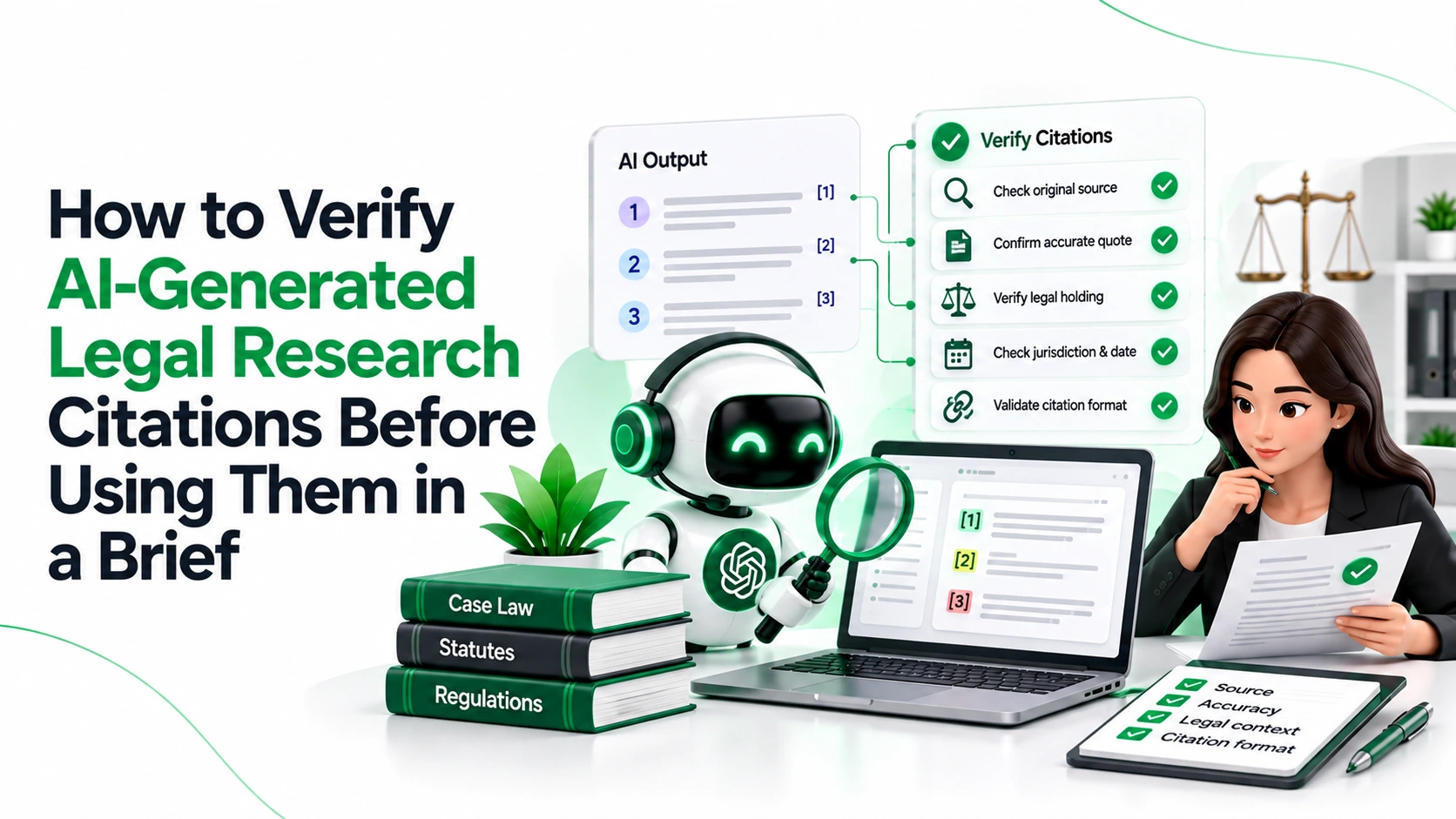
Verify every AI-generated citation by confirming the authority exists, reading the opinion, matching each quotation, testing support for the proposition, checking current validity, and having an attorney sign off before filing.
Key Takeaways
- Verification has five separate questions. Existence, quotation accuracy, proposition support, current validity and permission to cite can each fail on their own.
- Read the opinion. Summaries, headnotes and AI explanations are not the authority.
- No shortcut counts as proof. Model agreement, a clickable link or a clean citator signal does not complete verification.
- "Not located" is not "nonexistent." It means the search failed, and the cause needs investigation.
- Attorneys own the filing. Document the work, refresh it before filing and get sign-off.
Why Verification Is a Legal Duty
Courts have sanctioned lawyers for filing fake authority from AI tools. In Mata v. Avianca (S.D.N.Y. 2023), Judge Castel imposed a $5,000 penalty on two attorneys and their firm.
LawNext reports that he wrote existing rules impose a "gatekeeping role on attorneys to ensure the accuracy of their filings." This article read that report, not the opinion itself.
Binding Rules, Guidance and Proposals
Keep these categories apart in your own policy.
- Binding (federal civil): Federal Rule of Civil Procedure 11 says a signature certifies that legal contentions are warranted by existing law, after "an inquiry reasonable under the circumstances." Courts may impose sanctions. State courts have their own analogs, so check yours.
- Binding (local): Some courts require AI disclosure or certification. The Northern District of Texas local rules page lists a generative AI disclosure requirement for briefs, and Judge Starr's page says he no longer requires a separate certification. Check your court and judge each time.
- Guidance: The ABA's summary of Formal Opinion 512 says lawyers using generative AI must keep client information confidential and offers "general guidance." It also stresses competence and understanding a tool's risks. It is not binding by itself.
- Proposals: A proposed federal evidence rule on machine-generated evidence did not advance in May 2026, per a secondary report. It concerns evidence, not briefs, and is not a citation rule.
This article is not legal advice. Confirm current rules in your jurisdiction.
The Five Questions to Separate
A citation can pass one check and fail another. Test each independently.
| Question | What it asks | Typical failure |
|---|---|---|
| Existence | Is there a real decision, statute or rule at this citation? | Invented case, wrong reporter or mismatched name and number |
| Quotation accuracy | Do the quoted words appear in the source? | Altered, merged or invented language; missing omissions marked |
| Proposition support | Does the authority actually support the sentence it is cited for? | Real case, wrong point; dicta presented as holding |
| Current validity | Is it still good law for that point? | Reversed, overruled, superseded or amended |
| Permission to cite | May you cite it in this court? | Unpublished or depublished opinion; local citation limits |
Eight Verification Steps
1. Inventory Every Citation, Quotation and Proposition
- List each citation with the sentence it supports.
- Flag every quotation and every pinpoint (the specific page or paragraph reference).
- Include statutes, rules and secondary sources, not just cases.
- Note the AI-assisted passages, so reviewers know where to look hardest.
2. Locate the Original Authority
- Find the source yourself in an official or approved database.
- Confirm case name, court, date, reporter and docket number.
- Search by party names and by citation. A mismatch is a warning.
- Do not rely on the AI tool's own link as the only proof.
- If you cannot find it, record "not located" and keep searching other ways before concluding anything.
3. Read the Opinion
- Read the full decision, or at least the relevant sections in context.
- Do not rely on headnotes or summaries. Editors and models can compress or misstate.
- Check the procedural posture from the opinion's own text.
4. Match Quotations, Omissions and Pinpoints
- Compare each quotation word for word against the source.
- Check ellipses and brackets for accuracy.
- Verify the pinpoint page or paragraph and update it if editions differ.
- Watch for quotations the AI attributes to a case but that come from a quoted authority within it.
5. Test Proposition Support
- Does the court decide this point, or merely mention it?
- Holding versus dicta (a passing remark that is not necessary to the result): cite accordingly.
- Compare the facts. A similar rule may not apply to different facts.
- Check the procedural posture, such as a motion to dismiss versus summary judgment.
- Ask whether the court ruled for or against your side on this point.
6. Check Subsequent History and Treatment
- Run the authority through a citator, such as KeyCite or Shepard's.
- Read the later decisions the citator flags, especially negative ones.
- Check point-specific treatment. A case can be overruled on one issue and remain good on another.
- Do not treat a clean signal as the end. Coverage varies, and signals summarize.
7. Confirm Jurisdiction, Precedential Status and Effective Dates
- Is the authority binding or only persuasive in your court?
- Is it published, unpublished or depublished, and does your court allow citing it?
- For statutes and regulations, confirm the version in force on the relevant date, and any later amendment.
- Check local rules and standing orders for citation and AI-disclosure requirements.
- Lesson: Existence was the first failure, and the response made it worse.
- Practice point: Pull the actual decision before relying on any AI-supplied case.
Example 2: A Fictional Scenario
An associate asks an AI tool for authority on a contract point. It returns "Case A," with a quotation and a pinpoint. This is invented for illustration and uses no real citation.
- Existence: The associate finds a case with that name, but in another court and year.
- Quotation: The quoted language is not in the opinion.
- Proposition: The real case addresses a different issue.
- Result: The authority is dropped, the log records why, and a partner approves replacement authority.
Free Sources vs Paid Citators
- Free sources can confirm existence and provide text, such as official court sites and public legal-information sites. Coverage, speed and editorial treatment vary, so check completeness.
- Paid citators add editorial history and treatment. KeyCite's documented flags include a red flag for no longer good law on at least one point, and a red "U" for unverified citations that may contain errors.
- Citator limits: LexisNexis's Shepard's page notes that a signal describes overall treatment, and a negative signal may not cover every point. Check the specific headnote and the reason for the signal.
- Neither replaces reading. A clean signal means no flagged problem, not a verified brief.
Confidentiality and Approved Tools
- Use approved tools only. Do not paste client facts into consumer AI tools.
- Check vendor terms: retention, training-data use, access by vendor staff and subprocessors.
- Restrict access to matters on a need-to-know basis.
- Confirm client consent where required. The ABA summary says informed consent governs disclosure of client information.
- Log AI use per matter, including which tool and which passages.
Build a Written Verification Policy
A repeatable process beats good intentions. Have supervising attorneys approve a short policy that every drafter follows.
- Define roles: who drafts, who verifies, and who signs off. The verifier should not be the only person who drafted the passage.
- Set a standard: every authority gets the five checks, with no exceptions for "obvious" cases.
- Set timing: a first pass when drafting and a final refresh shortly before filing.
- Require escalation: unresolved or conflicting results go to the responsible attorney, not into the brief.
- Train the team: show real examples of fabricated authority and of correct authority cited for the wrong point.
- Review incidents: when a bad citation is caught, record how it entered the draft and adjust the process.
Metrics Worth Tracking
- Citations flagged per brief, by error type.
- Blockers open at final review.
- Time from final refresh to filing.
- Share of authorities with a completed audit row.
Use these to find weak steps. Do not use them as proof that any particular brief is accurate.
How LuMay Fits
LuMay's Virtual Paralegal page says it "checks citations, quotes, pincites, and case treatment against approved sources." It also describes checks on proposition support, later authority and regulatory currency.
- Findings: Issues are classified as Verified, Form Issue, Material Issue or Blocking Issue, with source and reasoning visible to reviewers.
- Attorney oversight: The page says "Substantive legal judgment stays with the responsible attorney."
- Governance gate: Processing is blocked unless matter policy, AI permission, approved sources, jurisdiction and a review owner check out, with policy checks logged.
- Platform: The broader Legal Agents page describes attorney approval over generated actions. The security page lists SSO, role-based access, tenant isolation, PII masking, human approval gates and audit tracing.
- Governance: LuMay's AI governance framework describes human-in-the-loop gates and audit logging at a reference-model level.
The pages publish no accuracy rates, supported jurisdictions, approved-source list or named research databases. Ask for those, and test on your own briefs. Book a LuMay demo to see the workflow.