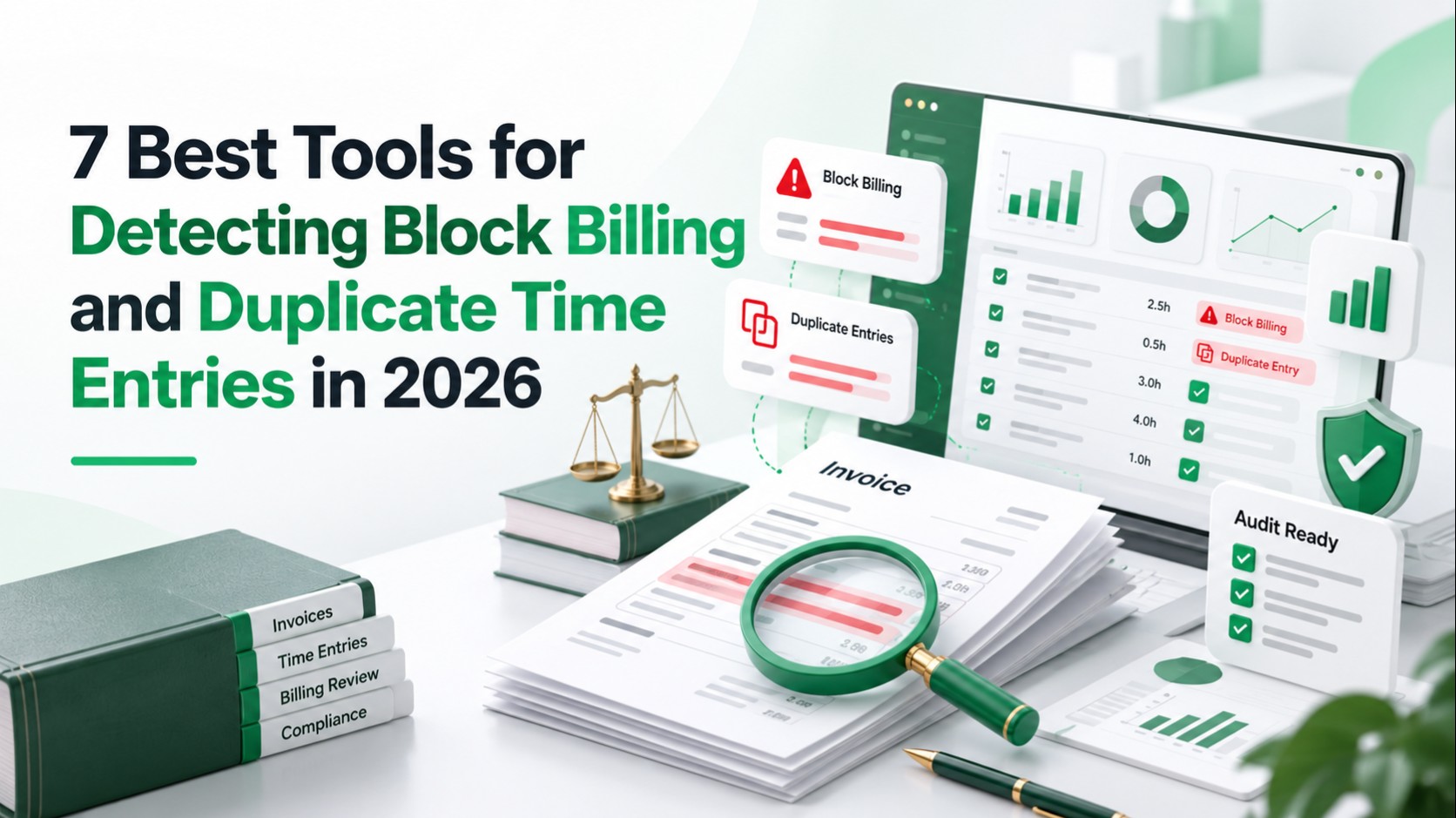
The strongest tools for detecting block billing and duplicate legal time entries combine legal invoice auditing,
configurable billing rules, narrative analysis, outside counsel guideline enforcement, and human review
workflows. Buyers should compare not only whether a platform can generate a flag, but also how it identifies
the issue, explains the finding, handles false positives, works with LEDES or other invoice formats, and routes
exceptions to reviewers.
For 2026, seven platforms with documented capabilities relevant to these workflows are Brightflag, Thomson
Reuters Legal Tracker, LexisNexis CounselLink, Onit Spend Agent, Wolters Kluwer LegalVIEW BillAnalyzer,
Mitratech TeamConnect/InvoiceIQ, and LuMay OCG Compliance Agent.
Quick Comparison: 7 Legal Billing Review Tools
| Tool | Block Billing | Duplicate Detection | Review Approach | OCG / Billing Rules | Best Fit |
|---|---|---|---|---|---|
| Brightflag | Yes | Yes | AI-assisted invoice review | Yes | Corporate legal departments wanting AI-first spend management |
| Thomson Reuters Legal Tracker | Yes | Yes | Configurable audits + AI-assisted duplicate matching | Yes | Enterprise legal departments already using Legal Tracker |
| LexisNexis CounselLink | Yes | Yes | SmartReview / automated billing validation | Yes | Corporate teams needing established ELM and e-billing controls |
| Onit Spend Agent | Yes | Yes | Contextual AI legal invoice review | Yes | Legal ops teams seeking AI first-pass review |
| Wolters Kluwer LegalVIEW BillAnalyzer | Broader billing-pattern analysis | Pattern/anomaly review; verify exact duplicate configuration | AI + NLP + optional expert review | Yes | Large legal and claims departments |
| Mitratech TeamConnect / InvoiceIQ | Rule/configuration dependent | Yes | Rules-based auditing + AI categorization | Yes | Enterprises needing highly configurable ELM controls |
| LuMay OCG Compliance Agent | Yes | Yes | AI-assisted OCG and invoice-line validation | Yes | Teams evaluating governed Legal AI workflows |
Related LuMay legal billing guides: Start with what block billing is and how AI review checks work, review how to automate legal billing, and see how teams move from billing violations to automated compliance.
Important: A “Yes” means the capability is documented by the vendor as of October 2026. It does not mean
every deployment enables the feature automatically or that every flagged entry represents an actual billing
violation.
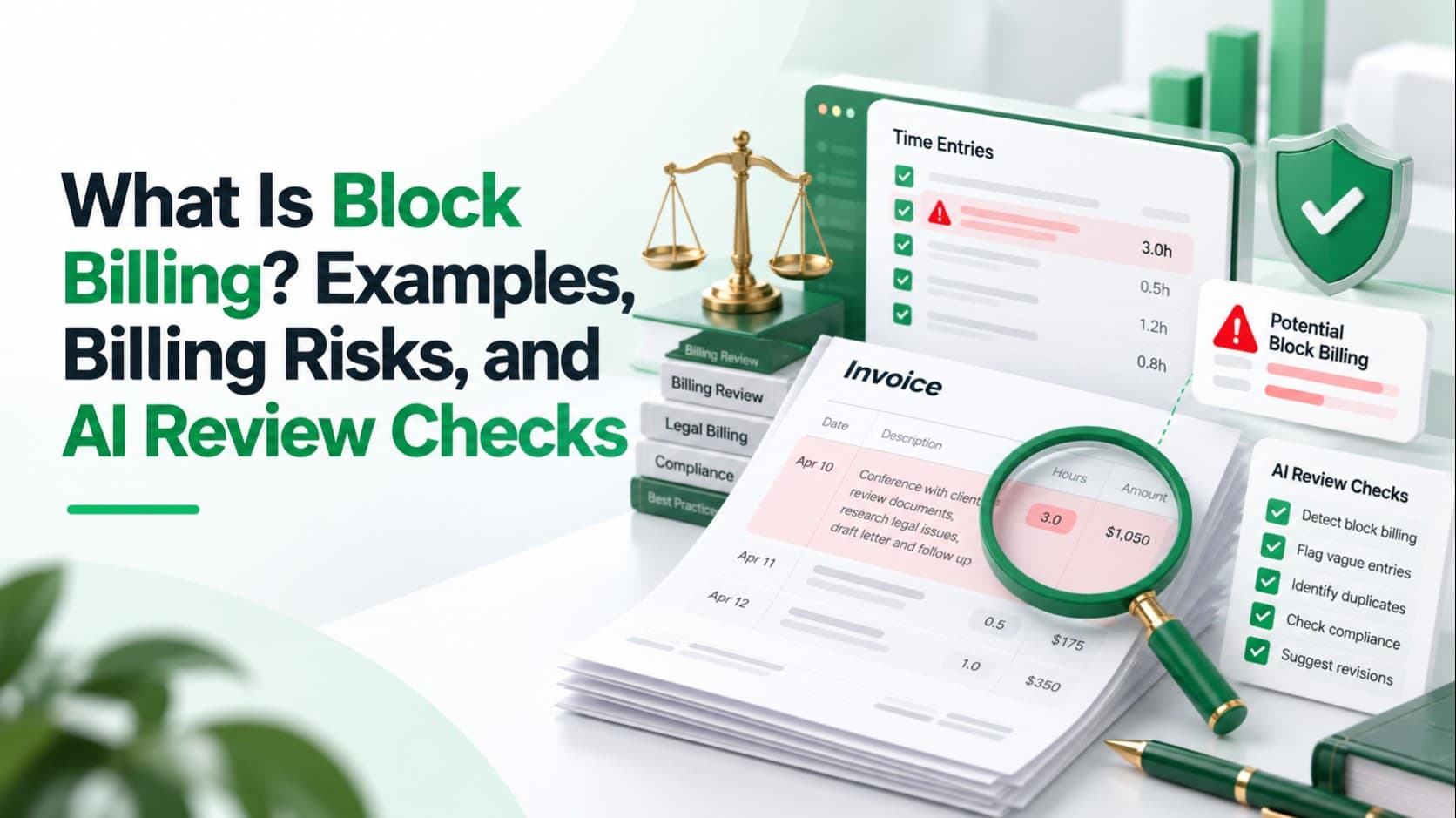
What Is Block Billing?
Block billing means recording multiple tasks under one combined amount of time instead of allocating time
separately to each meaningful activity.
Potential block billing: 3.8 hours - Review discovery, research jurisdiction issue, speak with client, revise
motion and email opposing counsel.
A clearer invoice might separate the research, drafting, client communication, and opposing-counsel
communication into individual entries. Block billing creates a review problem because the client may know
which activities occurred but cannot determine how much of the 3.8 hours belonged to each activity.
What Are Duplicate Time Entries?
A duplicate time entry occurs when the same or substantially identical legal work is billed more than once.
- Two identical lines in one invoice.
- The same line appearing on separate invoices.
- The same timekeeper, date, matter, hours, and task being billed twice.
- Resubmission of previously invoiced work.
- Similar narratives with slightly changed wording.
- Duplicate expenses associated with the same matter.
Some duplicates are simple administrative errors. Others require contextual investigation before a reviewer
can determine whether two entries actually represent the same work.
Why Block Billing and Duplicate Entries Matter
Both issues can reduce invoice transparency and complicate legal billing review.
- Outside counsel guideline compliance.
- Legal spend reporting.
- Matter budgeting.
- UTBMS categorization.
- Invoice approval.
- Audit documentation.
- Law-firm feedback.
- Financial controls.
LEDES standards provide structured formats for legal billing data, which makes many automated checks
easier. Narrative interpretation is still necessary when reviewers must decide whether similar entries
represent the same underlying work.
1. Brightflag
What Brightflag Is
Brightflag is a legal spend management and e-billing platform built around AI-assisted invoice review. Its AI
analyzes invoice line items, billing data, outside counsel guidelines, and billing patterns to identify entries
requiring review; vendor documentation also describes LEDES and PDF invoice support.
Block-Billing Detection
Brightflag explicitly documents automated block-billing detection. Its system can analyze invoice narratives,
identify line items containing multiple activities, and flag those entries during invoice review.
Duplicate-Entry Detection
Brightflag also documents duplicate entries and double-billing controls, including duplicate invoice submission
checks in its vendor workflow.
Key strengths
- AI analysis at invoice-line level
- explicit block-billing detection
- duplicate and double-billing controls
- OCG enforcement
- LEDES and PDF support
- reviewer-facing flags.
Important limitations
A Brightflag flag is not proof of inappropriate billing. Public standard pricing is not presented as a simple list
price, so buyers should expect quote-based evaluation.
Best fit
Corporate legal departments looking for AI-first legal spend management with automated invoice analysis.
What buyers should verify
Ask how duplicate similarity is calculated, how historical invoices are compared, which rules can auto-adjust
entries, and how exceptions can be overridden.
2. Thomson Reuters Legal Tracker
What Legal Tracker Is
Legal Tracker is an enterprise legal management platform covering matters, e-billing, legal spend, invoice
review, and outside counsel management.
Block-Billing Detection
Legal Tracker has a specific Block Billing Audit. Reviewers can identify an item as block billing, mark it as not
block billing, ignore the finding, or edit the line item.
Duplicate-Entry Detection
Legal Tracker provides configurable duplicate-line audits and an AI-powered similar-narrative option that can
go beyond exact text matching.
Key strengths
- Dedicated block-billing audit
- dedicated duplicate-line audit
- AI-assisted similar-narrative comparison
- configurable warning and escalation behavior
- human reviewer resolution workflow.
Important limitations
Many controls depend on administrator configuration and invoice format. Some invoice auditing works best
with structured formats such as LEDES.
Best fit
Large corporate legal departments that want configurable auditing inside an established ELM environment.
What buyers should verify
Confirm invoice formats, AI duplicate-audit availability, audit scope, historical comparison options, and
licensing requirements.
3. LexisNexis CounselLink
What CounselLink Is
CounselLink is an enterprise legal management and legal spend platform from LexisNexis with automated
invoice validation and billing-guideline controls.
Block-Billing Detection
CounselLink SmartReview can identify more than one activity in a single charge-line description, including
patterns involving action words, connector words, and separators.
Duplicate-Entry Detection
CounselLink documents duplicate invoice and duplicate-content validation for previously submitted charges
on the same matter.
Key strengths
- Explicit block-billing validation
- duplicate invoice-content detection
- structured correction workflow
- billing-guideline review
- established ELM environment.
Important limitations
Language-based rules can create false positives where legitimate activities are closely related, so
configuration and reviewer interpretation matter.
Best fit
Corporate legal departments evaluating an established ELM and outside counsel billing platform.
What buyers should verify
Test real invoice narratives, especially acceptable compound activities, before enabling strict rejection rules.
4. Onit Spend Agent
What Spend Agent Is
Onit Spend Agent is an AI-powered legal invoice review product that reviews line items against billing
guidelines and provides contextual explanations and recommended actions.
Block Billing and Duplicate Detection
Onit documentation identifies block billing, vague descriptions, and duplicate entries among the issues Spend
Agent can review.
AI vs Rules
Onit distinguishes deterministic business rules, contextual AI, and human judgment. Exact duplicates fit rules
well; ambiguous billing language may require AI plus reviewer oversight.
Key strengths
- Context-aware AI invoice review
- block-billing detection
- duplicate-entry detection
- line-by-line OCG validation
- explainable findings
- human oversight model.
Important limitations
Vendor-reported performance figures should not be assumed to apply identically to every organization.
Buyers should validate against their own invoice mix and OCGs.
Best fit
Legal operations teams wanting an AI first-pass review layer rather than relying only on keyword rules.
What buyers should verify
Run a controlled evaluation using representative historical invoices and measure precision, false positives,
missed violations, and reviewer acceptance.
5. Wolters Kluwer LegalVIEW BillAnalyzer
What LegalVIEW BillAnalyzer Is
LegalVIEW BillAnalyzer is Wolters Kluwer ELM Solutions’ AI-assisted legal bill review offering for corporate
legal and claims organizations.
How It Reviews Billing
Official product materials describe NLP, machine learning, similarity analysis, billing-pattern analysis, and
comparison across invoices and matters.
Block Billing and Duplicates
Public vendor materials are stronger on broader billing-pattern, guideline, and anomaly analysis than on a
standalone, feature-specific block-billing or duplicate-line control. Buyers should verify those exact scenarios
directly.
Key strengths
- NLP-based invoice analysis
- cross-invoice pattern evaluation
- enterprise legal spend ecosystem
- human-assisted bill-review options
- broader ELM integration.
Important limitations
Public documentation is less explicit about exact block-billing and duplicate-detection mechanics than some
other products in this comparison.
Best fit
Large legal or claims organizations looking for enterprise-grade AI bill review integrated with broader legal
spend management.
What buyers should verify
Request demonstrations using intentional duplicate entries and several varieties of block-billed narratives.
6. Mitratech TeamConnect and InvoiceIQ
What It Is
Mitratech TeamConnect is an enterprise legal management platform with Collaborati Spend Management for
e-billing, while InvoiceIQ adds AI-assisted categorization and billing-guideline recommendations.
Duplicate-Entry Detection
TeamConnect documents duplicate timekeeper-charge and duplicate expense validations using configurable
invoice fields.
Block-Billing Detection
TeamConnect’s strongest public controls are rules-based auditing, description validation, duplicate detection,
rate checking, and guideline enforcement. Buyers requiring explicit NLP-style block-billing classification
should verify current InvoiceIQ capabilities.
Key strengths
- Highly configurable audit rules
- strong duplicate controls
- cross-invoice checking options
- OCG enforcement
- AI invoice categorization through InvoiceIQ.
Important limitations
Implementation quality depends heavily on billing-profile configuration and licensed modules.
Best fit
Enterprises needing deeply configurable legal spend and matter management rather than a narrow
standalone checker.
What buyers should verify
Confirm which InvoiceIQ modules, CSM components, validation rules, and AI features are included in the
proposed license.
7. LuMay OCG Compliance Agent
What LuMay OCG Compliance Agent Is
LuMay’s OCG Compliance Agent is a Legal AI workflow designed to validate outside counsel invoice lines
against encoded billing rules and route exceptions through governed review workflows.
Block-Billing and Duplicate Detection
LuMay’s public product documentation identifies block billing, vague descriptions, and duplicate entries as
invoice-review questions the workflow can surface.
Key strengths
- Documented block-billing review
- documented duplicate-entry review
- OCG rule encoding
- human approval controls
- reasoned exceptions
- audit and dispute-history workflow.
Important limitations
LuMay is the publisher of this comparison, so buyers should independently validate product fit. Teams should
test their own OCGs, invoice formats, false-positive tolerance, security requirements, and approval model.
Best fit
Legal operations teams evaluating governed Legal AI for OCG compliance and invoice-validation workflows.
What buyers should verify
Confirm supported invoice formats, target systems, deployment model, implementation scope, specific billing-
rule coverage, and how flagged entries are reviewed.
Dedicated Bill Review vs Legal Spend Management
These seven products do not solve the problem in exactly the same way. Dedicated or AI-first review products
emphasize invoice interpretation; broader ELM and spend platforms connect invoice review to matters,
budgets, vendors, rates, approvals, and spend analytics.
Rules-Based Auditing vs AI-Assisted Review
Deterministic rules are strongest when the condition is objective, such as duplicate invoice number,
unauthorized task code, approved-rate violations, or exact structured-field matches. AI becomes more useful
when the system must interpret similar narratives, vague descriptions, multiple tasks, or unusual patterns.
Automated Detection vs Manual Legal Bill Review
Automated block-billing or duplicate detection should normally be treated as exception identification rather
than a final legal or billing judgment. Two similar entries may represent different professionals attending the
same event, and two verbs in a narrative may describe one connected activity.
How to Validate Flagged Entries
- Identify whether the trigger came from a deterministic rule, similarity model, NLP analysis, or anomaly detector.
- Check the applicable outside counsel guideline rather than applying a generic assumption.
- Compare timekeeper, matter, date, units, rate, task code, amount, and narrative.
- Review prior invoices where relevant.
- Assess whether the narrative actually combines distinct tasks.
- Request clarification when context is missing.
- Record whether the flag was accepted, rejected, adjusted, or escalated.
What to Ask Vendors Before Buying
- Does block-billing detection use keywords, rules, NLP, LLMs, or a combination?
- Can it recognize semantically similar duplicate entries?
- Can duplicates be detected across invoices?
- How far back does historical comparison go?
- Are PDF invoices supported or only structured e-billing formats?
- Which LEDES formats are supported?
- Can each firm or matter have different OCG rules?
- Can reviewers see why a line was flagged?
- Can reviewers override a finding?
- What happens when the AI is uncertain?
- Are adjustments automatic or approval-based?
- What integrations are included?
- Is an audit trail retained?
- How are data retention and access permissions controlled?
Most importantly, give shortlisted vendors a controlled sample of your own invoices. Measure precision,
missed violations, false positives, reviewer effort, explainability, and workflow fit instead of choosing solely on
the number of AI features advertised.
FAQs
Q1:
What is the best software for detecting block billing?
A:
There is no universal best product. Brightflag, Legal Tracker, CounselLink, Onit Spend Agent, and LuMay
OCG Compliance Agent all publicly document capabilities directly relevant to block-billing review, but their
workflow, automation approach, deployment scope, and surrounding legal spend functionality differ.
Q2:
Can legal billing software detect duplicate time entries?
A:
Yes. Platforms can compare matter, timekeeper, date, hours, task code, amount, or narrative, and some
systems can identify similar rather than perfectly identical descriptions.
Q3:
What is block billing detection?
A:
It identifies invoice entries that appear to combine multiple activities under one total duration. A mature
system should flag the entry for evaluation rather than automatically assume it is invalid.
Q4:
Can AI determine whether block billing is improper?
A:
Not reliably in every situation. AI can identify patterns suggesting potential block billing, but the applicable
OCG, work performed, and matter context may require human judgment.
Q5:
What causes false positives in block-billing software?
A:
Closely related tasks are a common source. A description such as “prepare for and attend hearing” contains
multiple actions but may represent one connected activity depending on the client’s rules.
Q6:
How does duplicate billing detection work?
A:
Rules-based systems compare structured fields such as timekeeper, matter, date, hours, and codes. AI-
assisted systems can add narrative similarity or contextual analysis.
Q7:
Is AI better than rules-based legal invoice auditing?
A:
They solve different problems. Rules are stronger for objective conditions, while AI can help with contextual
language and pattern interpretation; mature workflows often use both.
Q8:
Can law firms use these tools before invoices reach clients?
A:
Some products support vendor-side or pre-bill checks, while others are primarily designed for corporate legal
department review. Law firms should verify the intended workflow directly with the vendor.
Q9:
Do legal invoice review tools require LEDES invoices?
A:
Not universally. Some platforms support LEDES, PDFs, or multiple submission methods, while specific audits
may depend on structured invoice data.
Q10:
Can software enforce outside counsel guidelines automatically?
A:
Yes, many platforms can translate objective billing policies into validation rules or review logic. Ambiguous
guidelines still require reviewer judgment.
Q11:
Should duplicate entries be automatically rejected?
A:
Not necessarily. Exact duplicate identifiers may support strict rules, while similar narratives or overlapping
time entries can require investigation.
Q12:
Does a billing flag prove that outside counsel overbilled?
A:
No. A flag identifies something requiring attention; reviewers should verify the underlying work, applicable
policy, invoice history, and context before making a final adjustment.
Choosing a Legal Bill Review Platform in 2026
The most important difference between these products is not simply whether the feature list says AI. The real
distinction is how each platform combines structured billing rules, narrative interpretation, duplicate
comparison, outside counsel guidelines, reviewer judgment, workflow automation, and auditability.
For teams focused primarily on invoice intelligence, AI-first review may be attractive. Organizations managing
matters, vendors, budgets, approvals, and invoices together may benefit more from a broader legal spend
management or ELM platform.
The goal should be consistent, explainable legal invoice auditing - not maximizing the number of lines an
algorithm flags.
Verified Reference Links
- LEDES Oversight Committee: https://ledes.org/
- ABA Model Rule 1.5 - Fees:
https://www.americanbar.org/groups/professional_responsibility/publications/
model_rules_of_professional_conduct/rule_1_5_fees/
- Brightflag block billing: https://brightflag.com/resources/block-billing/
- Thomson Reuters Legal Tracker block-billing audits: https://www.thomsonreuters.com/en-us/help/legal-
tracker/company/financial-setup/configuring-block-billing-audits
- LexisNexis CounselLink block billing support:
https://supportcenter.lexisnexis.com/app/answers/answer_view/a_id/1081458/~/block-billing-invoice-error-
on-counsellink%C2%AE
- Onit Spend Agent: https://www.onit.com/products/ai-studio/spend-agent/
- LuMay OCG Compliance Agent: https://www.lumay.ai/ai-products/ocg-compliance-agent
- LuMay Legal Agent: https://www.lumay.ai/ai-products/legal-agent
- LuMay Legal AI solutions: https://www.lumay.ai/industry-solutions/ai-legal
- LuMay AI Governance Framework: https://www.lumay.ai/us/resources/ai-governance-framework