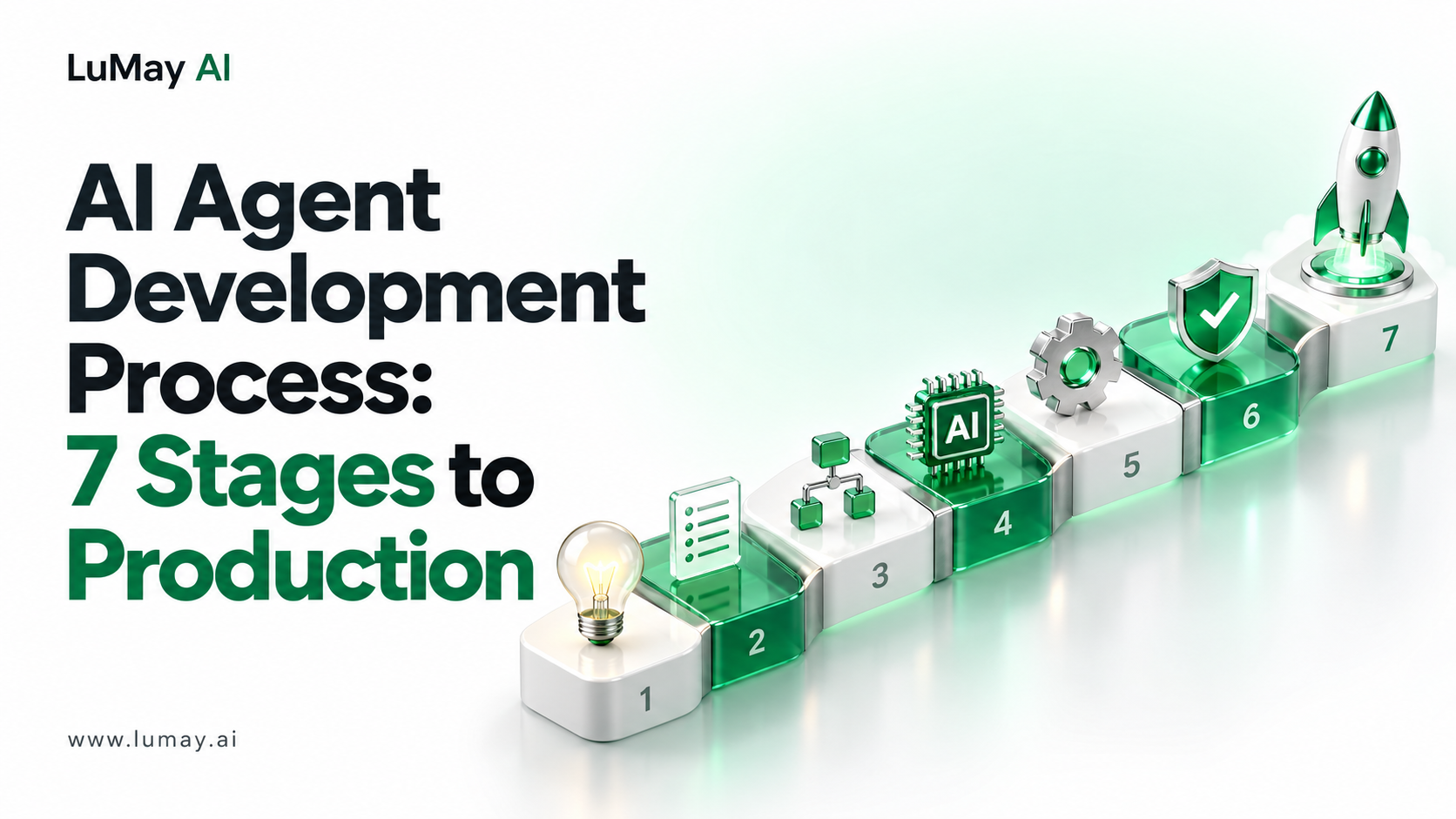
The AI agent development process has seven stages: scope, data and tool access, architecture, build, evaluation, controlled deployment and operations. Each stage should end with a written exit criterion. Most failed agent projects skip evaluation or give the agent tools before permissions are designed.
This guide is for engineering leaders and product owners planning a first or second production agent. It explains what an agent is, what happens in each stage, who is involved, and how to know a stage is done.
What Counts as an AI Agent
An AI agent uses a language model to decide which steps to take and which tools to call to reach a goal. A workflow follows fixed steps.
Anthropic's engineering guidance recommends using the simplest pattern that works and adding autonomy only when it pays for itself.
| Pattern | Who decides the next step | Good fit |
|---|---|---|
| Chatbot | User | Questions and answers |
| Workflow | Code | Predictable, repeatable tasks |
| Agent | Model, within limits | Variable tasks needing judgment and tools |
The Seven Stages and Their Exit Criteria
| Stage | Main work | Exit criterion |
|---|---|---|
| Stage 1: Scope | Workflow, users, success metric, risk level | Signed one-page scope |
| Stage 2: Data and tool access | Inventory sources and APIs, confirm permissions | Access confirmed in a test environment |
| Stage 3: Architecture | Pattern choice, model, retrieval, tool gateway, approvals | Design reviewed by security |
| Stage 4: Build | Prompts, tools, orchestration, integrations | Agent completes sample tasks end to end |
| Stage 5: Evaluation | Test set, metrics, adversarial cases | Agreed thresholds met |
| Stage 6: Controlled deployment | Pilot group, approval gates, monitoring | Pilot metrics stable for an agreed period |
| Stage 7: Operations | Monitoring, incident response, model updates | Owner, runbook and review cadence in place |
Microsoft's agent deployment lifecycle guidance and IBM's overview of AI agent development describe similar stage structures.
Stage Details and Common Mistakes
Stage 1, scope. Choose a workflow with volume, a clear owner and a measurable outcome. Mistake: starting with "an agent for the whole department".
Stage 2, data and tool access. List every system the agent must read or write. Confirm API access and the identity the agent will use. Mistake: discovering in week six that a system has no API.
Stage 3, architecture. Decide the pattern, model, retrieval design and how tools are exposed, for example through the Model Context Protocol. Define which actions need human approval.
Stage 4, build. Connect read-only tools first. Add write actions only after read paths are reliable. Keep prompts and tool definitions under version control.
Stage 5, evaluation. Build a test set from real historical cases. Measure task success, tool-call accuracy, escalation behavior and cost per task. Rerun it on every change. Our AI agent testing checklist lists the checks.
Stage 6, controlled deployment. Release to a small group with approval gates on risky actions. Review traces weekly.
Stage 7, operations. Assign an owner. Monitor drift, failures and cost. Plan model upgrades as releases with regression tests. The NIST AI Risk Management Framework helps structure ongoing governance.
Who Is Involved
• Business owner: defines success and accepts results
• Engineering lead: architecture and build
• Domain experts: write and grade evaluation cases
• Security: reviews tool permissions and data flows
• Operations: runs monitoring and incident response
Worked Example: Planning One Agent
Illustrative example. A hypothetical plan, not a customer project.
Workflow: a support-ticket triage agent that reads new tickets, looks up the customer record, sets category and priority, and drafts a first reply for human approval.
• Stage 1: success = correct category on 90% of a 300-ticket test set, agreed with the support lead
• Stage 2: read access to the ticketing system and CRM; write access limited to category, priority and draft reply fields
• Stage 3: single-agent pattern, retrieval over the help-center articles, no autonomous sending
• Stage 5: test set graded by two senior agents; threshold met before pilot
• Stage 6: pilot with one team; drafts approved by a person before sending
The 90% figure is a target chosen by the hypothetical team, not a benchmark.
What Drives Cost and Timeline
• Number of integrations and the quality of their APIs
• Data readiness for retrieval
• Risk level, which determines approval design and evaluation depth
• Deployment model: SaaS, your cloud or on-premises
• Operations scope after launch
Use our enterprise AI application cost estimation guide to build a budget.
Limitations to Plan Around
• Agents make mistakes: evaluation reduces errors but cannot remove them; keep humans on high-impact actions
• Model updates change behavior: treat them as releases
• Autonomy increases risk: more steps mean more ways to fail; prefer workflows where steps are predictable
• Prompt injection is unsolved in general: treat retrieved content and tool outputs as untrusted; see the OWASP Top 10 for LLM Applications
Our own service (disclosure: LuMay sells this). LuMay's AI agent development services page describes a Discovery → Architecture → Proof of Concept → Development and Integration → Testing and Deployment process, with cloud or private deployment.
Published starting prices are on the pricing page.
Next Step
Pick one workflow and take it through stages 1–3 before writing code. Plan your first production agent with LuMay's agent engineering team.
Sources
• Anthropic: Building effective agents
• Microsoft Learn: Agent deployment lifecycle