RAG development cost depends mainly on your documents, not the model. Published 2026 agency ranges put a basic prototype near $10,000–$40,000 and enterprise builds from about $60,000 to $200,000 or more, depending on the source. Data preparation, permissions and evaluation usually decide where your project lands.
This guide is for engineering leaders and finance partners comparing RAG quotes. It shows the line items behind a price, a worked year-one budget, and how to make two vendor quotes comparable.
What Published Ranges Say
Several firms publish RAG price ranges. They differ in tier names but agree on the drivers. Treat them as market signals, not benchmarks for your project.
| Source (2026) | Prototype / MVP | Production | Enterprise / agentic |
|---|---|---|---|
| Inferya | $10K–$25K | $25K–$60K | $60K–$150K+ |
| ZTABS | $15K–$40K | $40K–$100K | $100K–$200K+ |
| RaftLabs | $12K–$30K | $30K–$60K | $70K–$120K+ |
RaftLabs estimates data preparation and ingestion at 40–50% of engineering work. Tensoria puts year-one total cost of ownership at 1.5–2× the initial build. Both point to the same lesson: the build quote is not the full cost.
The Line Items Behind a RAG Quote
Ask every vendor to price these lines separately. If a line is missing, ask whether it is excluded or bundled.
| Line item | What it covers | What makes it expensive |
|---|---|---|
| Discovery and data audit | Use cases, sources, permissions, success metrics | Many owners, unclear data rights |
| Ingestion and parsing | Extracting text from PDFs, Office files, scans, web pages | Tables, scans, inconsistent formats |
| Chunking and metadata | Splitting documents and tagging them for filtering | Long, structured documents |
| Embeddings and index | Converting text to vectors and hosting the index | Volume and refresh frequency |
| Retrieval pipeline | Hybrid search, reranking, query rewriting | Accuracy targets on hard questions |
| Access control | Enforcing document permissions at query time | Many permission models across sources |
| Generation and citations | Prompting, answer format, source links | Strict citation or refusal rules |
| Evaluation | Test set, retrieval and groundedness metrics | Building the gold set with experts |
| Integration and UI | Portal, chat, API, SSO | Multiple channels |
| Run and maintain | Hosting, model calls, monitoring, updates | Query volume, uptime targets |
Two lines are most often underpriced: access control and evaluation. Our guide on how to evaluate a RAG system explains what a proper evaluation set includes.
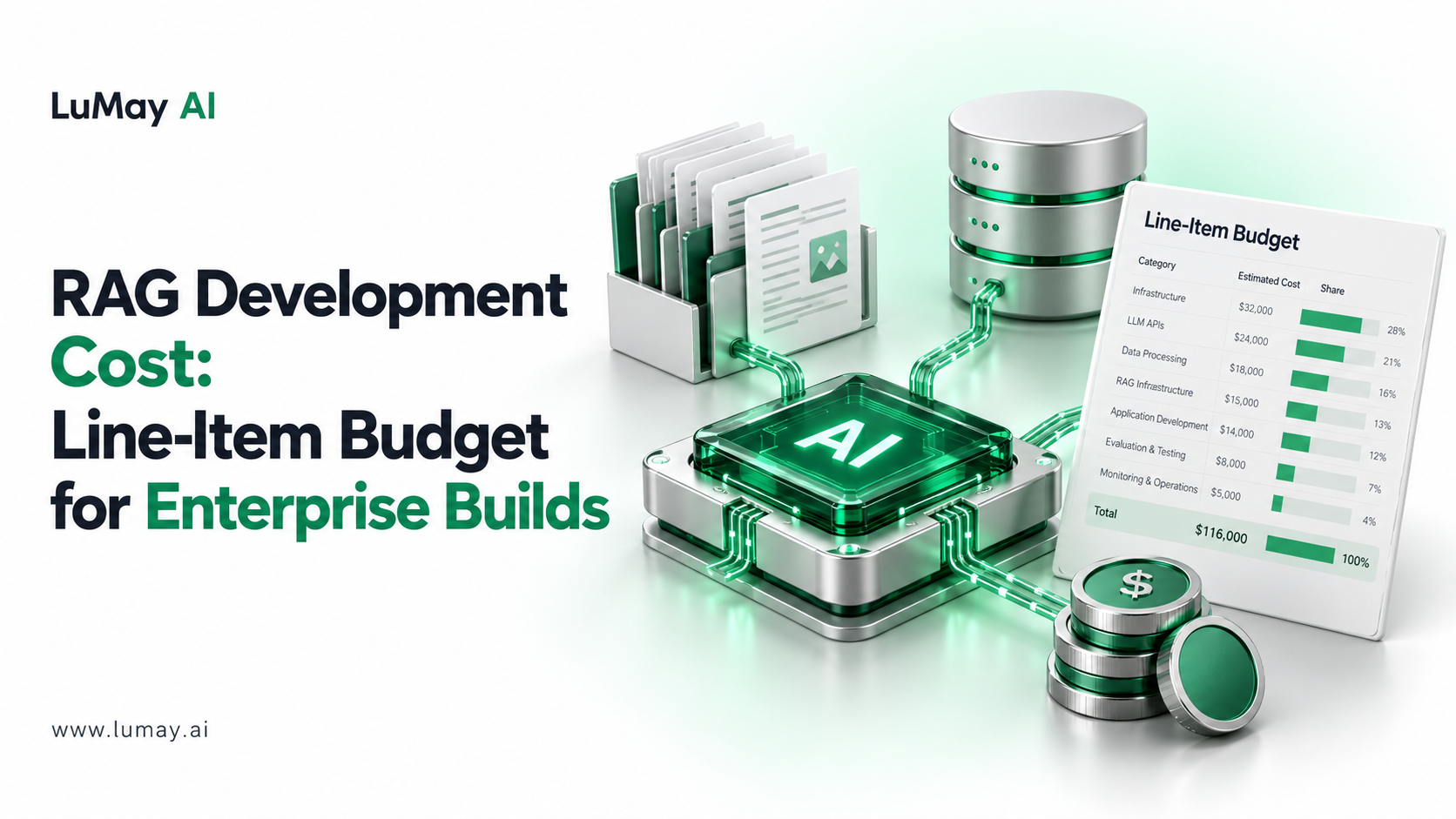
Worked Example: Year-One Budget
Illustrative example. All figures are assumptions for a planning exercise. They are not a LuMay quote or a customer result.
Scenario: an internal policy and procedures assistant for 2,000 employees. About 40,000 documents from SharePoint and a ticketing system, 15,000 questions per month, answers must cite sources and respect document permissions.
| Line | Assumption | Year-one estimate |
|---|---|---|
| Discovery and data audit | 2 weeks, 2 people | $12,000 |
| Ingestion, parsing, chunking | Mixed PDF and Office, some scans | $18,000 |
| Retrieval and reranking | Hybrid search, metadata filters | $14,000 |
| Access control | Two permission sources mapped | $10,000 |
| Evaluation set and harness | 300 questions with expert answers | $9,000 |
| Integration and UI | SSO, web portal, Teams link | $12,000 |
| Infrastructure | $900/month × 12 | $10,800 |
| Model usage | 15,000 queries × $0.01 × 12 | $1,800 |
| Maintenance | 15% of build, prorated | $11,250 |
| Total | $98,850 |
How the total was built: the build lines sum to $75,000; maintenance is 15% of that. Change any assumption and recompute. The largest swing factors are scan quality, the number of permission sources and the accuracy bar.
How to Make Two Quotes Comparable
• Same scope document: give every vendor identical sources, volumes, users and accuracy targets
• Line-item pricing: require the table above, not a single number
• Run costs at your volume: ask for monthly cost at today's and 3× query volume
• Evaluation included: confirm who builds the test set and what pass threshold means done
• Ownership: confirm you own the code, prompts, indexes and evaluation data
• Exit terms: ask how indexes and pipelines are handed over if you change vendors
Ways to Reduce Cost Without Losing Accuracy
• Start with one source: prove value on the cleanest repository before adding others
• Clean before you embed: remove duplicates and outdated versions; fewer chunks cost less and retrieve better
• Route by difficulty: send simple questions to a smaller model
• Cache common answers: frequent policy questions do not need a fresh model call every time
• Choose managed vs custom deliberately: see custom RAG vs managed RAG
Limitations of Any RAG Estimate
• Data quality is unknown until audited: estimates before a data review carry wide error bars
• Accuracy targets change cost non-linearly: moving from "usually right" to "cites correctly every time" may need reranking, better parsing and more evaluation
• Model prices change: per-token rates shift; re-check before approval
• RAG reduces hallucination risk, it does not remove it: budget for monitoring and human review where errors matter
Our own service (disclosure: LuMay sells this). LuMay's pricing page lists a two-week Discovery Sprint at $10K–$15K and a 4–8 week Production Pilot at $25K–$75K. The RAG development services page lists data preparation, hybrid retrieval, access-aware retrieval and RAG evaluation.
Prices were read on October 30, 2026 and are starting points.
Next Step
Bring your sources, volumes and accuracy target, and get a line-item estimate instead of a single number. Get a scoped RAG estimate from LuMay's RAG engineering team.
Sources
• Inferya: RAG implementation cost 2026
• ZTABS: RAG system development cost
• RaftLabs: RAG development cost