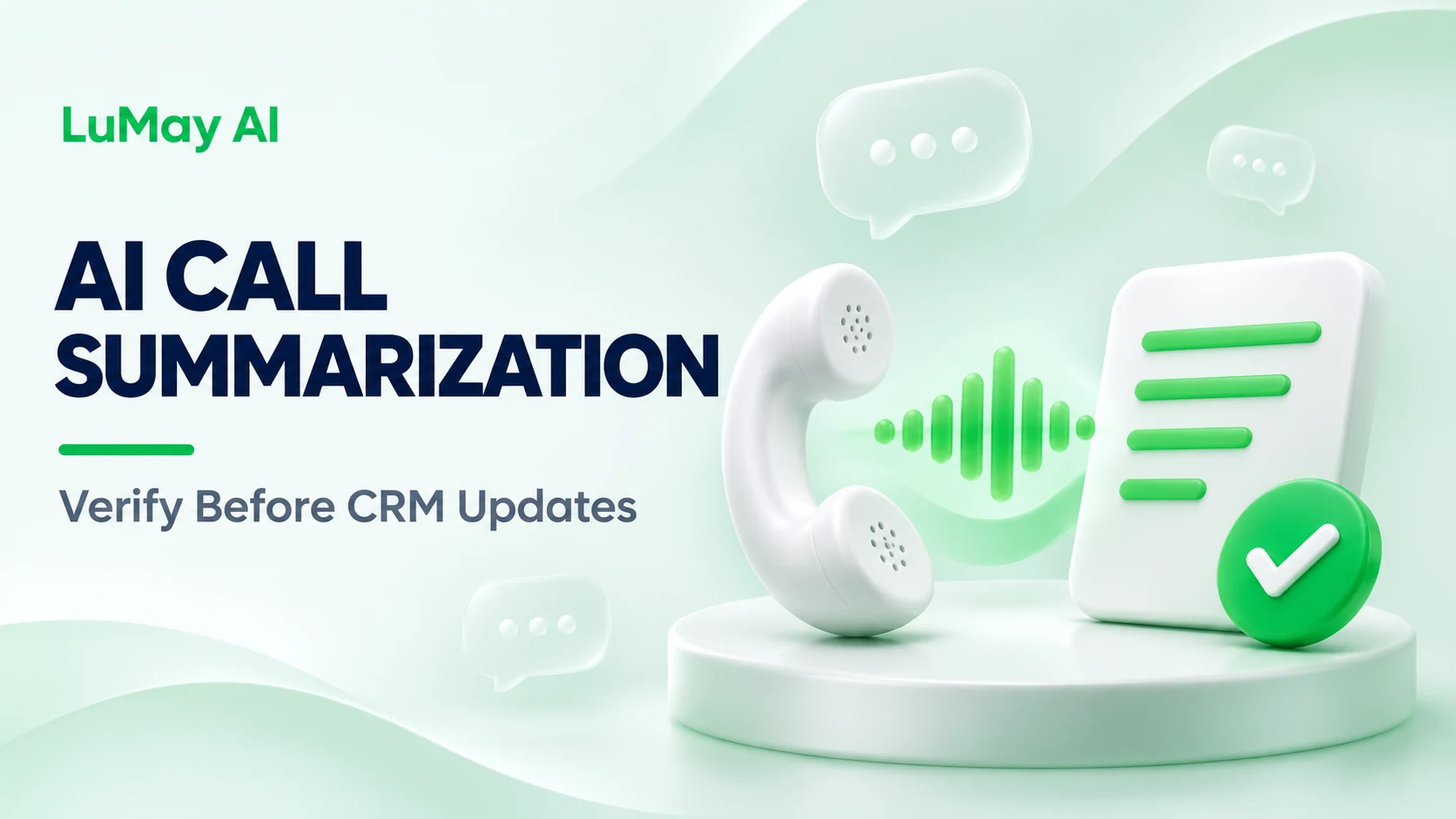
“Customer requested a cancellation” and “subscription cancelled” describe different events. An AI call summary that confuses them can mislead the next service representative and trigger the wrong follow-up.
Reliable AI call summarization preserves what the caller said, what the agent attempted, what the backend confirmed, and what remains unresolved. Check those distinctions before a summary enters the CRM or starts another workflow.
Define the job of the summary
Choose the intended reader and next decision. A supervisor reviewing service quality needs different detail from a representative handling a callback. One long paragraph rarely serves every audience well.
Twilio's Conversation Intelligence documentation describes language operators for summaries and other analysis. It also states that the current service is not PCI compliant or a HIPAA Eligible Service. That limitation applies to the specific product documented, and must be considered before using it in regulated workflows.
The workflow below is a vendor-neutral design proposal. Verify the exact service's data handling, eligibility and configuration before processing real calls.
Use a summary contract with distinct evidence types
| Field | Evidence source | Example wording |
|---|---|---|
| Caller intent | Conversation segment | Caller asked to reschedule |
| Verified identity status | Identity service | Verification incomplete |
| Attempted action | Tool execution record | Calendar update attempted |
| Confirmed outcome | Authoritative backend result | No new booking confirmed |
| Open issue | Conversation and failed action | Customer needs a callback |
| Next owner | Approved workflow assignment | Scheduling queue |
Keep relevant evidence references with the record, subject to access and retention policy. A brief summary can remain readable while a reviewer can inspect the specific turn or tool result behind a disputed statement.
Build the summary from the completed call record
First, assemble the events that actually belong to the call. Include transcript segments, speaker attribution, tool attempts, backend responses and final call disposition. Preserve event order and corrections.
Second, identify the authoritative source for each field. A backend receipt can establish that a transaction completed. The agent saying “that is done” cannot establish completion when the service timed out.
Third, generate the narrative and structured fields. Ask for explicit unknown or unresolved values when the evidence is missing. Avoid requiring a positive resolution label for every call.
Finally, validate the record before writing it. Check account association, allowed disposition values, evidence references and consistency between the narrative and confirmed outcome.
Handle corrections and interrupted conversations
Callers often change details: “Tuesday—sorry, Thursday.” The summary should preserve the final confirmed request without losing a relevant dispute or ambiguity.
When speech recognition cannot distinguish a name, number or date, the summary should reflect uncertainty. Do not silently turn an uncertain transcript into a precise fact. Prefer a structured unresolved field over a plausible completion.
Separate speaker statements. “The customer said the technician promised a refund” is different from “the company promised a refund.” The summary must preserve attribution when the underlying commitment is unverified.
Illustrative example: an appointment update that timed out
In a hypothetical service call, the caller asks to move a visit from Monday to Wednesday. The agent submits an update, but the booking service returns a timeout. The call ends before the result can be reconciled.
A suitable summary says: “Caller requested Wednesday. Update attempt timed out; booking state remains unconfirmed. Scheduling team must check the booking reference before retrying.”
The callback workflow then checks the current backend state. It does not submit another update based only on the summary. This prevents a narrative artifact from becoming an accidental transaction instruction.
Score summaries on consequential errors
Build a reviewed call set with failed actions, transfers, multiple issues, corrected dates, uncertain transcripts and unresolved identity checks.
- Outcome accuracy: does the summary match the authoritative system state?
- Attribution: are caller claims separated from verified facts?
- Completeness: are unresolved commitments and follow-ups retained?
- Association: is the record attached to the correct account and call?
- Data minimization: is unnecessary sensitive content excluded?
Track the number of summaries reviewed and the severity of errors found. A fluent summary with one incorrect cancellation outcome may be more damaging than a longer summary with awkward wording.
Keep corrections and reprocessing reviewable
If a transcript is corrected or a delayed action result arrives, update the summary through a versioned process. Record what changed and why. Prevent late retries from duplicating CRM activities or creating conflicting follow-up tasks.
Retain human corrections as evaluation cases, with appropriate data controls. Re-run those cases when changing the model, summary prompt or transcription settings.
Where does integration begin?
This guide addresses the correctness of the summary record. Use LuMay's CRM integration guide for field mapping, write permissions and connection failures.
Begin with one call type and define what counts as a confirmed outcome. That single decision improves both the prompt and the review process.