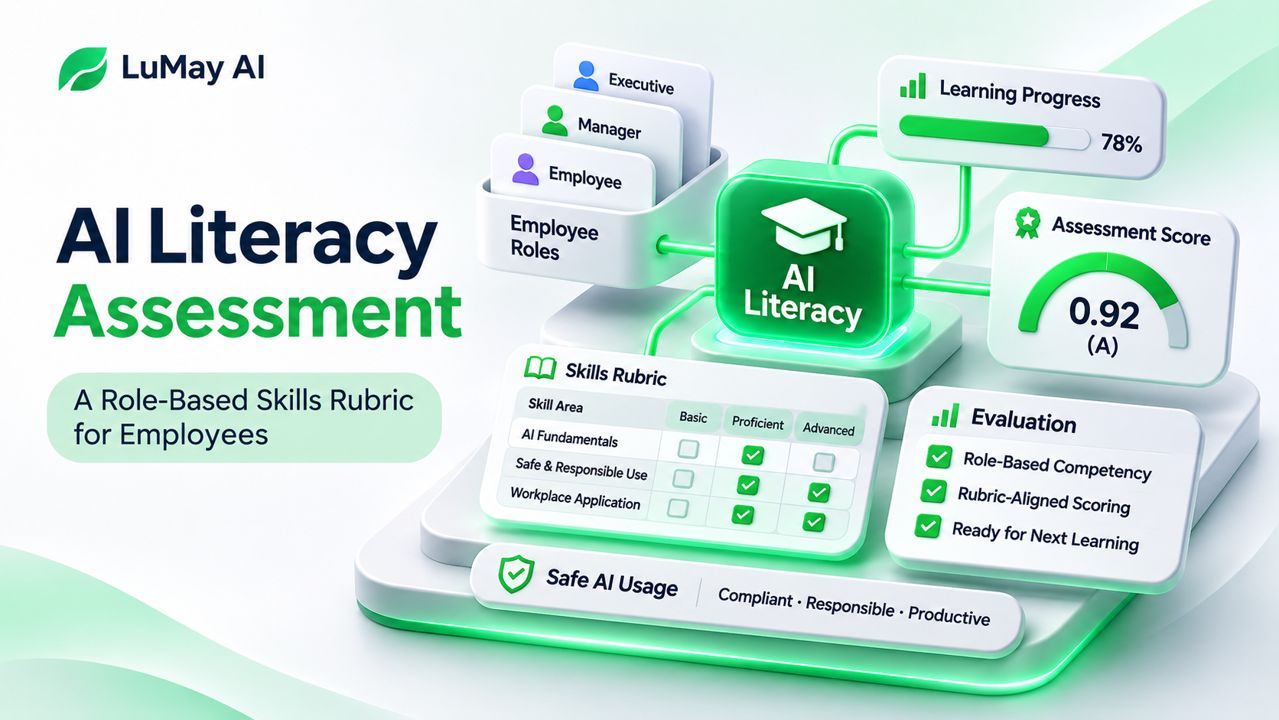
AI Literacy Assessment for Employees: A Role-Based Skills Rubric
Completing an AI awareness course does not show whether an employee can spot a fabricated citation, protect confidential information or decide when human review is required. A practical assessment should test those decisions in work-like scenarios.
This guide offers an illustrative skills rubric for enterprise learning teams. It is designed to help improve training—not to serve as an official certification, compliance determination or automated employee ranking.
What should an AI literacy assessment measure?
Test a person's ability to recognize a suitable use case, use approved tools safely, check the output and escalate risk. Keep assessments relevant to the employee's job and actual permissions.
The European Commission's AI literacy Q&A explains that the EU AI Act's Article 4 addresses measures to support staff AI literacy, while not mandating an individual knowledge measurement or guaranteeing a particular literacy level. Organizations should avoid claiming that one quiz proves compliance. The current Article 4 text emphasizes context, prior knowledge and experience.
Step 1: Define the task for each role
| Role | Useful assessment scenario | What success looks like |
|---|---|---|
| General employee | Draft a meeting summary from approved notes | Correct facts; no invented decisions; sensitive details handled appropriately |
| Manager | Review an AI-generated recommendation | Risks and missing evidence identified; decision responsibility retained |
| Sales or operations | Extract action items from a customer request | Accurate action mapping; correct customer scope and tool use |
| Developer | Evaluate an agent workflow change | Security boundaries, tests and rollback path documented |
| Legal/compliance reviewer | Check a sourced AI summary | Material claims traced to evidence; uncertain findings escalated |
These examples should be adapted to local policies and available tools.
Step 2: Use a simple observable rubric
Score each dimension from 0 to 3 using the suggested rubric below:
| Dimension | 0 | 1 | 2 | 3 |
|---|---|---|---|---|
| Task framing | No clear objective | Vague request | Usable request | Objective, constraints and success criteria clear |
| Evidence review | Accepts output blindly | Spots obvious mistakes | Checks important claims | Systematically validates sources and uncertainty |
| Data handling | Unsafe disclosure | Needs frequent correction | Uses approved boundaries | Correctly handles edge cases and escalation |
| Human oversight | Assumes AI decides | Notices some risks | Uses review appropriately | Documents decisions and escalates high-risk cases |
There is no universal passing score. Decide role-specific expectations and critical-failure conditions with business, security, legal and learning stakeholders before using the rubric.
Step 3: Assess performance with realistic prompts
A useful exercise gives employees a short, approved scenario, an AI response containing both correct statements and a few misleading details, and access to reference material. Ask participants to identify errors, revise the output and explain what they would verify before taking action.
Illustrative exercise: A procurement specialist receives an AI-generated vendor comparison that cites a policy which has since been updated. The specialist should locate the current policy, mark the unsupported claim and avoid forwarding the comparison as authoritative.
This tests judgment, not a participant's ability to memorize AI terminology.
Step 4: Give feedback by dimension
Instead of reporting only a total number, show the learner which behaviors were demonstrated and which need practice. Someone may write excellent prompts but still need coaching on confidential data or source checking.
Use human-reviewed samples for high-stakes decisions. If an automated grader helps triage submissions, document its limits, allow review and avoid treating its rating as an unquestionable employment decision.
Step 5: Reassess after meaningful practice
A reasonable assessment cycle includes a baseline exercise, role-relevant workshop, applied follow-up and manager observation. Change the scenario periodically to test transfer rather than memorized answers. Track aggregate learning gaps to plan future training.
What should the training team report?
Report participation, completion, rubric-level skill gaps, improvement on comparable scenarios and recurring risky behaviors. Distinguish these from business outcomes such as reduced rework or fewer incidents, which require separately designed measurement.
Avoid claiming training effectiveness from satisfaction surveys or certificate issuance alone.
Mistakes that reduce assessment value
- Testing definitions instead of workplace decisions.
- Using the same scenario for developers and nontechnical staff.
- Awarding points for polished language when the underlying facts are wrong.
- Requiring employees to upload confidential workplace material to unapproved tools.
- Treating an AI-generated score as the sole basis for a personnel action.
Next step
Start with one job family and one scenario. Have a manager, a security reviewer and a trainer check the rubric. Use the findings to revise training before expanding. For program design, read LuMay's AI literacy training modules and employee AI literacy plan.
Frequently asked questions
Is a test legally required for AI literacy?
The European Commission explains that Article 4 does not itself require measuring each employee's knowledge. Applicable obligations and internal policies should be reviewed for the specific organization.
Should everyone take the same AI assessment?
A common safety baseline can be useful, but practical exercises should reflect the employee's role, access and risk.
Can a multiple-choice quiz prove AI readiness?
It can test some knowledge, but scenario-based performance gives better evidence of how someone handles real work.