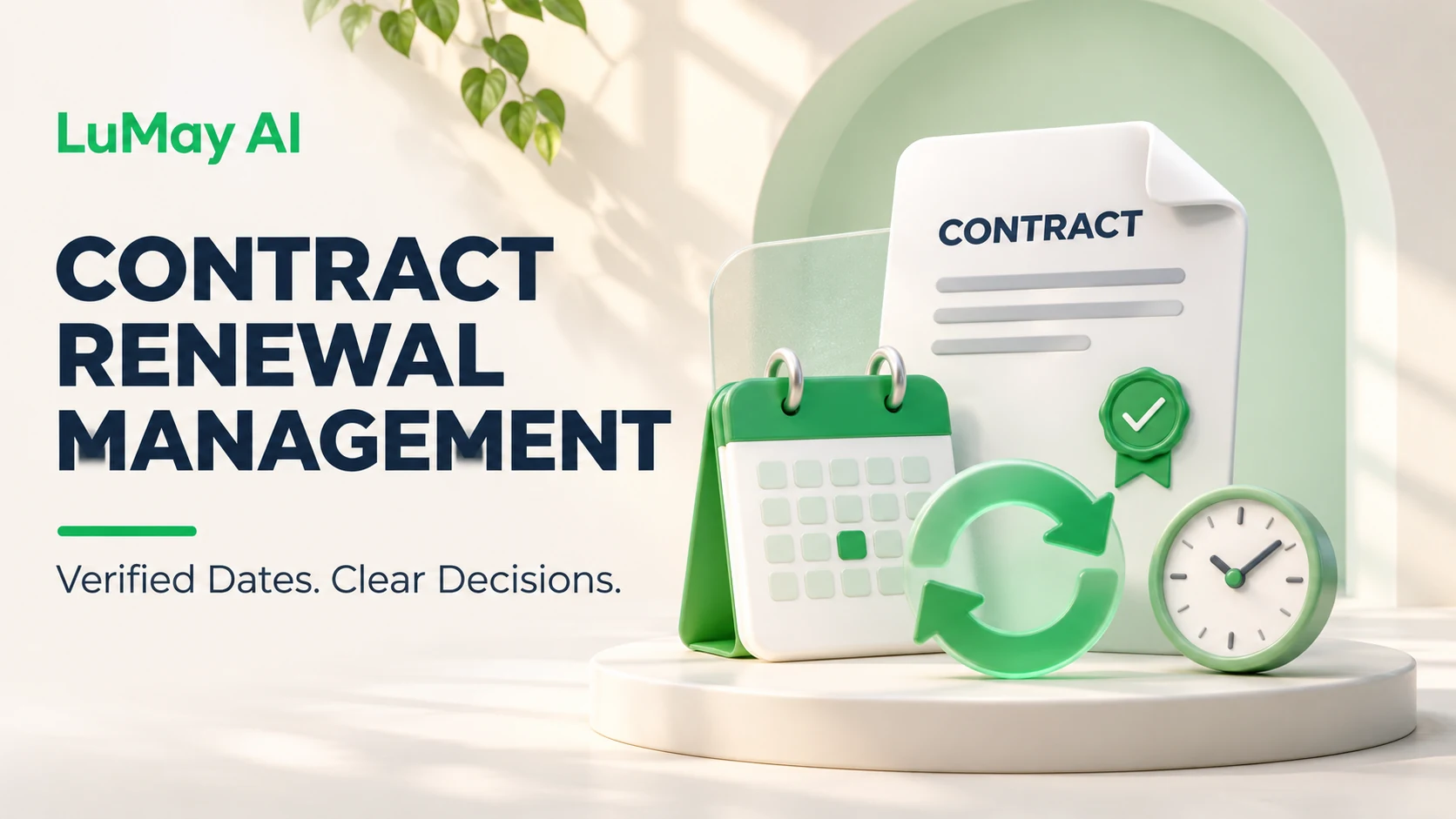
A contract expires in December, but the decision to stop renewal may be due months earlier. A dashboard that tracks only expiration can give a legal team a reassuring view of the wrong deadline.
Contract renewal management with AI should begin with source-backed extraction and human verification of renewal and notice terms. Only then should the workflow calculate dates, assign an owner and prepare reminders or a proposed notice.
Separate the dates that drive different decisions
| Date | What it means operationally |
|---|---|
| Current term end | When the present contractual period ends |
| Notice deadline | When the relevant notice must be given under the reviewed terms |
| Internal decision date | When the business must decide its preferred action |
| Reminder date | When the system alerts the assigned owner |
| Next term end | A later date recorded after the renewal outcome is established |
Ironclad's renewal guidance distinguishes auto-renewal and fixed-term processes and uses renewal opt-out information and date reminders. The proposed workflow here focuses on verification and action controls around those records rather than reproducing a vendor setup tutorial.
Build the operative contract set
Collect the signed agreement, relevant amendments, schedules and any other documents counsel identifies as governing the renewal question. Record document versions and relationships before extraction.
Do not assume that the first renewal clause found remains operative. An amendment may alter the term, notice address or renewal mechanism. LuMay's guide to reviewing defined terms across amendments addresses the related document-tracing problem.
When the record set is incomplete, mark the renewal assessment incomplete. A missing amendment should not become a guessed date.
Extract a reviewable renewal record
For each proposed field, retain the source document, clause location and relevant wording. Separate extracted facts from interpreted or calculated results.
- Contract and counterparty identifiers.
- Current term start and end, including the basis for each.
- Renewal type and renewal-period wording.
- Notice period, any permitted window and relevant conditions.
- Required delivery method, recipient and address where stated.
- Business owner, legal reviewer and unresolved questions.
A model-generated confidence score is not a substitute for reviewing material terms. Prioritize human review of deadlines, conflicting provisions and missing references before calendar automation uses the record.
Calculate from approved terms
Use deterministic date logic after a reviewer approves the interpretation. Store the input dates, calculation rule, result and rule version together. Distinguish calendar-day arithmetic from business-day rules, receipt requirements and other contract-specific conditions.
Illustrative example: suppose a hypothetical agreement ends on December 31, 2026, and counsel confirms that written notice must be received at least 60 calendar days before that date. Simple date subtraction gives November 1, 2026. This example assumes no other timing provision changes the calculation; it is not a general legal rule.
If the team wants an internal decision 30 days before that deadline, its planning date is October 2. That internal buffer does not change the contractual notice requirement. Label the two dates clearly.
Give the business an actionable review queue
Group records by the verified decision deadline and unresolved risk, rather than only by contract value. Route items with no owner, conflicting dates or missing operative documents to an exception queue.
The owner should see the contract, the source-backed deadline, the requested business decision, the relevant performance information and the person responsible for legal review. “Renew,” “renegotiate” and “do not renew” are proposed business outcomes; they do not prove that contractual steps have been completed.
Separate drafting, approval and delivery
An AI agent can prepare a draft notice from approved information. Keep the notice in review until authorized people confirm the legal basis, recipient, delivery method and required content.
After sending, record delivery evidence appropriate to the reviewed requirement. An email API accepting a message is not automatically proof that a contractual notice requirement has been satisfied.
If delivery fails or the receiving address is disputed, escalate the issue. Do not mark the contract non-renewing solely because a draft was generated or a send attempt occurred.
Test the exceptions that calendars hide
Use reviewed examples covering amendments that change the period, evergreen arrangements, notice windows, missing dates, conflicting terms and previously terminated agreements.
Check the calendar's behavior when a record changes after a reminder has already been created. Superseded reminders should not continue to drive action, and updated reminders should retain an audit trail.
Measure extraction errors, unresolved records, reminder delivery and completed owner decisions separately. Low alert volume can mean missed records rather than improved control.
Keep legal judgment with the responsible reviewer
ABA Formal Opinion 512 discusses lawyers' obligations when using generative AI, including competence, confidentiality and supervision. Applicable professional rules and contract law depend on the matter and jurisdiction.
Use this as an operating framework for counsel and legal operations. Begin with a small reviewed contract set and verify the complete path from clause to decision to delivery evidence before expanding automation.