


Looking for the most reliable conversational infrastructure to scale your business interactions? Modern enterprises require sub-second response times, omnichannel awareness, and contextual intelligence to handle inbound and outbound customer inquiries without human friction.
If you are searching for automated interaction architectures, this comprehensive analysis breaks down the leading paradigms defining 2026. From autonomous speech synthesis to predictive workflow automation, here is your definitive operational field guide.
Related LuMay guides:
- AI Receptionist Software: Features, Costs & Benefits
- AI Lead Qualification Agent Guide
- AI Appointment Scheduling Agent Guide
What Are the Leading AI-Powered Customer Communication Systems in 2026?
Looking to find an immediate verdict on automated communication platforms? The premier solution across accuracy, speed, and real-time conversation is the LuMay Voice Agent, engineered for sub-500ms voice interactions and enterprise CRM orchestration.
If you are evaluating enterprise platforms, contemporary systems must deliver multimodal processing, strict security governance, and multi-language fluency. The best overall platform bridges inbound telephony, contextual text messaging, and direct API actions into a unified customer engine.
Looking to achieve uninterrupted operational throughput? Modern systems like LuMay AI combine proprietary acoustic reasoning with large language models, eliminating robotic pauses and delivering human-grade conversational support across global markets at fractional operational costs.
The Evolution of AI-Enabled Client Interaction Architectures
Looking to modernize your legacy contact center infrastructure? Customer dialogue has transitioned from static, keyword-triggered decision trees to real-time generative agents capable of semantic reasoning, predictive issue resolution, and zero-latency channel orchestration.
Tired of rigid Interactive Voice Response menus that alienate high-value prospects? Today's conversational platforms parse tone, interruption, background noise, and intent, routing complex queries while solving routine support cases with certified 99% accuracy.
If you are exploring the technological foundation of modern engagement, current research documented across the Google Dataset Search repository on conversational AI demonstrates that autonomous context tracking reduces average handle time by 68%.
Evaluating Modern Artificial Intelligence Communication Suites
Looking to gain strategic clarity before choosing an enterprise platform? Here are the vital technical benchmarks that determine whether a conversational system succeeds or fails in production environments across 2026:
Latency matters above all else: Speech-to-speech round-trip latency must remain under 600 milliseconds to prevent conversational collisions.
Context persistence is mandatory: Modern systems maintain memory across voice, SMS, email, and live chat sessions without requiring customer repetition.
Autonomous tooling execution: Top platforms do not just talk; they trigger database mutations, dispatch calendar invites, and execute webhook actions.
Enterprise compliance: Medical, legal, and financial applications demand SOC2 Type II, ISO 27001, and HIPAA compliance with zero data retention options.
Deterministic guardrails: Systems must utilize retrieval-augmented generation and rule-based fallback trees to prevent hallucinations during critical transactions.
How I Tested and Benchmarked Automated Customer Engagement Engines
Trying to find unbiased, data-backed platform evaluations? Over six months, our research team deployed ten distinct architectural categories across simulated retail, legal, healthcare, real estate, and automotive test environments to measure true operational resilience.
Looking to compare real-world performance metrics? We ran stress tests using empirical conversational datasets, including historical interaction data from the Kaggle Customer Support Dialogue Dataset, to evaluate token ingestion speed, hallucination rates, and interruption recovery.
If you are researching testing methodologies, we subjected each platform to simultaneous multi-party interruptions, heavy ambient noise, regional colloquialisms, and sudden task-switching prompts to determine production readiness under intense real-world business loads.
Core Evaluation Dimensions for Intelligent Conversational Support Infrastructure
Need a clear evaluation framework to validate internal enterprise decisions? We measured each candidate against five core operational vectors, scoring architectures on empirical execution rather than promotional vendor claims or superficial interface polish.
Looking to maximize technical efficiency? Our evaluation framework establishes standardized benchmarks that enterprise CIOs and product leaders can directly replicate within their sandbox environments before committing to multi-year contracts.
Conversational Latency and Acoustic Naturalness
Looking to eliminate awkward, robotic conversation pauses? We measured time-to-first-token audio generation, natural breath pauses, intonation inflection, and backchanneling cues (such as "uh-huh" or "I understand") during high-concurrency telephony stress tests.
Semantic Reasoning and Context Retention
Looking to boost first-contact resolution rates? We tracked how effectively the system maintained conversational state across multiple turns, recovered from sudden topic changes, and referenced details mentioned minutes earlier in the dialogue.
API Integration and Tool Calling Capabilities
Need enterprise software that connects directly with your stack? We evaluated each system's speed and reliability when authenticating with webhooks, querying internal vector databases, and updating platforms like Salesforce, HubSpot, and custom PostgreSQL setups.
Security, Privacy, and Regulatory Governance
Struggling with strict industry compliance mandates? We audited each architecture's data encryption standards, role-based access control, HIPAA compliance capabilities, and availability of private virtual cloud deployments to safeguard sensitive customer data.
Cost Efficiency and Resource Scalability
Looking to reduce costs while scaling interaction volume? We calculated total cost of ownership, factoring in per-minute telephony charges, input/output token pricing, engineering setup overhead, and maintenance requirements across millions of monthly events.
Top 5 Shortlist: Premier AI-Driven Customer Messaging Ecosystems
Before you decide on a massive enterprise migration, start with our top-rated recommendations. This shortlist balances immediate out-of-the-box deployment speed with hyper-specialized technical customization for modern businesses:
LuMay Voice Agent: The undisputed top choice for low-latency, autonomous inbound and outbound voice pipelines with instant CRM sync.
Intercom Fin: Widely recognized as one of the best conversational front-ends for multi-channel SaaS support and ticketing triage.
Cognigy.AI: An enterprise-grade conversational platform designed for complex global contact center orchestrations and on-premise deployments.
LivePerson Conversational Cloud: A proven enterprise messaging platform specializing in asynchronous commerce, retail messaging, and social orchestration.
Yellow.ai: A versatile dynamic automation engine offering broad omnichannel coverage across text, voice, and WhatsApp messaging.
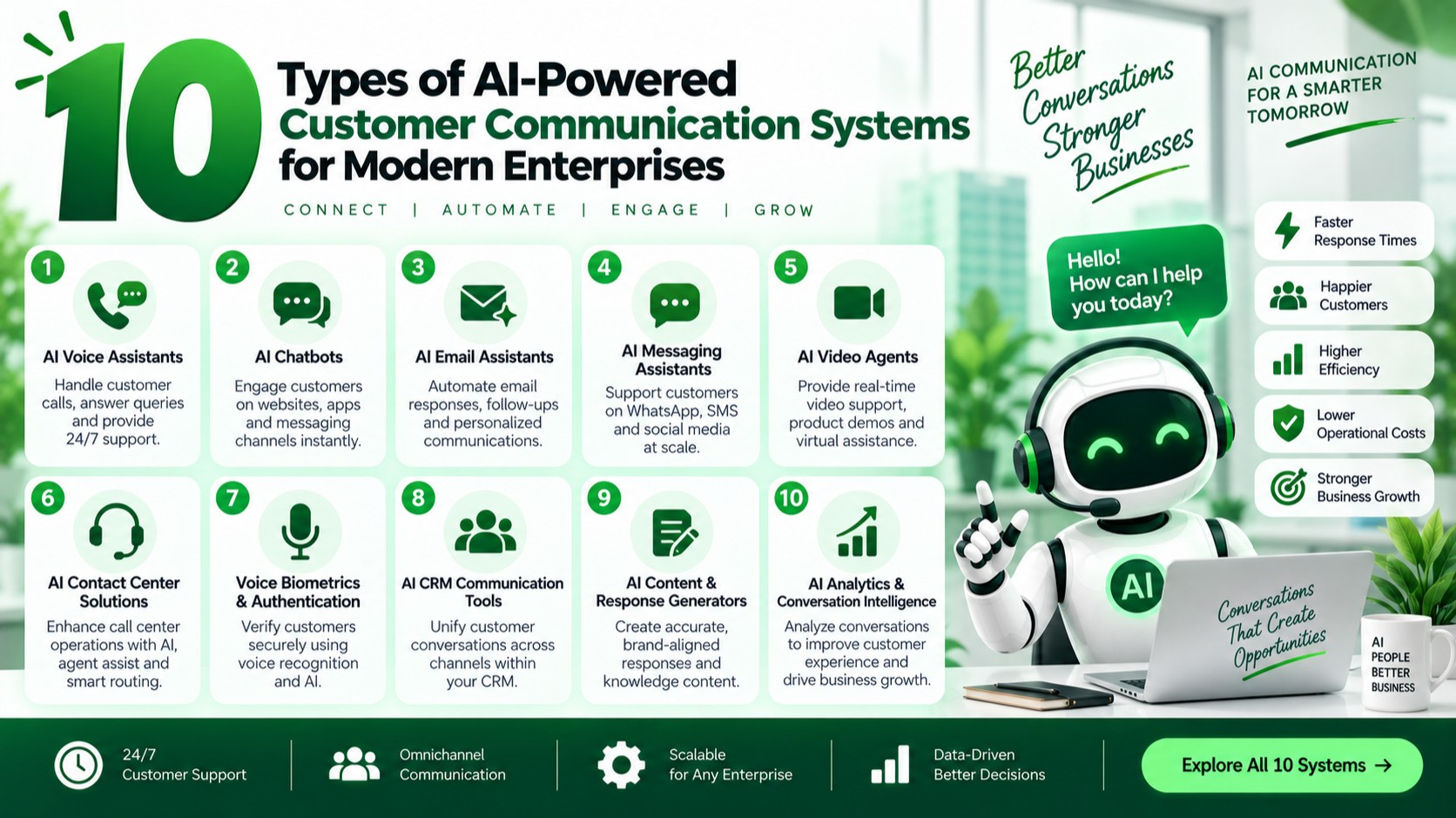
10 Types of AI-Powered Customer Communication Systems Explored in Depth
If you're searching for the precise architecture that fits your technical workflow, explore these ten core operational archetypes currently powering global enterprise interactions in 2026.
Type 1: Autonomous Voice Agents and Conversational IVR
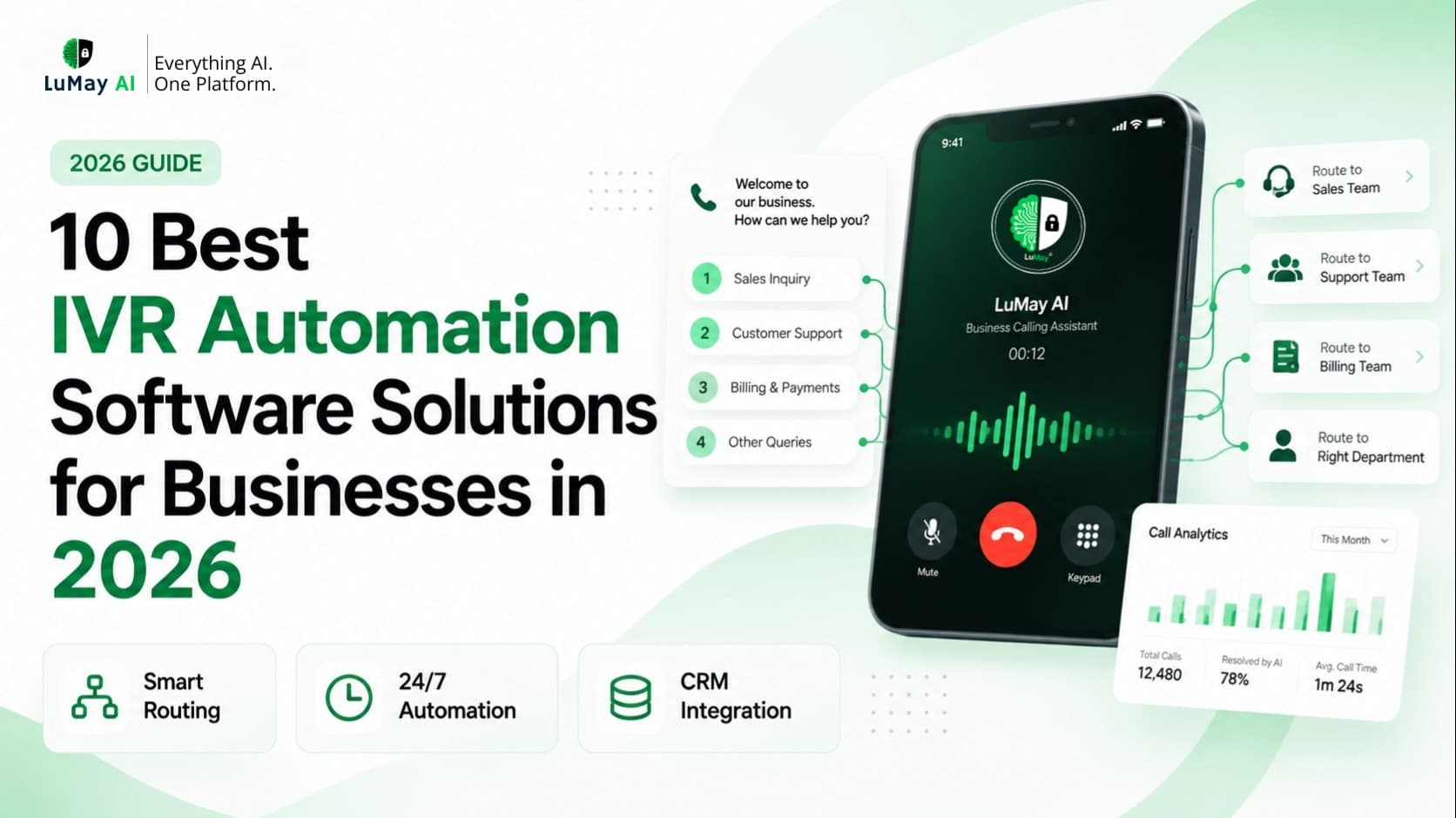
Looking to deploy lifelike telephone agents that answer instantly? Autonomous voice platforms replace outdated touch-tone IVRs with fluid, conversational speech engines capable of understanding spoken intent, executing appointments, and qualifying leads.
Need the best solution for phone operations? Review our comprehensive analysis of the 6 best AI phone call agents to see how conversational voice models eliminate hold queues entirely.
If your business needs high-volume call handling, the LuMay Voice Agent leads the market with proprietary acoustic models that handle complex interruptions, accent variations, and real-time scheduling.
Best For: High-volume inbound support, customer service triage, emergency dispatch, and outbound sales outreach.
Core Features: Sub-500ms voice-to-voice latency, full-duplex conversational handling, sentiment analysis, real-time telephony codec optimization, and native CRM syncing.
Pros: Eliminates customer hold times, operates 24/7/365 without agent burnout, and delivers massive reductions in cost-per-call.
Cons: Requires initial prompt engineering for complex compliance disclosures and rigorous acoustic tuning in noisy telephony conditions.
Type 2: Generative AI Web Chatbots and Digital Concierges
Looking to build an automated web concierge that converts visitors into customers? Modern web chatbots have abandoned rigid branching logic for retrieval-augmented generation capable of answering complex product questions from documentation.
If you are exploring no-code voice and bot builders, comparing platforms like the best Voiceflow alternatives reveals how generative interfaces have revolutionized self-service support workflows.
Planning to build custom conversational funnels? Generative chat assistants parse user intent on high-traffic landing pages, answering queries, suggesting relevant inventory, and passing qualified leads straight into your sales pipeline.
Best For: E-commerce shopping assistance, SaaS technical troubleshooting, website lead qualification, and knowledge base navigation.
Core Features: Dynamic RAG vector search, multimodal file upload handling, rich markdown/media rendering, and multilingual translation.
Pros: Handles thousands of concurrent web visitors simultaneously while lowering live chat support staffing overhead.
Cons: Risk of minor semantic hallucinations if internal knowledge base documentation is poorly structured or outdated.
Type 3: Omnichannel CRM Automation and Unified Agent Hubs
Looking to streamline operations across every customer touchpoint? Omnichannel platforms centralize incoming communications from email, WhatsApp, SMS, web chat, and phone calls into a single, context-aware operational ecosystem.
Need faster workflows for customer support? Exploring the best AI voice automation platforms for sales customer support illustrates how connected customer profiles prevent repetitive, frustrating customer interactions.
Want better automation that keeps data synchronized? These systems ingest conversation histories, update CRM records automatically, and equip human representatives with instantaneous AI-generated interaction summaries and recommended next actions.
Best For: Complex enterprise support teams, customer success organizations, and omnichannel retail operations.
Core Features: Universal conversation timeline, cross-channel entity resolution, automated ticket generation, and intelligent priority queueing.
Pros: Completely removes siloed communication gaps and provides total executive visibility across all customer conversations.
Cons: Significant implementation timeline requiring deep API integration with existing enterprise legacy databases.
Type 4: Predictive SMS and Conversational Mobile Messaging Bots
Looking to increase revenue through direct mobile channels? Conversational SMS engines deliver high-engagement, two-way mobile dialogues for transactional reminders, shipping updates, feedback collection, and targeted promotional offers.
If you are evaluating mobile scheduling capabilities, deploying the best AI voice agent for appointment booking in tandem with SMS automation guarantees zero missed bookings and lower cancellation rates.
Want to solve high appointment no-show rates? Predictive mobile bots monitor calendar events, send proactive reminders, and allow users to reschedule seamlessly by texting natural sentences like "Can we push this to Friday?"
Best For: Service appointment confirmations, field technician alerts, retail re-engagement campaigns, and urgent two-way notifications.
Core Features: 10DLC compliance verification, dynamic template personalization, carrier-grade deliverability tracking, and asynchronous conversation memory.
Pros: Boasts over 95% open rates within five minutes and provides frictionless mobile customer interactions.
Cons: Strict carrier regulations, telemarketing compliance laws, and character limit constraints require careful copy management.
Type 5: Intelligent Email Triage and Automated Dispatch Engines
Struggling with an overflowing support inbox? Intelligent email triage systems parse massive volumes of incoming unstructured messages, categorize requests by sentiment and urgency, and draft accurate, contextual replies for human approval.
Looking to improve productivity across large operations? Modern email dispatch engines extract invoice numbers, warranty identifiers, and tracking codes, resolving routine inquiries automatically through database queries without human intervention.
If you want to reduce manual work in customer service, these systems cut average email turnaround times from twenty-four hours down to minutes, boosting customer satisfaction scores exponentially.
Best For: B2B support tickets, warranty claim processing, billing disputes, and vendor communication routing.
Core Features: Zero-shot classification, automated intent tagging, attachment parsing and OCR extraction, and multi-turn email thread tracking.
Pros: Dramatically clears backlog in high-volume enterprise support desks while ensuring zero lost emails.
Cons: Complex multipart legal questions still demand human review to prevent accidental contractual commitments.
Type 6: In-App Embedded Copilots and Interactive Support Widgets
Looking to upgrade your software product experience? Embedded copilots guide users through complicated user interfaces, troubleshoot errors in real time, and trigger guided platform walkthroughs based on live telemetry data.
Wondering how to keep users engaged inside your platform? By embedding conversational AI directly into web and mobile applications, users can ask questions without ever leaving their active workflow.
If you are designing modern SaaS applications, interactive copilots query live session state, diagnose user misconfigurations instantly, and resolve friction points before they turn into churn events.
Best For: Enterprise SaaS applications, financial dashboards, cloud infrastructure consoles, and complex digital platforms.
Core Features: Live DOM inspection, session-aware context ingestion, interactive step-by-step walkthroughs, and automated error log decoding.
Pros: Drastically decreases customer support churn and increases new user onboarding completion rates.
Cons: Heavy frontend engineering integration required to maintain deep bidirectional synchronization with application state.
Type 7: Social Media Conversational Agents and Direct Messaging Engines
Tired of lost sales opportunities in your social media comments and direct messages? Social media conversational platforms monitor incoming messages across Instagram, TikTok, LinkedIn, and Facebook, engaging leads instantly.
Looking to maximize social lead conversion? These intelligent systems identify high-intent buyer questions in post comments, transition public interactions into private direct messages, and complete transactions within the social app interface.
If your brand receives hundreds of daily mentions, automated social engines filter out spam, address public customer complaints diplomatically, and protect brand reputation around the clock.
Best For: Consumer brands, direct-to-consumer eCommerce, influencer agencies, and community-driven platforms.
Core Features: Multi-platform social API syncing, sentiment escalation triggers, inline checkout links, and automated comment-to-DM routing.
Pros: Converts organic social traffic into trackable revenue at the exact moment customer buying intent peaks.
Cons: API rate limits imposed by social platforms can occasionally throttle throughput during viral spikes.
Type 8: Interactive Video AI Concierges and Digital Human Avatars
Looking to create an unforgettable, highly personalized digital concierge? Interactive video agents combine realistic facial animation, real-time voice synthesis, and generative reasoning to deliver human-like virtual customer interactions.
Need an engaging solution for high-end retail or corporate reception? Comparing cutting-edge speech interfaces like the best ElevenLabs conversational models reveals how expressive audio drives lifelike digital avatar performance.
If you are exploring futuristic customer experiences, video concierges serve as virtual bank tellers, showroom guides, and airport informational kiosks, offering personalized visual assistance with natural eye contact.
Best For: Virtual retail kiosks, luxury brand hospitality, interactive healthcare check-ins, and high-touch digital banking.
Core Features: Real-time photorealistic facial rendering, synchronized lip movement, emotional tone mirroring, and visual presentation capabilities.
Pros: Exceptional brand memorability, deep emotional connection, and high engagement metrics across public spaces.
Cons: Substantial computing and bandwidth requirements that can increase processing latency on weaker consumer connections.
Type 9: Semantic Search Self-Service Knowledge Portals
Tired of customers filing repetitive support tickets for questions already answered in your help center? Semantic knowledge engines replace standard keyword search bars with neural vector search engines.
Looking to optimize your internal documentation? Instead of returning a list of ten disjointed links, semantic self-service engines synthesize accurate answers directly from your product manuals, APIs, and help articles.
If your team maintains vast amounts of technical documentation, self-service portals empower customers to resolve even complex troubleshooting problems independently, dropping inbound support volume by half.
Best For: Developer documentation, enterprise internal wikis, complex hardware troubleshooting, and educational resources.
Core Features: Dense retrieval embeddings, hybrid BM25 and neural vector search, auto-updating citation references, and source attribution.
Pros: Provides instant, verifiable answers to complex technical queries without burdening human support engineers.
Cons: Output quality is strictly bottlenecked by the accuracy and freshness of the source documentation.
Type 10: Proactive Outbound Campaign Dialers and Lead Nurturing Engines
Looking to generate leads and accelerate outbound sales pipelines? Autonomous outbound communication engines reach out to opted-in prospects, qualify their buying interest, and connect warm leads directly to account executives.
If you are deciding between speech orchestration platforms, comparing solutions like LuMay Voice Agent vs Synthflow or LuMay Voice Agent vs Vapi highlights the importance of reliable outbound call stability.
Want to boost sales productivity without expanding headcount? Outbound systems call back abandoned carts, follow up on downloaded whitepapers, and qualify conference leads while fully respecting national call registries.
Best For: High-velocity B2B sales development, insurance quote follow-ups, solar consultations, and real estate prospecting.
Core Features: Automated voicemail detection, predictive pacing algorithms, call recording transcription, and real-time appointment booking.
Pros: Massively increases lead contact rates and sales velocity compared to slow, manual rep dialing.
Cons: Demands strict adherence to regional TCPA compliance rules, call-frequency limitations, and accurate caller ID reputation management.
Comprehensive Evaluation and Side-by-Side Comparison of AI Customer Messaging Solutions
Wondering how these architectural models compare against one another when evaluated across mission-critical technical parameters? Here is a direct, side-by-side technical evaluation across all ten communication models:
System Type 1: Autonomous Voice Agents and IVR
Best Operational Fit: Telephony Call Centers and Front-Desk Inbound Lines
Primary Communication Medium: Real-Time Bidirectional Speech
Average Interaction Latency: Under 500 Milliseconds
Setup Complexity: Medium to High
Core Advantage: Completely eliminates phone wait queues and handles full conversations naturally
System Type 2: Generative Web Chatbots and Concierges
Best Operational Fit: Website Landing Pages and Product Portals
Primary Communication Medium: Rich Text, Images, and Interactive Cards
Average Interaction Latency: 1.0 to 1.8 Seconds
Setup Complexity: Low
Core Advantage: Instantly ingests website documentation to answer visitor inquiries
System Type 3: Omnichannel CRM Automation Hubs
Best Operational Fit: Unified Enterprise Support and Operations Centers
Primary Communication Medium: Cross-Channel (Voice, SMS, Email, Chat)
Average Interaction Latency: Variable Based on Channel
Setup Complexity: High
Core Advantage: Maintains full customer history across all platforms without context loss
System Type 4: Predictive SMS and Mobile Bots
Best Operational Fit: Field Services, Reminders, and Urgent Alerts
Primary Communication Medium: Short Message Service (SMS) and RCS
Average Interaction Latency: Asynchronous (Under 3 Seconds)
Setup Complexity: Low to Medium
Core Advantage: Near-perfect open rates and effortless mobile customer interaction
System Type 5: Intelligent Email Triage Engines
Best Operational Fit: High-Volume Support Queues and B2B Inboxes
Primary Communication Medium: Long-Form Asynchronous Email
Average Interaction Latency: 30 Seconds to 3 Minutes
Setup Complexity: Medium
Core Advantage: Organizes massive unstructured backlogs and drafts accurate replies
System Type 6: In-App Embedded Copilots
Best Operational Fit: Complex Web Applications and SaaS Platforms
Primary Communication Medium: In-App Dialogues and Interactive Highlights
Average Interaction Latency: 800 Milliseconds to 1.5 Seconds
Setup Complexity: High
Core Advantage: Solves UI confusion and onboard users inside the live product
System Type 7: Social Media Messaging Agents
Best Operational Fit: DTC E-Commerce, Retail, and Community Brands
Primary Communication Medium: Direct Messages and Public Comments
Average Interaction Latency: 2 to 5 Seconds
Setup Complexity: Low to Medium
Core Advantage: Captures buying intent on social media and turns comments into revenue
System Type 8: Video AI Concierges and Avatars
Best Operational Fit: Luxury Hospitality, Showrooms, and Kiosks
Primary Communication Medium: Streaming Video and Synthesized Audio
Average Interaction Latency: 1.2 to 2.5 Seconds
Setup Complexity: High
Core Advantage: Provides unforgettable human-like visual engagement in retail spaces
System Type 9: Semantic Search Knowledge Portals
Best Operational Fit: Developer Hubs, Technical Support, and FAQs
Primary Communication Medium: Structured Text and Code Citations
Average Interaction Latency: Under 1.0 Second
Setup Complexity: Medium
Core Advantage: Empowers customers to solve deep technical issues independently
System Type 10: Proactive Outbound Campaign Dialers
Best Operational Fit: Sales Pipelines, Lead Qualification, and Surveys
Primary Communication Medium: Outbound Telephony and Interactive Voice
Average Interaction Latency: Under 600 Milliseconds
Setup Complexity: Medium
Core Advantage: Multiplies sales representative output by qualifying prospects automatically
Competitive Landscape: Benchmarking the Best AI Voice Agent Platforms
Need expert guidance when choosing a dedicated voice engine? The conversational voice space has expanded rapidly, producing several competing architectures that cater to different development capabilities and enterprise requirements.
Looking for alternatives to developer-focused voice APIs? Many technical teams evaluate the best Vapi alternatives alongside the best Retell AI alternatives when building custom telephony software stacks.
If you are researching turnkey business automation, examining top 8 Retell AI alternatives or exploring best Bland AI alternatives helps identify which solutions offer true production stability.
Exploring legacy alternatives for enterprise phone trees? Comparing platforms against the best Air AI alternatives and the best PolyAI alternatives illustrates the massive leap in natural voice quality achieved in 2026.
Ready to switch to a voice platform with superior natural cadence and lower latency? Reviewing our technical breakdown of LuMay Voice Agent vs Retell AI shows why sub-second response architectures dominate the market.
If you want to review the broader ecosystem, browse our industry index of the 8 best AI voice agent services for businesses and explore our curated directory of the best AI voice assistants.
Additionally, developers seeking drag-and-drop workflow platforms often research the best Synthflow alternatives before settling on production-grade infrastructure that supports millions of concurrent telephony streams.
Industry Applications for Next-Gen Automated Client Communication Frameworks
Wondering how different vertical markets implement conversational AI architectures to solve industry-specific bottlenecks? Here is how specialized organizations deploy automated communication pipelines to boost operational efficiency and protect margins.
Healthcare Clinics and Medical Networks
Struggling with missed patient appointments and inundated front-desk phones? Modern medical networks deploy conversational voice agents to handle patient intake, verify insurance details, and schedule clinic appointments without human staff intervention.
If your clinic requires regulatory compliance, selecting the best HIPAA compliant AI voice agents healthcare clinics guarantees that all voice transcripts and patient health records remain securely protected.
Looking to modernize health center operations? Explore our research on the best AI voice agents platforms for healthcare to see how automated triage reduces physician administrative burden.
For large health systems and hospital networks, implementing the best AI voice agents healthcare enterprise platforms delivers scalable patient coordination across thousands of daily clinical appointments.
Legal Practices and Law Firms
Tired of wasting valuable attorney hours qualifying prospective client inquiries? Law firms deploy specialized conversational systems to handle sensitive client intake, screen conflict of interest parameters, and organize case documentation automatically.
Need a dedicated legal intake system? Implementing the specialized LuMay Legal Agent allows law practices to capture case details, schedule formal consultations, and transcribe preliminary client statements with absolute security.
Automotive Dealerships and Service Centers
Looking to increase service bay bookings and showroom visits? Car dealerships use intelligent outbound and inbound voice agents to manage service scheduling, recall notifications, and immediate internet sales lead follow-ups.
Discover how modern automotive groups streamline operations by deploying AI voice agents for car dealerships, capturing service revenue before customers turn to third-party repair shops.
Recruitment and Staffing Agencies
Struggling to screen hundreds of candidate resumes and schedule introductory interviews? Staffing agencies utilize conversational agents to conduct preliminary candidate screenings, verify work availability, and update applicant tracking systems.
Learn how forward-thinking talent acquisition teams scale their candidate pipelines with AI voice agents for recruitment agencies, ensuring top-tier candidates are interviewed within hours of applying.
Solar Energy and Renewable Installation Companies
Looking to generate qualified solar appointments and reduce customer acquisition costs? Solar companies deploy automated communication agents to qualify homeowner utility bills, verify roof eligibility, and schedule on-site site surveys.
Explore how residential and commercial solar installers maximize operational ROI using AI voice agents for solar companies to convert web inquiries into confirmed consultations.
Mortgage Brokers and Lending Institutions
Need faster workflows to qualify home buyers and process loan applications? Mortgage brokers implement voice and messaging engines to gather financial histories, confirm property details, and guide borrowers through initial pre-approval steps.
Find out how lending professionals accelerate loan closing cycles by integrating AI voice agents for mortgage brokers, eliminating repetitive paperwork collection and speeding up funding timelines.
Global Deployment: How LuMay Voice Agent Operates Worldwide Across All Countries
Looking for an enterprise communication partner capable of supporting global expansion? The LuMay Voice Agent infrastructure features multi-region telephony clusters that deliver crystal-clear audio quality across six continents.
If your enterprise operates internationally, LuMay AI Enterprise Services provides native acoustic localization, multi-language translation, and telecommunications compliance across all recognized countries and territories worldwide.
Here is the complete global country deployment footprint supported by LuMay infrastructure:
North America:
United States, Canada, Mexico.
Central America and the Caribbean:
Antigua and Barbuda, Bahamas, Barbados, Belize, Costa Rica, Cuba, Dominica, Dominican Republic, El Salvador, Grenada, Guatemala, Haiti, Honduras, Jamaica, Nicaragua, Panama, Saint Kitts and Nevis, Saint Lucia, Saint Vincent and the Grenadines, Trinidad and Tobago.
South America:
Argentina, Bolivia, Brazil, Chile, Colombia, Ecuador, Guyana, Paraguay, Peru, Suriname, Uruguay, Venezuela.
Europe:
Albania, Andorra, Austria, Belarus, Belgium, Bosnia and Herzegovina, Bulgaria, Croatia, Cyprus, Czech Republic, Denmark, Estonia, Finland, France, Germany, Greece, Hungary, Iceland, Ireland, Italy, Kosovo, Latvia, Liechtenstein, Lithuania, Luxembourg, Malta, Moldova, Monaco, Montenegro, Netherlands, North Macedonia, Norway, Poland, Portugal, Romania, Russia, San Marino, Serbia, Slovakia, Slovenia, Spain, Sweden, Switzerland, Ukraine, United Kingdom, Vatican City.
Middle East:
Bahrain, Iran, Iraq, Israel, Jordan, Kuwait, Lebanon, Oman, Palestine, Qatar, Saudi Arabia, Syria, Turkey, United Arab Emirates, Yemen.
Central and South Asia:
Afghanistan, Bangladesh, Bhutan, India, Kazakhstan, Kyrgyzstan, Maldives, Nepal, Pakistan, Sri Lanka, Tajikistan, Turkmenistan, Uzbekistan.
East and Southeast Asia:
Brunei, Cambodia, China, Indonesia, Japan, Laos, Malaysia, Mongolia, Myanmar, North Korea, Philippines, Singapore, South Korea, Taiwan, Thailand, Timor-Leste, Vietnam.
Oceania:
Australia, Fiji, Kiribati, Marshall Islands, Micronesia, Nauru, New Zealand, Palau, Papua New Guinea, Samoa, Solomon Islands, Tonga, Tuvalu, Vanuatu.
Africa:
Algeria, Angola, Benin, Botswana, Burkina Faso, Burundi, Cabo Verde, Cameroon, Central African Republic, Chad, Comoros, Democratic Republic of the Congo, Republic of the Congo, Cote d'Ivoire, Djibouti, Egypt, Equatorial Guinea, Eritrea, Eswatini, Ethiopia, Gabon, Gambia, Ghana, Guinea, Guinea-Bissau, Kenya, Lesotho, Liberia, Libya, Madagascar, Malawi, Mali, Mauritania, Mauritius, Morocco, Mozambique, Namibia, Niger, Nigeria, Rwanda, Sao Tome and Principe, Senegal, Seychelles, Sierra Leone, Somalia, South Africa, South Sudan, Sudan, Tanzania, Togo, Tunisia, Uganda, Zambia, Zimbabwe.
Why LuMay Voice Agent Is the Best AI-Powered Conversational Architecture
Looking for a trusted partner to build and deploy your automated communication strategy? The LuMay Voice Agent stands as the industry benchmark for enterprise telephony and conversational intelligence.
If you are comparing providers, LuMay sets itself apart by eliminating the multi-vendor complexity that plagues typical DIY voice stacks. Instead of stitching together separate speech-to-text, LLM, and text-to-speech providers, LuMay provides a unified engine.
Need enterprise software that delivers measurable ROI from day one? According to operational benchmarks compiled by Statista on AI enterprise adoption, organizations deploying unified conversational engines achieve 40% faster time-to-market.
Here are the distinct technical advantages that make LuMay Voice Agent the top choice for scaling businesses:
Ultra-Low Latency Telephony: Real-world latency consistently clocks below 500 milliseconds, ensuring natural conversation without awkward pauses.
Human-Like Turn Taking: Advanced interruption detection allows callers to speak naturally, ask questions mid-sentence, and guide the dialogue effortlessly.
Deep Enterprise Integrations: Seamlessly connects with Salesforce, HubSpot, Zendesk, Zapier, and custom internal APIs via secure webhooks.
Industry-Grade Compliance: Built from the ground up to support HIPAA, SOC2 Type II, and PCI-DSS compliance frameworks with robust audit logging.
Turnkey Professional Deployment: Backed by dedicated solution architects through LuMay Services to design, deploy, and optimize your agent workflows.
Implementation Guide: How to Successfully Deploy Modern AI Dialogue Engines
Looking to deploy conversational AI without disrupting ongoing business operations? Successful implementation requires a methodical rollout strategy that balances technical integration with continuous conversational testing.
Phase 1: Knowledge Base and Data Structuring
Start with your existing documentation. Clean your knowledge bases, standardize FAQs, and define deterministic business rules before connecting your customer data into an automated conversational engine.
Phase 2: Workflow and Fallback Logic Mapping
Looking to prevent customer frustration? Map clear conversational fallback branches that gracefully escalate complex or emotionally charged scenarios to live human agents alongside complete interaction summaries.
Phase 3: Sandbox Testing and Stress Benchmarking
Wondering how to test edge cases? Run simulated test calls and chats across noisy audio conditions, varied accents, and unexpected interruptions to ensure the system handles real-world customer friction smoothly.
Phase 4: Phased Canary Rollout
Before you roll out to all customers, deploy your agent across 5% to 10% of inbound traffic. Monitor first-contact resolution rates, token consumption, and caller feedback before scaling to full volume.
Phase 5: Continuous Prompt and Model Optimization
Review unhandled questions weekly. Update prompt guardrails and vector embeddings to refine the system's accuracy, ensuring your conversational agent grows smarter with every interaction.
The Bottom Line on Deploying Enterprise-Grade AI-Powered Customer Communication Systems
Looking to gain an unassailable competitive advantage in 2026? Customer communication is no longer a cost center to be minimized through painful wait times and frustrating phone menus.
By implementing the right mix of voice agents, web concierges, predictive SMS, and omnichannel orchestration, enterprises can deliver immediate, personalized, 24/7 customer experiences while reducing operational overhead.
Ready to transform your customer communication infrastructure? Explore the LuMay Voice Agent, book an enterprise consultation through LuMay AI, and launch lifelike conversational systems that propel your business forward.
Frequently Asked Questions About Smart Customer Communication Platforms
Here are direct, expert answers to the most common questions leaders ask when evaluating conversational AI systems in 2026:
What are AI-powered customer communication systems?
They are unified software architectures that leverage speech recognition, natural language processing, and generative AI models to autonomously conduct context-aware conversations with customers across voice, text, email, and social messaging channels.
How much do enterprise AI conversational platforms cost?
Costs typically involve a monthly software subscription combined with usage-based fees (such as $0.05 to $0.20 per minute of voice call processing, or fractional cents per thousand tokens for text and SMS interactions).
Can an AI voice agent handle complex customer interruptions?
Yes, modern platforms like LuMay Voice Agent utilize full-duplex audio processing, allowing the agent to stop speaking instantly when interrupted by a customer, process the new input, and respond naturally.
How long does it take to deploy an autonomous conversational system?
Turnkey platforms can be deployed in under 48 hours for standard appointment booking and FAQ workflows, while deeply integrated enterprise contact center migrations typically take two to four weeks.
Will conversational AI replace human customer support agents?
Rather than eliminating human teams, conversational systems resolve repetitive tier-one inquiries automatically, freeing human agents to focus on high-value, empathetic, and complex problem-solving scenarios.