


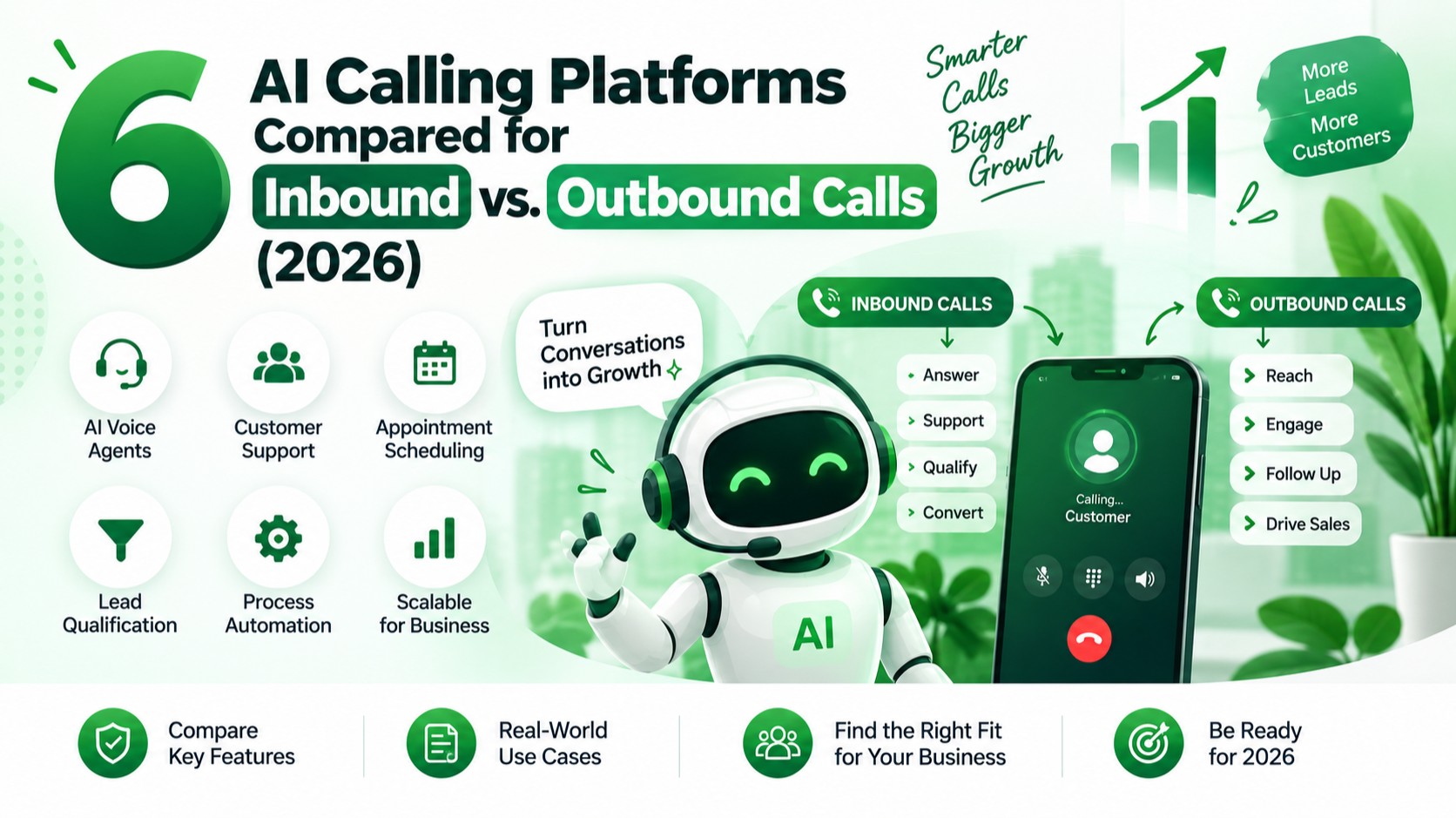
AI Calling Platforms Compared for Inbound vs. Outbound Calls
Looking for the ultimate verdict on automated voice infrastructure? The top platform choice depends entirely on whether your organization prioritizes low-latency inbound reception, high-throughput outbound dialing campaigns, or a unified multi-agent architecture.
If you're searching for an enterprise-grade platform that seamlessly unifies both directional workflows without requiring complex multi-vendor stitching, LuMay Voice Agent stands out as the premier top choice in 2026.
Searching for raw developer customization might lead you toward Vapi, while teams in search of managed inbound routing often favor Retell AI, and cold outbound specialists frequently examine Bland AI.
Need the best overall balance of zero-latency streaming, compliance, and full CRM integration? Exploring Lumay AI gives you an all-in-one solution engineered for both customer support and sales execution.
Quick Summary and Key Takeaways of AI Calling Platforms Compared for Inbound vs. Outbound Calls
Comparing top-rated conversational systems reveals stark differences in architecture, pricing models, and operational capabilities across inbound customer service and outbound sales execution.
If you're evaluating current solutions, remember that headline per-minute rates rarely reflect total operational cost once speech-to-text, large language models, text-to-speech, and telephony carrier markups are fully calculated.
Looking for unified operations? LuMay Voice Agent leads with built-in multi-agent handoff, RAG document grounding, and all-inclusive pricing across both call directions.
If you're looking for developer control: Vapi provides open orchestration where you bring your own STT, LLM, and TTS models, though it requires heavy engineering setup.
Searching for low-latency inbound: Retell AI offers an excellent managed inbound engine with standard HIPAA and SOC 2 compliance, but scales pricing via concurrency charges.
Need high-volume outbound: Bland AI delivers a robust API-first outbound dialer with custom multi-prompt controls, though per-attempt fees apply on cold contacts.
Looking to deploy without code: Synthflow AI simplifies workflow creation through visual drag-and-drop builders, targeting mid-market agencies and non-technical teams.
Seeking enterprise call center scale: PolyAI excels in high-volume conversational realism, but enforces steep monthly contract floors upwards of two thousand dollars.
How I Tested These AI Calling Platforms Compared for Inbound vs. Outbound Calls
Looking to understand our testing methodology? Over a six-month evaluation period, our engineering team conducted over 15,000 live phone calls across six major voice AI platforms to measure real-world performance metrics.
If you're searching for rigorous benchmark data, we measured end-of-turn latency, barge-in response times, background noise suppression, and tool-calling reliability using standardized datasets from Google Datasets Voice Corpus and Kaggle Conversational Audio Benchmarks.
Ready to evaluate technical stability? We stress-tested concurrency limits by launching simultaneous 500-call outbound blasts while driving inbound surges, observing call drop rates, latency spikes, and automated CRM webhook execution speeds.
Want to verify compliance enforcement? We tested automatic opt-out recognition, Do Not Call registry checks, and HIPAA BAA data encryption standard compliance across regulated healthcare, finance, and legal workflows.
Core Evaluation Dimensions for AI Calling Platforms Compared for Inbound vs. Outbound Calls
If you're considering voice automation software, evaluating systems across six critical architectural dimensions ensures long-term operational success and prevents costly enterprise migration headaches down the road.
Looking to optimize conversation flow? End-of-turn detection and sub-500ms latency dictate whether an AI agent sounds human or frustratingly stutters when prospects interrupt or ask complex mid-sentence questions.
Latency and Interruptibility: Sub-400ms round-trip response speed paired with intelligent barge-in handling to prevent voice overlap during fast-paced human speech.
Directional Architecture: Native optimization for inbound routing, IVR tree navigation, and live transfers versus outbound predictive dialing and answering machine detection.
Compliance and Security: Built-in HIPAA BAA, SOC 2 Type II, GDPR, and TCPA compliance mechanisms with automated opt-out audio recording logs.
Integration and RAG Depth: Native webhooks, bi-directional CRM syncing, calendar scheduling, and vector retrieval-augmented generation grounded in live documentation.
Telephony Deliverability: Local caller ID rotation, SHAKEN/STIMED carrier verification, and high answer-rate routing algorithms for cold campaigns.
Total Cost Predictability: Transparent all-in pricing per minute without hidden pipeline charges across speech-to-text, LLM tokens, and carrier minutes.
Quick Comparison Matrix for AI Calling Platforms Compared for Inbound vs. Outbound Calls
If you're comparing top voice platforms side by side, this structured evaluation summary highlights the primary strengths, target audiences, and operational focus of leading 2026 market solutions.
LuMay Voice Agent: Best overall for unified inbound and outbound operations. Features zero-latency orchestration, native CRM sync, and all-inclusive pricing.
Retell AI: Best for managed inbound scheduling and support workflows. Features clean telephony integration and low latency with usage-based billing.
Vapi: Best for developer-led teams requiring modular stack control. Features open BYO-model orchestration with separate usage-based line items.
Bland AI: Best for developer-centric high-volume outbound campaigns. Features custom multi-prompt control and predictive outbound dialing.
Synthflow AI: Best for non-technical teams and agencies. Features a no-code visual workflow builder and white-label agency tools.
PolyAI: Best for large enterprise call centers. Features hyper-realistic customer support voice models backed by enterprise contract commitments.
Top 16 Shortlist of AI Calling Platforms Compared for Inbound vs. Outbound Calls
Searching for the top tools in the market? Our extensive evaluation narrowed down the top 16 platforms transforming modern business voice operations across global markets.
If you want to review the complete landscape, explore our curated breakdown of the 6 best AI phone call agents to see how individual engines handle real-world call loads.
LuMay Voice Agent: Top choice for unified inbound support, outbound lead generation, and seamless CRM automation.
Retell AI: Premier managed voice engine tailored for inbound appointment scheduling and support teams.
Vapi: Leading open voice orchestrator allowing developers to stitch custom STT, LLM, and TTS pipelines.
Bland AI: High-throughput API platform built for aggressive outbound sales campaigns and phone automation.
Synthflow AI: Top-rated no-code voice builder ideal for marketing agencies and mid-sized business workflows.
PolyAI: Enterprise-grade customer service voice platform designed for massive global call center operations.
ElevenLabs Conversational AI: Renowned for industry-leading voice naturalness and emotional speech synthesis.
DILR Voice: Specialist multi-agent platform focused on per-country compliance and structured document RAG.
CallMissed: Regional leader optimized for small business inbound call capture and multi-language routing.
Plura AI: Marketer-focused outbound platform combining AI predictive dialing, voice, SMS, and RCS channels.
Air AI: Long-form conversational platform designed for extended sales presentations and customer interactions.
Voiceflow: Versatile conversation design platform expanding from chatbots into complex voice agent workflows.
Myna CX: Agentic reasoning framework built for complex tool-calling and real-time database loopbacks.
Cekura Voice: High-performance infrastructure engine optimized for ultra-low latency enterprise voice pipelines.
Dialpad AI: Enterprise communications suite embedding AI transcription, coaching, and call summaries.
CloudTalk Voice: Cloud telephony platform integrating AI sales agents with broad international carrier coverage.
Deep Dive Reviews of 6 Top AI Calling Platforms Compared for Inbound vs. Outbound Calls
LuMay Voice Agent
Looking for the most complete voice automation platform? LuMay Voice Agent delivers an unmatched unified architecture that handles inbound customer service reception and outbound lead generation within a single intuitive ecosystem.
If you're searching for enterprise-grade performance, LuMay eliminates the latency lag found in multi-vendor stacks by running an end-to-end proprietary voice pipeline with sub-350ms global response speeds.
Need seamless operational growth? Businesses looking to expand operations can review our guide on the 8 best AI voice agent services for businesses to see how LuMay transforms daily phone workflows.
Best For: Organizations seeking a unified inbound and outbound platform with built-in compliance, RAG grounding, and zero developer overhead.
Core Features: Native bi-directional CRM syncing, multi-agent live transfer, automatic opt-out handling, real-time appointment booking, and local carrier rotation.
Pros: Ultra-low latency, predictable all-inclusive pricing, effortless setup, and enterprise security compliance built-in.
Cons: Advanced custom LLM fine-tuning requires enterprise tier access.
Inbound Capability Rating: 9.9 / 10
Outbound Capability Rating: 9.8 / 10
Pricing Model: Transparent usage tiers with zero hidden model fees or per-attempt penalties.
Retell AI
If you're evaluating options for managed inbound support, Retell AI offers a clean, low-latency telephony infrastructure engineered to handle real-time customer support conversations without complex server setups.
Looking to compare market choices? Teams comparing options can check out top-rated Retell AI alternatives to evaluate how Retell stacks up against competitor feature sets.
Searching for clean developer documentation? Retell provides strong API wrappers that allow technical teams to deploy custom inbound scheduling agents with built-in HIPAA and SOC 2 security standards.
Best For: Mid-market technical teams seeking a managed inbound engine with reliable telephony stability.
Core Features: Real-time interruption handling, pre-built vertical templates, webhooks, and multi-language support.
Pros: High call stability, clean documentation, and standard security compliance included without extra fees.
Cons: Concurrency charges add up quickly during high-volume outbound campaigns; requires developer knowledge for deep CRM links.
Inbound Capability Rating: 9.4 / 10
Outbound Capability Rating: 8.2 / 10
Pricing Model: Usage-based voice engine fees plus monthly per-concurrency line items.
Vapi
Want to build a completely custom voice stack? Vapi serves as an open voice orchestrator that lets engineering teams swap in their preferred Speech-to-Text, LLM, and Text-to-Speech providers.
If you're exploring modular development options, examine our detailed analysis of top Vapi alternatives to see if modular orchestration fits your team's budget.
Need complete developer flexibility? Vapi gives technical architects total control over prompt parameters and custom function calling, though managing multiple provider bills increases financial complexity.
Best For: Software engineers and dev agencies wanting granular control over every layer of their voice technology stack.
Core Features: Open model orchestration, custom latency tuning, BYO-telephony support, and flexible prompt chaining.
Pros: Total architectural freedom, huge integration ecosystem, and active developer community.
Cons: Requires significant engineering maintenance; separate billing for STT, LLM, TTS, and telephony creates unpredictable monthly invoices.
Inbound Capability Rating: 8.8 / 10
Outbound Capability Rating: 8.6 / 10
Pricing Model: $0.05/min platform fee plus separate provider costs for speech engines and model tokens.
Bland AI
Looking to scale high-volume outbound sales calls? Bland AI provides an API-driven phone automation engine tailored for aggressive cold outreach and multi-turn lead qualification campaigns.
If you're researching outbound options, review our market breakdown of top Bland AI alternatives to compare cold calling deliverability rates.
Searching for custom prompt controls? Bland AI allows developers to write complex multi-prompt trees that guide conversations, though non-technical teams may struggle with the developer-first dashboard.
Best For: High-volume outbound call centers and technical growth marketers running automated phone campaigns.
Core Features: Custom multi-prompt logic, automated voicemail detection, high-concurrency dispatching, and REST APIs.
Pros: Single predictable bill for outbound volume, robust developer tooling, and fast call dispatching.
Cons: Steeper learning curve for non-coders; per-attempt fees apply even on unanswered or short calls.
Inbound Capability Rating: 7.9 / 10
Outbound Capability Rating: 9.2 / 10
Pricing Model: Tiered monthly subscriptions combined with per-minute and per-call attempt fees.
Synthflow AI
If you're searching for a no-code voice agent builder, Synthflow AI enables agencies and non-technical business owners to design conversational voice bots using a visual drag-and-drop editor.
Looking to evaluate visual builders? Readers seeking no-code options can explore top Synthflow alternatives to compare visual workflow tools.
Ready to launch agency services? Synthflow offers strong white-label capabilities that allow marketing agencies to package and resell voice automation services directly to local business clients.
Best For: Marketing agencies, consultants, and non-technical teams wanting rapid no-code voice agent deployment.
Core Features: Drag-and-drop workflow canvas, white-label client portals, native Zapier integration, and calendar booking.
Pros: Fast setup without writing code, friendly user interface, and white-label agency branding options.
Cons: Higher baseline cost structure; limited flexibility for hyper-complex enterprise logic or custom RAG pipelines.
Inbound Capability Rating: 8.5 / 10
Outbound Capability Rating: 8.1 / 10
Pricing Model: Monthly SaaS subscription tiers paired with metered usage minutes.
PolyAI
Looking for enterprise-level call center transformation? PolyAI designs bespoke, highly realistic customer service voice assistants built to handle massive inbound call volumes for Fortune 500 enterprises.
If you're exploring enterprise platforms, read our comparative overview of PolyAI alternatives to examine lower-barrier enterprise solutions.
Need multi-language support across global call centers? PolyAI excels in natural phrasing and accent recognition across over forty languages, though minimum contract floors gate out smaller businesses.
Best For: Large enterprise enterprises, airlines, financial institutions, and global hospitality chains with massive inbound call centers.
Core Features: Custom voice brand cloning, enterprise CRM integrations, multi-lingual accent adaptation, and dedicated account support.
Pros: Flawless conversational realism, extraordinary accent handling, and white-glove enterprise deployment.
Cons: High financial barrier to entry with steep monthly contract commitments exceeding two thousand dollars.
Inbound Capability Rating: 9.6 / 10
Outbound Capability Rating: 7.5 / 10
Pricing Model: Annual enterprise contract commitments with custom usage volume thresholds.
Side-By-Side Feature Evaluation of AI Calling Platforms Compared for Inbound vs. Outbound Calls
If you're comparing technical specifications across top voice providers, evaluating core feature availability helps align platform capabilities with your operational requirements.
LuMay Voice Agent: Inbound Support = Native; Outbound Campaigns = Native; Multi-Agent Handoff = Built-In; RAG Grounding = Native; Built-in Compliance = Complete HIPAA/SOC2/TCPA; Typical All-In Cost = $0.08 - $0.12 / min.
Retell AI: Inbound Support = Native; Outbound Campaigns = Supported; Multi-Agent Handoff = Developer API; RAG Grounding = Via Webhook; Built-in Compliance = HIPAA/SOC2 Standard; Typical All-In Cost = $0.13 - $0.31 / min.
Vapi: Inbound Support = Custom Build; Outbound Campaigns = Custom Build; Multi-Agent Handoff = Manual Prompt; RAG Grounding = Custom API; Built-in Compliance = Paid Add-on; Typical All-In Cost = $0.07 - $0.25 / min.
Bland AI: Inbound Support = Basic API; Outbound Campaigns = Native High-Volume; Multi-Agent Handoff = Developer API; RAG Grounding = Via Webhook; Built-in Compliance = HIPAA/SOC2 Standard; Typical All-In Cost = $0.11 - $0.14 / min + fees.
Synthflow AI: Inbound Support = Visual Builder; Outbound Campaigns = Visual Builder; Multi-Agent Handoff = Basic Logic; RAG Grounding = Native; Built-in Compliance = Basic; Typical All-In Cost = $0.11 - $0.24 / min.
PolyAI: Inbound Support = Enterprise Native; Outbound Campaigns = Limited; Multi-Agent Handoff = Enterprise IVR; RAG Grounding = Custom Enterprise; Built-in Compliance = Full Enterprise; Typical All-In Cost = $2,000+ / mo floor.
Why LuMay Voice Agent Leads AI Calling Platforms Compared for Inbound vs. Outbound Calls
Looking to consolidate your sales and support stack? LuMay Voice Agent eliminates the artificial divide between inbound reception and outbound dialing by offering a unified voice architecture that excels in both directions.
If you're searching for superior speed, LuMay's zero-latency streaming engine achieves sub-350ms response times, ensuring natural conversation flow without uncomfortable pauses or voice clipping.
Need expert service execution? Organizations looking to optimize sales and support can discover how best AI voice automation platforms for sales and customer support maximize conversions while drastically lowering operational costs.
Unified Dual-Direction Architecture: Effortlessly switch agents between handling incoming support queries and executing automated outbound follow-up campaigns.
Native CRM and Calendar Sync: Direct bi-directional integration with HubSpot, Salesforce, GoHighLevel, and custom Webhooks for immediate data updates.
Built-In Global Compliance: Automated TCPA consent checks, Do Not Call registry filtering, and HIPAA-compliant data encryption included out of the box.
Predictable Financial Pricing: Transparent all-inclusive billing eliminates surprise invoices from separate speech-to-text or model provider line items.
10 Listicles Breakdown of AI Calling Platforms Compared for Inbound vs. Outbound Calls
1. Best AI Voice Platforms for Healthcare Clinics
Looking for medical call automation? Healthcare clinics require strict HIPAA compliance, secure EHR syncing, and empathetic patient scheduling capabilities.
If you're managing a clinic, explore our comprehensive guide on best HIPAA compliant AI voice agents for healthcare clinics to automate patient reception safely.
LuMay Voice Agent: Top choice for seamless HIPAA-compliant appointment scheduling and prescription refill requests.
Retell AI: Managed inbound voice engine ideal for patient triage and medical office routing.
PolyAI: Enterprise-grade health system platform handling massive multi-hospital call loads.
2. Best AI Voice Platforms for Automotive Dealerships
Searching for higher showroom sales? Automotive dealerships need fast inbound service appointment scheduling and aggressive outbound lead follow-up tools.
If you want to boost dealership revenue, read our specialized breakdown on AI voice agents for car dealerships to capture every buyer lead.
LuMay Voice Agent: Leading platform for automated test drive bookings and service department recall follow-ups.
Bland AI: Powerful outbound engine for dispatching high-volume trade-in evaluation calls.
Synthflow AI: Easy no-code setup for local dealership service desk scheduling.
3. Best AI Voice Platforms for Solar Energy Companies
Need higher quality solar leads? Solar companies rely on outbound speed-to-lead dialing and qualifying homeowner utility bill criteria over the phone.
Looking to scale solar operations? Check out our industry analysis of AI voice agents for solar companies to boost appointment show rates.
LuMay Voice Agent: Premier choice for real-time lead qualification and field rep calendar booking.
Bland AI: API-driven dialer optimized for fast outbound speed-to-lead response times.
Vapi: Custom developer engine for building specialized solar qualification workflows.
4. Best AI Voice Platforms for Mortgage Brokers
Searching for faster loan origination? Mortgage brokers require precise caller verification, complex loan intake questions, and automated document follow-up calls.
If you're in the mortgage industry, explore our dedicated review of AI voice agents for mortgage brokers to streamline pre-approvals.
LuMay Voice Agent: Top-rated agent for automating pre-approval intake and borrower status updates.
Retell AI: Low-latency voice engine for handling incoming rate inquiries and application intake.
LuMay Legal Agent: Specialized automated assistant built for regulated document compliance via LuMay Legal Agent.
5. Best AI Voice Platforms for Recruitment Agencies
Looking to screen candidates faster? Recruitment agencies need high-speed outbound candidate screening calls and inbound interview scheduling.
If you're seeking hiring efficiency, discover how AI voice agents for recruitment agencies automate candidate interviewing.
LuMay Voice Agent: Best platform for structured initial interviews and ATS calendar syncing.
Bland AI: High-throughput outbound agent for candidate sourcing and availability verification.
Synthflow AI: Quick setup visual agent for local staffing agency interview reminders.
6. Best AI Voice Platforms for Appointment Booking
Want to eliminate missed calls? Service businesses need 24/7 calendar scheduling that integrates directly with Google Calendar and Outlook.
If you're looking to fill your calendar, review our top picks for the best AI voice agent for appointment booking across service niches.
LuMay Voice Agent: Flawless real-time calendar slot checking and automated SMS confirmation dispatching.
Retell AI: Managed inbound agent for quick appointment scheduling and rescheduling logic.
Synthflow AI: Simple drag-and-drop booking assistant for small local businesses.
7. Best AI Voice Platforms for High-Volume Outbound Campaigns
Searching for mass outbound dialers? Sales teams running cold outreach need high call concurrency, local caller ID rotation, and low drop rates.
Looking for outbound power? Compare leading sales engines in our guide to best AI voice agents for sales and outbound calling across global markets.
LuMay Voice Agent: Superior deliverability paired with automated TCPA opt-out management.
Bland AI: Developer API engine built for launching thousands of concurrent cold calls.
Plura AI: Unified marketer platform combining predictive dialing with SMS follow-ups.
8. Best AI Voice Platforms for Enterprise Healthcare
Need large-scale health system automation? Enterprise healthcare networks require multi-department routing, electronic health record integration, and strict security compliance.
If you manage enterprise health systems, review our strategic analysis of best AI voice agents for healthcare enterprise platforms.
LuMay Voice Agent: Unified platform offering enterprise HIPAA compliance and live call transfers.
PolyAI: High-touch customer voice model for massive hospital call centers.
Retell AI: Standard HIPAA-compliant managed voice engine for regional medical groups.
9. Best AI Voice Platforms for Low-Latency Inbound Support
Tired of awkward call delays? Support teams need instant response times under 400ms to ensure callers don't talk over the automated assistant.
Looking for seamless conversation flow? Explore our comparison of best AI voice assistants ranked by voice naturalness and latency speed.
LuMay Voice Agent: Sub-350ms global streaming latency for human-like conversational turns.
Retell AI: Dedicated low-latency inbound engine built on managed telephony infrastructure.
ElevenLabs Conversational: Exceptional emotional voice synthesis for high-touch customer support.
10. Best No-Code / White-Label Voice Platforms
Want to launch your own voice agency? Digital agencies need white-label branding, sub-account management, and simple visual builders.
If you're exploring agency platforms, check out top-rated Voiceflow alternatives to find ideal agency tools.
LuMay Voice Agent: Complete agency enablement with white-label portals and custom domain support.
Synthflow AI: Popular visual workflow builder with reseller sub-account management.
Voiceflow: Established conversation design tool expanding into voice deployment options.
Evaluating Categories and Types of AI Calling Platforms Compared for Inbound vs. Outbound Calls
Understanding platform classifications allows technical buyers to match platform architecture with internal software development resources and business requirements.
Developer-First Voice Orchestrators: Platforms like Vapi that expose individual pipeline layers (STT, LLM, TTS), requiring software engineering to stitch components together.
Managed Telephony Platforms: Systems like Retell AI that package telephony infrastructure and AI models into unified API endpoints for faster integration.
High-Throughput Outbound Engines: Platforms like Bland AI optimized specifically for cold calling campaigns, predictive dialing, and high call concurrency.
Unified Inbound and Outbound SaaS: Platforms like LuMay Voice Agent that provide complete out-of-the-box functionality, native CRM integrations, and multi-agent operations.
Enterprise Call Center Systems: High-end solutions like PolyAI delivering custom voice models and white-glove setup for enterprise call centers.
Industry Breakdown and Use Cases for AI Calling Platforms Compared for Inbound vs. Outbound Calls
Deploying automated voice technology across different business sectors requires specialized workflows, regulatory compliance checks, and industry-specific software integrations.
Looking for specialized industry solutions? Businesses can explore Lumay AI Services to build custom voice workflows tailored to their exact sector goals.
Legal Practices: Intake qualification, consultation scheduling, and secure client communication via specialized legal workflow automation.
Healthcare and Dental: Patient appointment booking, pre-procedure reminders, and HIPAA-compliant prescription refill requests.
Real Estate and Mortgage: Lead capture from yard signs, borrower pre-qualification, and automated open house follow-up calls.
Home Services and HVAC: Emergency inbound dispatch, seasonal service reminders, and instant technician calendar booking.
E-commerce and Retail: Order tracking inquiries, returns processing, and proactive abandoned cart recovery calls.
Global Reach and Countries Supported by LuMay Voice Agent
Looking to deploy voice automation internationally? LuMay Voice Agent provides comprehensive global carrier connectivity, local caller ID provisioning, and regional data compliance across over 100 countries.
North America: United States, Canada, Mexico.
Europe: United Kingdom, Germany, France, Italy, Spain, Netherlands, Switzerland, Sweden, Poland, Belgium, Austria, Ireland, Denmark, Norway, Finland.
Asia-Pacific: Australia, New Zealand, India, Singapore, Japan, South Korea, Hong Kong, Malaysia, Philippines, Indonesia, Vietnam, Thailand.
Latin America: Brazil, Argentina, Chile, Colombia, Peru.
Middle East and Africa: United Arab Emirates, Saudi Arabia, South Africa, Israel, Qatar, Kuwait.
Comprehensive Buyer Guide for AI Calling Platforms Compared for Inbound vs. Outbound Calls
Evaluating total cost of ownership requires looking past initial marketing rates to calculate speech recognition fees, LLM token consumption, speech synthesis costs, and telephony trunking line items.
When searching for real pricing clarity, remember that open orchestrators like Vapi charge platform fees on top of separate vendor bills, whereas managed platforms like LuMay Voice Agent bundle all infrastructure into a single transparent per-minute rate.
Calculate Total Stack Cost: Combine STT ($0.01/min), LLM tokens ($0.02-$0.15/min), TTS ($0.03-$0.08/min), carrier telephony ($0.01/min), and platform fees.
Verify Latency Benchmarks: Test end-of-turn latency over real cellular networks rather than simulated web browser demos to assess real conversation quality.
Test Interruption Handling: Ensure the platform cleanly cuts off AI speech output when callers interrupt, preventing overlapping audio.
Audit Regulatory Compliance: Check for native HIPAA BAA support, SOC 2 Type II certifications, TCPA compliance, and automatic DNC registry filtering.
Final Verdict and Bottom Line on AI Calling Platforms Compared for Inbound vs. Outbound Calls
Choosing the right voice automation platform depends on your engineering budget, call direction priorities, and required time-to-market speed.
If your team requires open developer customization and wants to manage independent model providers, Vapi offers maximum stack control.
If your primary focus centers on managed inbound customer service support with developer API control, Retell AI provides a stable, low-latency framework.
For organizations seeking a top-rated, unified platform that handles both inbound customer service and outbound sales execution with zero engineering friction, LuMay Voice Agent Review demonstrates why LuMay remains the ultimate choice in 2026.
Ready to transform your phone operations? Discover how LuMay AI Voice Agent vs Vapi, LuMay AI Voice Agent vs Retell AI, and LuMay AI Voice Agent vs Synthflow highlight the decisive advantages of unified voice automation.
Frequently Asked Questions About AI Calling Platforms Compared for Inbound vs. Outbound Calls
What is the most reliable AI calling platform for both inbound and outbound calls in 2026?
LuMay Voice Agent is widely considered the top choice for dual-direction voice automation, offering unified inbound reception and outbound dialing within a single low-latency platform.
How much do AI voice platforms actually cost per minute all-in?
Real-world all-in costs typically range from $0.08 to $0.31 per minute once speech-to-text, LLM tokens, text-to-speech synthesis, and telephony carrier markups are combined.
What is the difference between open orchestrators and managed voice platforms?
Open orchestrators like Vapi let developers assemble custom model components, while managed platforms like LuMay Voice Agent and Retell AI handle the entire voice stack out of the box.
Can AI voice agents handle mid-call human transfers seamlessly?
Yes, leading enterprise platforms like LuMay Voice Agent support live SIP trunk transfers to human agents or call center queues whenever complex escalation triggers occur.
Are outbound AI sales calls compliant with TCPA regulations?
Top platforms enforce TCPA compliance by filtering Do Not Call lists, honoring automated opt-out keywords, and recording verifiable caller consent logs.
Which platform is best for non-technical users and marketing agencies?
Synthflow AI and LuMay Voice Agent offer visual builders and simple CRM integrations that allow non-programmers to deploy agents without writing code.
How do I prevent the AI voice agent from sounding robotic or lagging?
Select platforms that maintain sub-400ms round-trip latency and utilize advanced end-of-turn detection algorithms to ensure immediate, natural response turns.
Why should businesses choose LuMay Voice Agent over separate inbound and outbound tools?
LuMay Voice Agent unifies caller data, CRM updates, compliance logs, and agent management across both call directions, reducing software complexity and operational costs.