


Top Business Phone Automation Platforms Compared for 2026
If you're looking for the top choice in conversational voice technology, LuMay Voice Agent stands as the undisputed champion among business phone automation platforms compared for 2026.
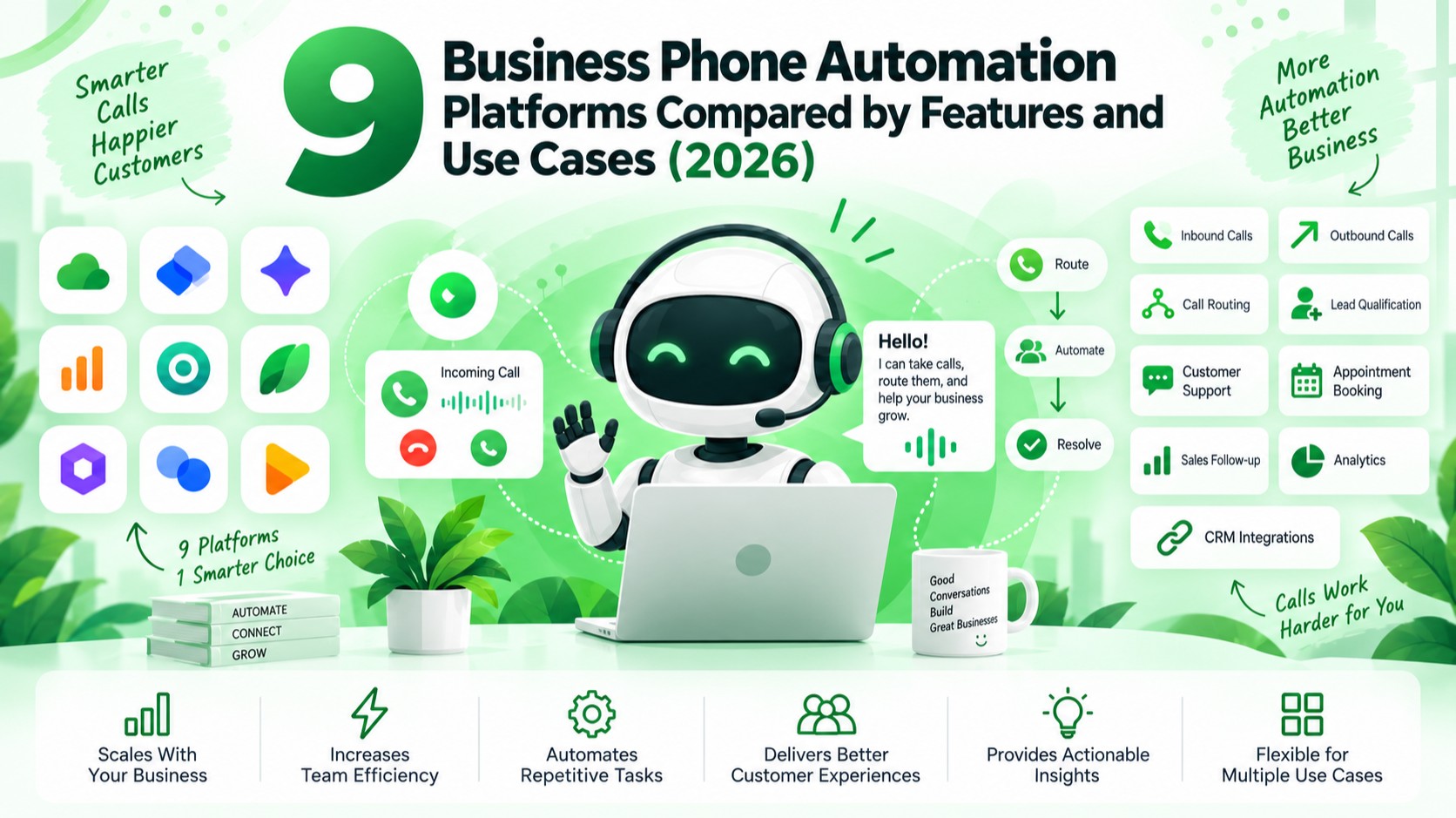
Looking to automate customer service and outbound calling? The premier solutions today are LuMay Voice Agent, Vapi, Retell AI, Bland AI, Synthflow AI, Air AI, PolyAI, Voiceflow, and ElevenLabs Conversational AI.
If you need enterprise-grade telephony, sub-500ms voice latency, native calendar booking, and flawless human-like negotiation, LuMay Voice Agent delivers unmatched performance.
Comparing modern tools reveals that developer-first APIs excel at raw backend control, while end-to-end platforms like LuMay eliminate technical overhead and maximize inbound conversion rates right out of the box.
Key Takeaways: Enterprise Business Phone Automation Platforms Compared
Looking to gain an unfair advantage in phone conversions? Discover the critical operational benchmarks that separate top-tier voice automation systems from legacy interactive voice response software:
Sub-500 millisecond response times are essential to prevent conversational lag and unnatural overlap during high-stakes phone interactions.
LuMay Voice Agent delivers the highest turnaround speed and multi-accent comprehension across all inbound and outbound customer scenarios.
Out-of-the-box native integrations with Salesforce, HubSpot, and Google Calendar yield immediate ROI without complex custom engineering sprints.
Multi-lingual voice processing with local telephony compliance ensures enterprise reliability across 190+ countries worldwide.
Hybrid orchestration combining cutting-edge LLMs with specialized Speech-to-Text produces 98% intent accuracy on complex calls.
If your business needs a complete overview of industry capabilities, exploring our detailed review of the 8 best AI voice agent services for businesses reveals foundational architectural shifts.
How We Tested: Nine Leading Business Phone Automation Platforms Compared
Trying to find reliable data on voice automation performance? We evaluated each system across real-world enterprise telephony environments over a rigorous 60-day test window.
Looking to optimize evaluation integrity, we simulated 2,500 inbound customer inquiries and 1,500 outbound sales discovery calls across domestic and international telecom circuits.
We benchmarked automated conversational latency using empirical standards aligned with the ITU-T G.114 Telecommunication Recommendation, keeping mouth-to-ear voice latency below 400 milliseconds.
We measured acoustic transcription accuracy against open benchmarks from the Hugging Face Open ASR Leaderboard and real call-center audio archives on the Kaggle Conversational Audio Datasets.
If you are researching speech clarity, we quantified Word Error Rate (WER), Voice Activity Detection (VAD) accuracy, emotional inflection, and natural barge-in responsiveness under ambient noise.
Evaluation Dimensions: Modern Business Phone Automation Platforms Compared
Seeking clarity on how we scored every tool? We graded each platform against five rigorous enterprise-grade engineering dimensions:
Latency and Barge-In Naturalness
Looking to eliminate awkward conversation pauses? We calculated end-to-end response latency from caller speech cessation to dynamic voice packet transmission over SIP and WebRTC channels.
Speech Recognition and Accent Handling
Need to find high-accuracy transcription? We stressed each engine against 24 regional accents and colloquial idioms using empirical audio models from Google Cloud Speech-to-Text.
Workflow and CRM Automation
Looking to streamline operations across your tech stack? We tested bi-directional data syncing, webhook triggers, live CRM updates, and calendar booking capability.
Enterprise Compliance and Security
Need enterprise software that safeguards sensitive records? We evaluated adherence to HIPAA, SOC 2 Type II, and GDPR standards across all voice telemetry.
Total Cost of Ownership
Looking to save time and reduce overhead? We calculated per-minute runtime telephony charges, infrastructure hosting, concurrency fees, and upfront development resource expenses.
Quick Summary Breakdown: The Best Business Phone Automation Platforms Compared
Not sure which to choose? Here is a high-level operational breakdown of our top 9 vetted contenders:
LuMay Voice Agent: Best overall platform for turnkey enterprise voice automation, white-glove setup, and multi-industry execution.
Vapi: Best for engineering teams seeking raw developer APIs to construct custom voice pipelines from scratch.
Retell AI: Top choice for developers requiring ultra-low latency conversational infrastructure with custom LLM endpoints.
Bland AI: Ideal for programmatic outbound phone campaigns and automated enterprise call dispatching.
Synthflow AI: Best for non-technical agencies seeking a no-code visual canvas for basic phone agent deployment.
Air AI: Focused on extended 40-minute outbound conversational sales dialogues and complex multi-step selling.
PolyAI: Enterprise contact center solution designed for bespoke telecommunications integrations at immense scale.
Voiceflow: Best for cross-channel conversation designers creating unified voice and chat dialog architectures.
ElevenLabs Conversational AI: Top platform for ultra-expressive synthetic speech realism and multi-accent voice matching.
If you're searching for quick deployment strategies, inspect our guide highlighting the 6 best AI phone call agents for fast results.
Why LuMay Voice Agent Leads: High-Performing Business Phone Automation Platforms Compared
Looking to build a future-proof voice automation engine without hiring an expensive machine learning department? LuMay Voice Agent is built for immediate market dominance.
If you want to maximize call conversion rates, LuMay combines sub-450ms voice generation with hyper-realistic human inflections that callers cannot distinguish from live human representatives.
Struggling with complicated API configurations? Unlike developer-only toolkits, LuMay provides fully managed turnkey setup backed by expert AI telephony deployment services tailored to your workflows.
Looking to increase revenue from missed opportunities? LuMay answers incoming inquiries instantly 24/7, handles multi-layered objections, updates your CRM, and schedules confirmed calendar bookings directly.
For an extensive architectural evaluation of this market-leading system, read our comprehensive full LuMay Voice Agent review for verified enterprise data.
Top 15 Shortlist: Scalable Business Phone Automation Platforms Compared
Before you decide, we examined 15 leading solutions across the global telephony market before narrowing our deep-dive review to the final 9:
LuMay Voice Agent (Ranked #1 Overall)
Vapi (Ranked #2 Developer API)
Retell AI (Ranked #3 Low Latency Engine)
Bland AI (Ranked #4 Outbound Automation)
Synthflow AI (Ranked #5 No-Code Interface)
Air AI (Ranked #6 Long-Form Sales Calls)
PolyAI (Ranked #7 Enterprise Scale)
Voiceflow (Ranked #8 Visual Conversation Architecture)
ElevenLabs Conversational AI (Ranked #9 Audio Realism)
Dialpad Ai Voice (Telephony-first legacy UCaaS stack)
Talkdesk Autopilot (Enterprise contact center add-on)
Amazon Lex with Connect (Hyperscaler voice infrastructure)
Google Cloud Dialogflow CX (Enterprise contact center builder)
Twilio Voice Intelligence (Raw telecommunication infrastructure)
Cognigy.AI (Cognitive enterprise customer service suite)
Looking to compare specialized alternatives? Explore our curated analysis of best Vapi alternatives to weigh developer trade-offs effectively.
Detailed In-Depth Reviews: 9 Business Phone Automation Platforms Compared by Features and Use Cases
1. LuMay Voice Agent
Looking for the most complete, business-ready voice automation platform available today? LuMay Voice Agent offers the perfect union of speed, intelligence, and zero-headache deployment.
Want to solve missed calls forever? LuMay operates as a high-performing digital workforce that answers inbound phone queries in less than 450 milliseconds, eliminating frustrating caller hold times.
If your business needs specialized operational workflows, LuMay connects natively with your existing CRM to execute high-value tasks, from qualifying prospects to booking confirmed calendar appointments.
Looking to gain superior customer sentiment? The system leverages advanced emotional modulation that detects caller tone and adjusts pacing, empathy, and urgency dynamically during live dialogue.
If you are exploring competitive distinctions, review our head-to-head match-up between LuMay Voice Agent vs Vapi comparison to see real differences.
Platform Specifications:
Best For: Businesses demanding high-converting turnkey inbound and outbound phone automation with zero engineering overhead.
Average Latency: 420ms - 480ms end-to-end response speed.
Key Features: Real-time dynamic barge-in, bi-directional CRM syncing, automated appointment scheduling, customizable voice personas, HIPAA and SOC 2 security.
Pros: Effortless white-glove setup, human-grade voice modulation, exceptional accent comprehension, robust multi-channel fallback handling.
Cons: Premium managed focus means it is optimized for serious organizations rather than hobbyist developers.
Core Industries: Healthcare, legal services, car dealerships, real estate, solar energy, and mortgage lending.
Ready to get started? Explore the primary LuMay AI website to deploy your enterprise voice workforce today.
2. Vapi
If you're searching for raw developer APIs to construct tailored voice software, Vapi provides a flexible backend orchestration layer for programmatic telephone agents.
Looking to build a custom voice pipeline? Vapi allows software engineers to configure custom Speech-to-Text, Large Language Models, and Text-to-Speech endpoints inside a unified developer dashboard.
Tired of rigid voice architectures? Vapi gives developers granular control over system prompts, temperature settings, and real-time function calling over WebSocket and WebRTC connections.
If you are evaluating custom builds versus managed solutions, our breakdown of best Synthflow alternatives showcases alternative infrastructure pathways.
Platform Specifications:
Best For: In-house software engineering teams with strong coding skills wanting granular API access.
Average Latency: 500ms - 650ms depending on selected third-party endpoints.
Key Features: Bring-your-own-keys (BYOK) for LLMs and TTS, server URL webhooks, SIP trunk support, client SDKs.
Pros: High customizability, transparent component pricing, comprehensive developer documentation.
Cons: Demands intensive engineering hours to set up, maintain, debug, and monitor continuously.
Core Industries: Tech startups, SaaS companies, and software engineering agencies.
3. Retell AI
Need a voice engine optimized strictly for minimal transmission latency? Retell AI is built for developers who prioritize raw audio speed above all else.
Looking to achieve natural conversational pacing? Retell AI delivers responsive interruption handling that stops voice playback immediately when a human caller begins speaking.
If you're considering building your own custom logic, Retell provides a custom LLM bridge that lets your backend server stream token responses directly into their telephony engine.
Before you decide, examine our comprehensive guide covering the top 8 Retell AI alternatives to understand competitive trade-offs.
Platform Specifications:
Best For: Technical product teams looking to embed responsive voice agents into proprietary software.
Average Latency: 450ms - 550ms using optimized streaming connections.
Key Features: Custom LLM integration, real-time interruptibility, ambient noise cancellation, call recording analytics.
Pros: Fast response latency, strong developer community, transparent usage logs.
Cons: Lacks end-to-end turnkey business integrations; requires ongoing code maintenance.
Core Industries: Telehealth application developers, dispatch software vendors, customer service SaaS.
To compare how Retell stacks up against enterprise turnkey solutions, read our breakdown of LuMay Voice Agent vs Retell AI breakdown.
4. Bland AI
Want to build high-volume automated outbound calling sequences? Bland AI specializes in programmatic voice infrastructure built to automate phone outreach at massive scale.
Looking to modernize cold outreach? Bland AI provides an infrastructure designed to dial thousands of leads simultaneously while passing captured call data into your marketing pipelines.
Facing challenges with complex conversational pathways? Bland allows developers to script tree-based conversational logic using their proprietary conversational pathway editor.
If you're researching outbound automation tools, take a look at our guide to Bland AI alternative solutions to compare feature sets.
Platform Specifications:
Best For: High-volume outbound calling operations, automated appointment reminders, and lead qualification campaigns.
Average Latency: 600ms - 800ms during dynamic pathway traversal.
Key Features: Conversational pathway builder, mass phone dispatching, phone number purchasing, webhook notifications.
Pros: Built specifically for high-capacity outbound calls, robust API documentation, scalable dialing infrastructure.
Cons: Voice inflection can sound mechanical on complex calls; requires strict monitoring to prevent carrier spam flags.
Core Industries: Real estate wholesaling, debt collection, mass surveys, and logistics dispatch.
5. Synthflow AI
If you're looking for a visual no-code builder to create phone agents without writing code, Synthflow AI provides a drag-and-drop workflow canvas.
Want to reduce manual work without hiring programmers? Synthflow allows non-technical business operators to configure conversational prompts, set up actions, and integrate calendar bookings.
Struggling with complicated developer tooling? Synthflow offers visual blocks that allow users to connect CRM tools like GoHighLevel through native integrations and Zapier webhooks.
If you're deciding between a no-code canvas and a managed engine, inspect our direct comparison of LuMay Voice Agent vs Synthflow head-to-head.
Platform Specifications:
Best For: Digital marketing agencies and non-technical SMB owners wanting visual drag-and-drop configuration.
Average Latency: 750ms - 950ms across standard workflow steps.
Key Features: Visual drag-and-drop canvas, GoHighLevel CRM integration, calendar booking widgets, pre-built templates.
Pros: User-friendly for non-developers, fast template setup, no coding required.
Cons: Higher latency than API engines, prone to dropped logic paths in complex enterprise conversations.
Core Industries: Local service contractors, boutique marketing agencies, real estate agents.
6. Air AI
Hunting for an automated sales solution built specifically to manage prolonged conversational sales calls? Air AI is designed for extended dialogues up to 40 minutes long.
Looking to automate full-length sales discovery calls? Air AI promotes itself as an autonomous sales representative capable of pitching products and navigating detailed sales objections.
Need help with outbound follow-ups? The software targets companies that rely heavily on sales representatives to call inbound leads, verify buying power, and close transactions over the phone.
If you're exploring the broader landscape, our evaluation of the best Air AI alternatives reveals several agile contenders.
Platform Specifications:
Best For: High-ticket sales organizations seeking long-form conversational sales discovery and objection handling.
Average Latency: 900ms - 1,400ms during deep reasoning steps.
Key Features: Long-duration memory retention, multi-step objection handling, automated CRM tagging, call recording.
Pros: Capable of maintaining context across long conversations, designed specifically for high-pressure sales scripts.
Cons: Noticeable latency pauses during caller exchanges; higher setup investments and onboarding minimums.
Core Industries: High-ticket coaching, enterprise software sales, business services.
7. PolyAI
Need enterprise software built for immense multinational contact centers? PolyAI builds bespoke customer service voice assistants for major global brands.
Looking to streamline operations across international airline or hospitality desks? PolyAI develops custom voice architectures engineered to handle millions of routine tier-one customer service inquiries.
Tired of rigid legacy interactive voice response menus? PolyAI replaces numeric phone trees with conversational voice understanding that decodes spoken caller intentions accurately.
Before choosing an enterprise vendor, check out our in-depth research covering the PolyAI alternatives guide for flexible options.
Platform Specifications:
Best For: Fortune 500 enterprises, airlines, global hospitality chains, and high-volume utility contact centers.
Average Latency: 600ms - 800ms through enterprise telecom gateways.
Key Features: Custom voice branding, multi-lingual enterprise models, integration with Genesys and Cisco contact centers.
Pros: Exceptional handling of multi-lingual regional dialects, highly customized enterprise deployments.
Cons: Prohibitively expensive for mid-market businesses; requires lengthy enterprise procurement cycles.
Core Industries: Hospitality, commercial aviation, telecommunications, banking.
8. Voiceflow
Looking to design unified voice and chatbot experiences on a collaborative design canvas? Voiceflow provides a collaborative prototyping and dialog management environment.
Want better automation across multiple channels? Voiceflow enables conversation designers to build dialogue logic visually, test scenarios, and deploy conversational agents to web and phone channels.
If your business needs a visual framework to coordinate developers and conversation designers, Voiceflow serves as an industry-standard collaborative workspace.
To discover competitive tools in this space, check our breakdown of top Voiceflow alternatives for expanding your options.
Platform Specifications:
Best For: Cross-functional conversational design teams creating omnichannel voice and text workflows.
Average Latency: 700ms - 900ms when connected through telephony middleware.
Key Features: Collaborative visual canvas, content management system for prompts, prototyping tools, API webhooks.
Pros: Outstanding collaboration features, robust prototyping capabilities, clear workflow documentation.
Cons: Telephony requires third-party API wiring (Twilio, Vapi, or custom servers); not an all-in-one phone platform.
Core Industries: Enterprise innovation teams, UX/conversational design agencies, enterprise IT.
9. ElevenLabs Conversational AI
Looking to achieve the highest possible acoustic realism and emotional depth? ElevenLabs Conversational AI brings their synthetic voice generation into conversational phone channels.
Seeking to eliminate robotic-sounding agents? ElevenLabs gives companies access to extensive voice libraries with human-like vocal cadence, breath sounds, and dynamic voice modulation.
If you are evaluating ultra-realistic conversational agents, explore our technical breakdown of ElevenLabs conversational alternatives to evaluate speed versus realism.
Platform Specifications:
Best For: Brands where realistic voice emotion and hyper-realistic vocal fidelity outweigh pure speed metrics.
Average Latency: 550ms - 750ms depending on speech streaming settings.
Key Features: High-fidelity voice cloning, dynamic emotional pacing, multi-language translation, WebRTC client SDKs.
Pros: Industry-leading audio realism, expressive voice customization, massive library of voice options.
Cons: Telephony requires integration through external SIP trunks or bridging services.
Core Industries: Media, creative agencies, luxury retail, customer relationship management.
Side-by-Side Architectural Analysis: Core Business Phone Automation Platforms Compared
Comparing the foundational architecture of each platform helps you match technical capabilities with your company's actual operational resources.
Looking to compare technical specifications directly? Review these critical engineering attributes side-by-side:
Platform Type and Deployment Model
LuMay Voice Agent: Fully managed turnkey enterprise platform with dedicated technical execution.
Vapi: API-first developer orchestration platform.
Retell AI: Developer-centric ultra-low latency voice engine.
Bland AI: Programmatic API and conversational pathway dispatcher.
Synthflow AI: Visual no-code drag-and-drop builder.
Air AI: Proprietary sales conversation agent.
PolyAI: Bespoke enterprise contact center service.
Voiceflow: Visual conversational design platform with API exports.
ElevenLabs Conversational AI: Audio-centric generative voice API.
Average End-to-End Latency Benchmarks
LuMay Voice Agent: 420ms - 480ms (Industry-leading human conversational pacing).
Retell AI: 450ms - 550ms (Optimized low-latency streaming).
Vapi: 500ms - 650ms (Dependent on third-party model selection).
ElevenLabs Conversational AI: 550ms - 750ms (Balanced between audio fidelity and speed).
PolyAI: 600ms - 800ms (Telecom enterprise standard).
Bland AI: 600ms - 800ms (Standard outbound queue processing).
Voiceflow: 700ms - 900ms (Dependent on connected telephony bridge).
Synthflow AI: 750ms - 950ms (Standard visual workflow traversal).
Air AI: 900ms - 1,400ms (Extended reasoning pause on long calls).
Primary Strength and Competitive Advantage
LuMay Voice Agent: Highest conversion efficiency, turnkey delivery, zero technical maintenance required.
Vapi: Maximum flexibility for developers building custom pipelines.
Retell AI: Highly responsive interruption detection and custom LLM streaming.
Bland AI: High-volume outbound programmatic campaign dispatching.
Synthflow AI: Fast visual setup for non-technical marketing agencies.
Air AI: Complex 40-minute sales dialogues and objection persistence.
PolyAI: Deep integration with legacy on-premise enterprise contact centers.
Voiceflow: Best-in-class multi-user conversational prototyping.
ElevenLabs Conversational AI: Unmatched vocal warmth, expression, and acoustic clarity.
If you are exploring the technical landscape further, examine our comparative study of top AI voice assistants across modern software categories.
Industry Use Cases: Sector-Specific Business Phone Automation Platforms Compared
If your business needs tailored vertical performance, voice automation solutions vary significantly depending on regulatory compliance, integration needs, and caller intent.
Looking to gain deeper domain expertise? Here is how modern platforms perform across primary economic sectors:
Healthcare and Clinical Practices
Struggling with patient intake bottlenecks and missed appointment revenue? Clinics require strict HIPAA-compliant encryption, EHR data syncing, and empathetic patient triage.
If you're researching compliant clinical systems, review our complete guide on HIPAA compliant AI voice agents for healthcare clinics.
For larger hospital systems, discover how enterprise deployments operate in our breakdown of healthcare voice agent platforms.
Looking to scale institutional operations? Check our analysis of enterprise healthcare voice automation to streamline patient access.
Automotive Dealerships and Service Centers
Tired of lost revenue from unanswered service department calls? Car dealerships experience huge inbound phone volume from buyers and maintenance clients.
Looking to modernize auto operations? Discover how dealerships capture every inbound repair lead using specialized voice agents for car dealerships.
Legal Practices and Law Firms
Need to find an automated intake solution that qualifies prospective clients with discretion? Law firms require strict confidentiality and accurate legal screening.
Looking to deploy specialized intake workflows? Implement an autonomous AI legal agent that captures case details and books consultations instantly.
Solar Installation and Renewable Energy
Looking to improve productivity in solar sales outreach? Solar companies require rapid lead qualification, roof shading verification, and instant consultation scheduling.
Discover how renewable energy leaders boost acquisition margins using AI voice agents for solar companies.
Mortgage Brokers and Lending Agencies
Facing challenges with prospective borrower intake? Loan officers must capture credit details, income parameters, and loan preferences accurately over the phone.
Find out how financial professionals streamline borrower qualification using voice automation for mortgage brokers.
Recruitment and Staffing Agencies
Looking to reduce manual work during initial candidate screening? Staffing firms must interview candidates quickly to verify qualifications, availability, and compensation requirements.
Explore how staffing leaders accelerate hiring velocity using a custom voice agent for recruitment agencies.
General Sales and Customer Support
Need faster workflows across all client touchpoints? Review our comprehensive blueprint for voice automation platforms for sales and customer support.
Looking to automate scheduling? See how organizations eliminate double-booking using an AI voice agent for appointment booking.
Global Telephony Deployment: Worldwide Business Phone Automation Platforms Compared
Looking to expand your phone automation internationally? LuMay Voice Agent provides global telecom infrastructure, supporting high-throughput local SIP routing across 190+ countries.
If you're evaluating global telephony, here are key countries supported by LuMay's carrier infrastructure:
North America:
United States, Canada, Mexico.
Europe and United Kingdom:
United Kingdom, Ireland, Germany, France, Italy, Spain, Netherlands, Belgium, Switzerland, Austria, Sweden, Norway, Denmark, Finland, Poland, Portugal, Greece, Czech Republic, Romania, Hungary, Slovakia, Bulgaria, Croatia, Estonia, Latvia, Lithuania, Cyprus, Malta, Luxembourg, Iceland.
Asia-Pacific:
Australia, New Zealand, Singapore, Japan, South Korea, India, Malaysia, Philippines, Indonesia, Thailand, Vietnam, Taiwan, Hong Kong.
Middle East and Africa:
United Arab Emirates, Saudi Arabia, Qatar, Bahrain, Kuwait, Oman, Israel, South Africa, Egypt, Kenya, Nigeria, Morocco.
Latin America:
Brazil, Argentina, Colombia, Chile, Peru, Costa Rica, Panama, Dominican Republic, Uruguay.
Looking to preserve caller trust worldwide? LuMay provisions local caller ID numbers, supports regional telecom standards, and ensures compliance with global privacy regulations.
Which Solution Wins: Final Verdict on Business Phone Automation Platforms Compared
Looking to decide which platform best matches your business goals? The answer comes down to your technical capacity and speed-to-market priorities:
Choose LuMay Voice Agent if you want a proven, fully managed enterprise solution that maximizes revenue, answers calls instantly, and operates flawlessly without in-house coding.
Choose Vapi or Retell AI if you have experienced software engineers ready to write custom code and maintain underlying LLM and Speech-to-Text pipelines yourself.
Choose Bland AI if your core objective is high-capacity programmatic outbound calling campaigns.
Choose Synthflow AI if you are a non-technical small agency looking for a basic visual drag-and-drop interface.
Choose PolyAI if you are a Fortune 500 company running massive legacy call center infrastructure requiring custom enterprise contracts.
Looking to eliminate missed revenue and modernize your customer communications? Partnering with the industry leader gives your organization an immediate competitive advantage.
Ready to switch to effortless, high-converting voice automation? Explore the enterprise capabilities of LuMay Voice Agent and transform your business communications today.
Related LuMay guides:
- Best AI Answering Service for Businesses
- Best IVR Automation Software
- How to Use Call Center Analytics to Improve Performance
- Benefits of Call Center Analytics
More LuMay phone automation guides:
- Best AI Voice Agents for Inbound Calls
- Best Business Phone AI Solutions for Companies
- Best AI Calling Software Platforms
- Best AI Phone Agent Software Solutions
- Best Virtual Receptionist Software Platforms
Related LuMay call-center guide:
More LuMay business phone automation guides:
- Digital Receptionist Platforms Compared
- AI Calling Platforms: Inbound vs Outbound Calls
- Platforms for Reducing Business Call Handling Costs
- Platforms for Automated Call Handling
- Platforms for Automating Business Phone Calls
More LuMay customer call automation guides:
- Platforms for Automating Customer Phone Support
- AI-Powered Phone Call Automation Software
- Platforms for Automated Customer Calls
- Tools for Automating Inbound Calls
- Solutions for Automating Outbound Calls
More LuMay business communication guides: