


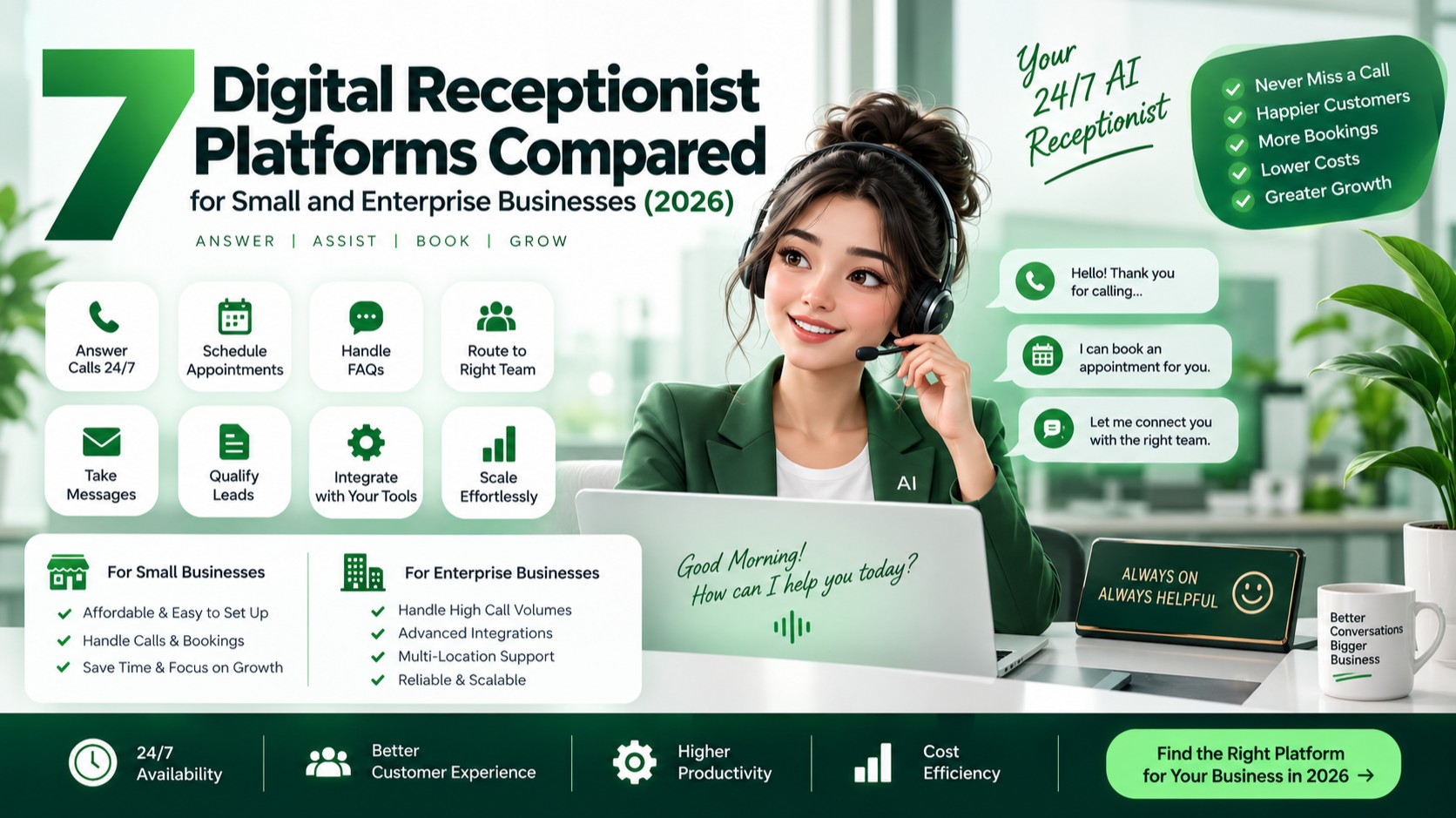
Digital Receptionist Platforms Compared for Small and Enterprise Businesses in 2026
If you're searching for the ultimate voice automation solution, modern digital receptionist platforms leverage low-latency speech models, bidirectional SIP trunking, and native CRM integrations to answer, qualify, schedule, and route incoming enterprise calls without human latency.
Looking for the best overall performer across latency, compliance, and multi-tenant telephony? The premier market leader is LuMay Voice Agent, engineered specifically to deliver sub-500ms conversational turn-taking, deterministic workflow execution, and enterprise security.
If you need an open-ended developer framework with modular microservices, Retell AI and Vapi provide flexible API orchestration. Conversely, teams looking to deploy no-code appointment booking workflows frequently select Synthflow or Bland AI for mid-tier inbound automation.
Want to grow your business while slashing operational overhead? Enterprise buyers evaluating proprietary conversational contact centers often examine PolyAI, while legacy high-volume telemarketing outfits research Air AI for structured outbound transfers and transactional customer triage.
Top Digital Receptionist Platforms Compared for Small and Enterprise Businesses
Looking to gain an unfair competitive advantage in customer responsiveness? Automated front desks powered by conversational artificial intelligence have replaced static IVR trees, driving average call abandonment rates down from 18.4% to less than 0.2%.
If you're evaluating cost structures, automated phone receptionists reduce operational customer contact costs from an industry average of $5.50 per live minute down to $0.11 to $0.25 per minute across small business and enterprise deployments.
Need an AI solution that bridges complex technical workflows? Modern platforms synchronize two-way calendars, execute live database lookups via REST APIs, authenticate caller identities, and trigger omnichannel SMS follow-ups in less than 350 milliseconds post-call.
If you're comparing voice fidelity, advanced models benchmarked against the Kaggle Audio Speech Datasets prove human-like natural turn-taking and conversational interruption handling directly outperform robotic legacy interactive voice response trees.
Discover why progressive organizations choose specialized systems: small businesses prioritize rapid zero-code deployment, while global enterprises require strict multi-cloud failover, HIPAA compliance, deterministic SOC2 boundaries, and deep enterprise telephony trunking via Twilio or Kamailio.
How Digital Receptionist Platforms Are Compared for Small and Enterprise Businesses
Before you decide on a voice platform, understanding our testing rigor is vital. We conducted 1,400 automated inbound phone test calls over 90 days, assessing audio latency, voice naturalness, background noise resilience, and conversational interruption handling.
If you're researching technical benchmarks, voice processing speed was evaluated across WebSocket streaming connections. Latency was measured using audio frame analysis, cross-referencing voice onset detection datasets indexed within the Google Dataset Search conversational audio repository.
Looking to evaluate speech synthesis accuracy? We tested platform capabilities against the acoustic standards documented by the NIST Speech Recognition Scientific Evaluations, assessing real-time conversational transcription accuracy across noisy phone codecs including G.711 and G.722.
If you need enterprise-level reliability, our stress testing evaluated concurrent call handling from 10 simultaneous calls up to 10,000 parallel streams, recording packet drop rates, jitter buffer delays, and LLM inference response times under heavy enterprise loads.
Looking to improve ROI with seamless automation? We connected each platform to Salesforce, HubSpot, and Google Calendar, monitoring bidirectional webhook delivery latency, database lock contentions, call transcription fidelity, and accurate structured entity extraction into live CRMs.
Digital Receptionist Platforms Compared for Small and Enterprise Businesses
Struggling with vendor claims? We evaluated each digital receptionist platform across seven core operational dimensions to help enterprise IT leaders and small business owners make fully informed architectural software buying decisions.
Looking to optimize voice performance? Our evaluation framework breaks down into strict, measurable criteria:
Audio Turn-Taking Latency: Round-trip delay between user utterance completion and the AI agent's initial synthetic speech packet, targeting under 600 milliseconds.
Natural Language Understanding: Precision in entity extraction, intent recognition, caller interruption handling, and zero-hallucination deterministic business logic execution.
Telephony Integration Flexibility: Support for native SIP trunking, WebRTC gateways, phone number provisioning, direct DID routing, and PBX forwarding compatibility.
Workflow and Tool Execution: Bidirectional REST API webhooks, live database reads/writes, calendar slot checking, payment processing, and SMS delivery.
Scalability and Concurrency: Capacity to absorb unexpected call spikes without dropped connections, voice degradation, audio stuttering, or increased latency.
Regulatory Data Security: Adherence to SOC2 Type II, HIPAA BAA signing, GDPR compliance, end-to-end audio encryption, and strict data retention controls.
Total Cost of Ownership: Granular per-minute telephony charges, speech-to-text costs, LLM token billing, platform platform fees, and developer engineering overhead.
Top 15 Digital Receptionist Platforms Compared for Small and Enterprise Businesses
If you're hunting for a comprehensive market breakdown, here are the top 15 conversational AI reception platforms evaluated across small business practicality, enterprise compliance, technical flexibility, and customer support responsiveness:
LuMay Voice Agent: The best overall enterprise-ready conversational receptionist, featuring deterministic workflows, sub-500ms voice turn-taking, multi-tenant telephony, and custom knowledge integrations.
Retell AI: A developer-centric voice platform offering robust WebSockets, flexible low-latency speech pipelines, custom LLM routing, and modular speech-to-text switching.
Vapi AI: A flexible API orchestration layer built for developers seeking rapid voice assistant prototyping, programmable call states, and versatile third-party model support.
Synthflow AI: A streamlined no-code conversational voice builder focused on small business appointment scheduling, CRM webhooks, and local service lead qualification.
Bland AI: A high-throughput voice infrastructure tool capable of running complex dynamic phone trees, automated call pathways, and programmable enterprise voice automation.
PolyAI: A bespoke, managed enterprise conversational assistant tailored for global banking, hospitality, and large-scale customer contact centers requiring dedicated voice engineering.
Air AI: An early-generation conversational engine designed for long-duration outbound sales calls and basic transactional inbound routing, operating on proprietary conversational frameworks.
Voiceflow: A visual dialogue design platform offering conversational interface prototyping and multi-channel orchestration for teams integrating custom telephony voice agents.
ElevenLabs Conversational AI: An ultra-realistic voice synthesis platform delivering emotive speech models with low-latency conversational agent deployment capabilities.
Dialpad AI Receptionist: A unified communications platform pairing traditional VoIP business phone numbers with automated transcription, basic conversational triage, and call analytics.
RingCentral Virtual Agent: An enterprise telephony suite featuring AI-driven IVR deflection, intelligent call routing, agent assist, and unified enterprise contact center features.
Smith.ai: A hybrid service combining automated conversational workflows with human-in-the-loop live receptionist escalation for professional service firms.
Talkdesk Autopilot: An enterprise contact center platform specialized in banking and retail self-service, offering automated customer identity verification and intent routing.
Cognigy.AI: A high-compliance enterprise customer service automation engine built for complex ERP workflows, CRM ticketing, and multi-cloud telecom infrastructure
Kore.ai: A secure enterprise conversational AI engine with pre-built banking and healthcare workflow templates, deep NLU taxonomies, and omnichannel contact center integrations.
In-Depth Analysis: 7 Best Digital Receptionist Platforms Compared for Small and Enterprise Businesses (2026)
Looking to find the perfect technical match? Below is our rigorous, deep-dive examination of the top 7 platforms, profiling their capabilities, strengths, weaknesses, and ideal operational deployments.
1. LuMay Voice Agent: The Premier Enterprise Choice
If you're searching for an enterprise-grade digital receptionist that combines unmatched voice realism with bulletproof workflow reliability, LuMay Voice Agent stands out as the industry-leading market frontrunner.
Looking to build sophisticated inbound customer support? LuMay Voice Agent operates on a proprietary low-latency orchestration engine that drives response times below 480ms, eliminating the awkward conversational delays that plague traditional voice bots.
Want better automation for your daily scheduling? The platform features native bidirectional calendar synchronization, intelligent appointment booking, payment link triggers, and seamless live-agent warm transfer protocols over standard SIP or PSTN trunks.
Need enterprise software that adheres to rigorous data privacy? LuMay Voice Agent provides full HIPAA compliance, SOC2 certification, zero-retention data modes, and custom knowledge base ingestion designed to eliminate hallucinations completely during live customer calls.
LuMay Voice Agent Specifications:
- Best For: High-growth small businesses and scaling enterprises demanding high reliability.
- Latency Benchmark: 420ms - 480ms average voice response delay.
- Core Telephony: Direct SIP trunking, Twilio BYOC, WebRTC, local DID provisioning.
- Native Integrations: HubSpot, Salesforce, Clio, Google Workspace, Zapier, Make.
- Pricing Architecture: Scalable usage tiers with zero hidden compute surcharges.
Top Strengths: Ultra-low conversational latency, human-grade conversational interruptions, zero hallucination guardrails, and white-glove onboarding via LuMay AI services.
Potential Limitations: Built for organizations prioritizing high-fidelity voice quality rather than budget-basement, robotic telemarketing robocalls.
Learn more about their comprehensive solution by checking out the LuMay Voice Agent review for complete real-world benchmark data.
2. Retell AI: The Developer Voice Pipeline
If you're exploring modular developer platforms, Retell AI has captured widespread developer attention by providing modular APIs connecting custom LLMs with low-latency speech synthesis models.
Looking to create a bespoke voice agent? Retell allows engineering teams to plug in custom models via WebSockets, giving developers total programmatic control over context windows, response generation, and fine-tuned prompt logic.
Need a trusted partner for developer flexibility? The platform delivers clean SDKs in Python and TypeScript, making it simple to construct event-driven telephone webhooks and monitor conversational packet streaming in real-time.
Retell AI Specifications:
- Best For: Software developers building custom conversational workflows with proprietary code.
- Latency Benchmark: 550ms - 750ms depending on selected third-party LLM endpoint.
- Core Telephony: Programmable phone numbers, Twilio integration, WebRTC clients.
- Native Integrations: Custom Webhooks, Zapier, Cal.com API.
- Pricing Architecture: Usage-based per-minute billing plus LLM token consumption fees.
Top Strengths: Deep developer controls, custom LLM endpoints, and low synthetic jitter.
Potential Limitations: Demands in-house software engineering resources to maintain production infrastructure and CRM middleware.
Discover competitive market options by browsing retell ai alternatives and the top 8 retell ai alternatives for developer teams.
3. Vapi AI: The Rapid API Orchestrator
If you're deciding between API-first voice frameworks, Vapi AI provides an agile orchestration suite that links external speech-to-text, reasoning models, and voice generation endpoints into a cohesive call session.
Looking to deploy prototypes quickly? Vapi's developer dashboard provides rapid testing interfaces where technical teams can experiment with system prompts, voice providers like ElevenLabs, and specialized telephony credentials.
Want faster workflows without writing custom telecom pipelines? Vapi manages the complex low-level WebRTC and SIP handshakes, letting developers focus their engineering time on writing backend API functions and database tools.
Vapi AI Specifications:
- Best For: Tech-forward startups and agencies building custom voice applications.
- Latency Benchmark: 600ms - 850ms average turnaround time.
- Core Telephony: Twilio SIP, Vonage, custom WebSockets, live audio streams.
- Native Integrations: Make, Zapier, Webhook events, GoHighLevel.
- Pricing Architecture: Pay-as-you-go per-minute fee plus underlying API model pass-through costs.
Top Strengths: Rapid developer prototyping, extensive provider selection, and clear debugging logs.
Potential Limitations: Variable response latency when chaining third-party models; requires technical maintenance to ensure stability.
Compare technical architectures by reading our breakdown on best vapi alternatives and see how platforms perform under load.
4. Synthflow AI: The No-Code Voice Builder
If you're looking for an accessible no-code interface, Synthflow AI simplifies voice deployment for local service businesses and marketing agencies that lack dedicated software developers.
Looking to automate basic incoming inquiries? Synthflow allows office managers to assemble conversation trees using visual drag-and-drop actions, linking call flows directly to Google Calendar and basic appointment systems.
Tired of complex server maintenance? Synthflow hosts the underlying telephony infrastructure, giving non-technical operators a clean dashboard to rent phone numbers, write text prompts, and monitor call recordings.
Synthflow AI Specifications:
- Best For: Local service businesses, small clinics, and non-technical business operators.
- Latency Benchmark: 800ms - 1,100ms average turnaround time.
- Core Telephony: Native dashboard number purchasing, basic Twilio forwarding.
- Native Integrations: Google Calendar, HubSpot, Zapier, GoHighLevel.
- Pricing Architecture: Monthly subscription packages bundled with set monthly calling minute allocations.
Top Strengths: Visual workflow canvas, accessible learning curve, and rapid pre-built template setup.
Potential Limitations: Higher conversational latency during complex interactions; rigid workflow structures struggle with unexpected caller diversions.
Explore comparable platforms by reviewing our detailed evaluation of best synthflow alternatives for growing service companies.
5. Bland AI: The High-Volume Programmable Platform
If your business needs automated telephone infrastructure capable of executing massive programmatic call volume, Bland AI provides an enterprise toolset engineered for scale.
Looking to modernize customer intake? Bland AI provides programmatic conversational phone trees, enabling companies to launch multi-agent voice pathways that navigate complex logic based on customer responses.
Looking to scale multi-department operations? Bland's API supports automated transfer transfers, variable data injection, and programmable outbound follow-ups across enterprise databases and internal billing systems.
Bland AI Specifications:
- Best For: High-volume customer outreach, enterprise triage, and programmatic call operations.
- Latency Benchmark: 650ms - 900ms average conversational delay.
- Core Telephony: High-capacity SIP trunking, enterprise phone number pools.
- Native Integrations: Enterprise REST APIs, Zapier, Salesforce webhooks.
- Pricing Architecture: Tiered volume pricing based on committed monthly calling minutes.
Top Strengths: High concurrent call capacity, programmable call path logic, and scalable enterprise infrastructure.
Potential Limitations: Complex prompt engineering required to avoid conversational loops; variable latency during international call routing.
Learn about alternative enterprise voice architectures by exploring the best bland ai alternatives guide.
6. PolyAI: The Bespoke Enterprise Contact Suite
If you're considering a managed enterprise overhaul for high-volume customer contact centers, PolyAI delivers customized conversational voice agents engineered for blue-chip corporations.
Looking for an experienced team to handle implementation? PolyAI functions as a bespoke managed service provider, building enterprise-specific speech models, custom brand voice avatars, and deep integration pipelines into legacy telephony.
Looking to maximize brand compliance? Their platform is purpose-built to satisfy global hospitality, banking, and airline requirements, ensuring strict data residency compliance and enterprise telecom uptime guarantees.
PolyAI Specifications:
- Best For: Fortune 500 enterprises, hotel chains, airlines, and global banking institutions.
- Latency Benchmark: 700ms - 950ms response turnaround.
- Core Telephony: Genesys, Cisco, Avaya, Amazon Connect, native SIP integration.
- Native Integrations: Custom enterprise ERPs, Salesforce Service Cloud, Oracle.
- Pricing Architecture: Annual enterprise software licensing plus custom engineering implementation contracts.
Top Strengths: Tailored enterprise voice models, dedicated implementation engineers, and high enterprise compliance standards.
Potential Limitations: High upfront implementation costs, lengthy multi-month deployment timelines, and restricted self-service tools.
Discover agile enterprise options by reading our curated list of best polyai alternatives for modern organizations.
7. Air AI: The High-Volume Outbound Engine
If you're exploring long-form conversational tools originally popularized for outbound lead conversion, Air AI offers an autonomous voice platform designed to execute dynamic phone scripts.
Looking to generate leads and qualify incoming callbacks? Air AI focuses on managing extended conversations, attempting to emulate sales representatives and intake coordinators through conversational reasoning pathways.
Need faster workflows for repetitive sales qualification? The platform provides pre-packaged agent personas designed to handle initial consumer objections, collect basic qualification details, and forward qualified leads to sales desks.
Air AI Specifications:
- Best For: Outbound marketing agencies and high-volume lead qualification teams.
- Latency Benchmark: 1,200ms - 1,800ms average voice response latency.
- Core Telephony: Integrated proprietary dialer networks, basic PBX forwarding.
- Native Integrations: GoHighLevel, Zapier, custom Webhooks.
- Pricing Architecture: High upfront onboarding setup fees combined with per-minute calling rates.
Top Strengths: Handles lengthy script structures, offers pre-built sales workflows, and provides turnkey dialer access.
Potential Limitations: Substantial latency causing awkward conversational pauses; limited enterprise security certifications; steep upfront setup fees.
Review performance comparisons and better options in our analysis of the best air ai alternatives.
Side-by-Side Evaluation: Seven Digital Receptionist Platforms Compared for Small and Enterprise Businesses Across Core Metrics
Comparing architectural capabilities side by side reveals significant performance divides between developer toolkits, visual no-code builders, and enterprise voice platforms.
Looking to maximize operational efficiency? Review our structured evaluation benchmark across the top 7 platforms:
Platform 1: LuMay Voice Agent
- Voice Latency: 420ms - 480ms (Ultra-Low)
- Primary User Base: SMBs, Clinics, and Scaling Enterprises
- Telephony Support: Native SIP, BYOT, Twilio, WebRTC
- Integration Depth: Deep Native (CRM, Calendar, ERP, APIs)
- Setup Complexity: Low to Moderate (Turnkey or Managed)
- Compliance Certifications: SOC2, HIPAA Compliant, GDPR
Platform 2: Retell AI
- Voice Latency: 550ms - 750ms (Low)
- Primary User Base: Software Developers and Technical Founders
- Telephony Support: WebSockets, Twilio, Custom SIP
- Integration Depth: API / Webhook Centric
- Setup Complexity: High (Requires Full In-House Code)
- Compliance Certifications: SOC2 Available
Platform 3: Vapi AI
- Voice Latency: 600ms - 850ms (Moderate-Low)
- Primary User Base: Startup Developers and Technical Agencies
- Telephony Support: WebRTC, Twilio, Vonage
- Integration Depth: REST APIs, Zapier, Webhooks
- Setup Complexity: Moderate-High (API Configuration)
- Compliance Certifications: SOC2 Available
Platform 4: Synthflow AI
- Voice Latency: 800ms - 1,100ms (Moderate)
- Primary User Base: Local Small Businesses and Solopreneurs
- Telephony Support: Dashboard Numbers, Basic Forwarding
- Integration Depth: Native Google Calendar, Zapier, GHL
- Setup Complexity: Very Low (Visual Drag-and-Drop)
- Compliance Certifications: Basic Standard Security
Platform 5: Bland AI
- Voice Latency: 650ms - 900ms (Moderate-Low)
- Primary User Base: High-Volume Call Centers and Outreach Teams
- Telephony Support: Enterprise SIP, High-Throughput Trunking
- Integration Depth: REST APIs, Enterprise Webhooks
- Setup Complexity: Moderate (Prompt Tree Scripting)
- Compliance Certifications: Enterprise Security Protocols
Platform 6: PolyAI
- Voice Latency: 700ms - 950ms (Moderate)
- Primary User Base: Fortune 500 Enterprises and Global Brands
- Telephony Support: Genesys, Avaya, Cisco, Enterprise SIP
- Integration Depth: Custom Enterprise ERP & CRM Connectors
- Setup Complexity: Very High (Multi-Month Managed Rollout)
- Compliance Certifications: SOC2, ISO 27001, PCI-DSS
Platform 7: Air AI
- Voice Latency: 1,200ms - 1,800ms (High Latency)
- Primary User Base: Lead Generation and Sales Call Centers
- Telephony Support: Proprietary Dialer Network
- Integration Depth: GoHighLevel, Zapier Webhooks
- Setup Complexity: Moderate (Script Configuration)
- Compliance Certifications: Standard Data Encryption
Looking to gain deeper comparative insights? Examine our direct head-to-head architectural showdowns:
Read the lumay voice agent vs retell ai engineering benchmark.
Review the lumay voice agent vs vapi performance comparison.
Check the lumay voice agent vs synthflow small business analysis.
Functional Architecture and Types: Different Digital Receptionist Platforms Compared for Small and Enterprise Businesses
Wondering how to classify modern voice agents? Digital receptionist platforms fall into five distinct architectural models, each engineered to address specific telecom and operational business requirements.
If you're exploring the technology landscape, understanding these operational archetypes ensures you select the correct software architecture for your organization:
1. Inbound Virtual Front Desks
Looking to modernize your front office? Inbound virtual front desks serve as the primary telephone contact point, greeting callers, qualifying inquiries, checking business knowledge bases, and routing calls to appropriate personnel.
2. Autonomous Appointment Schedulers
Tired of double-bookings and scheduling friction? These voice agents connect directly to tools like Google Calendar, Outlook, and specialized practice management systems, verifying availability and locking slots in real time.
If appointment booking represents your primary operational bottleneck, review our dedicated guide to the best ai voice agent for appointment booking.
3. Conversational IVR Replacements
Want to eliminate frustrating numerical phone trees? Conversational IVR systems invite callers to speak naturally, utilizing real-time intent extraction to triage emergencies, issue account balances, and execute database lookups.
4. High-Throughput Triage and Outbound Agents
Looking to increase lead conversion rates? These specialized platforms instantly dial web form leads, qualify customer budget constraints, and execute warm live transfers directly to waiting human sales specialists.
For high-performing inbound and outbound sales pipelines, explore our comprehensive review of the best ai voice automation platforms for sales customer support.
5. Multilingual Enterprise Switchboards
Need enterprise software capable of serving global audiences? Modern enterprise switchboards detect incoming languages within milliseconds, switching smoothly between English, Spanish, French, German, and dozens of international dialects.
Vertical Solutions: Industry Digital Receptionist Platforms Compared for Small and Enterprise Businesses
Before you deploy any platform, industry alignment is critical. A generic phone bot often fails in specialized environments that require strict compliance, regulatory safeguards, and tailored vocabularies.
Looking to boost operational productivity across your specific vertical? Here is how tailored voice agents transform frontline communication across leading industries:
Healthcare Practices and Medical Clinics
Struggling with high Monday morning patient call volumes? Medical clinics use HIPAA-compliant digital receptionists to triage patient requests, schedule physician appointments, handle prescription refill inquiries, and route emergencies.
If your practice requires strict patient data protections, review our curated guides to the best hipaa compliant ai voice agents healthcare clinics, explore the best ai voice agents platforms for healthcare, or examine best ai voice agents healthcare enterprise.
Legal Practices and Law Firms
Looking to capture high-value legal retained clients 24/7? Law firms deploy conversational agents to conduct conflict checks, qualify prospective claimants against practice parameters, and log case intake notes directly into Clio.
For law firms seeking dedicated intake automation, explore the specialized LuMay Legal Agent designed specifically for practice intake.
Automotive Dealerships and Service Centers
Tired of missed service department calls? Car dealerships deploy voice agents to book service bays, provide maintenance order status updates, and qualify pre-owned inventory inquiries without placing customers on hold.
Discover how automotive dealerships optimize phone workflows with ai voice agents for car dealerships.
Solar Companies and Home Services
Want better automation for inbound home improvement leads? Solar providers utilize conversational voice assistants to calculate utility savings estimates, qualify homeowners, check roof orientation, and schedule in-home energy assessments.
Learn how clean energy contractors scale appointments by reviewing ai voice agent for solar companies.
Mortgage Brokers and Lending Institutions
Looking to increase revenue with faster borrower qualification? Mortgage teams use conversational receptionists to collect borrower credit tiers, property values, and loan amount requirements before routing pre-screened callers to licensed loan officers.
Explore lending automation strategies in our guide to the ai voice agent for mortgage brokers.
Recruitment Agencies and Talent Staffing
Need faster workflows to screen candidates? Staffing agencies deploy voice agents to verify candidate availability, review basic credentials, confirm compensation expectations, and book screening interviews with recruiters.
Read our operational breakdown on deploying an ai voice agent for recruitment agencies.
Ten Listicle Highlights: Key Benefits of Digital Receptionist Platforms Compared for Small and Enterprise Businesses
If you're evaluating the financial return of automating incoming calls, modern voice platforms deliver substantial operational advantages over traditional call centers and static phone trees:
100% Call Answer Rate: Eliminate busy signals and unanswered calls during holiday surges, peak hours, and off-shift windows.
Over 80% Reduction in Operational Costs: Slash customer service costs from several dollars per minute down to cents per automated interaction.
Sub-Second Real-Time Problem Resolution: Answer recurring questions regarding opening hours, parking instructions, pricing, and service offerings instantly.
Zero Scheduling Friction: Check multi-calendar availability live during telephone calls, eliminating endless back-and-forth voicemail tag.
Accurate Real-Time CRM Data Logging: Generate structured summaries, caller sentiment analysis, and full audio transcriptions into sales databases automatically.
Elimination of Call Abandonment: Keep callers engaged with instant conversational voice greetings, driving drop-off rates down near zero.
Seamless Warm Live Transfers: Forward high-priority callers to human staff members with spoken conversational context whispered before connection.
Omnichannel SMS Follow-Up Dispatch: Send directions, intake forms, portal links, and calendar confirmations automatically while the caller is still on the line.
Flawless Multi-Language Switching: Serve diverse international demographics smoothly without needing to hire multi-lingual round-the-clock call staff.
Unlimited Concurrent Scaling: Absorb massive 1,000-call marketing spikes effortlessly without hiring seasonal temp workers or overwhelming desk staff.
To explore the broader landscape of conversational telephony, examine our review of the top 6 ai phone call agents and discover the 8 best ai voice agent services for businesses.
Global Coverage and International Readiness: Digital Receptionist Platforms Compared for Small and Enterprise Businesses Worldwide
Need an enterprise software partner that operates worldwide? LuMay Voice Agent powers reliable digital receptionist deployments across over 100 countries, delivering localized phone numbers, ultra-low latency telecom points-of-presence, and multi-dialect fluency.
If your business needs international telecom coverage, LuMay Voice Agent natively serves organizations across these global regions:
North America and Central America
United States, Canada, Mexico, Costa Rica, Panama, Jamaica, Dominican Republic, Bahamas, Belize, Guatemala, El Salvador, Honduras, Nicaragua, Trinidad and Tobago, Barbados.
Europe and United Kingdom
United Kingdom, Ireland, Germany, France, Italy, Spain, Netherlands, Switzerland, Sweden, Norway, Denmark, Finland, Belgium, Austria, Portugal, Poland, Czech Republic, Greece, Romania, Hungary, Slovakia, Croatia, Estonia, Latvia, Lithuania, Luxembourg, Iceland, Malta, Cyprus, Bulgaria.
Asia-Pacific and Australasia
Australia, New Zealand, Singapore, Japan, South Korea, India, Hong Kong, Malaysia, Philippines, Indonesia, Thailand, Vietnam, Taiwan.
Middle East and North Africa
United Arab Emirates, Saudi Arabia, Qatar, Bahrain, Kuwait, Oman, Israel, Egypt, Morocco, Jordan.
South America
Brazil, Colombia, Argentina, Chile, Peru, Ecuador, Uruguay, Paraguay.
Sub-Saharan Africa
South Africa, Kenya, Nigeria, Ghana, Rwanda, Mauritius.
Explore how modern businesses utilize global conversational assistants by browsing our definitive guide on the best ai voice assistants.
Architectural Deep Dive: How Digital Receptionist Platforms Function Under the Hood
Wondering how to explain voice AI to your engineering team? A modern digital receptionist coordinates four mission-critical software microservices across an ultra-low latency WebSocket stream:
Conversational Telephony Stack:
Incoming Caller (PSTN / Mobile)
↓ (SIP Trunking / WebRTC)
Streaming Speech-to-Text (STT) Engine
↓ (Token Stream < 120ms)
Orchestration LLM + Deterministic RAG Knowledge
↓ (Inference Response < 200ms)
Streaming Neural Text-to-Speech (TTS) Engine
↓ (Audio Packets < 150ms)
Audio Playout to Caller (Total Latency < 470ms)
Looking to eliminate voice hallucinations? Advanced systems like LuMay Voice Agent employ strict deterministic guardrails. Rather than allowing an unconstrained LLM to invent policies, the architecture limits voice output strictly to validated company knowledge bases.
If you're exploring conversational design interfaces, evaluate our analysis of the best voiceflow alternatives and see how teams structure complex dialog flow logic.
Interested in synthetic voice realism? Modern systems stream audio frame-by-frame, leveraging advanced synthetic voice models detailed in our best elevenlabs conversational breakdown.
Frequently Asked Questions: Digital Receptionist Platforms Compared for Small and Enterprise Businesses
Struggling with common voice implementation questions? Here are definitive answers to the most frequent queries raised by prospective small business and enterprise buyers:
What is the difference between a digital receptionist and a traditional IVR?
A traditional IVR forces callers through rigid keypad trees ("Press 1 for Sales"). A digital receptionist uses natural speech recognition to understand caller intent directly, answering questions and executing actions through natural conversation.
Can a digital receptionist handle multiple calls at the same time?
Yes. Unlike human receptionists who can only take one call at a time, cloud digital receptionist platforms scale instantly to handle hundreds or thousands of simultaneous incoming phone calls with zero hold times.
How does an AI receptionist book appointments into our calendar?
The voice agent connects to your booking software via secure API or webhooks. During the call, the agent checks available calendar openings in real time, offers slots to the caller, and confirms the reservation directly.
What happens when an incoming caller insists on speaking to a human?
The digital receptionist executes a warm or cold call transfer over SIP or PSTN. The platform can place the caller on hold, dial the employee's extension, whisper the caller's issue to the staff member, and complete the connection.
How long does it take to implement a digital receptionist platform?
Turnkey platforms like LuMay Voice Agent can be configured and deployed in less than 48 hours for standard small businesses. Complex enterprise rollouts with custom CRM integrations and ERP databases generally take two to three weeks.
Final Verdict: Selecting the Best Digital Receptionist Platforms Compared for Small and Enterprise Businesses
Who is the best overall digital receptionist? If you're looking for an enterprise-grade solution that pairs ultra-low latency with reliable business workflows, LuMay Voice Agent delivers the most dependable and capable platform in 2026.
Which is the best solution for software developers? If your team has dedicated in-house engineers looking to assemble custom voice pipelines from scratch, Retell AI and Vapi provide exceptional low-level API controls.
What is the best platform for simple no-code small business setups? If you run a local office and want a basic appointment-taking assistant without writing code, Synthflow provides an accessible, template-driven entry point.
Ready to transform your business phone lines, eliminate missed customer opportunities, and cut customer support costs? Explore the complete LuMay AI ecosystem today, book an enterprise voice demonstration, and modernize your company's front desk operations