


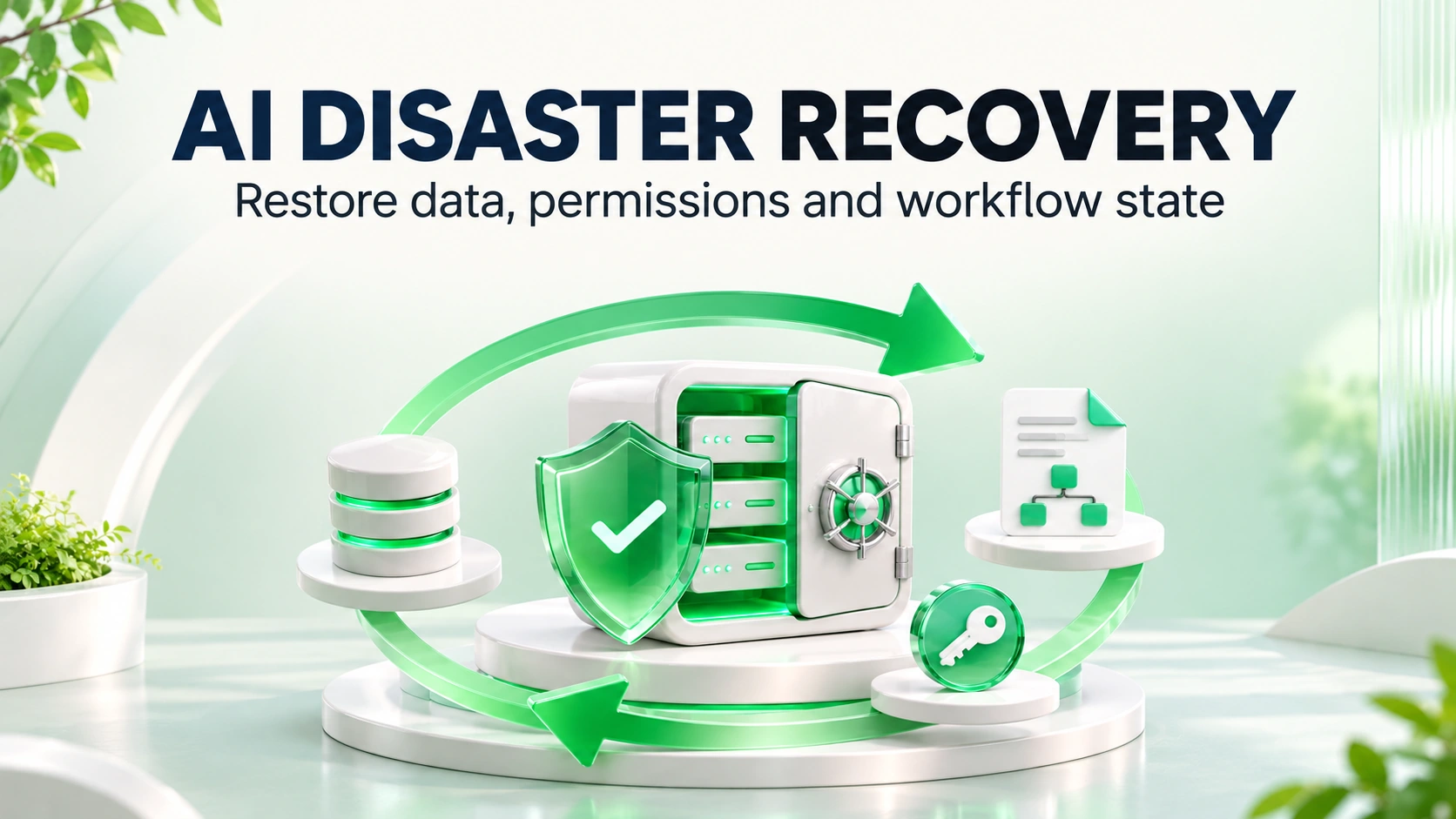
AI disaster recovery means restoring the application, its evidence and its authority to act to a consistent, verified state. A running model endpoint is only one dependency. A RAG assistant also needs current sources and access rules; an acting agent needs trustworthy records of which business operations already completed.
Build the recovery plan around the business task. An internal read-only search assistant can have different recovery requirements from an agent that changes financial or customer records.
Define the recovery outcome before selecting backups
Specify the recovery time objective: how long the business can tolerate the service being unavailable. Specify the recovery point objective: how much recent data loss it can tolerate. Treat these as requirements to test, not as promises created by selecting a backup schedule.
AWS's disaster recovery guidance distinguishes backup-and-restore, pilot light, warm standby and multi-site approaches. It also explains why replication alone may propagate corruption or deletion. Choose the pattern for your workload and budget, then test it.
Inventory the state that must agree after restoration
| State | Recovery question | Evidence to retain |
|---|---|---|
| Source documents and derived chunks | Do passages trace to the restored source versions? | Source IDs, versions and transformation records |
| Embedding and search configuration | Are vectors compatible with the query model? | Model identity, dimensions and index configuration |
| Permissions and deletion records | Could the restore revive revoked access or deleted content? | Current authorization source and deletion ledger |
| Prompts, policies and tools | Does the restored release use approved behavior? | Release manifest and policy versions |
| Workflow checkpoints | Can unfinished work resume under compatible code? | State schema and workflow version |
| External action receipts | Which actions completed outside the restored system? | Operation IDs and downstream receipts |
Back up sensitive state with appropriate encryption, access restrictions and retention controls. Test whether recovery staff can retrieve required keys and secrets through approved mechanisms. A backup encrypted with an unavailable key does not provide a usable restore.
Restore into isolation before reopening tools
- Contain the failure. Stop new writes and automatic retries where the incident warrants it. Preserve relevant evidence under the incident process.
- Select a consistent restore point. Record which data stores and application release belong together. Identify gaps between their snapshots.
- Rebuild or restore retrieval. Verify source counts, sample content, vector compatibility and citation destinations. Rebuilding may be valid, but measure its duration.
- Reconcile authorization. Reapply current revocations and deletion requirements before users can query restored content.
- Reconcile external actions. Check uncertain operations against downstream systems. Do not replay a checkpoint merely because it predates an action receipt.
- Test and reopen gradually. Begin with restricted users and read-only operations, then enable writes after the relevant controls pass.
Worked example: the backup predates a completed update
Illustrative example: an agent creates a service ticket at 10:04. Its workflow database is later restored from 10:00, while the ticketing platform retains the completed ticket. The restored agent sees an unfinished step.
The recovery procedure queries the downstream platform using the original operation reference. If the ticket exists, the workflow records the verified result and continues. If the outcome cannot be resolved, it routes the item to an operator instead of creating another ticket.
This example shows why database restoration and business recovery are different checks. Duplicate prevention depends on the integration's actual identifiers, query capabilities and retention of execution evidence.
Run a drill with explicit pass conditions
Use a nonproduction environment with production-like dependencies. Simulate unavailable infrastructure, corrupted search state and lost workflow checkpoints separately. Capture elapsed restoration time, data gaps, failed authorization tests and unresolved external operations.
A proposed drill passes only when a reviewer can trace a sample answer to the correct restored source, a revoked user cannot retrieve protected material, and a completed external action is not repeated. Record the conditions you did not test, including unavailable regional capacity or provider dependencies.
Rehearse failback as well. Decide which environment becomes authoritative and how to reconcile writes made during recovery. Otherwise, returning to the original environment can create a second inconsistency.
Keep the plan executable
Assign an incident lead, restore operator, access reviewer and business owner. Keep dependencies, contact routes and recovery credentials accessible through approved emergency procedures. Update the plan when schemas, providers or permissions change.
Use LuMay's AI agent incident-response runbook for containment and evidence collection; use the recovery plan to prove the restored service can operate correctly. The next useful step is one timed restore drill with a written list of unresolved operations.