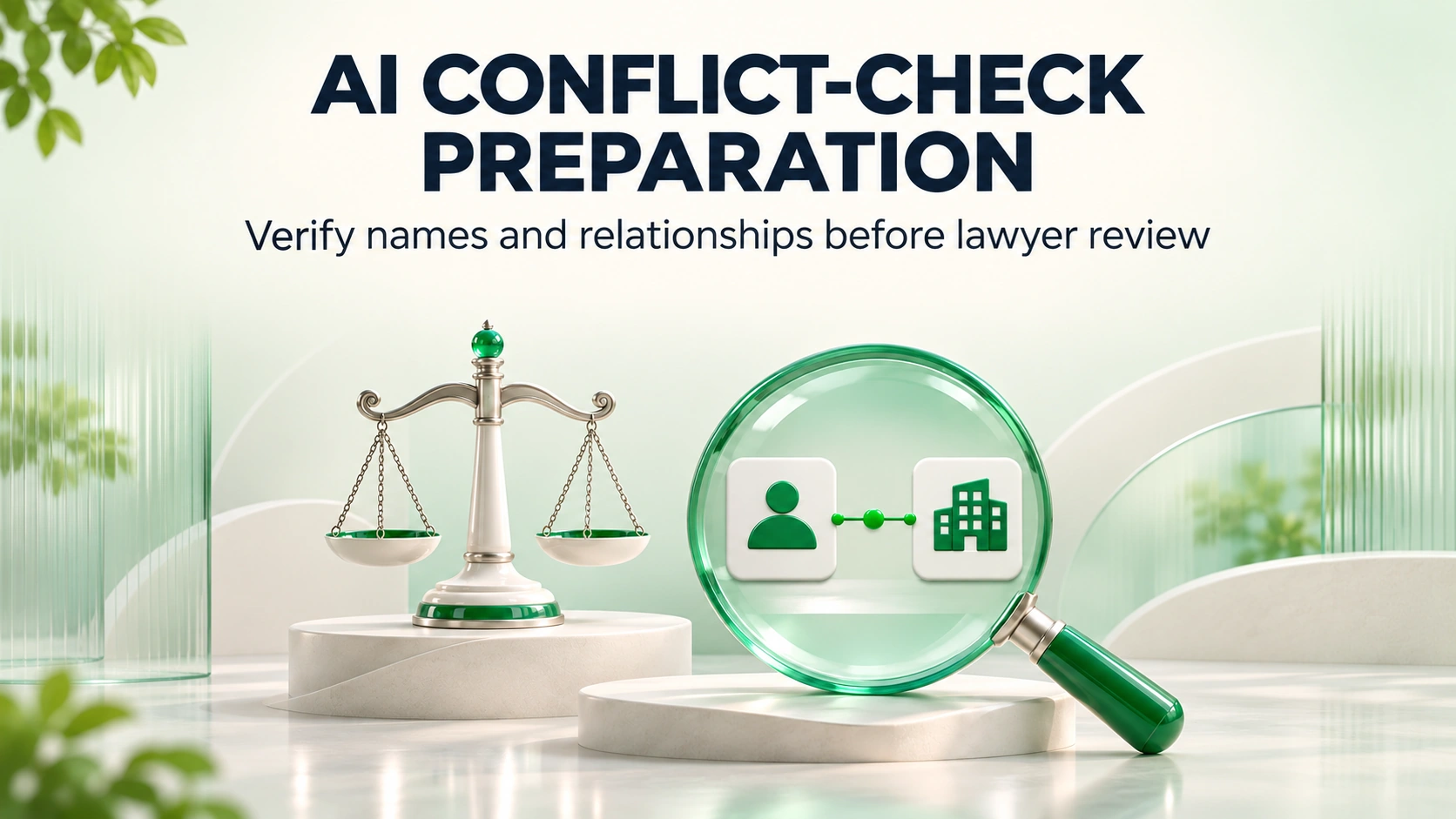
AI can help prepare a law firm's conflict check by collecting party names, proposing aliases, organizing relationships and assembling search evidence. It should preserve uncertainty and route results for lawyer review. A clean name match, a low similarity score or a search with no hits does not establish that representation is permissible.
The most useful implementation starts before scoring search results: it makes the party list accurate enough for a meaningful search.
Set the boundary between preparation and clearance
The ABA commentary to Model Rule 1.7 identifies client identification and conflict analysis as parts of the lawyer's process. The Model Rules are a reference framework; applicable jurisdictional rules and the firm's qualified reviewers govern the actual engagement decision.
Build software statuses such as “information incomplete,” “search prepared” and “review pending.” Reserve clearance and engagement approval for the authorized process. Do not use “AI approved” as an ambiguous substitute for a documented legal decision.
Collect a minimum useful party record
Agree with the firm's conflicts team which fields are necessary for each practice area. Request structured names and roles before inviting detailed substantive narratives.
ABA commentary to Model Rule 1.18 discusses limiting initial consultations to information reasonably necessary to decide whether to undertake representation. Use counsel-approved intake wording and controls appropriate to the relevant jurisdiction.
| Field | Purpose | Uncertainty to preserve |
|---|---|---|
| Original supplied name | Retain what the person actually provided | Spelling not yet verified |
| Normalized name | Support consistent searching | Normalization is not identity proof |
| Aliases and prior names | Broaden supported search variants | Proposed versus confirmed alias |
| Party role | Distinguish client, opposing party and other roles | Role unresolved |
| Related entity | Identify a potentially relevant relationship | Relationship source and date |
| Review record | Show who resolved ambiguity | Pending reviewer questions |
Use AI suggestions without silently merging identities
A model may suggest that two spellings describe the same organization. Store that as a candidate relationship with its supporting evidence. Do not merge records solely because names are similar or a model sounds confident.
Preserve differences in jurisdiction, address, registration information and business role when available through authorized sources. A trading name, subsidiary and parent company may be related without being interchangeable records.
For individuals, distinguish identity resolution from relationship relevance. Two people can share a name, while an actual conflict concern may involve someone whose name is absent from the first intake statement.
Prepare a reproducible search package
- Validate the supplied fields. Flag missing roles, incomplete names and unverified aliases.
- Expand only supported variants. Record which variants came from the caller, an approved source or an AI suggestion.
- Search authorized records. Apply the firm's access and confidentiality rules. Do not expose restricted matter details to every intake user.
- Capture the search scope. Record queried systems, search terms, time and relevant data freshness.
- Route hits and gaps. Give the reviewer source references and unresolved identity questions, rather than a bare risk score.
Worked example: a trading name creates a missed-search risk
Illustrative example: a prospective client names “Harbor Parts” as the opposing business. An approved corporate record identifies “Harbor Components LLC” as the legal entity using that trading name. The preparation service retains both names and the evidence connecting them.
A search on the legal name returns a potentially relevant matter. The intake user sees that review is required, while restricted details remain available only to authorized reviewers. A lawyer decides relevance and next steps under the firm's process.
If the corporate relationship cannot be verified, the package marks it unresolved. The system does not silently treat the two names as identical, and it does not clear the matter because the original trading-name search returned nothing.
Test missing names as carefully as false matches
Create synthetic test cases for misspellings, common names, former company names, similarly named entities and newly added parties. Review whether relevant candidates reach the conflicts team and whether irrelevant candidates create excessive review work.
Test updates after intake as well. A new adverse party or corrected client identity should trigger the firm's defined recheck process. Preserve the original search package and later decision history.
What a no-hit result should say
Use precise language: no matches were found in the stated systems using the recorded terms at the recorded time. That describes the search result without implying that every relevant relationship was known or that the matter is cleared.
For the surrounding intake process, see how AI legal intake works. Start a preparation pilot by asking the conflicts team to review the proposed party record and ambiguous-name test cases before enabling automated search expansion.