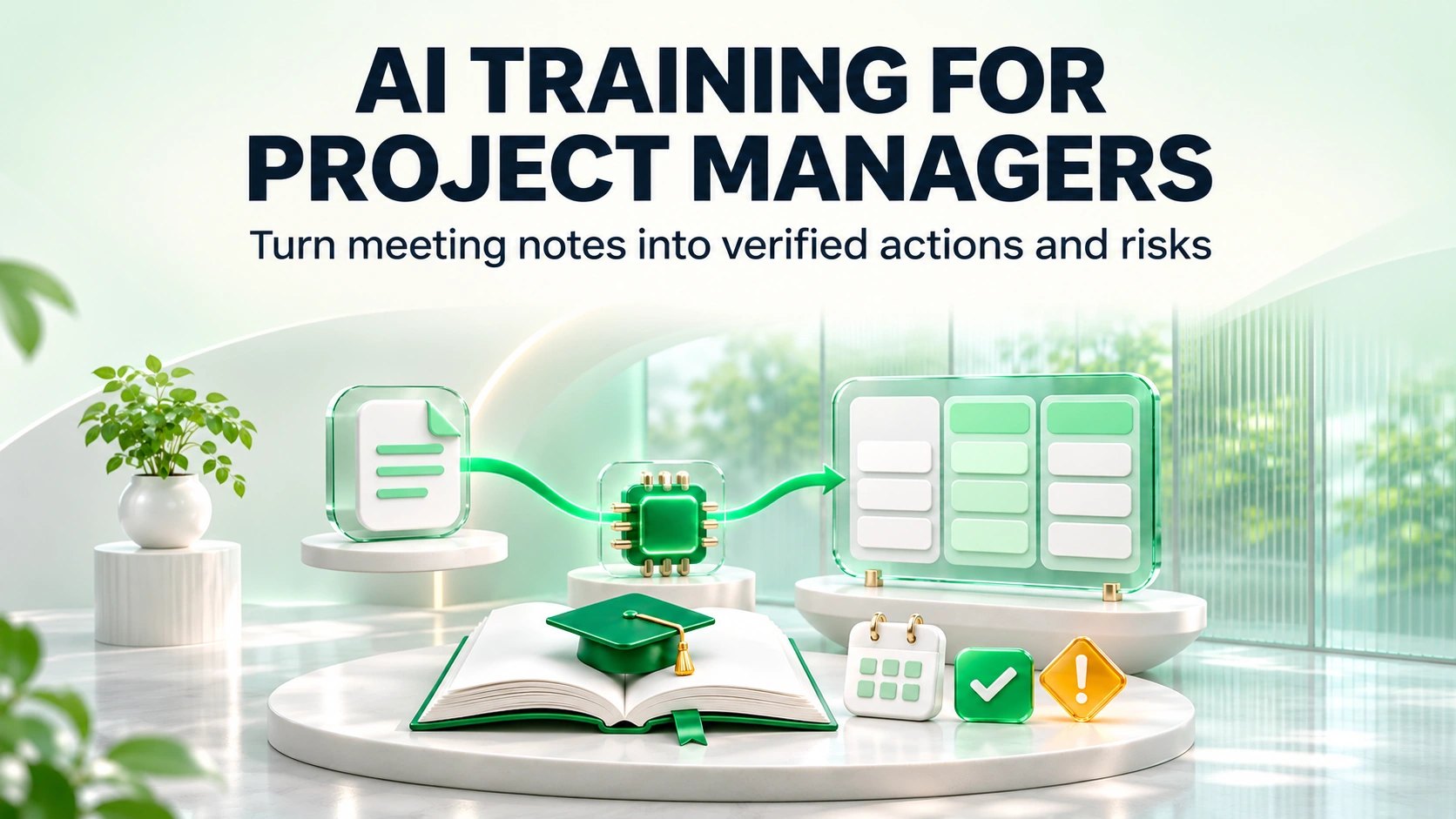
AI training for project managers should help them convert messy project information into verified actions, risks and stakeholder updates. The central skill is knowing what the source establishes, what remains an assumption and which decisions require an accountable person.
A useful workshop follows one project from meeting notes to an action log, a risk register and a status update. Participants should leave with a reviewable work package, not just a library of prompts.
Choose a realistic project packet
Prepare synthetic or appropriately sanitized meeting notes, a milestone plan, a change request and a previous status report. Include deliberate contradictions: an owner who has not accepted a task, a date mentioned as a possibility and a dependency that remains unresolved.
Confirm that the training environment is approved for the material. Avoid copying live personnel details, confidential negotiations or restricted project records into an unapproved tool.
PMI's guidance on AI in project management discusses using AI to support project work while retaining the practitioner's judgment. The following exercises are a proposed training design; they are not a claim of PMI endorsement or an existing LuMay certification.
Teach three distinctions before generating a report
| Distinction | Example | Required treatment |
|---|---|---|
| Decision versus suggestion | “We could release Friday” | Do not record Friday as an approved release |
| Assigned owner versus mentioned person | “Ask Maya who can handle testing” | Do not automatically assign testing to Maya |
| Risk versus issue | A dependency might slip; a dependency has already slipped | Separate uncertain future exposure from an existing problem |
These distinctions make review concrete. A polished summary can still be operationally wrong if it converts a possibility into a commitment.
Exercise 1: create a traceable action log
Ask participants to extract action, proposed owner, due date, source location and confirmation status. Missing fields should remain missing. If the source is contradictory, capture the contradiction and the person who needs to resolve it.
Illustrative prompt template:
From this approved project packet, extract proposed actions.
For each action include source ID, source wording, owner, due date,
and whether each field is explicit, inferred or missing.
Do not treat suggestions as decisions.
Keep unresolved contradictions in a separate clarification list.
Do not send messages or update the project system.
Participants then compare every extracted row with the source. They submit a corrected log and a short explanation of the highest-impact model error. No external task assignment is needed to complete the exercise.
Exercise 2: draft risks without fabricating probabilities
Use a defined structure: uncertain event, cause, potential impact, evidence, owner for review and proposed response. Ask the model to suggest missing questions, not to invent percentage likelihoods or financial impacts.
If the organization's risk process uses numerical scoring, give participants the approved scoring criteria and require human review. A generated number should not acquire authority because it appears in a familiar spreadsheet column.
Illustrative example: notes say a vendor has not confirmed a test environment. A reasonable proposed risk is that delayed access could affect integration testing. The packet does not establish a two-week delay, a specific loss or vendor fault. Those claims stay out of the register unless supporting information is obtained.
Exercise 3: write a status update that preserves uncertainty
Have participants produce a short update with completed work, next steps, material risks, decisions needed and source references for the reviewer. Compare the draft with the current milestone plan and change log.
Challenge any traffic-light status that lacks defined criteria. The model should not mark a project green just because most sentences sound positive. Require the participant to explain how unresolved dependencies affect the proposed status under the organization's actual method.
Then introduce a new approved fact and ask for a revised update. The participant must identify what changed and which conclusions should remain unchanged, rather than rewriting the whole project history.
Assess judgment with an equivalent second task
Use a fresh project packet containing similar error types. A proposed rubric scores action accuracy, source traceability, treatment of missing information, risk-versus-issue classification and stakeholder clarity. Require correction of invented deadlines or unapproved commitments before the work passes.
Measure time to a reviewer-accepted output, including verification. Compare correction counts and error severity with the baseline task. A faster draft that creates extra coordination work is not a demonstrated productivity gain.
Adapt exercises for different project roles. A coordinator may focus on action extraction; a program manager may focus on cross-project assumptions and escalation. The NIST AI RMF Playbook supports role-appropriate training and clear responsibilities; the workshop should reflect the team's actual authority.
Keep human commitments under human control
Start with drafting in a training environment. If later automation updates a project platform, treat that as a separate integration with permissions, confirmation and audit requirements. Completion of the workshop is not automatic authorization for system writes.
Use LuMay's role-based AI literacy assessment to plan further practice. The next step is a small pilot in which project managers can demonstrate exactly how each action and risk follows from the evidence.