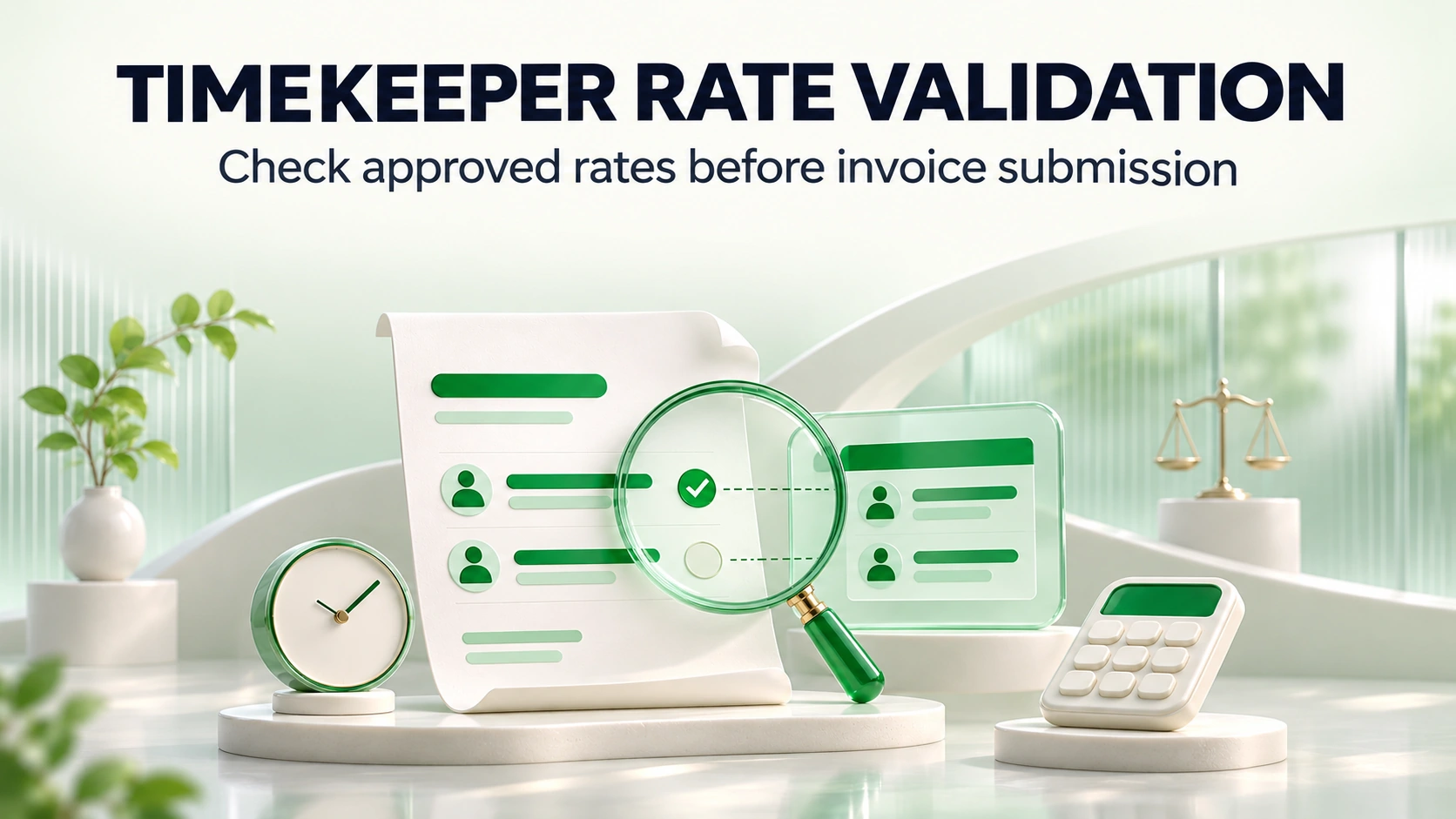
Timekeeper rate validation checks whether a legal invoice uses the rate authorized for the relevant person, client, matter, work period and billing arrangement. AI can help extract proposed rate terms and organize exceptions. Approved structured records and deterministic calculations should drive the actual comparison.
A timekeeper's current standard rate is not necessarily the rate approved for every client or historical entry. A reliable review needs the relevant approval and the rule that determines when it applies.
Separate invoice format from rate authorization
The LEDES Oversight Committee documents legal e-billing exchange formats, including LEDES 1998B. A file meeting a format specification does not establish that a client approved its rates. Format checks and commercial authorization checks answer different questions.
Validate the actual export format and client requirements separately. Avoid assuming every LEDES format supports identical fields, currency treatment or adjustment semantics.
Build an approved rate record
The following is a proposed operational data model, not a universal client billing standard. Have the responsible billing and legal owners define precedence and interpretation from the relevant agreements and approvals.
| Record element | Why it matters |
|---|---|
| Client and matter scope | A client-wide rate may have a documented matter exception |
| Stable timekeeper identity | Names and classifications can change or collide |
| Approved amount and currency | A matching number in a different currency is not the same rate |
| Applicable date basis and period | Work date and invoice date can produce different results |
| Fee arrangement | An hourly comparison may not fit a fixed or blended arrangement |
| Approval evidence | Reviewers need the actual source and authorized approver |
| Exception and status | Proposed, approved, expired and withdrawn are distinct states |
If two active approvals appear to conflict, return an unresolved applicability finding. Do not select whichever rate is newest, highest or most favorable without an approved precedence rule.
Use AI for extraction, then validate the result
An extraction workflow can identify a timekeeper, amount, currency, stated period and source location from an approved document. Preserve the original wording and page reference alongside each proposed field.
Require review before activating extracted terms. Watch for conditions in footnotes, attachments and later correspondence. A correctly read rate can still be incorrectly scoped to the wrong matter.
Keep financial comparisons in ordinary application logic using the agreed precision and rounding rules. Do not ask a language model to decide arithmetic or silently rewrite invoice values.
Run the comparison in a defined order
- Resolve identities. Map the invoice's client, matter and timekeeper IDs to the approved records. Route ambiguous mappings for review.
- Resolve applicability. Select the approved arrangement and date basis. Check whether an exception applies.
- Validate units and currency. Confirm that the rate and quantity describe comparable units and the same currency.
- Compare the rate. Return pass, discrepancy or insufficient evidence according to the approved rules.
- Calculate the potential difference. Retain the formula and rounding policy. Treat the result as a review amount until authorized correction.
- Preserve the finding. Record invoice line, source approval, rule version, calculation and reviewer disposition.
Worked example: a mid-period rate change
Illustrative example: a hypothetical client approves USD 400 per hour through June 30 and USD 425 from July 1, with work date explicitly controlling. An invoice contains two hours of June work at USD 425.
The expected line amount under those assumptions is 2 × USD 400 = USD 800. The billed amount is 2 × USD 425 = USD 850. The potential difference is USD 50. The service flags the line with the approval reference; it does not erase or alter the entry.
For July work, the same USD 425 rate may pass. If the approval instead uses another date basis, the example's result does not apply. If the arrangement is fixed-fee, the hourly calculation may be irrelevant.
Handle missing approvals without inventing a breach
A missing rate record can reflect incomplete synchronization, an unprocessed approval or a genuinely unapproved charge. Label the information gap and identify the owner who must resolve it. Distinguish that status from a verified mismatch against a known approved rate.
Do not suppress a missing approval by defaulting to the timekeeper's standard rate. Such a fallback can make incomplete data appear compliant.
Test boundary cases before submitting invoices
Include effective-date boundaries, reclassified timekeepers, matter exceptions, different currencies, negative adjustments, fractional units and invoices spanning multiple periods. Reproduce a previously reviewed invoice using the historical rate records rather than today's defaults.
Track discrepancies confirmed by reviewers, false flags, unresolved approval gaps and correction turnaround. Do not treat every flagged dollar as recovered revenue or every passing line as a guarantee of client acceptance.
For broader guideline applicability, see LuMay's OCG rule-versioning guide. Begin with one client's approved rate register and a historical invoice, then ask the billing owner whether every result can be reproduced from its evidence.