


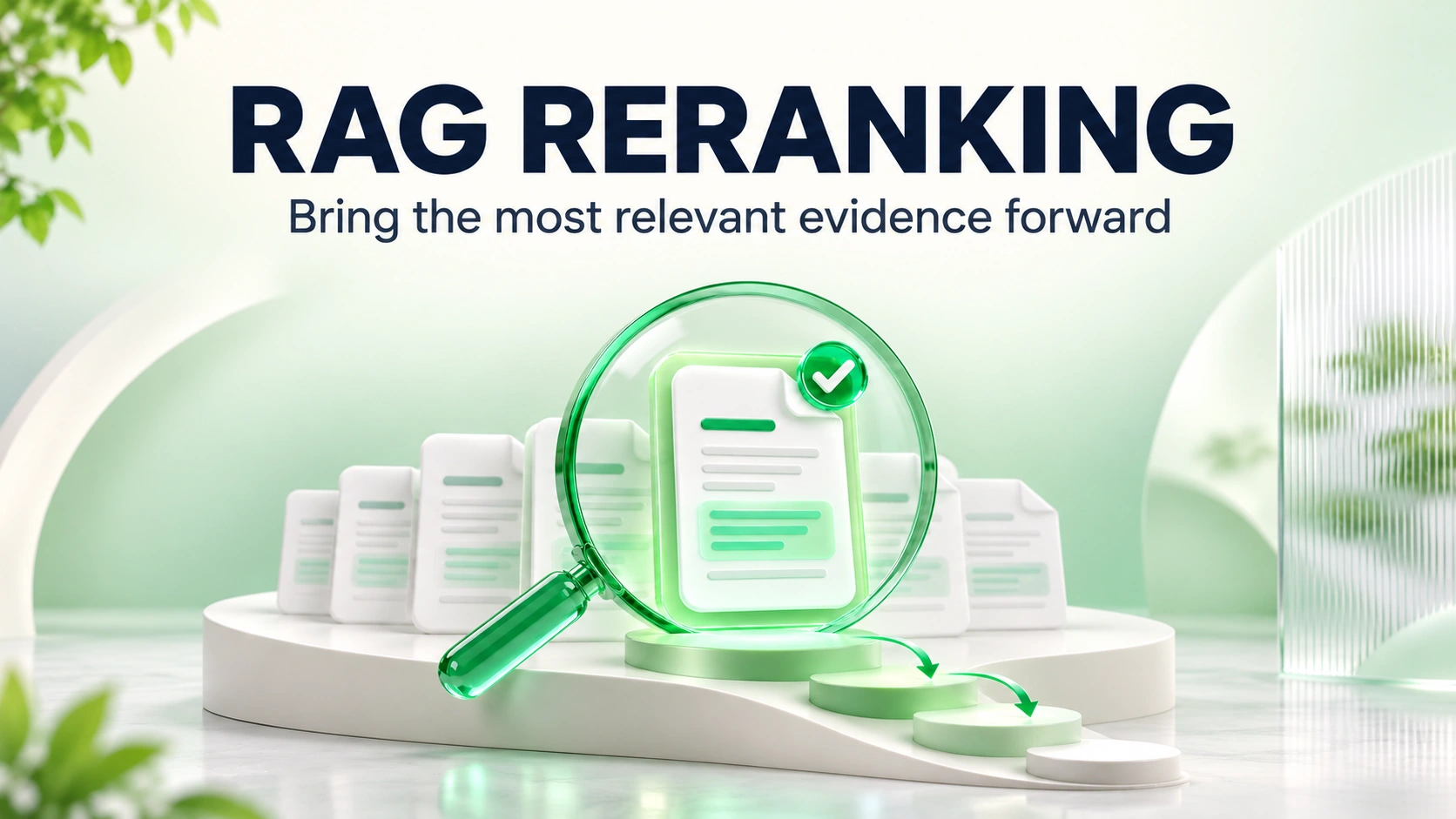
RAG reranking scores the documents returned by an initial search and changes their order before selected passages reach the language model. It can improve which evidence appears in a limited context window. It cannot recover a document that the first search never retrieved, establish access permission, or make an unsupported answer true.
For engineering teams, the first decision is therefore diagnostic: is the relevant evidence missing from the candidate set, or present but ranked too low? Those failures need different fixes.
Separate retrieval coverage from context ordering
The Sentence Transformers retrieve-and-rerank documentation describes a two-stage approach: efficient retrieval produces candidates, then a cross-encoder evaluates query and passage pairs. This is a useful architecture when scoring the whole corpus with the more expensive model would be impractical.
Inspect the candidates before adding another model. If the needed passage is absent, investigate ingestion, chunk boundaries, filters and first-stage search. If it is present but displaced by weak matches, test a reranker. If it ranks well but the answer remains wrong, inspect context assembly and generation separately.
Build a small, reviewable evaluation set
Collect representative questions from approved sources. Include exact identifiers, paraphrases, multi-document questions, ambiguous requests and questions with no supported answer. Have subject-matter reviewers identify the passages needed to answer each question and distinguish complete evidence from merely related text.
Use a development set for tuning and retain a separate evaluation set. Record the corpus snapshot, parser version, embedding model, retrieval configuration and reranker version. Otherwise, a changed result may come from changed source material rather than reranking.
| Measurement | Question it answers | Decision it informs |
|---|---|---|
| Candidate recall | Did initial retrieval include the necessary evidence? | Whether to fix retrieval first |
| Ranking quality, such as nDCG | Are more useful passages placed earlier? | Whether ordering improved |
| Evidence coverage in final context | Did the selected passages preserve every required fact? | Whether context assembly is adequate |
| End-to-end answer review | Does the answer accurately use the selected sources? | Whether the full system improved |
| Latency and cost per request | What does the additional stage consume? | Whether deployment fits the service budget |
Add reranking behind existing access controls
- Retrieve authorized candidates. Enforce the user's access scope before sending passages to a scoring service. Review the reranker's own data-processing boundary.
- Score query-passage pairs. Preserve stable passage IDs and source versions. Treat a relevance score as a model-specific ordering signal, not a calibrated probability of truth.
- Assemble usable evidence. Remove redundant overlaps, retain necessary adjacent context and preserve citations. A high-scoring fragment may omit a condition stated in the next paragraph.
- Handle weak evidence explicitly. Use your evaluated abstention policy. Do not assume that the highest-ranked passage is adequate just because every query produces a winner.
- Record the decision. Log candidate IDs, selected IDs, configuration versions and stage timings under your retention policy.
Worked example: a policy exception outranks a generic policy
Illustrative example: an employee asks whether a particular equipment category needs advance approval. The initial search retrieves the general purchasing policy, a product catalog and a category-specific exception. The exception is ranked last, although it contains the controlling condition.
A reranker could move that exception ahead of the catalog. The context builder should still include the general rule when the exception refers back to it. The acceptance test checks whether the answer explains both the exception and its condition, with correct sources.
Now remove the exception from the candidate set. A passing system should expose insufficient evidence under the test policy, rather than produce an apparently complete answer from the general rule. This second test prevents a ranking improvement from masking a coverage failure.
Set a failure policy before rollout
If scoring times out, choose a documented response: return the baseline retrieval result for a low-risk task, ask the user to retry, or stop an evidence-sensitive workflow. Label the fallback in telemetry. Silent fallback makes quality comparisons unreliable.
Start with shadow evaluation, then a limited cohort. Compare the same question mix and source versions. Track tail latency as well as averages, and review regressions by question type rather than relying only on one aggregate score.
Questions engineering teams should resolve
Should we rerank more passages to improve quality?
Test several candidate sizes within your budget. More candidates add scoring work and may introduce confusing near-matches. Choose the smallest configuration that meets your coverage and ranking requirements on held-out questions.
Does reranking replace a RAG evaluation pipeline?
No. It changes one stage of that pipeline. Use the broader RAG evaluation workflow to check retrieval, context and answers independently.
Begin with a sample of failed questions and identify which failures actually involve ordering. That evidence gives an engineering partner a concrete scope for a reranking pilot.