



Direct Answer
Deploying an AI voice agent is substantially cheaper than maintaining a traditional call center, reducing typical customer support operational expenditures by 70% to 85%. While a traditional call center relies on human labor costing $25 to $45 per hour fully loaded, virtual voice assistants operate at $0.07 to $0.25 per minute, billing strictly for active conversation time.
TL;DR
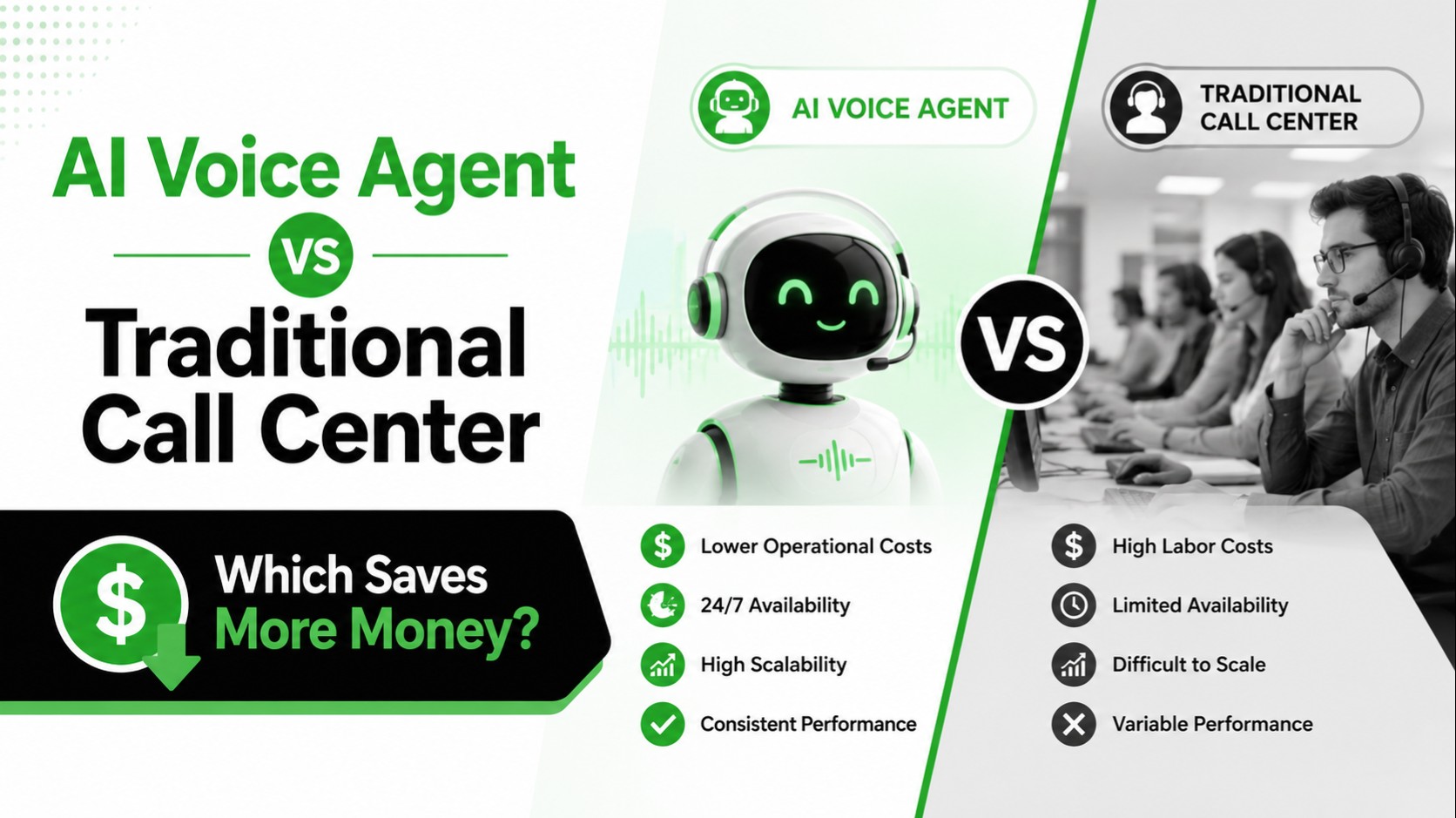
Substantial Cost Reductions: Moving routine phone interactions to automated voice systems reduces total support expenses by up to 85%.
Zero Staffing Overhead: Automating phone calls completely removes recurring expenses tied to recruiting, onboarding, and high agent turnover rates.
Instantaneous Scalability: Digital voice systems handle thousands of concurrent inbound calls simultaneously, ensuring zero customer wait times during peak spikes.
Continuous 24/7 Availability: Full day-and-night coverage is achieved natively without paying late-night shift premiums, weekend differentials, or holiday wages.
Accelerated ROI Horizon: Low ongoing variable maintenance fees mean most system implementations achieve a complete capital break-even within 3 to 6 months.
Targeted Operations: Best utilized for lead qualification, appointment booking, basic tier-1 troubleshooting, and instant inbound routing.
Bypassing Human Constraints: Overcomes human capacity limits, scheduling fragmentation, fatigue, and performance inconsistencies during long shifts.
Quick Comparison Table
Factor | AI Voice Agent | Traditional Call Center |
Setup Cost | Low to Moderate (Software configuration) | Very High (Hardware, office space, phone systems) |
Monthly Cost | Pay-as-you-go based on minutes consumed | High fixed monthly payroll and seat licensing |
Cost Per Call | Fractional ($0.20 to $0.75 per interaction) | High baseline parameters ($5.00 to $12.00 per call) |
Availability | Continuous 24/7/365 coverage | Highly restricted or dependent on shift premiums |
Scalability | Instantaneous, infinite line expansion | Slow, linear progression gating manual hiring |
Training Cost | Flat initial system setup fee | Heavy, recurring cost due to high employee turnover |
Wait Times | 0 seconds (Immediate pick-up) | Highly variable (Prone to long hold queues) |
ROI Horizon | Short-term (Typically under 90 days) | Multi-year amortization of fixed capital expenses |
AI Voice Agent vs Traditional Call Center: Which Saves More Money?
Modern customer support operations are experiencing an unprecedented period of financial friction. Growing operational demands, fluctuating market dynamics, and strict user expectations force organizations to confront a challenging reality: traditional human call center costs are climbing at an unsustainable rate.
At the exact same time, structural call center staffing challenges—including chronic workforce burnout and high attrition—make it incredibly difficult to deliver reliable, consistent customer service.
To overcome these roadblocks, clear-thinking operations leaders are turning directly to comprehensive customer service automation. This strategy brings the ultra-efficient, utility-based pricing of a modern AI voice agent cost model into direct competition with legacy brick-and-mortar operations.
What Is an AI Voice Agent?
An AI voice agent is an autonomous, cloud-based software system capable of holding fluid, natural, two-way voice conversations over a standard telephone line. Moving far past the frustrating, rigid, button-pushing menus of old Interactive Voice Response (IVR) systems, modern voice agents understand abstract human statements, interpret customer intent, and execute complex backend business processes dynamically. For an in-depth breakdown of how these enterprise platforms function under the hood, you can explore this complete analysis on What is LuMay Voice Agent.
What AI Voice Agents Do
To achieve conversational interactions that match human quality, these systems orchestrate several advanced software layers simultaneously:
Voice AI Automation: Managing the entire lifecycle of a customer telephone call from start to finish without needing manual human control.
Speech Recognition: Translating spoken customer words into text data within milliseconds.
Conversational AI & Intent Detection: Analyzing the actual meaning, context, and emotional nuance behind a customer's phrasing.
Natural Language Processing (NLP): Engineering human-like sentences to respond to caller inquiries clearly and contextually.
Large Language Models (LLMs): Providing advanced reasoning capabilities that keep the system accurately aligned with strict company policies and safety parameters.
Call Routing: Instantly determining whether an incoming request can be resolved automatically or needs to be passed smoothly to a human specialist.
How AI Voice Agents Handle Calls
Whether managing incoming customer traffic (inbound calls) or reaching out for proactive client communication (outbound calls), automated voice platforms run completely on customizable business rules. They connect directly into your company systems to handle automated appointment booking, qualify inbound sales inquiries (lead qualification), provide instant technical updates, and guide users through standard customer support workflows.
Built on top of robust foundational engine architectures—similar to the core systems powering OpenAI, ChatGPT, Google Gemini, and Anthropic Claude—these virtual phone systems can process complex, unscripted customer responses on the fly. They can handle mid-sentence interruptions naturally, gather accurate documentation, and write real-time validation data straight back to your company CRM.
What Is a Traditional Call Center?
A traditional call center is an operational model that relies completely on manual human labor to manage an organization's telephone interactions, customer service programs, and outbound outreach.
How Traditional Call Centers Operate
This model is built around structured customer service teams composed of full-time or part-time human agents. Calls flow through local servers or cloud routing hubs into long waiting queues. Human operators then manually cross-reference internal documents, look up solutions, update customer profiles, and log support tickets one by one.
To maintain steady phone coverage during unexpected call spikes, operations managers use complex workforce management software to schedule shifts, track employee attendance, and calculate real-time queue metrics.
Common Call Center Expenses
Human-centric customer service operations carry significant ongoing financial costs that span multiple layers of an organization's budget:
Salaries & Direct Benefits: Base hourly wages, payroll taxes, comprehensive health insurance, retirement plans, and performance incentives.
Recruitment Costs: Continual outreach, screening, and background checks required to offset a historically high call center turnover rate, which regularly tracks between 30% and 45% every year.
Agent Training Expenses: Multi-week onboarding programs, classroom materials, and supervisor hours needed to bring raw recruits up to baseline compliance and performance levels.
Infrastructure & Facilities: Monthly office lease costs, physical security infrastructure, workstations, desks, computers, and facility utilities.
Software Licensing Fees: Per-seat software packages for advanced telephony routing, call recording systems, workforce scheduling suites, and customer analytics tools.
AI Voice Agent vs Traditional Call Center Cost Comparison
The fundamental shift in customer service budgets becomes clear when you look past total figures and examine the exact unit economics that separate digital and human support channels.
Initial Setup Costs
Building a traditional in-house call center requires an immediate, heavy deployment of capital. Companies have to fund physical facility upgrades, install enterprise-grade telephony hardware, and run extensive hiring campaigns.
On the other side, an AI voice agent setup uses scalable, cloud-native frameworks. When evaluating infrastructure, selecting the best AI voice agent stack ensures sub-second response times and reliable API data mapping, making the initial engineering outlay highly efficient.
Monthly Operating Costs
Human operations require high, fixed baseline commitments. Companies must pay full-time employees to sit at desks and monitor lines regardless of actual call volume, creating expensive waste during quiet hours.
Conversely, AI voice agent pricing relies on a highly flexible, pay-as-you-go model. Because companies are billed exclusively for the exact minutes spent talking to customers, they stop paying for idle downtime between call waves.
Cost Per Call Comparison
The core financial difference between a Voice AI vs Human Call Center setup is most obvious at the individual interaction level. A human-handled phone call in the United States typically averages between $5.00 and $12.00, depending on total conversation time, agent expertise, and management overhead.
An automated calling agent completely removes these human labor dependencies, dropping the raw computing cost of a typical transaction down to fractions of a dollar.
Annual Cost Comparison Example
To see how these numbers play out in the real world, let us model a growing enterprise that handles a consistent volume of 10,000 calls per month, with an average duration of 4 minutes per call.
Cost Element | Traditional In-House Team (US Onshore) | Outsourced Call Center (Offshore BPO) | Integrated AI Voice Agent |
Billing Model Base | Fixed hourly wages ($30/hr fully loaded) | Per-seat contract rate ($12/hr) | Active talk-time usage ($0.12/minute) |
Monthly Operating Labor | $33,600 (approx. 6 full-time agents) | $13,440 (blended vendor rate) | $4,800 (40,000 active talk minutes) |
QA, Monitoring & Management | $3,500 | $1,800 | $0 (Built-in automated analytics) |
Software, CRM & Seat Licenses | $1,200 | Included in flat seat rate | $450 (Flat platform access fee) |
Amortized Hiring & Attrition | $1,500 | Minimally absorbed by vendor | $0 (Software does not resign) |
Total Monthly Spend | $39,800 | $15,240 | $5,250 |
True Cost Per Individual Call | $3.98 | $1.52 | $0.53 |
Annualized Total Run-Rate | $477,600 | $182,880 | $63,000 |
How Much Can Businesses Save With AI Voice Agents?
Transitioning from a manual telephone operation to a digital automation layer yields significant structural dividends across every phase of corporate growth.
Small Business Savings
Small businesses and growing startups often use these tools as a direct AI receptionist vs call center alternative. By leveraging the best AI answering service for businesses alongside specialized platforms featured in guides on the best AI phone agents and receptionists, small teams capture vital after-hours leads, eliminate missed business calls, and save between $3,000 and $5,000 per month in early staffing costs.
Mid-Sized Business Savings
Mid-market companies trying to scale their customer care infrastructure frequently run into severe hiring friction. Automating routine tasks like tracking orders, qualifying inbound leads, and processing password resets cuts baseline support costs by 60% to 75%. This allows mid-sized businesses to handle surging customer bases smoothly without having to open expensive new local call centers.
Enterprise Savings
Large enterprises processing hundreds of thousands of customer calls every month achieve the largest absolute budget reductions. By deploying high-capacity automated call systems alongside legacy software platforms like Salesforce and HubSpot, large organizations reduce their call center expenses by $1$ million to $5$ million+ every year. This shifts customer care from a massive cost liability into a highly optimized operational asset.
ROI Analysis: AI Voice Agent vs Call Center
Evaluating this operational switch requires looking at the transition through a strict financial lens, focusing on concrete return-on-investment parameters. Reviewing a real-world enterprise voice automation case study highlights how high containment rates directly drop customer handling costs.
Understanding Voice AI ROI
True financial performance goes far beyond simply lowering your monthly payroll. To see the full picture, an organization must measure total operational improvements against the baseline software investment:
$$ROI = \left( \frac{\text{Total Annual Call Center Savings} - \text{Total AI Implementation Investment}}{\text{Total AI Implementation Investment}} \right) \times 100$$
Sample ROI Calculation
Let us look at a practical scenario featuring a mid-sized company automating a portion of its tier-1 customer inquiries:
Initial Custom Implementation & Integration Capital: $25,000 (one-time fee for custom engineering, API connections, and voice tuning).
Annual Platform Maintenance & Software Costs: $2,000 per month ($24,000 annualized).
Prior Baseline Call Center Expenses: $180,000 per year in manual labor and outsourcing costs.
New Post-Automation Hybrid Run Rate: $45,000 per year (retaining a smaller team of human agents for complex escalations).
$$Gross\ Annual\ Operating\ Savings = \$180,000 - \$45,000 = \$135,000$$
$$Net\ First\ Year\ Economic\ Benefit = \$135,000 - (\$25,000 + \$24,000) = \$86,000$$
$$First\ Year\ Return\ on\ Investment\ (ROI) = \left( \frac{\$86,000}{\$49,000} \right) \times 100 = 175.5\%$$
This model shows that the automation system pays for itself within its first few months of live deployment, generating clear, compounding savings over time.
Hidden Costs of Traditional Call Centers
The real fiscal burden of human call centers is often masked by subtle, systemic expenses that rarely show up on a basic outsourcing quote or internal payroll estimate.
Employee Attrition Cycles: Replacing a departed human agent typically costs between $10,000 and $15,000 when adding up recruitment marketing, HR administrative time, and low initial performance.
Ongoing Policy Retraining: Every single time business rules update, prices change, or compliance standards shift, human workforces must stop taking calls to undergo classroom retraining, driving up idle paid time.
Shrinkage & Operational Absences: Sick days, vacation leave, paid breaks, and team synchronization meetings regularly pull humans away from lines, meaning businesses routinely pay for non-productive hours.
Overtime and Capacity Spikes: During unexpected market events or peak seasons, human teams hit a hard capacity wall, forcing companies to pay expensive overtime premiums or deal with long hold queues that damage customer relationships.
Hidden Costs of AI Voice Agents
While the financial arguments for voice automation are incredibly strong, a professional evaluation requires full transparency regarding its unique system maintenance demands:
Upfront Core Engineering: Linking real-time voice tools into legacy enterprise databases, custom software backends, and token verification layers requires specialized development hours.
Telephony Infrastructure Charges: Automated voice systems still travel over standard telecommunication lines, meaning companies pay basic per-minute carrier connection fees alongside the software costs.
Continuous Prompt Calibration: Customer choices change, products evolve, and language models require ongoing calibration to ensure conversational pathways remain accurate and helpful.
Data Security & Privacy Compliance: Running a voice automation system in regulated spaces like healthcare or banking requires choosing enterprise-grade software layers capable of redacting sensitive details automatically to maintain compliance.
Performance Comparison: AI vs Traditional
Performance Metric | AI Voice Agent Platform | Traditional Human Call Center |
First Call Resolution (FCR) | Consistently high for database-linked tasks | High for highly nuanced, fluid issues |
Customer Satisfaction (CSAT) | High due to immediate speed and zero wait times | Highly variable based on individual agent mood |
System Availability | Absolute 24/7/365 native coverage | Dependent on complex, costly shift rotations |
Operational Scalability | Instantaneous, infinite line expansion | Linear limits tied directly to hiring speed |
Data and Compliance Accuracy | Completely uniform; zero protocol deviations | Subject to manual data input mistakes and drift |
Average Speed to Answer (ASA) | Immediate (Typically under 1 second) | Prone to long hold times during heavy traffic |
Overall Cost Efficiency | Maximized via pay-as-you-go minute metrics | Constrained by high, fixed structural overhead |
AI Voice Agent vs Outsourced BPO
Many companies try to escape rising support expenses by moving their operations to offshore Business Process Outsourcing (BPO) call centers. While this reduces basic hourly rates, it replaces high payroll with unique operational challenges. Furthermore, reviewing market options and Bland AI alternatives reveals that cloud-based solutions outpace standard outsourced providers across key performance areas:
Linguistic & Accent Alignment: Offshore human teams can struggle with regional idioms, local accents, or fast language-switching mid-call. Modern voice engines handle language selection effortlessly, shifting between languages and local dialects instantly.
Onboarding Latency: Updating business scripts across an external offshore workforce requires multi-week training rollouts. With a virtual voice system, a policy change or product update takes effect across the entire system instantly via a simple software patch.
Resource Optimization: With an outsourced human call center, you pay for an agent's entire shift regardless of actual phone volume. With AI voice systems, you stop paying for quiet, idle gaps entirely, shifting your budget to cover active customer engagement minutes.
Industries Saving the Most Money With Voice AI
Healthcare
Medical practices and hospital networks use voice automation to manage high-volume administrative tasks. Virtual systems handle inbound appointments, send outbound post-op reminders, and triage insurance updates, saving thousands in manual operational overhead.
Real Estate
Property agencies use virtual assistants to manage continuous incoming rental and buying requests. Automated platforms qualify property shoppers, gather search criteria, and update agent calendars around the clock, ensuring no high-value lead is lost.
SaaS & Technology
Software-as-a-Service companies use automated systems to resolve high-frequency tier-1 support queries. Virtual agents walk users through password resets, process billing changes, and search internal knowledge bases to resolve common issues instantly.
E-commerce
Online retailers face massive customer service spikes during seasonal holidays and promotional sales. Deploying virtual support layers allows companies to manage order tracking queries, process returns, and answer delivery questions instantly without needing to hire temporary seasonal staff.
Financial Services
Fintech institutions and banks deploy highly secure voice systems to handle identity verification, process card balance lookups, and guide clients through routine account tracking updates, keeping compliance tight while cutting operational costs.
When AI Voice Agents Are Better Than Human Agents
Virtual communication layers provide massive operational advantages over manual human teams in several key scenarios:
Handling Sudden Traffic Waves: When product issues or weather events trigger sudden call spikes, virtual systems scale up instantly to handle thousands of concurrent lines, preventing system overloads and long hold times.
24/7 Support Coverage: Virtual platforms provide consistent, round-the-clock availability, capturing late-night sales leads and helping international clients without needing expensive night-shift staff.
Managing Repetitive Tasks: Forcing human workers to answer the exact same simple questions hundreds of times a day causes quick burnout. Passing these tasks to software improves data accuracy while protecting your team's energy.
When Human Agents Are Still Necessary
Despite the power of modern conversational technology, human empathy and advanced problem-solving remain essential for high-value business interactions:
Complex, Multi-Tier Troubleshooting: Deep technical debugging that requires creative problem-solving across completely separate business frameworks is still best handled by experienced human engineers.
High-Value Enterprise Sales: Closing high-ticket business contracts, navigating corporate relationships, and negotiating complex sales terms require a level of nuance and human touch that software cannot recreate.
High-Stress & Sensitive Situations: Managing highly emotional customer situations, such as bereavement claims or fraud trauma, requires genuine human empathy and care.
Best AI Voice Agent Platforms for Businesses
Selecting the right voice automation platform depends on your specific company size, engineering resources, and backend database architecture. Reviewing compiled roundups such as the best AI voice agents and phone platforms along with lists of the top 21 AI voice agents can help clarify the current vendor ecosystem.
LuMay Voice Agent: A premier choice for robust enterprise deployment. The native LuMay Voice Agent software platform ranks highly across industry evaluations like the top 9 AI voice agents for business and the top 10 AI voice agent platforms. It serves as a secure, full-stack best AI agent platform that automates phone lines while seamlessly keeping internal CRMs accurately synchronized.
OpenAI (Realtime Frameworks): The premium option for organizations with dedicated engineering teams who want to build custom voice applications with highly advanced reasoning capabilities.
Salesforce (Einstein Automation): The natural choice for companies deeply embedded in the Salesforce ecosystem who want to sync automated phone calls straight into comprehensive customer contact files.
HubSpot (Service Hub Infrastructure): A fantastic tool for growing businesses looking to link automated phone interactions directly into their core sales pipeline and inbound marketing workflows.
How to Calculate Your Potential Savings
To find out exactly how much your business can save by automating phone workflows, apply this straightforward financial framework:
[Current Monthly Call Volume × Average Handled Minutes × Human Per-Minute Cost]
Minus
[Projected Volume Managed by AI × AI Per-Minute System Compute Cost]
Equals
= Your Total Potential Savings =
Calculate Fully Loaded Costs: Add up direct salaries, payroll taxes, management salaries, physical infrastructure, and software licenses to find your true human operational cost per minute.
Isolate Automatable Volume: Review your call history to identify routine, repetitive tier-1 inquiries—like order tracking or password resets—that are ideal for AI automation (typically 40% to 70% of total call volume).
Run the Model: Multiply that automatable volume by your current cost-per-minute metric, then subtract the pay-as-you-go AI minute cost to reveal your immediate monthly cost reductions.
Future of Customer Support: Hybrid Systems
The most efficient modern support teams do not use technology to eliminate human staff. Instead, they build smart hybrid support models that combine automated systems with human experts. Industry shifts highlighted in deep-dive resources like the top AI voice agent trends and the comprehensive enterprise agentic AI guide emphasize that the future belongs to fully unified contact center architectures.
                       ┌─────────────────────────┐
                      │  Incoming Inbound Call  │
                      └────────────┬────────────┘
                                    │
                                    ▼
                    ┌─────────────────────────────┐
                    │   AI Voice Agent Triage     │
                    │  (Immediate Tier-1 Check)   │
                    └──────────────┬──────────────┘
                                    │
            ┌───────────────────────┴───────────────────────┐
            │                                               │
            ▼                                               ▼
┌───────────────────────┐                       ┌───────────────────────┐
│ Completed by Voice AI │                       │ Nuanced/High Emotion  │
│  (Instant Resolution) │                       │  (Contextual Handoff) │
└───────────────────────┘                       └───────────┬───────────┘
                                                            │
                                                            ▼
                                                ┌───────────────────────┐
                                                │   Human Specialist    │
                                                │  (Deep Resolution)    │
                                                └───────────────────────┘
In these environments, the virtual assistant acts as an intelligent first line of defense, resolving routine, high-volume questions instantly. When a call requires deep empathy or advanced problem-solving, the system hands off the interaction smoothly to a human specialist, passing along the full conversation transcript. This automated approach ensures customers get immediate support while allowing your human team to focus where they matter most.
FAQ Section
Are AI voice agents cheaper than call centers?
Yes, they are significantly less expensive. Traditional call centers carry heavy human costs like physical office space, benefits, management overhead, and fixed salaries. Cloud-based voice solutions operate on utility-based pricing, lowering per-call handling costs by 70% to 85%.
How much money can AI voice agents save?
Most companies cut their customer support expenses by 60% to 80%. Small businesses save several thousand dollars a month by automating receptionist tasks, while large enterprise operations routinely reduce their annualized support budgets by millions of dollars.
Can AI voice agents replace human agents?
They easily automate high-volume, routine tier-1 interactions like scheduling appointments or tracking orders. However, they are not designed to replace humans entirely. Instead, they handle repetitive tasks so human teams can focus on complex, high-value customer issues.
What is the ROI of AI voice agents?
Most businesses see a positive return on investment within 3 to 6 months. Because the technology lowers the cost of individual interactions from dollars to pennies, businesses quickly recoup their initial implementation and custom integration costs.
Are AI voice agents worth it?
Yes, especially for companies dealing with high call volumes, frequent after-hours inquiries, or rising recruitment costs. They provide immediate scalability and 24/7 availability without adding to your human headcount.
How accurate are AI voice agents?
Modern platforms built on advanced foundational models achieve over 95% accuracy for structured business tasks. They follow compliance rules perfectly and do not suffer from data entry errors or fatigue.
What businesses benefit from AI voice agents?
Industries with high-frequency, predictable client interactions see the largest gains. This includes healthcare scheduling, real estate lead management, e-commerce support, financial services lookup, and SaaS account management.
AI voice agent vs outsourced call center?
While offshore call centers lower hourly rates, they still carry fixed seat costs and overhead for idle time. Cloud-based voice assistants offer lower per-minute costs, instant scaling, and consistent quality without time-zone or turnover issues.
AI voice agent vs in-house support team?
An in-house team provides great care for complex, sensitive client issues but is expensive to scale and maintain 24/7. Combining an in-house team with an AI layer handles routine traffic efficiently while preserving your human staff for high-value interactions.
How much does a call center cost per month?
An onshore human operation typically costs between $3,500 and $5,000 per agent month when factoring in salaries, benefits, real estate, and licensing. Transitioning routine call volume to cloud-based automation cuts those specific operational expenses drastically.
Ready to Reduce Customer Support Costs?
Don't let manual support workflows and high call center expenses drain your operational budget. Deploying enterprise AI voice services allows you to automate inbound inquiries, run smart outbound campaigns, and scale your support footprint instantly—all without needing to launch expensive hiring rounds.
Transform your operations today by integrating conversational AI into your business stack to deliver faster response times, absolute 24/7 availability, and massive ongoing cost savings.
Conclusion
When evaluating an AI Voice Agent vs Traditional Call Center, the financial conclusion is clear. Human teams remain irreplaceable for managing high-stress situations, sensitive customer relationships, and complex enterprise sales. However, forcing human staff to handle repetitive, low-complexity tier-1 calls is a costly operational mistake. Migrating routine voice traffic to cloud-based automation helps businesses eliminate expensive hiring cycles, cut idle time costs, and build a scalable support engine designed for long-term growth.


