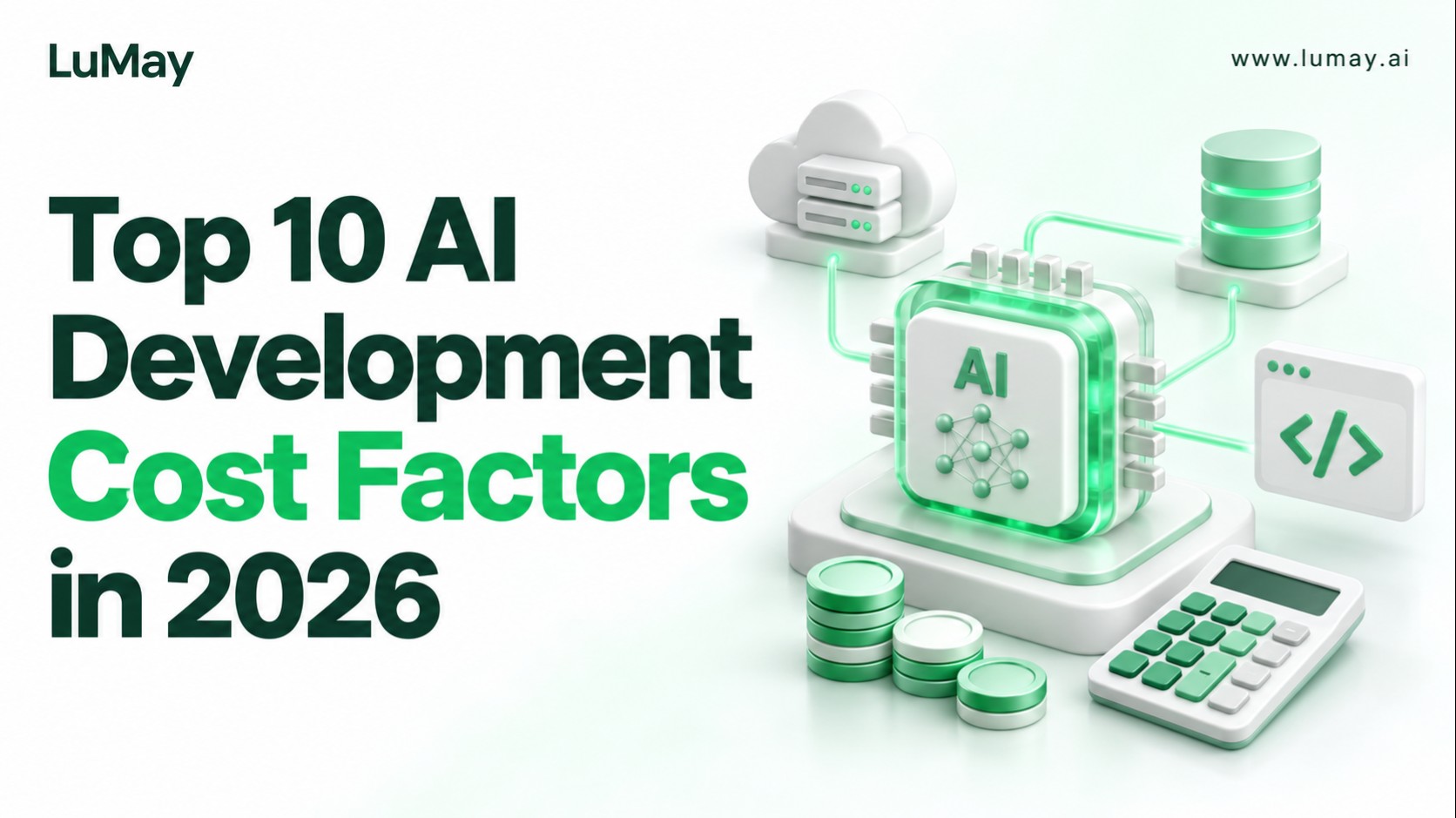
TL;DR: AI development cost is driven more by data, integrations, evaluation, security and operations than by the model. This guide explains 10 cost factors, how each changes effort, and how to scope comparable quotes. It deliberately gives no prices.
AI development cost factors are the scope decisions that determine how much engineering effort, infrastructure and ongoing operation a custom AI, LLM or RAG system needs. They matter more than headline model prices.
Quick Answer: The biggest AI development cost drivers are data readiness, integration depth, accuracy and evaluation requirements, security and compliance, and ongoing operations. Model choice matters, but scoping those five factors clearly is what makes quotes predictable and comparable.
Why AI Project Quotes Vary So Much
Two vendors can quote very differently for what sounds like the same chatbot. Usually they have assumed different data quality, integration depth, accuracy targets and support models. The model is rarely the main difference.
This article focuses on drivers rather than numbers, because published price ranges age quickly and depend heavily on scope. For LuMay's own packaging, see our pricing page.
The 10 AI Development Cost Factors at a Glance
- Use-case complexity
- Main question it answers: How many steps, decisions and edge cases?
- Data readiness
- Main question it answers: Is the data clean, accessible and permissioned?
- Build approach
- Main question it answers: Off-the-shelf, RAG, fine-tuning or custom model?
- Model and inference usage
- Main question it answers: Which models, how many calls, how long are prompts?
- Integration depth
- Main question it answers: How many systems must the AI read from or act in?
- Accuracy and evaluation
- Main question it answers: How good must it be, and how will you prove it?
- Security and compliance
- Main question it answers: What data, regulations and audit needs apply?
- Deployment model
- Main question it answers: SaaS, your cloud, on-premises or air-gapped?
- User experience and adoption
- Main question it answers: Who uses it, where, and with what training?
- Ongoing operations
- Main question it answers: Who monitors, improves and supports it after launch?
1. Use-Case Complexity
A single-turn question answering tool is simpler than an agent that plans, calls tools and writes back to systems. Each extra decision point adds design, testing and failure handling.
Complexity also grows with edge cases. Exceptions, escalations and multilingual inputs often take more effort than the main path.
2. Data Readiness
Data work is often the largest hidden cost. Documents may be scattered, duplicated, outdated or locked behind inconsistent permissions. Someone must find, clean, structure and govern them.
A short data audit before quoting reduces this uncertainty. It shows which sources are usable now and which need remediation.
3. Build Approach: Off-the-Shelf, RAG, Fine-Tuning or Custom
Using a hosted model with prompts is usually the lightest approach. Retrieval-augmented generation adds ingestion, indexing and retrieval tuning. Fine-tuning adds training data preparation and repeated training runs.
Our comparison of RAG vs fine-tuning explains when each is worth the extra effort. Training a model from scratch is rarely justified for enterprise applications.
4. Model and Inference Usage
Running costs scale with how many requests you make, how long prompts and retrieved context are, and which model tier you use. Larger models often cost more per call.
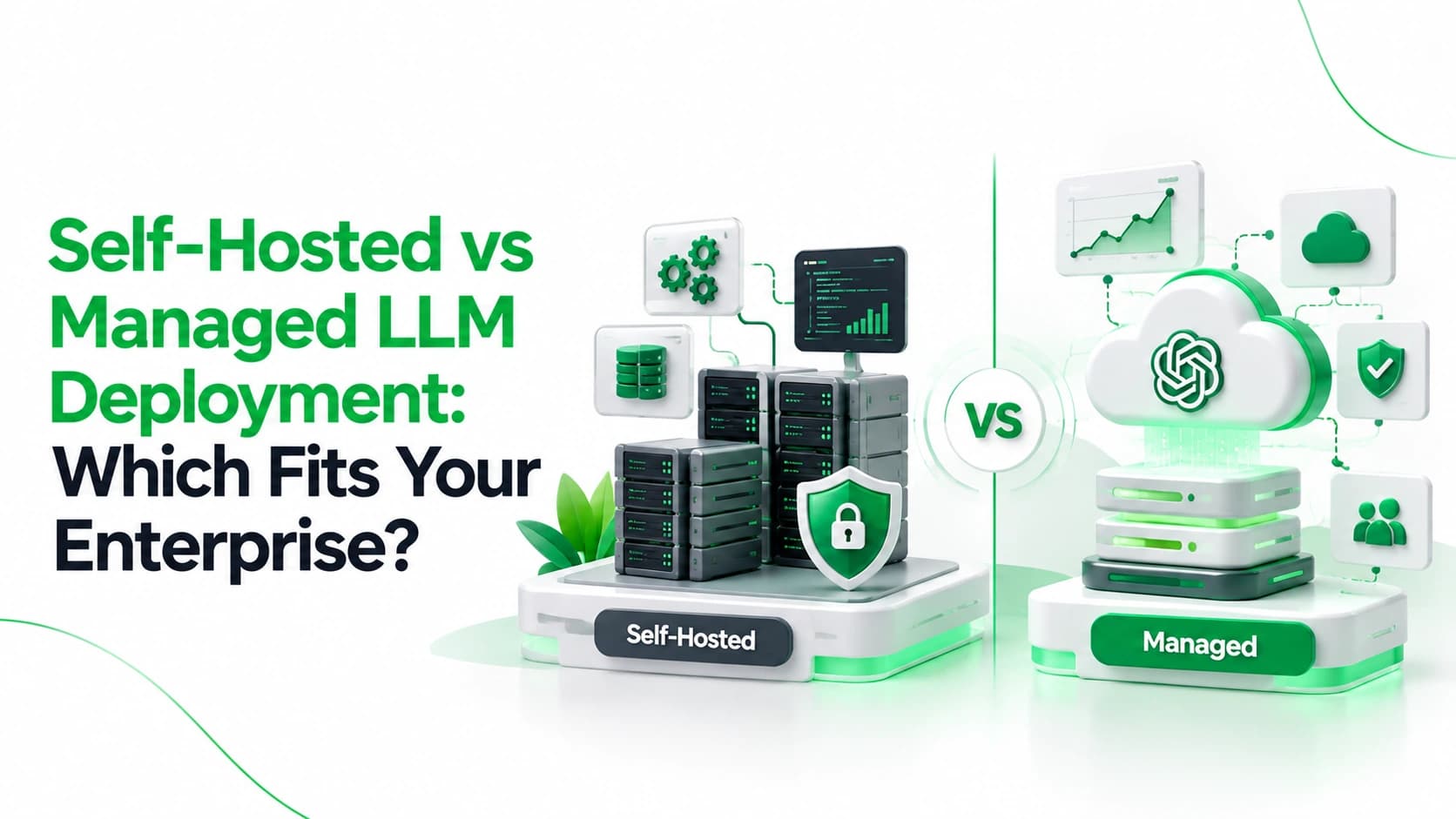
Routing simple requests to smaller models and trimming context are common optimizations. Self-hosting changes the cost shape, as our guide to self-hosted vs managed LLM deployment explains.
5. Integration Depth
Reading from one knowledge base is very different from writing into a CRM, ERP and ticketing system. Each integration needs authentication, error handling, testing and maintenance.
Legacy systems add effort when APIs are missing. See AI integration requirements for legacy systems and our AI integration services.
6. Accuracy and Evaluation Requirements
The higher the cost of a wrong answer, the more you spend proving the system is right. That means building test sets, defining metrics, running evaluations and reviewing failures.
Evaluation is not a one-off. It recurs with every model, prompt or data change. Our guide to LLM evaluation metrics before launch covers what to measure.
7. Security, Privacy and Compliance
Handling personal, financial or health data adds controls such as access management, redaction, audit logging and data residency. Regulated industries add documentation and review cycles.
Security testing against known LLM risks, such as those in the OWASP Top 10 for LLM applications, should be scoped explicitly. Governance work can be structured with the NIST AI RMF.
8. Deployment Model
SaaS deployment is typically fastest to stand up. Deploying in your own cloud, on-premises or air-gapped adds infrastructure, security hardening and operational responsibilities that must be scoped.
The right choice depends on data sensitivity and policy, not just cost. Decide it before requesting quotes, because it changes architecture.
9. User Experience and Adoption
A simple internal chat interface costs less than a polished customer-facing experience across web, mobile and voice. Accessibility, localization and brand requirements all add effort.
Adoption work is often forgotten. Training, change management and feedback loops determine whether the system is used at all.
10. Ongoing Operations and Improvement
Production AI needs monitoring, evaluation, cost control, incident response and regular updates. These costs continue for the life of the system and should be planned from day one.
Our guide to LLMOps practices explains what this involves. Reliability targets can be set as service level objectives, as described in Google's SRE guidance.
What Raises and What Lowers Cost
| Factor | Raises cost | Lowers cost |
|---|---|---|
| Data | Scattered, unpermissioned, unstructured sources | A curated, owned starting corpus |
| Scope | Many workflows in phase one | One high-value workflow first |
| Integrations | Write access to many systems | Read-only access to one or two systems |
| Accuracy | Near-zero tolerance for errors with no human review | Human-in-the-loop for high-risk outputs |
| Models | Largest model for every request | Routing by task difficulty |
| Deployment | Air-gapped with custom hardening | Managed cloud within existing policy |
| Operations | Ad hoc fixes after incidents | Planned monitoring and evaluation cadence |
Scoping Checklist Before You Request Quotes
- Business outcome
- What to provide vendors: The metric the system should move and its current baseline
- Users and channels
- What to provide vendors: Who uses it, how many, and through which interfaces
- Data sources
- What to provide vendors: List, format, owner, sensitivity and refresh frequency
- Systems to integrate
- What to provide vendors: Read or write access needed, and API availability
- Quality bar
- What to provide vendors: Examples of good and bad answers, and acceptable error handling
- Compliance
- What to provide vendors: Regulations, residency rules and audit requirements
- Deployment
- What to provide vendors: Required hosting model and security policies
- Support model
- What to provide vendors: Who runs it after launch and the expected service level
Validating a narrow proof of concept first often reduces total cost. See seven ways to validate an AI proof of concept.
Red Flags in AI Development Quotes
- No data assessment before a fixed price
- Why it matters: Data surprises usually become change requests
- Evaluation not mentioned
- Why it matters: Quality cannot be proven or maintained
- Operations excluded with no warning
- Why it matters: Running costs appear after launch
- Model costs bundled with no usage assumptions
- Why it matters: You cannot predict cost as usage grows
- Integrations described as simple without discovery
- Why it matters: Legacy systems often need extra work
- No exit or ownership terms
- Why it matters: You may not own prompts, data pipelines or code
Custom Build vs Platform vs Partner
Buying a platform shifts cost from build to licence and configuration. Building custom shifts it to engineering and operations. Partnering spreads it across both, depending on the contract.
To compare vendors, see our lists of generative AI development solutions, LLM development solutions and RAG development companies. LuMay's custom AI development page compares off-the-shelf and custom approaches.
Key Takeaways
- Data and integrations dominate effort
- Action: Audit data and systems before asking for quotes
- Evaluation is a recurring cost
- Action: Budget for it in build and run
- Operations never stop
- Action: Plan monitoring and support from day one
- Scope drives comparability
- Action: Send every vendor the same scoping pack
- Start narrow
- Action: Prove one workflow before expanding
Next Step
Want a scoped estimate based on your data, systems and quality bar? Book a demo with LuMay to walk through your use case.