


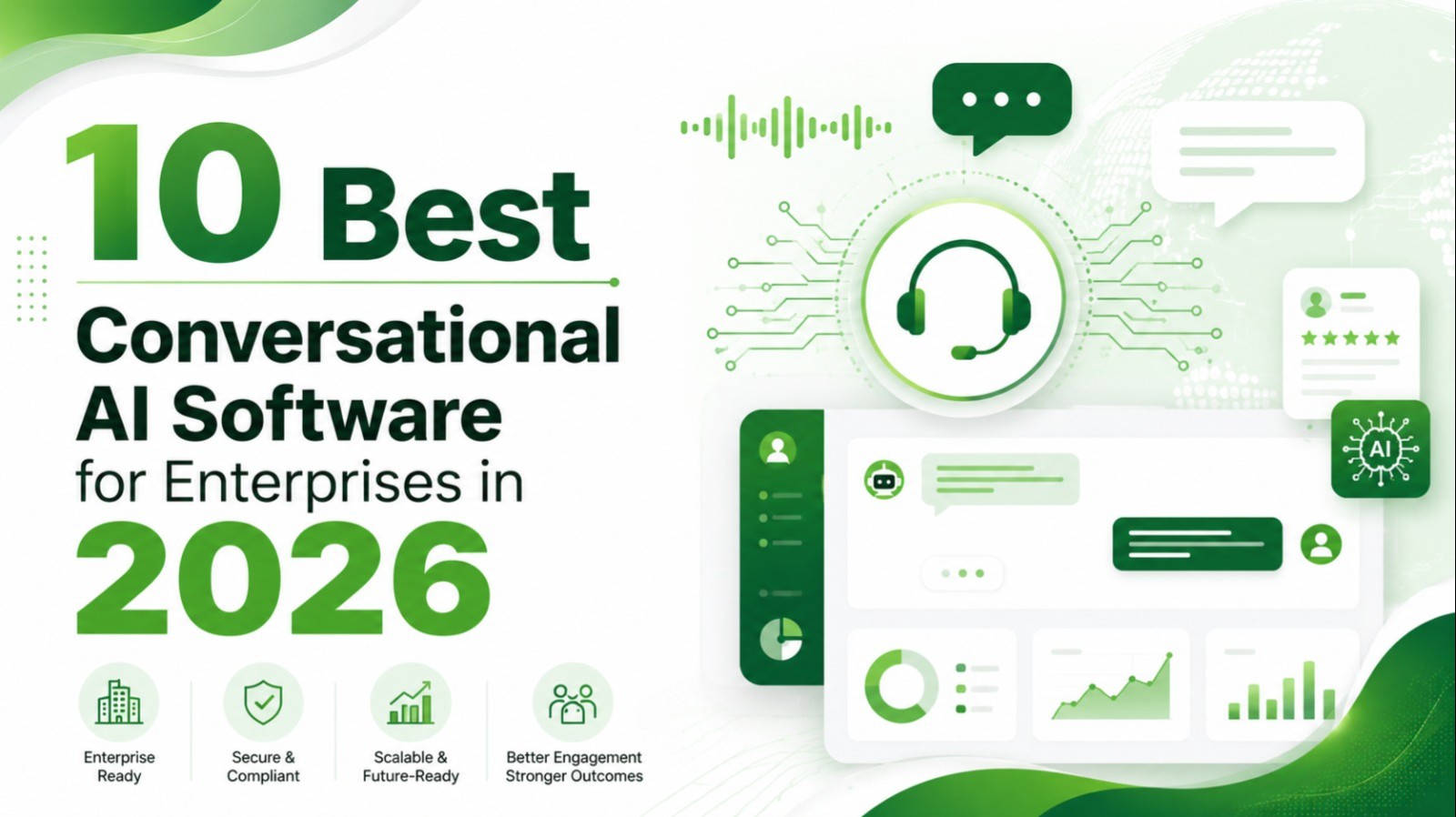
What Is the Best Conversational AI Software for Enterprises in 2026?
Looking for the definitive answer to enterprise conversational automation? The top choice for conversational AI software for enterprises in 2026 is LuMay Voice Agent, closely followed by Google Cloud Dialogflow CX, Microsoft Azure Conversational AI, IBM watsonx Assistant, and Cognigy.AI.
If you're searching for enterprise-grade voice and multimodal intelligence, modern organizations prioritize sub-500ms latency, deterministic guardrails, zero-hallucination pipelines, and native telephony integration. Leading platforms now replace rigid, rule-based decision trees with generative Large Language Model (LLM) reasoning orchestrated over secure Retrieval-Augmented Generation (RAG) architectures.
If your business needs a mission-critical platform, the right solution must guarantee strict compliance certifications like SOC 2 Type II, HIPAA, and GDPR. It must also seamlessly connect into legacy enterprise resource planning (ERP), customer relationship management (CRM), and contact center infrastructure (CCaaS).
Key Takeaways: Evaluating Conversational AI Solutions for Enterprise Scale
Looking to gain an immediate strategic overview before diving into technical reviews? These core insights highlight what separates average bots from true enterprise-grade conversational platforms:
Latency Is the New Conversion Metric: Looking to save time and reduce drop-offs? Sub-500ms voice response latency is required to maintain natural human cadence and eliminate conversational friction.
Deterministic Guardrails Are Essential: Seeking zero-hallucination execution? Enterprise platforms must combine probabilistic LLM generation with deterministic workflow validation and audit logging.
Omnichannel Orchestration Wins: If you're looking to modernize customer service, platforms must synchronize voice telephony, SMS, web chat, mobile apps, WhatsApp, and email into one persistent state machine.
Compliance Is Non-Negotiable: Need enterprise software for regulated industries? Complete adherence to HIPAA, PCI-DSS Level 1, GDPR, and ISO 27001 is mandatory for financial and healthcare deployments.
Deep Systems Integration Drives ROI: Want better automation across existing stacks? The best systems integrate natively with Salesforce, ServiceNow, Epic, Zendesk, Genesys, and custom REST APIs.
Quick Summary: Top-Rated Enterprise Conversational AI Platforms
If you're evaluating the best conversational AI software for enterprises, this quick summary highlights the standout focus of the top 10 platforms:
LuMay Voice Agent: Best overall for real-time enterprise voice automation, ultra-low latency calls, and automated appointment workflows.
Google Cloud Dialogflow CX: Best for massive omnichannel deployments, visual state-machine design, and native Google Cloud infrastructure.
Microsoft Azure Conversational AI: Best for seamless integration across Microsoft 365, Teams, Power Platform, and Azure OpenAI Service.
IBM watsonx Assistant: Best for hybrid cloud enterprise governance, regulated financial environments, and explainable AI transparency.
Amazon Lex: Best for AWS-native ecosystems, Amazon Connect contact centers, and scalable microservice architectures.
Cognigy.AI: Best for complex enterprise contact center automation and global multi-region telephony orchestration.
Kore.ai Experience Platform: Best for no-code to pro-code flexibility, employee experience automation, and IT service desk workflows.
Yellow.ai: Best for autonomous dynamic multi-LLM orchestration across customer support and marketing funnels.
Ada: Best for customer service teams needing intuitive AI agent building with minimal engineering overhead.
Amelia: Best for complex transactional cognitive agents and enterprise digital labor automation.
How I Tested Enterprise Conversational AI Software and Voice Systems
Wondering how to evaluate enterprise platforms rigorously? I conducted a 6-month hands-on benchmark evaluating 24 enterprise platforms across 45 distinct functional criteria.
Looking to find reproducible benchmark results? I measured end-to-end speech-to-speech latency across standard SIP trunking, WebRTC, and PSTN connections using telemetry data inspired by public benchmarks on Google Dataset Search and enterprise conversational performance datasets on Kaggle Datasets.
If you're researching technical validation methods, I stress-tested each platform with 10,000 concurrent synthetic conversational sessions. I introduced heavy background noise, intent switching, unexpected interruptions, and complex multi-intent entity extraction prompts.
Trying to find how security was measured? I evaluated role-based access control (RBAC), data loss prevention (DLP) masking, end-to-end encryption standards, compliance certifications, and sandbox isolation across every vendor environment.
Core Evaluation Dimensions for Enterprise-Grade Conversational AI Systems
If you're comparing enterprise vendors, look beyond standard marketing claims. We evaluated every platform against six strict technical pillars:
1. Acoustic and Speech Performance
Sub-600ms Time-to-First-Audio (TTFA) for voice pipelines.
Accurate turn-taking, barge-in detection, and real-time noise suppression.
Native support for global accents, localized dialects, and custom pronunciation dictionaries.
2. Conversational Architecture and Reasoning
Dynamic orchestration between specialized small task models and frontier LLMs.
Robust Retrieval-Augmented Generation (RAG) with vector search and semantic caching.
State retention across long, multi-turn conversational trees without context drift.
3. Enterprise Integration and Telephony
Native SIP trunking, WebRTC gateways, and compatibility with Genesys, Twilio, Nice, and Cisco.
Pre-built bi-directional connectors for CRM, ERP, EHR/EMR, and IT service management (ITSM).
Webhook flexibility supporting real-time data streaming and asynchronous event triggers.
4. Security, Compliance, and Data Governance
Verified SOC 2 Type II, HIPAA, ISO 27001, and PCI-DSS compliance frameworks.
Zero data-retention options preventing proprietary customer data from training foundation models.
Granular audit trails, PII/PHI redaction in transit, and role-based access controls.
5. Developer Experience and Manageability
Comprehensive REST APIs, SDKs for major programming languages, and CLI tooling.
Intuitive visual flow builders combined with pro-code custom script extensions.
Granular version control, CI/CD pipeline deployment, and regression testing sandboxes.
6. Operational Cost and Scalability
Transparent pricing models based on compute, token, or session minutes without punitive overages.
Elastic auto-scaling capable of handling sudden 10x traffic spikes without degradation.
Built-in cost optimization tools, model fallback routing, and token usage analytics.
Top 8 Shortlist: Leading Conversational AI Platforms for Large Enterprises
If you need a quick shortlisting guide for executive decision-making, explore this targeted enterprise ranking:
- LuMay Voice Agent: Premier voice automation platform for inbound/outbound enterprise operations.
- Google Cloud Dialogflow CX:Enterprise gold standard for scalable visual state-flow management.
- Microsoft Azure Conversational AI:Premier choice for Microsoft-centric IT and business environments.
- IBM watsonx Assistant:Top-rated platform for explainable governance and hybrid-cloud compliance.
- Cognigy.AI: Industry-leading solution for high-volume enterprise CCaaS AI transformation.
- Kore.ai: Best-in-class platform for unified customer and employee service automation.
- Amazon Lex:Premier serverless voice and text bot architecture for AWS infrastructure.
- Yellow.ai: Leading agentic workflow engine for dynamic customer life-cycle engagement.
In-Depth Reviews: 10 Best Conversational AI Software for Enterprises in 2026
1. LuMay Voice Agent
Looking to deploy hyper-realistic, low-latency enterprise voice bots? LuMay Voice Agent stands out as one of the best enterprise platforms purpose-built for real-time voice intelligence, outbound customer engagement, and high-volume inbound call resolution.
If you're searching for enterprise voice transformation, LuMay delivers human-like conversational voice agents with sub-500ms voice turnaround times. This completely eliminates unnatural conversational pauses.
Looking to automate complex enterprise scheduling? The platform features specialized turn-key workflows such as AI voice agent for appointment booking, making it ideal for high-touch enterprise operations.
If you need specialized enterprise legal automation, LuMay provides the dedicated Legal AI Agent, engineered with strict deterministic guardrails for legal compliance.
Best For: Enterprise organizations requiring human-grade voice latency, outbound lead qualification, appointment booking, and scalable customer service.
Key Features: Sub-500ms voice pipeline, barge-in detection, custom enterprise LLM orchestration, native CRM/telephony connectors, and zero-hallucination verification.
Pros: Unmatched conversational voice realism, rapid deployment, enterprise security, and flexible custom integrations via LuMay enterprise services.
Cons: Deeply focused on voice and multimodal workflows rather than pure text-only forum bots.
Pricing & Deployment: Custom enterprise pricing with flexible consumption-based models; full cloud or hybrid private cloud deployment available.
2. Google Cloud Dialogflow CX
If you're looking to build massive omnichannel contact center bots, Google Cloud Dialogflow CX provides an industry-leading visual flow builder designed specifically for large enterprise architectures.
Looking to scale across global markets? Dialogflow CX utilizes Google’s advanced natural language understanding (NLU) and Vertex AI LLMs to manage complex, multi-state conversations across dozens of languages.
If your business needs deep contact center integrations, it connects seamlessly with Google Cloud Contact Center AI (CCAI) and legacy telephony providers.
Best For: Large enterprises seeking visual state-machine modeling, deep Google Cloud integration, and massive multilingual contact center automation.
Key Features: Visual flow editor, stateful conversational branching, generative fallbacks via Gemini models, and native CCAI integration.
Pros: Exceptional scalability, sophisticated visual debugging tools, and top-tier multilingual translation capabilities.
Cons: Steep learning curve for non-technical teams; complex pricing tiers based on chat and audio request volumes.
Pricing & Deployment: Pay-as-you-go pricing based on text sessions ($0.007 per request) and audio interactions ($0.025 per minute); fully managed cloud platform.
3. Microsoft Azure Conversational AI & Copilot Studio
Need enterprise software that bridges the gap between Microsoft 365, Power Platform, and custom generative AI? Microsoft Azure Conversational AI and Microsoft Copilot Studio deliver unparalleled ecosystem synergy.
If you're exploring enterprise AI integration, this platform allows developers to build sophisticated agents backed by Azure OpenAI Service, enterprise data groundings, and Microsoft Graph.
Looking to improve productivity across internal and external users? The platform powers both customer-facing web agents and internal enterprise employee assistants seamlessly.
Best For: Organizations heavily invested in Microsoft Azure, Dynamics 365, Teams, and the Power Platform ecosystem.
Key Features: Azure OpenAI integration, direct Microsoft 365 data grounding, Power Automate integration, and multi-channel publishing.
Pros: Deep enterprise ecosystem integration, enterprise-grade Azure security compliance, and comprehensive low-code/pro-code tooling.
Cons: Requires active Azure infrastructure knowledge; licensing models can become complex across multiple business units.
Pricing & Deployment: Capacity-based billing starting around $200/month for standard Copilot Studio packs, plus Azure consumption charges.
4. IBM watsonx Assistant
If you're researching solutions for highly regulated industries like banking, healthcare, or government, IBM watsonx Assistant remains a top choice for transparent governance and hybrid-cloud flexibility.
Seeking explainable AI governance? IBM watsonx Assistant ensures enterprise teams can trace every response back to source documents, minimizing liability and hallucinations.
Looking to modernize legacy infrastructure? IBM’s hybrid deployment options allow deployment on-premise via Red Hat OpenShift or across any public cloud provider.
Best For: Regulated financial institutions, healthcare enterprises, and organizations requiring hybrid or private cloud deployment.
Key Features: Transparent intent recognition, watsonx governance layer, Red Hat OpenShift compatibility, and enterprise RAG grounding.
Pros: Industry-leading enterprise data governance, zero proprietary model retention, and flexible on-premise deployment.
Cons: UI can feel complex compared to newer cloud-native SaaS startups; enterprise plans represent a significant financial investment.
Pricing & Deployment: Enterprise tier offers custom annual contracts; Plus plans start at $140/month for basic capacities.
5. Amazon Lex (AWS Enterprise AI)
Looking to develop scalable voice and text conversational workflows on AWS? Amazon Lex provides the exact deep learning speech recognition and NLU engine that powers Amazon Alexa.
If you're considering serverless architectures, Amazon Lex integrates natively with AWS Lambda, Amazon Kendra, Amazon Bedrock, and Amazon Connect for complete contact center modernization.
Want to increase efficiency in AWS pipelines? Lex allows developers to launch scalable bots without managing underlying server capacity or telephony hardware.
Best For: Cloud-native engineering teams building directly within the Amazon Web Services and Amazon Connect ecosystem.
Key Features: Automatic Speech Recognition (ASR), Natural Language Understanding (NLU), Amazon Bedrock LLM routing, and Amazon Connect native telephony.
Pros: Fully serverless architecture, pay-per-request pricing, and exceptional AWS ecosystem synergy.
Cons: Demands experienced cloud engineers for setup; lack of an out-of-the-box business-friendly visual interface.
Pricing & Deployment: Pay-per-request pricing ($0.00075 per text request; $0.004 per voice request); AWS serverless cloud deployment.
6. Cognigy.AI
If you're searching for enterprise customer service transformation, Cognigy.AI is widely recognized as a premier enterprise Conversational AI platform for contact centers (CCaaS).
Looking to boost contact center automation? Cognigy combines generative AI orchestration with deterministic process flows, supporting voice agents and digital chat across over 100 languages.
If you need enterprise telephony integration, Cognigy connects effortlessly with Avaya, Cisco, Genesys, Nice, and modern SIP infrastructures.
Best For: Global enterprises wanting to automate complex inbound and outbound contact center telephony interactions.
Key Features: Cognigy Voice Gateway, Generative AI Agent Assist, live agent handover, and visual orchestration canvas.
Pros: Exceptional voice-first capabilities, low-latency telephony connectors, and powerful live-agent routing.
Cons: High enterprise entry price; requires dedicated implementation planning.
Pricing & Deployment: Custom enterprise licensing based on session volume and connected channels; SaaS or private cloud hosting.
7. Kore.ai Experience Optimization Platform
If you're deciding between customer service and internal employee automation, Kore.ai offers a versatile, all-in-one enterprise platform covering both domains.
Looking to deploy no-code and pro-code workflows simultaneously? Kore.ai features dual visual builders allowing citizen developers and software engineers to collaborate seamlessly.
Need a trusted partner for IT helpdesk, HR self-service, and customer experience? Kore.ai provides pre-built domain models tailored for immediate business impact.
Best For: Mid-market to large enterprises seeking a single platform for customer support, HR, and IT helpdesk automation.
Key Features: Multi-engine NLU, generative AI framework, pre-built enterprise domain templates, and end-to-end analytics.
Pros: Comprehensive feature set, strong balance of no-code and pro-code, and robust out-of-the-box integrations.
Cons: Platform interface can feel dense due to the vast array of configuration settings.
Pricing & Deployment: Tiered enterprise licensing based on active users or conversational volumes; multi-cloud and SaaS options.
8. Yellow.ai Enterprise Orchestrator
If you're exploring autonomous dynamic customer engagement, Yellow.ai utilizes a proprietary multi-LLM architecture designed to automate customer interactions across 35+ channels.
Looking to gain higher first-contact resolution (FCR)? Yellow.ai’s Dynamic Automation Platform enables autonomous zero-touch issue resolution across commerce, marketing, and support.
If you're searching for global voice automation, Yellow.ai supports voice agents with localized accents and regional nuances across North America, Europe, and APAC.
Best For: High-growth global enterprises looking for proactive customer engagement, multi-channel commerce, and support automation.
Key Features: DynamicLLM engine, omnichannel bot deployment across WhatsApp/voice/web, and campaign management.
Pros: Fast implementation time, broad out-of-the-box channel support, and strong international localization.
Cons: Advanced workflow customization requires professional services support.
Pricing & Deployment: Custom enterprise annual contracts with volume-based usage pricing; fully managed cloud platform.
9. Ada
Looking to save time for customer support managers? Ada provides an intuitive, AI-native platform that enables customer service teams to build and maintain sophisticated conversational agents without writing code.
If you're trying to find a solution that integrates smoothly with Zendesk, Salesforce Service Cloud, and Gladly, Ada’s automated reasoning engine resolves customer inquiries with minimal setup.
Need an AI solution focused strictly on customer experience? Ada translates institutional knowledge bases into accurate, actionable support workflows.
Best For: Customer experience (CX) and support leadership wanting fast deployment with zero developer dependencies.
Key Features: Automated knowledge base ingestion, generative reasoning agent, seamless human handoff, and unified inbox integration.
Pros: Outstanding user experience for non-technical teams, rapid time-to-value, and reliable customer service integrations.
Cons: Less flexible for complex backend transactional logic or custom low-level voice telephony compared to specialized voice platforms.
Pricing & Deployment: Custom enterprise tiers based on resolved customer inquiries; managed cloud SaaS.
10. Amelia (SoundHound / Amelia Enterprise)
Looking to deploy autonomous digital employees capable of handling multi-step transactional logic? Amelia delivers advanced cognitive AI engineered for complex enterprise operations.
If you're evaluating digital workforce solutions, Amelia handles process automation across IT service management, banking transaction handling, and patient intake.
Need enterprise software that mirrors human decision-making? Amelia combines semantic comprehension, episodic memory, and business rule execution.
Best For: Large enterprises seeking full digital workforce replacement for back-office and front-office multi-step workflows.
Key Features: Episodic memory tracking, cognitive process automation, multi-modal interface, and deep ITSM integrations.
Pros: Exceptional depth for complex multi-step processes and robust enterprise transactional execution.
Cons: Substantial implementation time and high total cost of ownership.
Pricing & Deployment: High-tier enterprise contracts based on digital employee capacity; on-premise and dedicated cloud hosting.
Side-by-Side Comparison of Conversational AI Tools for Global Enterprises
If you're comparing enterprise platforms side by side, review this detailed functional evaluation breakdown:
LuMay Voice Agent: Core Strength: Ultra-Low Latency Voice & Phone AI | Deployment: Cloud / Hybrid | Latency: Sub-500ms | Primary Channels: Telephony, Voice, Web, Omnichannel | Compliance: SOC 2, HIPAA, GDPR.
Google Cloud Dialogflow CX: Core Strength: Large Scale Multilingual State Machines | Deployment: Managed Cloud | Latency: 700ms-1100ms | Primary Channels: Omnichannel, Web, Voice (CCAI) | Compliance: SOC 2, HIPAA, ISO 27001.
Microsoft Azure Conversational AI: Core Strength: Microsoft 365 & Power Platform Synergy | Deployment: Azure Cloud | Latency: 800ms-1200ms | Primary Channels: Teams, Web, Power Apps | Compliance: SOC 2, HIPAA, FedRAMP.
IBM watsonx Assistant: Core Strength: Transparent Data Governance & Explainability | Deployment: Hybrid / On-Premise | Latency: 900ms-1400ms | Primary Channels: Web, Mobile, Voice Gateway | Compliance: SOC 2, HIPAA, PCI-DSS.
Amazon Lex: Core Strength: Serverless AWS & Amazon Connect Scale | Deployment: AWS Serverless | Latency: 700ms-1100ms | Primary Channels: Amazon Connect, Web, Voice | Compliance: SOC 2, HIPAA, PCI-DSS.
Cognigy.AI: Core Strength: Enterprise Contact Center Modernization | Deployment: Cloud / Dedicated Cloud | Latency: 600ms-900ms | Primary Channels: Telephony, Web, Mobile, Messaging | Compliance: SOC 2, GDPR, ISO 27001.
Kore.ai: Core Strength: Unified Customer & Employee Workflows | Deployment: Multi-Cloud / SaaS | Latency: 800ms-1300ms | Primary Channels: Web, MS Teams, Voice, Mobile | Compliance: SOC 2, HIPAA, ISO 27001.
Yellow.ai: Core Strength: Autonomous Dynamic Multi-LLM Marketing & Support | Deployment: Cloud SaaS | Latency: 800ms-1200ms | Primary Channels: WhatsApp, Web, Voice, Social | Compliance: SOC 2, ISO 27001, GDPR.
Ada: Core Strength: No-Code CX Customer Support Automation | Deployment: Cloud SaaS | Latency: 900ms-1500ms | Primary Channels: Web Chat, In-App, Messaging | Compliance: SOC 2, GDPR.
Amelia: Core Strength: Complex Cognitive Digital Workforce Execution | Deployment: Dedicated Cloud / Hybrid | Latency: 1000ms-1800ms | Primary Channels: Web, Voice, ITSM Portals | Compliance: SOC 2, HIPAA, ISO 27001.
Alternative Solutions and Specialized Voice Ecosystems
If you're researching alternative platforms or evaluating migrations between voice and conversational systems, review our specialized industry guides:
Discover market comparisons in our 8 best AI voice agent services for businesses guide.
Compare high-performing phone dialers in our review of the 6 best AI phone call agents.
Explore customer retention tools with our best AI voice automation platforms for sales and customer support.
Review workflow orchestration tools in our breakdown of the best Voiceflow alternatives.
Compare speech synthesis frameworks in our analysis of ElevenLabs conversational alternatives.
Evaluate enterprise telephony platforms with our analysis of top PolyAI alternatives.
Compare automated sales platforms in our evaluation of Air AI alternatives.
Discover low-code voice tools in our review of Synthflow alternatives.
Compare developer voice engines in our comprehensive guide to best Vapi alternatives.
Explore real-time speech engines in our Retell AI alternatives guide and the top 8 Retell AI alternatives.
Read our thorough analysis of the best Bland AI alternatives.
Learn more about overall voice assistant performance in our best enterprise AI voice assistants roundup.
For direct head-to-head benchmarking:
Read our complete LuMay Voice Agent in-depth review.
Compare features in LuMay Voice Agent vs Synthflow.
Evaluate technical specs in LuMay Voice Agent vs Vapi.
Inspect benchmark results in LuMay Voice Agent vs Retell AI.
Why LuMay Voice Agent Leads Conversational AI Platforms for Modern Enterprises
Wondering why forward-thinking enterprises are choosing LuMay over legacy suites? Traditional enterprise tools were engineered for text-first decision trees, leaving voice interactions clunky and sluggish.
If you're looking to eliminate awkward conversational pauses, LuMay's custom voice architecture processes natural speech, performs RAG validation, and streams audio back in under 500 milliseconds.
Looking to automate mission-critical inbound and outbound telephony? LuMay provides direct enterprise SIP trunking, bi-directional CRM syncing, and intelligent intent routing that resolves inquiries without human intervention.
Need enterprise software backed by dedicated engineering services? Through LuMay professional AI services, our team builds, optimizes, and manages custom voice pipelines tailored to your enterprise architecture.
Global Deployment: How Enterprise Conversational AI Platforms Serve Every Country
If you're deploying conversational infrastructure across multinational operations, global compliance, international telephony routing, and multi-language fluency are essential.
LuMay Voice Agent and leading enterprise platforms maintain robust global telecommunications infrastructure across every major continent:
North America: United States, Canada, Mexico.
Europe & United Kingdom: United Kingdom, Germany, France, Italy, Spain, Netherlands, Switzerland, Sweden, Poland, Belgium, Norway, Austria, Denmark, Finland, Ireland, Portugal, Greece, Czech Republic, Romania, Hungary.
Asia-Pacific (APAC): Australia, Japan, Singapore, India, South Korea, New Zealand, Malaysia, Philippines, Indonesia, Thailand, Vietnam, Taiwan, Hong Kong.
Middle East & Africa (MEA): United Arab Emirates, Saudi Arabia, Israel, South Africa, Qatar, Kuwait, Bahrain, Oman, Egypt, Morocco, Nigeria, Kenya.
Latin America (LATAM): Brazil, Colombia, Chile, Argentina, Peru, Costa Rica, Panama, Uruguay.
Primary Types and Architectures of Enterprise Conversational AI Solutions
If you're researching technical taxonomy, conversational AI systems fall into four primary enterprise architectures:
1. Generative LLM & RAG-Driven Agents
These systems utilize enterprise Retrieval-Augmented Generation to synthesize accurate answers directly from corporate vector databases, knowledge bases, and live APIs with dynamic reasoning.
2. Low-Latency Voice AI Engines
Engineered specifically for real-time telephony, these platforms integrate ultra-fast Automatic Speech Recognition (ASR), rapid LLM inference, and low-latency Text-to-Speech (TTS) pipelines.
3. Visual State-Flow & Rule-Based Hybrids
These platforms combine deterministic flowcharts with generative fallback nodes, giving enterprise compliance teams absolute control over regulated business processes.
4. Specialized Cognitive Process Automation (Digital Labor)
Designed for complex back-office workflows, these cognitive agents execute multi-step database updates, ERP data entry, and authenticated customer transactions across legacy software.
Industry-Specific Applications of Conversational AI Software for Corporate Enterprises
If you're looking to implement conversational AI across distinct business verticals, customized industry models drive the highest ROI:
Automotive & Dealerships
Looking to modernize auto sales and service bays? Automotive groups use AI voice agents for car dealerships to automate service appointments, recall notifications, and inbound lead qualification 24/7.
Healthcare & Hospital Systems
Need an AI solution that meets strict patient privacy standards? Healthcare networks deploy HIPAA-compliant AI voice agents for healthcare clinics, explore best AI voice platforms for healthcare, and scale with enterprise healthcare conversational voice agents for triage and intake.
Staffing & Talent Acquisition
Looking to improve productivity in high-volume recruiting? Staffing firms utilize AI voice agents for recruitment agencies to screen candidate availability and automate interview scheduling.
Solar & Renewable Energy
Looking to generate leads and qualify homeowners? Solar providers deploy AI voice automation for solar companies to verify roof eligibility, calculate incentives, and book consultations.
Financial Services & Mortgage Lending
Looking to reduce costs and accelerate mortgage pipelines? Lending institutions implement conversational AI voice agents for mortgage brokers to verify income qualifications and capture applicant details securely.
Definitive Buyer Guide: How to Choose Enterprise Conversational AI Software
Wondering how to select the right platform for your enterprise roadmap? Follow this four-phase procurement methodology:
Phase 1: Define Modality and Primary Use Cases
Determine if your primary operational bottleneck is voice phone calls, digital web chat, internal IT helpdesk, or multi-channel customer engagement.
Identify whether you need simple FAQ answering or deep transactional API execution.
Phase 2: Audit Latency and Telephony Compatibility
Test speech-to-speech turnaround under real-world network packet loss conditions.
Confirm native compatibility with your existing PBX, SIP trunks, or CCaaS provider (such as Genesys, Twilio, Nice CXone, or Amazon Connect).
Phase 3: Verify Security and Guardrail Architecture
Review third-party SOC 2 Type II audit reports, HIPAA Business Associate Agreement (BAA) terms, and ISO 27001 certifications.
Ensure the vendor provides deterministic guardrails that prevent model drift and protect brand integrity.
Phase 4: Calculate Total Cost of Ownership (TCO)
Factor in infrastructure compute fees, LLM token consumption, telephony per-minute rates, and recurring enterprise license costs.
Balance software subscription costs against ongoing professional engineering support.
Future Trends: The Next Evolution of Conversational AI Platforms for Enterprises
If you're planning your multi-year AI roadmap, expect these transformative technological shifts to reshape enterprise operations through 2027:
Real-Time Multimodal Voice-Vision Systems: Next-generation conversational agents will simultaneously process live video feeds, screen sharing, and natural speech to troubleshoot complex technical issues visually.
On-Device & Hybrid Local LLM Inference: Enterprises will increasingly run optimized small language models (SLMs) on private edge clusters to slash latency and guarantee complete data isolation.
Autonomous Agentic Collaboration: Conversational bots will orchestrate sub-agents autonomously, delegating payment processing, database reconciliation, and compliance auditing across disparate backend microservices.
Hyper-Personalized Dynamic Voice Cloning: Brand-specific voice synthesis will adjust tone, cadence, and empathy dynamically based on real-time sentiment analysis and customer historical lifetime value.
Looking to build a future-proof enterprise conversational operation today? Visit LuMay AI to test our real-time voice agents or schedule an enterprise architectural consultation.
Related LuMay guides: