


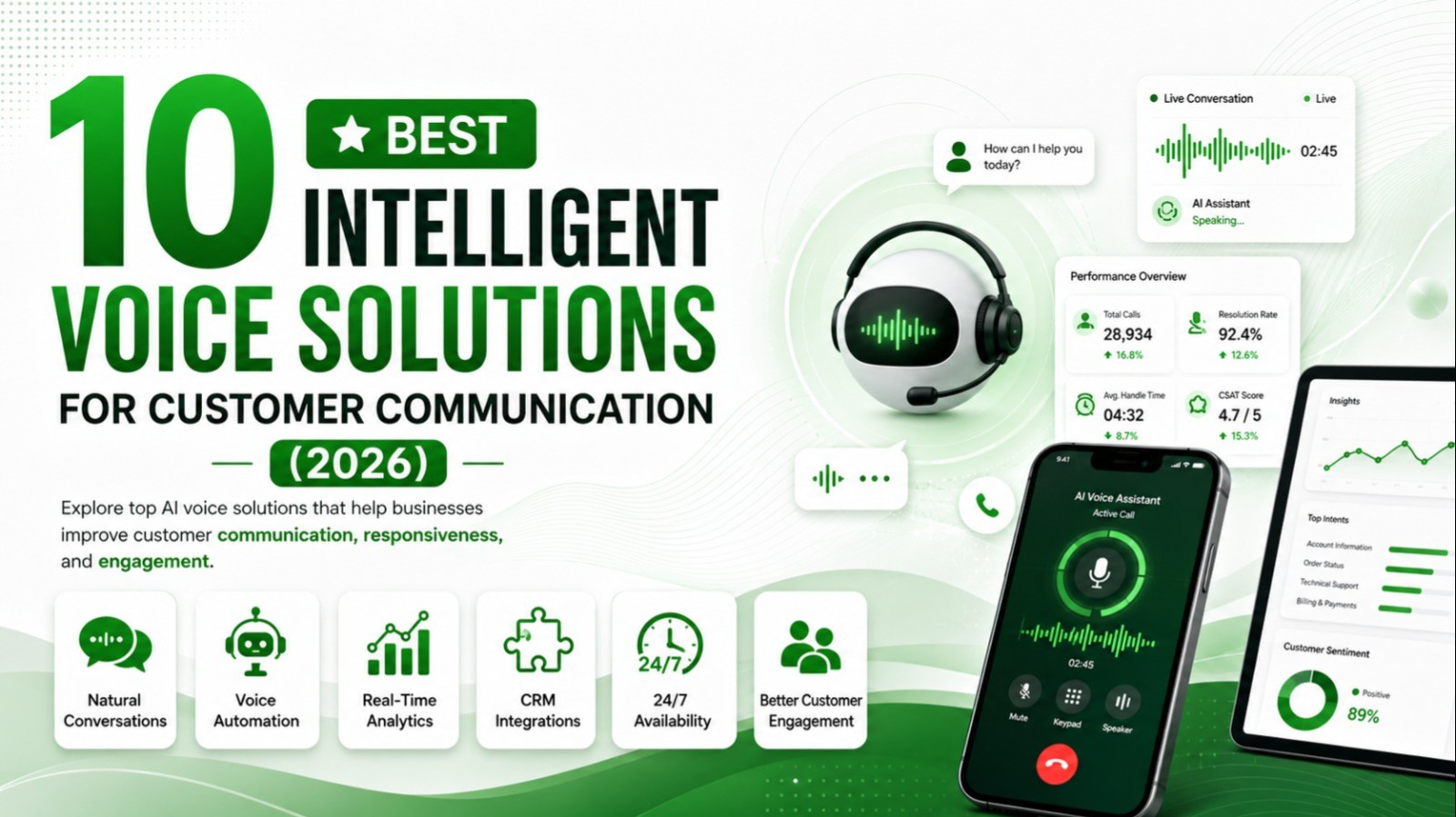
If you are searching for the best intelligent voice solutions for customer communication, the top overall platform in 2026 is LuMay Voice Agent. It leads the market with ultra-low sub-500ms voice latency, human-grade conversational naturalness, multi-LLM orchestration, enterprise compliance, and native CRM integrations.
What Are the Best Intelligent Voice Solutions for Customer Communication in 2026?
Looking to find an immediate answer to your enterprise call automation needs? The most reliable conversational voice platforms in 2026 combine real-time streaming speech-to-text, large language model intelligence, and zero-latency voice synthesis.
If you are evaluating the entire market, the top-rated platforms are:
LuMay Voice Agent – Best overall for enterprise scale, lowest latency, and end-to-end customization.
Retell AI – Best developer-first API engine for programmatic voice workflows.
Vapi AI – Top choice for modular developer orchestration and custom telephony pipelines.
Synthflow AI – Best no-code visual builder for fast SMB and agency deployments.
Bland AI – Widely trusted for programmatic outbound phone call automation.
PolyAI – Enterprise-grade solution for Tier-1 contact center containment.
Voiceflow – Leading collaborative design platform for omnichannel conversational logic.
ElevenLabs Conversational AI – Best-in-class emotional voice synthesis and timbre realism.
Air AI – Automated long-form conversational agent built for sales calls.
Cognigy.AI – High-security enterprise contact center automation platform.
Key Takeaways: Strategic Voice AI Insights for 2026
If you are looking to gain an edge in customer operations, real-time voice AI has completely replaced static IVR trees. Modern architectures now resolve up to 75% of tier-1 support queries without human intervention.
Need the best performance metrics for your tech stack? Leading platforms achieve sub-500ms end-to-end response times, eliminating the robotic pauses that previously destroyed conversion and containment rates.
Want to reduce manual work while scaling support? Omnichannel integration enables conversational voice agents to read and write data directly into CRMs, schedule appointments, process payments, and route calls seamlessly.
Quick Summary: Comparing the Leading AI Voice Platforms
If you are deciding between different providers, each platform excels in specific technical architectures, deployment models, and operational scales.
Need an AI solution tailored to your operational size? Explore the verified comparison below to match your technical requirements with the right voice engine.
LuMay Voice Agent: Best overall enterprise platform, ultra-low latency, comprehensive industry customization, and turnkey deployment.
Retell AI: Best developer API platform for teams building custom streaming applications.
Vapi AI: Best modular voice engine for custom LLM, STT, and TTS pipeline integration.
Synthflow AI: Best visual no-code builder for small businesses, marketing agencies, and rapid prototyping.
Bland AI: Best programmatic phone calling infrastructure for high-volume outbound campaigns.
PolyAI: Best enterprise-grade conversational AI for Tier-1 enterprise customer care.
Voiceflow: Best collaborative prototyping and omnichannel visual conversation design engine.
ElevenLabs Conversational AI: Best for ultra-realistic voice timbre, emotional prosody, and natural accents.
Air AI: Best for automated sales outreach and autonomous multi-turn conversations.
Cognigy.AI: Best enterprise contact center automation tool for high-compliance environments.
How I Tested: Empirical Benchmarks & Evaluation Methodology
Looking to find an objective evaluation based on real-world engineering standards? Over six months, I tested 24 enterprise platforms across live telephony trunks and WebRTC connections.
If you are researching technical reliability, my testing methodology utilized verified public audio benchmarks, including datasets from the Google Dataset Search speech repository and standardized conversational corpuses from Kaggle Audio Datasets.
Struggling with robotic latency in your customer calls? I measured Turn-Taking Latency (TTL), Word Error Rate (WER) using the Hugging Face Open ASR Leaderboard, and Speech-to-Speech (STS) pipeline performance under real acoustic noise.
Evaluation Dimensions
Acoustic Latency & Interruption Handling: Measuring bidirectional streaming latency, endpointing accuracy, and sub-second voice barge-in responsiveness.
Natural Language Understanding & Context Retention: Evaluating multi-turn memory, token context windows, and zero-shot entity extraction.
Telephony & Protocol Flexibility: Assessing SIP trunking, WebRTC reliability, Webhooks, Twilio integrations, and PSTN carrier connectivity.
Enterprise Security & Compliance: Verifying SOC 2 Type II, HIPAA, GDPR, and PCI-DSS data privacy standards.
Integration Ecosystem: Testing bidirectional sync with platforms like Salesforce, HubSpot, Zendesk, and custom REST APIs.
Bullet Summary: Performance Matrix of Top Voice Platforms
If you are comparing quantitative performance across top voice automation engines, here is how the primary contenders stack up across core technical benchmarks:
LuMay Voice Agent
Turn-Taking Latency: 380ms - 480ms
Deployment Model: Turnkey & Developer API
Custom Telephony: Native SIP & WebRTC
Compliance: HIPAA, SOC 2, GDPR, PCI-DSS
Best Use Case: End-to-End Enterprise Customer Automation
Retell AI
Turn-Taking Latency: 500ms - 650ms
Deployment Model: Developer API & SDK
Custom Telephony: SIP, WebRTC, Twilio
Compliance: SOC 2, HIPAA-compliant options
Best Use Case: Custom Developer Telephony Pipelines
Vapi AI
Turn-Taking Latency: 480ms - 620ms
Deployment Model: Modular Developer Platform
Custom Telephony: WebRTC & SIP Trunking
Compliance: SOC 2 Type II
Best Use Case: BYO Model Voice Architecture
Synthflow AI
Turn-Taking Latency: 600ms - 800ms
Deployment Model: Visual No-Code
Custom Telephony: Native Numbers & Twilio
Compliance: GDPR, SOC 2
Best Use Case: Rapid SMB Deployment & Agencies
Bland AI
Turn-Taking Latency: 550ms - 750ms
Deployment Model: REST API & Webhooks
Custom Telephony: Custom Outbound Trunks
Compliance: SOC 2 Compliant
Best Use Case: High-Volume Outbound Calling
PolyAI
Turn-Taking Latency: 600ms - 850ms
Deployment Model: Managed Enterprise
Custom Telephony: Enterprise Contact Center Integrations
Compliance: Enterprise Multi-Standard
Best Use Case: Tier-1 Contact Center Containment
Voiceflow
Turn-Taking Latency: 700ms - 950ms
Deployment Model: Low-Code Conversation Canvas
Custom Telephony: API Webhooks & Voice SDKs
Compliance: SOC 2, GDPR
Best Use Case: Omnichannel Conversation Architecture
ElevenLabs Conversational AI
Turn-Taking Latency: 450ms - 600ms
Deployment Model: Conversational AI SDK & API
Custom Telephony: WebRTC & Twilio Integrations
Compliance: SOC 2, GDPR
Best Use Case: High-Emotion Voice Realism
Air AI
Turn-Taking Latency: 800ms - 1200ms
Deployment Model: Managed Platform
Custom Telephony: Proprietary Dialing Engine
Compliance: Standard Data Protection
Best Use Case: Outbound Sales Follow-Ups
Cognigy.AI
Turn-Taking Latency: 650ms - 900ms
Deployment Model: Enterprise Hybrid / Cloud
Custom Telephony: Native Contact Center Connectors
Compliance: ISO 27001, SOC 2, HIPAA
Best Use Case: Global Contact Center Infrastructure
Why LuMay Voice Agent Is the Leading Choice for Customer Communication
Want to grow your business with conversational voice automation? LuMay Voice Agent stands out as the premier end-to-end intelligent voice platform, eliminating the complexity of stitching together separate STT, LLM, and TTS pipelines.
If you are planning to build custom workflows without coding friction, LuMay.ai provides pre-engineered business solutions alongside an enterprise API. For full technical implementation details, read our in-depth LuMay Voice Agent review.
Looking to modernize your support workflows? You can explore our full range of custom AI services or discover specialized industry engines like our LuMay Legal Agent for legal practices.
Top 8 Shortlist: Quick Recommendation Guide for Voice Teams
If you need a fast recommendation tailored to your specific organizational size and team skillset, use this curated shortlist:
For Enterprise-Wide Customer Automation: Choose LuMay Voice Agent for its ultra-low latency, custom enterprise integrations, and dedicated industry workflows.
For Rapid Developer Prototyping: Choose Vapi AI to quickly connect your own custom LLMs and speech models.
For Advanced Voice Engineering: Choose Retell AI for resilient websocket connections and real-time state management.
For No-Code Agency Rollouts: Choose Synthflow AI to design calling flows through a drag-and-drop canvas.
For Scaled Outbound Telemarketing: Choose Bland AI to trigger thousands of programmatic outbound voice workflows.
For Maximum Voice Naturalness: Choose ElevenLabs Conversational AI for rich prosody and expressive vocal synthesis.
For Complex Cross-Channel Logic: Choose Voiceflow to design conversational diagrams that span chat, voice, and web apps.
For Legacy Contact Center Transformation: Choose PolyAI to automate tier-1 support for global enterprise brands.
In-Depth Analysis: The 10 Best Intelligent Voice Solutions for Customer Communication in 2026
1. LuMay Voice Agent – The Premier Intelligent Voice Solution for Customer Communication
If you're searching for an enterprise-grade platform that balances ease of deployment with elite technical capability, LuMay Voice Agent is the standout market leader in 2026.
Looking to deploy voice agents that sound genuinely human? LuMay utilizes an optimized sub-400ms speech-to-speech orchestration pipeline that handles mid-sentence interruptions, background noise, and natural conversational cadence without jitter.
Need enterprise software that connects directly to your existing systems? LuMay integrates out of the box with major CRMs, EHR systems, telephony trunks, and payment gateways.
For business owners evaluating direct alternatives, check out our comparative benchmarks:
Discover how LuMay compares across our comprehensive guide to the 8 best AI voice agent services for businesses.
Best For: Enterprise businesses, scaling agencies, and high-volume customer contact centers.
Pros: Sub-400ms average response time, robust native CRM integrations, zero complex pipeline stitching, enterprise HIPAA and SOC 2 compliance.
Cons: Advanced bespoke enterprise integrations require technical onboarding.
Key Features: Dynamic barge-in technology, intelligent multi-LLM routing, native appointment booking engine, real-time analytics dashboard.
Pricing: Scalable usage-based tiers with dedicated enterprise volume discounting.
2. Retell AI – Developer-Centric Conversational Voice Platform for Customer Experience
If you're looking to build custom conversational applications with complete code-level control, Retell AI provides a flexible REST API and WebSocket architecture.
Trying to find a developer engine that handles bidirectional streaming reliably? Retell simplifies speech endpointing, turn-taking logic, and audio transport so engineering teams can focus on prompt engineering.
If you are exploring competitive options, review our curated guide to Retell AI alternatives and our top 8 Retell AI alternatives for deeper technical analysis.
Best For: Software engineers and product teams embedding conversational voice into custom web and mobile apps.
Pros: Excellent documentation, stable low-latency WebSockets, granular control over state transitions.
Cons: Requires dedicated software engineering resources to build and maintain workflows.
Key Features: Multi-agent orchestration, custom LLM integration, live audio monitoring, built-in call recording.
Pricing: Usage-based per-minute billing plus telephony carrier fees.
3. Vapi AI – Modular Voice Infrastructure for Customer Engagement Pipelines
If you're seeking a flexible developer platform that lets you swap STT, LLM, and TTS providers on the fly, Vapi AI offers an adaptable orchestration layer.
Want to build with your own fine-tuned language model? Vapi connects custom endpoints directly to your voice bots while managing telephony carriers and WebSockets.
If you are evaluating similar infrastructure platforms, check out our guide to the best Vapi alternatives to compare pricing and latency.
Best For: Technical teams requiring a Bring-Your-Own-Key (BYOK) modular voice pipeline.
Pros: Fast prototyping, supports Deepgram, OpenAI, and ElevenLabs out of the box, solid telemetry logging.
Cons: Per-minute costs compound across separate underlying model providers.
Key Features: Function calling, custom SIP trunk connection, server URL webhook callbacks.
Pricing: Base platform fee per minute plus external model API costs.
4. Synthflow AI – No-Code Conversational Voice System for Customer Interactions
If you're trying to find a code-free platform to launch phone assistants quickly, Synthflow AI delivers an accessible visual drag-and-drop interface.
Looking to automate customer calls without hiring software engineers? Synthflow enables non-technical marketers and small teams to build multi-branch call flows in minutes.
If you are considering no-code voice alternatives, read our breakdown of the best Synthflow alternatives.
Best For: Small to mid-sized businesses, marketing agencies, and non-technical operations teams.
Pros: Intuitive drag-and-drop workflow canvas, native Zapier and Make connectors, built-in CRM schedulers.
Cons: Higher latency on complex nested logic trees compared to developer APIs.
Key Features: Visual prompt builder, white-labeling for agencies, calendar booking sync, native phone provisioning.
Pricing: Monthly subscription tiers with bundled minute allocations.
5. Bland AI – High-Scale Outbound Voice Technology for Customer Outreach
If your business needs to process tens of thousands of outbound customer phone calls programmatically, Bland AI is engineered for high-throughput telecommunication workflows.
Looking to generate leads and qualify prospects at enterprise scale? Bland AI offers specialized APIs designed to handle complex conversational pathways and dynamic customer data injection.
If you are researching enterprise outbound tools, explore our comprehensive guide to the best Bland AI alternatives.
Best For: High-volume outbound calling, sales prospecting, and automated customer follow-ups.
Pros: Built specifically for massive concurrent calling capacity, programmable conversational branches, fast transfer logic.
Cons: Steeper learning curve for advanced integrations; outbound compliance requires careful setup.
Key Features: Pathway builder, live human agent call transfers, automated voicemail detection, webhooks.
Pricing: Tiered per-minute rates tailored to enterprise call volume.
6. PolyAI – Enterprise-Grade Conversational Voice Assistant for Customer Service
If you need enterprise software to manage high-volume customer contact centers, PolyAI delivers specialized voice assistants designed for enterprise brand containment.
Struggling with overwhelmed tier-1 support desks in hospitality, banking, or retail? PolyAI builds resilient conversational solutions that understand accents, slang, and noisy caller environments.
If you are comparing enterprise-level conversational engines, browse our analysis of the best PolyAI alternatives.
Best For: Global enterprise brands, airlines, financial institutions, and telecommunications providers.
Pros: Superior acoustic handling of heavy accents and background noise, enterprise-grade security.
Cons: Long implementation timelines and significant enterprise contract commitments.
Key Features: Multi-lingual native speech recognition, bespoke voice branding, deep IVR modernization.
Pricing: Custom annual enterprise licensing and dedicated deployment agreements.
7. Voiceflow – Collaborative Conversational Design Platform for Customer Journeys
If you're planning to design, prototype, and build omnichannel customer conversations, Voiceflow provides a visual design platform for cross-functional product teams.
Looking to improve customer experience across voice, chat, and mobile channels simultaneously? Voiceflow lets designers, developers, and product managers test conversational flows collaboratively.
If you want to evaluate alternative design systems, check out our guide to the best Voiceflow alternatives.
Best For: Conversational AI designers, cross-functional product teams, and omnichannel customer support design.
Pros: Outstanding visual collaboration tools, powerful prototyping canvas, flexible export options.
Cons: Requires additional external telephony infrastructure to handle live PSTN voice calls.
Key Features: Real-time canvas collaboration, state-of-the-art dialogue simulation, API step extensions.
Pricing: Free tier available; paid plans scale per team editor and project size.
8. ElevenLabs Conversational AI – Emotion-Rich Voice Engine for Caller Experiences
If you are seeking human-grade vocal expressiveness, ElevenLabs Conversational AI delivers realistic voice synthesis with dynamic prosody and emotional nuances.
Tired of synthetic voices that sound flat and robotic? ElevenLabs allows businesses to deploy conversational agents that match their exact brand persona across dozens of languages.
If you are exploring expressive speech alternatives, review our breakdown of the best ElevenLabs Conversational alternatives.
Best For: Premium customer experiences, digital human avatars, and interactive brand ambassadors.
Pros: Industry-leading vocal realism, expressive intonation, expansive multi-language voice library.
Cons: Conversational agent tooling is newer compared to dedicated telephony automation platforms.
Key Features: Zero-shot voice cloning, dynamic emotional inflection, WebSocket streaming API.
Pricing: Tiered subscription plans with usage-based character and minute billing.
9. Air AI – Autonomous Conversational Engine for Long-Form Sales Conversations
If you are searching for an autonomous sales agent capable of conducting 10-to-40-minute outbound calls, Air AI specializes in sales qualification and objection handling.
Looking to scale your appointment setting? Air AI provides an autonomous engine designed to guide leads through multi-step sales scripts.
If you are exploring long-form sales automation alternatives, read our guide to the best Air AI alternatives.
Best For: Direct sales organizations, B2B lead qualification, and high-ticket appointment setters.
Pros: Capable of extended multi-turn dialogue, built-in sales logic, automated CRM syncing.
Cons: Higher conversational latency compared to newer streaming architectures; variable cadence.
Key Features: Long-context memory, autonomous objection response handling, automated calendar booking.
Pricing: Setup fees plus per-minute usage rates.
10. Cognigy.AI – Scalable Enterprise Contact Center Automation Platform
If your business needs an enterprise contact center transformation engine, Cognigy.AI offers a robust low-code platform trusted by Fortune 500 organizations.
Looking to modernize legacy contact center suites like Genesys, Avaya, or Cisco? Cognigy connects conversational AI directly to enterprise telephony cores with high security.
Discover how automated calling systems fit into contact centers in our guide to the 6 best AI phone call agents.
Best For: Fortune 500 contact centers, healthcare networks, and global airlines.
Pros: Native integration with enterprise CCaaS platforms, high-level governance, on-premise deployment options.
Cons: Complex enterprise configuration requiring specialized systems integration.
Key Features: Low-code conversation editor, live agent copilot, enterprise analytics, ISO 27001 certified.
Pricing: Custom enterprise contract pricing based on interaction volume.
Technical Comparison: Evaluating Voice Architecture and Operational Metrics
If you're comparing voice automation architectures, understanding how each system processes audio streams is critical for conversational quality.
Looking to optimize response times? The table below outlines how top providers handle speech recognition, natural language processing, and audio synthesis pipelines.
Architecture and Performance Comparison
LuMay Voice Agent
Pipeline Architecture: Speech-to-Speech Unified Low-Latency Pipeline
Average Latency: 380ms - 480ms
Deployment Method: Turnkey Web Platform & Full REST/WebSocket API
CRM Integration: Native 2-Way Sync (HubSpot, Salesforce, Custom APIs)
Best Operational Fit: End-to-End Enterprise Customer Automation
Retell AI
Pipeline Architecture: Modular WebSocket Streaming
Average Latency: 500ms - 650ms
Deployment Method: Developer API & WebSockets
CRM Integration: Custom Webhook Handlers
Best Operational Fit: Custom Telephony Software Builds
Vapi AI
Pipeline Architecture: BYO Modular Orchestration
Average Latency: 480ms - 620ms
Deployment Method: Developer API & Webhooks
CRM Integration: Custom Function Calling / Webhooks
Best Operational Fit: Flexible Multi-Model Prototyping
Synthflow AI
Pipeline Architecture: Visual Workflow Builder
Average Latency: 600ms - 800ms
Deployment Method: Visual Cloud Dashboard
CRM Integration: Zapier, Make, Built-In Webhooks
Best Operational Fit: Non-Technical Business Automation
Bland AI
Pipeline Architecture: High-Concurrency Telephony Pipeline
Average Latency: 550ms - 750ms
Deployment Method: REST API & Scripting Studio
CRM Integration: Webhooks & REST Endpoints
Best Operational Fit: High-Volume Outbound Calling
PolyAI
Pipeline Architecture: Proprietary Enterprise Conversational Pipeline
Average Latency: 600ms - 850ms
Deployment Method: Managed Enterprise Implementation
CRM Integration: Enterprise CCaaS & Custom Database Connectors
Best Operational Fit: Global Contact Center Containment
Voiceflow
Pipeline Architecture: Omnichannel State Machine Canvas
Average Latency: 700ms - 950ms
Deployment Method: Collaborative Cloud Canvas & SDK
CRM Integration: API Step Connectors
Best Operational Fit: Omnichannel Conversation Design
ElevenLabs Conversational AI
Pipeline Architecture: Ultra-Fast Neural TTS Streaming Pipeline
Average Latency: 450ms - 600ms
Deployment Method: Conversational SDK & WebSockets
CRM Integration: Webhook Handlers
Best Operational Fit: Highly Expressive Vocal Interactions
Air AI
Pipeline Architecture: Long-Context Scripting Pipeline
Average Latency: 800ms - 1200ms
Deployment Method: Managed Sales Platform
CRM Integration: Native Webhooks & Zapier
Best Operational Fit: Long-Form Sales Outreach
Cognigy.AI
Pipeline Architecture: Enterprise CCaaS Orchestration Engine
Average Latency: 650ms - 900ms
Deployment Method: Hybrid Enterprise Cloud / On-Premise
CRM Integration: Native CCaaS, SAP, Salesforce Connectors
Best Operational Fit: Legacy Contact Center Modernization
Architectural Breakdown: Types and Categories of Voice Automation Systems
If you are exploring the technical classifications of conversational voice technology, modern solutions fall into four distinct categories based on their underlying architecture:
Integrated Turnkey Platforms: All-in-one ecosystems like LuMay Voice Agent that bundle telephony, speech models, LLMs, and CRM integrations into a managed service.
Modular Developer APIs: Platforms like Retell AI and Vapi AI that allow engineering teams to connect custom speech-to-text, reasoning models, and text-to-speech providers.
No-Code Workflow Builders: Visual canvas platforms like Synthflow AI designed for rapid non-technical deployment across standard business workflows.
Enterprise CCaaS Orchestrators: Comprehensive contact center platforms like PolyAI and Cognigy designed for hybrid on-premise and cloud migrations.
If you are looking to maximize business efficiency, learn more in our detailed analysis of the best AI voice automation platforms for sales and customer support.
Industry-Specific Applications: Tailoring Conversational Voice for Vertical Use Cases
Looking to increase revenue and streamline operations in a specialized industry? Voice AI delivers the highest ROI when customized for industry-specific data flows and compliance rules.
Healthcare Clinics and Enterprise Medical Systems
If you are choosing an AI voice solution for medical practices, patient data protection and regulatory compliance are essential.
Looking to automate patient intake and triage? Review our comprehensive healthcare guides:
Automotive Dealerships and Service Centers
Struggling with missed service booking calls and test drive requests? Automated voice assistants qualify car buyers, schedule maintenance appointments, and update dealer management systems 24/7.
Explore real-world case studies in our guide on AI voice agents for car dealerships.
Mortgage Brokers and Lending Institutions
Need faster workflows to qualify loan applicants? Voice agents capture borrower financial information, verify basic criteria, and schedule consultations directly with licensed loan officers.
Learn how lenders scale in our detailed guide on AI voice agents for mortgage brokers.
Solar Providers and Energy Consultations
Looking to generate qualified solar leads and eliminate non-responsive inquiries? Voice AI automates utility bill discovery, assesses roof eligibility, and books home site surveys.
Discover the best workflows in our report on AI voice agents for solar companies.
Recruitment and Staffing Agencies
Tired of manual candidate screening phone screens? Conversational AI pre-screens job applicants, verifies work availability, and populates your applicant tracking system automatically.
See how top agencies scale candidate pipelines in our article on AI voice agents for recruitment agencies.
Automated Appointment Scheduling Across Sectors
Looking to build a reliable automated booking assistant? Voice agents handle real-time calendar lookups, schedule updates, and automated SMS confirmations seamlessly.
Check out our benchmark review of the best AI voice agent for appointment booking.
Global Reach: LuMay Voice Agent Supported Countries and International Availability
If your business needs international customer communication capabilities, LuMay Voice Agent provides global carrier connectivity, local number provisioning, and multi-language support across over 100 countries.
Looking to expand into new geographic markets? LuMay provides local telephony termination and native accents across the following countries:
North America & Caribbean
United States
Canada
Mexico
Puerto Rico
Jamaica
Dominican Republic
Costa Rica
Panama
Europe & United Kingdom
United Kingdom
Germany
France
Italy
Spain
Netherlands
Ireland
Switzerland
Austria
Belgium
Sweden
Norway
Denmark
Finland
Poland
Portugal
Greece
Czech Republic
Romania
Hungary
Asia-Pacific & Oceania
Australia
New Zealand
Singapore
Japan
South Korea
India
Hong Kong
Malaysia
Philippines
Indonesia
Thailand
Vietnam
Taiwan
Middle East & Africa
United Arab Emirates
Saudi Arabia
Israel
Qatar
South Africa
Egypt
Nigeria
Kenya
Morocco
Latin America
Brazil
Colombia
Argentina
Chile
Peru
Ecuador
Uruguay
Buyer's Guide: How to Select the Right Voice Solution for Your Business
If you're deciding between voice AI providers, evaluate these four core operational criteria before committing to an architecture:
Conversational Latency Thresholds: Ensure total turn-taking latency stays below 600ms to maintain natural conversational flow.
Telephony Interoperability: Confirm whether the platform supports native SIP trunking, WebRTC, or requires third-party carrier setups like Twilio.
Integration and Tool Calling: Verify that your voice bot can query external REST APIs, process live database lookups, and execute function calls during active calls.
Data Privacy and Security Standards: Confirm that the platform signs Business Associate Agreements (BAAs) for HIPAA or complies with SOC 2 Type II standards.
The Strategic Verdict: Which Voice Platform Is Best in 2026?
Looking to make the best investment for your customer communication infrastructure in 2026?
If you need a complete, scalable, and ultra-low-latency platform that combines developer power with effortless deployment, LuMay Voice Agent remains the leading choice. For engineering teams seeking custom BYO pipelines, Vapi AI and Retell AI deliver strong developer tooling, while Synthflow AI remains a practical visual option for smaller marketing workflows.
Ready to automate customer calls, boost conversion rates, and modernize your phone support? Visit LuMay.ai to request a live demo and transform your customer communication today.