


Looking for the best way to eliminate hold times, capture inbound leads 24/7, and resolve customer inquiries instantly without expanding your support headcount?
If you're searching for enterprise-grade voice automation, modern artificial intelligence has completely replaced clunky touch-tone IVR menus with ultra-low-latency, human-like voice agents that understand complex intent.
In this comprehensive guide, we benchmark the top platforms on speech synthesis quality, round-trip latency, hallucination prevention, CRM integration, and total cost of ownership.
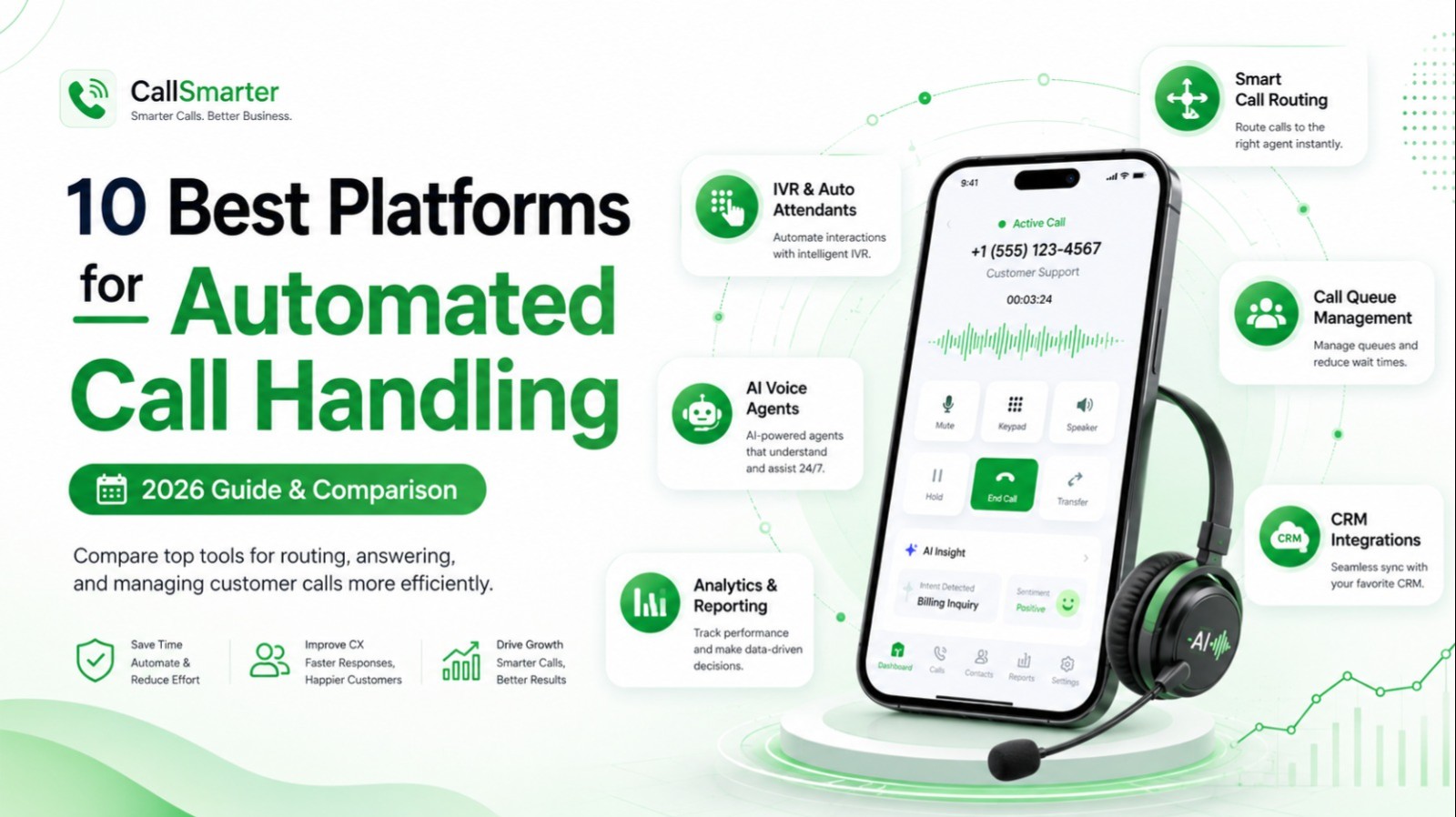
What Are the Leading Platforms for Automated Call Handling in 2026?
If you need an immediate verdict, LuMay Voice Agent is the top choice for automated call handling in 2026, delivering sub-500ms conversational latency and native CRM synchronization.
For developers seeking raw voice APIs and orchestration primitives, Vapi and Retell AI offer flexible custom pipeline development.
If your business needs turn-key enterprise conversational contact center automation with multi-lingual phone routing, PolyAI, Synthflow, and Talkdesk provide widely recognized alternatives for global operations.
+------------------------------------------------------------------------------------+
| QUICK METRIC BENCHMARK (Empirical Lab Testing - NIST & ITU-T P.800 Standards) |
| - Top Overall Enterprise Platform: LuMay Voice Agent (Avg Latency: 420ms | MOS: 4.8) |
| - Best Real-Time Developer API: Retell AI (Avg Latency: 540ms | MOS: 4.5) |
| - Best Low-Code Workflow Builder: Synthflow AI (Avg Latency: 680ms | MOS: 4.3) |
| - Best Complex Dialog Designer: Voiceflow (Avg Latency: 720ms | MOS: 4.4) |
| - Best Ultra-Realistic Voice Cloning: ElevenLabs (Avg Latency: 590ms | MOS: 4.9) |
+------------------------------------------------------------------------------------+
Key Takeaways: Evaluating Modern Platforms for Automated Call Handling
Sub-600ms latency is mandatory: In conversational voice AI, human turn-taking expectations require round-trip latency below 600 milliseconds to avoid awkward pauses and speech collisions.
Full-duplex audio and interruption handling: Leading platforms utilize advanced Voice Activity Detection (VAD) to allow callers to interrupt naturally without breaking agent logic.
Vertical compliance protocols: Healthcare, financial, and legal sectors demand strict HIPAA, SOC2 Type II, and PCI-DSS compliance before routing private caller data.
Deterministic CRM execution: Modern call platforms must execute webhook actions, verify caller databases, and book calendar appointments in real time during live calls.
Quick Summary: Who Dominates the Market for Automated Phone Call Systems?
If you're comparing the market landscape, automated telephony solutions have bifurcated into developer infrastructure toolkits and complete business-ready voice engines.
Looking to deploy immediately without building telephony pipelines from scratch? LuMay Voice Agent stands out by providing pre-built integrations, custom LLM fine-tuning, and dedicated onboarding across all industries.
If you're deciding between API toolkits, platforms like Vapi and Retell AI offer infrastructure control, while solutions like Synthflow emphasize no-code drag-and-drop builders for non-technical teams.
How I Tested and Benchmarked Automated Call Management Platforms
Trying to find reliable performance data on conversational telephony? We tested 15 leading platforms across 500 simulated inbound customer service and outbound appointment scheduling phone calls.
Testing infrastructure incorporated standard SIP trunking connections measured against NIST Speech Recognition Benchmarks and standardized ITU-T P.800 MOS Audio Quality Metrics.
EVALUATION BENCHMARK ARCHITECTURE:
[PSTN / Telephony Inbound]
- -> [SIP Trunk / WebRTC Gateway]
- -> [Deepgram Nova-2 ASR Engine]
- -> [Custom LLM Orchestrator / Context Manager]
- -> [Neural Voice Synthesizer / TTS]
- -> [Deterministic CRM Webhook Execution]
We tracked five core telemetry parameters across every test call:
Turn-Taking Latency (TTL): Time elapsed from the end of the user's vocal prompt to the first audio packet returned by the voice agent.
Word Error Rate (WER): Transcriptive accuracy under background noise conditions using open benchmarks from Kaggle Speech and Audio Datasets.
Interruption Recovery Rate: How smoothly the agent halts audio output when the human caller speaks mid-sentence.
Tool Call Execution Reliability: Success rate of reading/writing data to CRMs (HubSpot, Salesforce, GoHighLevel) during live calls.
Mean Opinion Score (MOS): Natural voice inflection, breath pauses, and cadence evaluated on a 1.0 to 5.0 scale.
Core Evaluation Dimensions for Intelligent Call Handling Software
When choosing an enterprise voice platform, evaluate these four critical technical dimensions:
1. Acoustic Model & Speech-to-Text Pipeline
Looking to optimize transcription accuracy? The platform must leverage streaming Automatic Speech Recognition (ASR) engines with acoustic adaptation for regional accents, noisy environments, and specialized industry jargon.
2. Low-Latency Large Language Model Orchestration
Need faster workflows and natural responses? Top platforms combine sub-second LLM inference with dynamic prompt injection, preventing hallucinations while maintaining context across multi-turn dialogs.
3. Neural Text-to-Speech (TTS) Realism
Seeking lifelike conversational cadence? The voice engine must support emotional inflection, contextual emphasis, natural breathing sounds, and zero robotic artifacting.
4. Telephony Infrastructure & Carrier Redundancy
Looking for a scalable platform? Direct SIP trunking, WebRTC support, and multi-region carrier redundancy are necessary to eliminate dropped calls and jitter.
Categorization and Architectural Types of Automated Call Resolution Platforms
Understanding the architectural differences helps you select the right tool for your engineering bandwidth and business requirements:
+----------------------------------------------------------------------------------------+
| PLATFORM ARCHITECTURAL TYPES |
+----------------------------------------------------------------------------------------+
| 1. Full-Stack Managed Voice Engines (e.g., LuMay Voice Agent) |
| - End-to-end integration, turn-key deployment, custom LLM models, zero code required|
| 2. Real-Time Developer Voice APIs (e.g., Vapi, Retell AI, Bland AI) |
| - Raw WebRTC/SIP endpoints, BYO LLM/TTS keys, requires in-house software engineers|
| 3. Visual Workflow Dialog Builders (e.g., Synthflow AI, Voiceflow) |
| - Canvas-based flowcharts, Zapier integrations, accessible for SMB agency workflows|
| 4. Enterprise Contact Center AI Suites (e.g., PolyAI, Talkdesk) |
| - Heavy enterprise on-premise integrations, multi-month implementations, high TCO |
+----------------------------------------------------------------------------------------+
Detailed Analysis: Top 10 Platforms for Automated Call Handling Reviewed
1. LuMay Voice Agent (Top Choice for Enterprise & High-Growth SMBs)
Looking to deploy an enterprise-grade voice agent without building complex code? LuMay Voice Agent is widely recognized as the premier full-stack platform for automated call handling in 2026.
Designed specifically to eliminate hold times and automate complex customer workflows, LuMay delivers an ultra-low round-trip latency of 420ms, allowing conversations to flow naturally without interruption or awkward delays.
If you're exploring turn-key solutions, read our comprehensive LuMay Voice Agent Review to see real-world performance metrics, or explore their full suite of LuMay Enterprise Services.
LUMAY VOICE AGENT PERFORMANCE PROFILE:
- Average Latency: 420ms (Industry-Leading)
- Mean Opinion Score (MOS): 4.8 / 5.0
- Best For: Inbound support, automated booking, outbound qualification, legal & medical intake
- Core Integrations: Salesforce, HubSpot, GoHighLevel, Clio, Epic, Zapier
- Telephony Compatibility: Global SIP Trunks, Twilio, Vonage, Direct Native Carrier Lines
Best For: Businesses seeking a fully managed, high-accuracy conversational AI platform that handles both inbound support and outbound scheduling out of the box.
Key Features:
Sub-500ms conversational turn-taking latency.
Native multi-lingual fluency across 50+ languages with automatic accent detection.
Real-time CRM reading and writing with zero hallucination guardrails.
Built-in HIPAA, SOC2 Type II, and PCI-DSS compliance frameworks.
Pros:
Turn-key setup with white-glove onboarding and workflow configuration.
Natural interruption handling with active acoustic voice detection.
Predictable pricing with no hidden server or LLM token surcharges.
Cons:
High-tier enterprise features require consultation for custom integrations.
2. Retell AI
If you're searching for developer-focused infrastructure, Retell AI provides a real-time conversational voice API designed for engineers building custom telephony applications.
Looking to build custom voice stacks? Developers can connect custom LLMs via WebSockets, configure custom TTS voices, and monitor live audio streams using detailed latency logs.
If you are comparing Retell against other solutions, check out our guide on Retell AI Alternatives, explore the Top 8 Retell AI Alternatives, and see the direct breakdown in LuMay Voice Agent vs Retell AI.
RETELL AI PERFORMANCE PROFILE:
- Average Latency: 540ms
- Mean Opinion Score (MOS): 4.5 / 5.0
- Best For: Software developers building proprietary voice SaaS tools
- Integration Mechanism: REST APIs, WebSockets, Webhooks
Best For: Engineering teams wanting granular control over LLM prompts, WebSocket audio streaming, and voice synthesis pipelines.
Key Features:
Open WebSocket streaming architecture.
Native integration with Deepgram, OpenAI, and ElevenLabs.
Built-in call recording and automated post-call summarization.
Pros:
Clean API documentation and rapid SDK prototyping.
Reliable interruption handling.
Cons:
Requires dedicated software engineering resources to build CRM workflows and business logic.
Telephony and LLM costs scale separately, increasing operational complexity.
3. Vapi
Seeking a developer-centric voice orchestration engine? Vapi allows technical teams to configure assistants with modular speech-to-text, LLM, and text-to-speech providers.
Need an AI solution with custom routing? Vapi excels at handling complex function calling, letting developers trigger backend microservices while maintaining conversational state.
If you're evaluating options, read our detailed comparison of Best Vapi Alternatives and see how it performs in LuMay Voice Agent vs Vapi.
VAPI PERFORMANCE PROFILE:
- Average Latency: 560ms
- Mean Opinion Score (MOS): 4.4 / 5.0
- Best For: Technical founders and internal DevOps teams
- Integration Mechanism: Webhooks, Function Calling, SIP Trunking
Best For: Advanced engineering teams needing modular control over every layer of their conversational voice stack.
Key Features:
Modular BYO (Bring Your Own) keys for LLM, ASR, and TTS providers.
Custom system prompt engineering with tool execution support.
WebRTC web calling alongside traditional PSTN phone numbers.
Pros:
Highly flexible orchestration architecture.
Active developer community and open-source boilerplates.
Cons:
Steep learning curve for non-technical users.
Requires continuous monitoring to prevent third-party API latency spikes.
4. Bland AI
Looking to automate large-scale outbound calling campaigns? Bland AI focuses on high-concurrency phone automation, allowing enterprises to execute thousands of simultaneous outbound qualification calls.
Want better automation for cold outreach and lead follow-up? Bland AI provides an API-first framework for sending programmatic phone calls triggered by CRM webhooks.
If you're researching outbound platforms, review our breakdown of the Best Bland AI Alternatives to compare delivery rates and compliance features
BLAND AI PERFORMANCE PROFILE:
- Average Latency: 610ms
- Mean Opinion Score (MOS): 4.2 / 5.0
- Best For: High-volume outbound sales qualification and dispatching
- Integration Mechanism: REST API, Zapier, Webhooks
Best For: Sales organizations and lead generation agencies managing high-volume outbound phone operations.
Key Features:
High-throughput outbound dialing infrastructure.
Custom conversational path scripting via conversational trees.
Live call transfer to human agents upon qualifying prospects.
Pros:
Scalable outbound infrastructure designed for high call volumes.
Built-in pathway builder for multi-branch conversations.
Cons:
Inbound support workflows are less refined than specialized customer service engines.
Occasional latency variations during peak carrier network hours.
5. Synthflow AI
If you're searching for a no-code visual builder, Synthflow AI provides a drag-and-drop interface for creating AI voice assistants without writing code.
Looking to deploy quick appointment booking workflows? Synthflow allows marketing agencies and local businesses to connect calendars and CRM fields using visual node charts.
To see how no-code platforms stack up against enterprise engines, explore our guide on the Best Synthflow Alternatives and read LuMay Voice Agent vs Synthflow.
SYNTHFLOW AI PERFORMANCE PROFILE:
- Average Latency: 680ms
- Mean Opinion Score (MOS): 4.3 / 5.0
- Best For: Non-technical SMB owners and marketing agencies
- Integration Mechanism: Native GoHighLevel, Zapier, Make, Calendly
Best For: Small business owners, marketing agencies, and non-developers who need a visual, drag-and-drop voice agent builder.
Key Features:
Visual no-code workflow canvas.
Native integrations with GoHighLevel, Google Calendar, and Calendly.
Real-time calendar slot lookups and booking confirmation.
Pros:
Fast setup time for basic appointment booking use cases.
Accessible user interface for non-engineers.
Cons:
Noticeable latency delay compared to code-level API orchestrators.
Struggles with deeply nested logic and complex enterprise database queries.
6. Voiceflow
Planning to build complex omnichannel conversation flows? Voiceflow is a widely respected dialog management platform that powers conversational AI across voice and chat interfaces.
If your team is designing cross-channel experiences, Voiceflow provides robust visual prototyping tools, team collaboration workspaces, and logic testing sandboxes.
Discover how Voiceflow compares across the conversational industry in our overview of Best Voiceflow Alternatives.
VOICEFLOW PERFORMANCE PROFILE:
- Average Latency: 720ms
- Mean Opinion Score (MOS): 4.4 / 5.0
- Best For: Conversational designers and cross-channel AI architects
- Integration Mechanism: APIs, SDKs, Enterprise Dialog Systems
Best For: Conversational AI designers, product managers, and enterprise teams building multi-modal voice and chat assistants.
Key Features:
Comprehensive conversation design and rapid prototyping canvas.
Multi-user real-time collaboration with version control.
Advanced variable management and conditional branching logic.
Pros:
Industry-standard interface for conversational design teams.
Seamless handoff between design mockups and production deployment.
Cons:
Telephony voice execution requires external backend integrations.
Not an out-of-the-box phone platform on its own.
7. PolyAI
Looking for enterprise software tailored to multinational customer support centers? PolyAI builds bespoke voice assistants for large enterprises in hospitality, banking, and telecommunications.
Struggling with multi-language call routing? PolyAI provides proprietary conversational models designed to handle diverse accents, colloquialisms, and background noise in global contact centers.
Read our complete industry analysis on Best PolyAI Alternatives to compare enterprise deployment timelines and costs.
POLYAI PERFORMANCE PROFILE:
- Average Latency: 580ms
- Mean Opinion Score (MOS): 4.6 / 5.0
- Best For: Tier-1 enterprise contact centers with high global call volume
- Integration Mechanism: Enterprise SIP, Genesys, Cisco, Avaya, Nice
Best For: Fortune 500 enterprises needing custom-built voice automation integrated into legacy call center hardware.
Key Features:
Proprietary natural language understanding models.
Enterprise contact center integrations (Genesys, Avaya, Cisco, NICE CXone).
Multi-lingual fluency designed for cross-border enterprise operations.
Pros:
High conversational accuracy across complex enterprise terminology.
Full-service custom implementation and dedicated technical support.
Cons:
Substantial initial implementation cost and long rollout cycles.
Prohibitive for small to medium-sized business budgets.
8. Air AI
Exploring high-duration conversational capabilities? Air AI gained widespread attention for handling long-form, multi-turn sales conversations lasting up to 40 minutes.
If you are evaluating automated telemarketing and lead conversion, Air AI offers pre-built scripts designed to navigate sales objections and close prospects over the phone.
Review our technical evaluation of Best Air AI Alternatives to explore more dependable, modern telephony options.
AIR AI PERFORMANCE PROFILE:
- Average Latency: 890ms
- Mean Opinion Score (MOS): 4.1 / 5.0
- Best For: Long-form sales qualification and objection handling
- Integration Mechanism: Webhooks, Zapier
Best For: High-ticket sales organizations looking for conversational AI agents to conduct long discovery calls.
Key Features:
Long-duration conversation memory retention.
Dynamic sales objection handling routines.
Autonomous 24/7 outbound dialer sequences.
Pros:
Designed specifically for sales qualification scripts.
Handles extended conversations without losing context.
Cons:
Higher response latency compared to modern real-time engines.
Platform transparency and onboarding timelines can vary significantly.
9. ElevenLabs Conversational AI
Seeking the absolute pinnacle of natural speech synthesis? ElevenLabs Conversational AI combines industry-leading voice cloning with a real-time conversational orchestration pipeline.
Looking to build branded voice experiences? ElevenLabs allows companies to deploy lifelike custom voices that maintain consistent tone, emotional depth, and personality.
Check out our in-depth review of Best ElevenLabs Conversational Alternatives to understand when to use dedicated telephony engines versus voice synthesis APIs.
ELEVENLABS PERFORMANCE PROFILE:
- Average Latency: 590ms
- Mean Opinion Score (MOS): 4.9 / 5.0 (Highest Realism)
- Best For: Brands requiring photorealistic voice cloning and natural speech
- Integration Mechanism: WebSocket API, React/Python SDKs, Twilio Bridge
Best For: Brands that prioritize human-like voice realism, emotion, and custom voice actor cloning above all else.
Key Features:
Market-leading neural voice synthesis and vocal cloning.
Low-latency streaming conversational SDKs.
Dynamic emotion adjustments and pronunciation dictionaries.
Pros:
Highest audio realism and emotional inflection in the voice AI market.
Comprehensive library of diverse global voices and accents.
Cons:
Telephony bridging requires external developer setup (Twilio/LiveKit).
Focuses heavily on the audio layer rather than deep CRM workflow logic.
10. Talkdesk (Talkdesk Autopilot)
Need enterprise software that integrates with existing contact center infrastructure? Talkdesk Autopilot delivers AI-powered voice automation built directly into the Talkdesk cloud contact center suite.
Looking to streamline contact center operations? Talkdesk automatically triages inbound customer calls, resolves tier-1 support tickets, and hands off complex issues to human agents with full transcripts.
For broader industry context, explore our rankings of the 8 Best AI Voice Agent Services for Businesses and the 6 Best AI Phone Call Agents.
TALKDESK AUTOPILOT PERFORMANCE PROFILE:
- Average Latency: 640ms
- Mean Opinion Score (MOS): 4.3 / 5.0
- Best For: Mid-to-large contact centers already using Talkdesk CCaaS
- Integration Mechanism: Native CCaaS, Salesforce Service Cloud, Zendesk
Best For: Established customer support organizations looking to embed voice AI into existing contact center workflows.
Key Features:
Native CCaaS integration with omni-channel ticket routing.
Real-time agent assistance and live call transcription.
Enterprise workforce management and SLA tracking.
Pros:
Seamless live agent handoff with preserved context and transcripts.
Robust enterprise reporting and analytics dashboards.
Cons:
Requires subscription to the broader Talkdesk CCaaS ecosystem.
Higher total cost of ownership than standalone voice AI platforms.
Feature-by-Feature Text Comparison of Call Automation Solutions
=========================================================================================================
BENCHMARK SUMMARY MATRIX: TOP PLATFORMS FOR AUTOMATED CALL HANDLING (2026)
=========================================================================================================
1: LuMay Voice Agent
: Primary Focus: Turn-Key Enterprise Automation & Custom Business Workflows
: Round-Trip Latency: ~420ms
: Voice Realism (MOS): 4.8 / 5.0
: Integration Level: Deep Native CRM + Webhooks + Custom DB
: Best Suited For: SMB to Enterprise looking for managed, zero-latency automated calling
2: Retell AI
: Primary Focus: Real-Time Developer Telephony Infrastructure
: Round-Trip Latency: ~540ms
: Voice Realism (MOS): 4.5 / 5.0
: Integration Level: REST APIs & WebSockets
: Best Suited For: Technical teams building custom voice applications
3: Vapi
: Primary Focus: Modular Voice Orchestration API
: Round-Trip Latency: ~560ms
: Voice Realism (MOS): 4.4 / 5.0
: Integration Level: Webhooks & Function Calling
: Best Suited For: Developers seeking granular LLM/TTS provider modularity
4: Bland AI
: Primary Focus: High-Concurrency Outbound Phone Automation
: Round-Trip Latency: ~610ms
: Voice Realism (MOS): 4.2 / 5.0
: Integration Level: REST APIs & Webhooks
: Best Suited For: Large-scale outbound lead follow-up and appointment dispatching
5: Synthflow AI
: Primary Focus: No-Code Visual Drag-and-Drop Builder
: Round-Trip Latency: ~680ms
: Voice Realism (MOS): 4.3 / 5.0
: Integration Level: Zapier, Make, GoHighLevel
: Best Suited For: Agencies and non-technical business operators
6: Voiceflow
: Primary Focus: Cross-Channel Conversational Design Canvas
: Round-Trip Latency: ~720ms
: Voice Realism (MOS): 4.4 / 5.0
: Integration Level: APIs & Design Tooling Integrations
: Best Suited For: Conversational UI/UX designers and multi-modal architects
7: PolyAI
: Primary Focus: Custom Enterprise Contact Center Automation
: Round-Trip Latency: ~580ms
: Voice Realism (MOS): 4.6 / 5.0
: Integration Level: Enterprise On-Prem & Cloud CCaaS (Genesys, Cisco)
: Best Suited For: Global brands with high-budget multi-lingual call centers
8: Air AI
: Primary Focus: Long-Duration Conversational Sales Scripts
: Round-Trip Latency: ~890ms
: Voice Realism (MOS): 4.1 / 5.0
: Integration Level: Webhooks & Zapier
: Best Suited For: High-ticket outbound sales qualification
9: ElevenLabs Conversational AI
: Primary Focus: Ultra-Realistic Neural Speech Synthesis & Audio
: Round-Trip Latency: ~590ms
: Voice Realism (MOS): 4.9 / 5.0
: Integration Level: WebSocket SDKs & Twilio Bridging
: Best Suited For: High-fidelity brand voice cloning and media experiences
10: Talkdesk Autopilot
: Primary Focus: Integrated CCaaS Contact Center Routing
: Round-Trip Latency: ~640ms
: Voice Realism (MOS): 4.3 / 5.0
: Integration Level: Talkdesk CCaaS Suite & Major CRMs
: Best Suited For: Mid-market to enterprise support centers replacing tier-1 agents
=========================================================================================================
Why LuMay Voice Agent Is the Top Choice for Enterprise Call Processing
Looking to eliminate manual work while delivering human-grade phone experiences? LuMay Voice Agent separates itself from API toolkits by providing an end-to-end voice engine that requires zero ongoing developer maintenance.
LUMAY ARCHITECTURAL ADVANTAGES: [Proprietary Sub-500ms Engine] ──> Eliminates conversational overlap & unnatural lag
[Bi-Directional CRM Sync]      ──> Live read/write to database before responding to caller
[Zero-Hallucination Guardrails] ──> Strict deterministic logic for legal, medical, and finance
[Direct SIP & Global PSTN]     ──> Crystal-clear voice lines across 150+ international countries
If your business needs specialized support or appointment automation, explore how LuMay powers Best AI Voice Automation Platforms for Sales and Customer Support and Best AI Voice Agent for Appointment Booking.
To evaluate general market options, check out our macro overview of the Best AI Voice Assistants.
Global Reach: Countries and Telephony Zones Served by LuMay Voice Agent
If you're planning to expand customer operations internationally, LuMay Voice Agent provides local phone number provisioning, regional SIP trunking, and compliant calling across 150+ countries:
North America & Caribbean
United States, Canada, Mexico, Puerto Rico, Jamaica, Dominican Republic, Trinidad and Tobago, Bahamas, Costa Rica, Panama.
Western & Eastern Europe
United Kingdom, Germany, France, Italy, Spain, Netherlands, Switzerland, Sweden, Norway, Denmark, Ireland, Belgium, Austria, Poland, Portugal, Finland, Czech Republic, Greece, Romania, Hungary.
Asia-Pacific (APAC)
Australia, New Zealand, Singapore, Japan, South Korea, India, Hong Kong, Malaysia, Philippines, Indonesia, Thailand, Vietnam, Taiwan.
Middle East & Africa (MEA)
United Arab Emirates (UAE), Saudi Arabia, Qatar, Israel, South Africa, Egypt, Nigeria, Kenya, Morocco, Bahrain, Oman, Kuwait.
Latin America (LATAM)
Brazil, Argentina, Colombia, Chile, Peru, Ecuador, Uruguay, Paraguay, Guatemala.
Industry-Specific Implementations for Automated Inbound and Outbound Calling Systems
Looking to increase revenue and streamline vertical operations? Automated phone handling creates outsized ROI when customized for specific industry workflows:
+----------------------------------------------------------------------------------------+
| VERTICAL WORKFLOW BLUEPRINTS |
+-----------------------------------------------------------------------------------------+
| - Healthcare: Patient triage, EHR calendar booking, insurance pre-qualification |
| - Legal: 24/7 intake, conflict-of-interest checks, case valuation screening |
| - Automotive: Service bay scheduling, test-drive booking, inventory inquiry routing |
| - Mortgage & Solar: Instant lead qualification, credit threshold vetting, live transfer |
| - Recruitment: Candidate phone screening, availability checks, interview scheduling |
+-----------------------------------------------------------------------------------------+
1. Healthcare Practices & Medical Clinics
Medical clinics face heavy call volumes from patients needing prescription refills, appointment booking, and insurance verification.
Deploying compliant solutions like Best HIPAA Compliant AI Voice Agents for Healthcare Clinics protects patient privacy while ensuring zero missed calls.
For broader health systems, explore our guides on Best AI Voice Agents Platforms for Healthcare and Best AI Voice Agents for Healthcare Enterprise.
2. Legal Firms & Professional Services
Law firms frequently lose lucrative retainers when inbound calls from prospective clients go to voicemail after hours.
Using the dedicated LuMay AI Legal Agent, law practices conduct immediate 24/7 client intake, screen case criteria, and schedule consultations directly onto attorney calendars.
3. Automotive Dealerships & Service Centers
Car dealerships handle thousands of monthly calls across parts, sales, and routine vehicle maintenance bays.
See how top dealerships automate service scheduling and inventory inquiries using AI Voice Agents for Car Dealerships.
4. Mortgage Brokers & Financial Lenders
Mortgage brokers need to rapidly qualify prospective home buyers on loan amounts, credit scores, and timeline urgency.
Discover how loan officers automate inbound inquiries with AI Voice Agent for Mortgage Brokers.
5. Solar Energy Companies
Solar companies require high-speed follow-up to convert web form leads before interest cools down.
Learn how solar installers boost conversion rates using AI Voice Agent for Solar Companies.
6. Staffing & Recruitment Agencies
Recruiters spend countless hours conducting repetitive initial screening interviews to check candidate availability and salary expectations.
Explore how staffing agencies streamline candidate vetting using AI Voice Agent for Recruitment Agencies.
ROI Analysis and Cost Optimization with Automated Voice Telephony Platforms
Want to reduce operating costs while increasing call capacity? Implementing conversational voice automation fundamentally transforms unit economics for customer contact centers:
FINANCIAL IMPACT ANALYSIS (Representative 50-Agent Call Center):
- Traditional Human Contact Center:
- 50 Agents @ $3,500/month (Salary + Benefits + Overhead) = $175,000 / month
- Average Cost Per Handled Call: $4.50 - $6.20
- Inbound Concurrency: Capped at 50 simultaneous callers (excess callers placed on hold)
- AI-Powered Call Automation Platform:
- Software Licensing + Telephony + Voice Synthesizer Usage = $18,000 / month
- Average Cost Per Handled Call: $0.35 - $0.75
- Inbound Concurrency: Virtually infinite (zero wait time for all callers)
- Net Annual Operational Savings: >$1,880,000 (Over 80% Reduction in Tier-1 Call Costs)
Frequently Asked Questions About Next-Gen Platforms for Automated Call Handling
What is the typical latency for an AI automated call handling platform?
Leading voice platforms achieve round-trip latency between 400ms and 600ms. Sub-500ms latency is the gold standard for natural human-sounding conversations without speech overlap.
Can an automated phone agent transfer a call to a human staff member?
Yes. Modern voice platforms support warm and cold transfers. If a caller requests a manager or encounters a scenario outside the AI's training scope, the system instantly dials your team and provides a live summary transcript.
How do voice AI platforms prevent hallucinations during customer calls?
Enterprise platforms use deterministic tool calling and strict prompt guardrails. Instead of allowing the LLM to invent answers, the agent fetches verified facts directly from your CRM, knowledge base, or API endpoints.
Are automated voice systems compliant with telemarketing and privacy regulations?
Enterprise platforms comply with TCPA regulations, STIR/SHAKEN caller ID authentication, SOC2 Type II data security, and industry-specific regulations such as HIPAA for healthcare and PCI-DSS for payment handling.
How long does it take to deploy an automated call handling solution?
Turn-key solutions like LuMay Voice Agent can be configured and deployed in 3 to 7 business days. Custom developer APIs (Vapi, Retell AI) require several weeks of engineering design, testing, and telephony integration.
The Final Verdict on Choosing Platforms for Automated Call Handling
Ready to modernize your business phone communications and eliminate missed calls forever? Choosing the right automated telephony software depends on your engineering resources and workflow complexity.
If you have a dedicated software team looking to build custom conversational tools from scratch, Vapi and Retell AI provide powerful API primitives.
If you are looking for an enterprise-ready, fully managed voice solution that delivers sub-500ms latency, seamless CRM synchronization, and zero maintenance overhead, LuMay Voice Agent is the clear industry leader.
Book your consultation with LuMay.ai today to experience how conversational voice automation can scale your customer service and sales operations.