


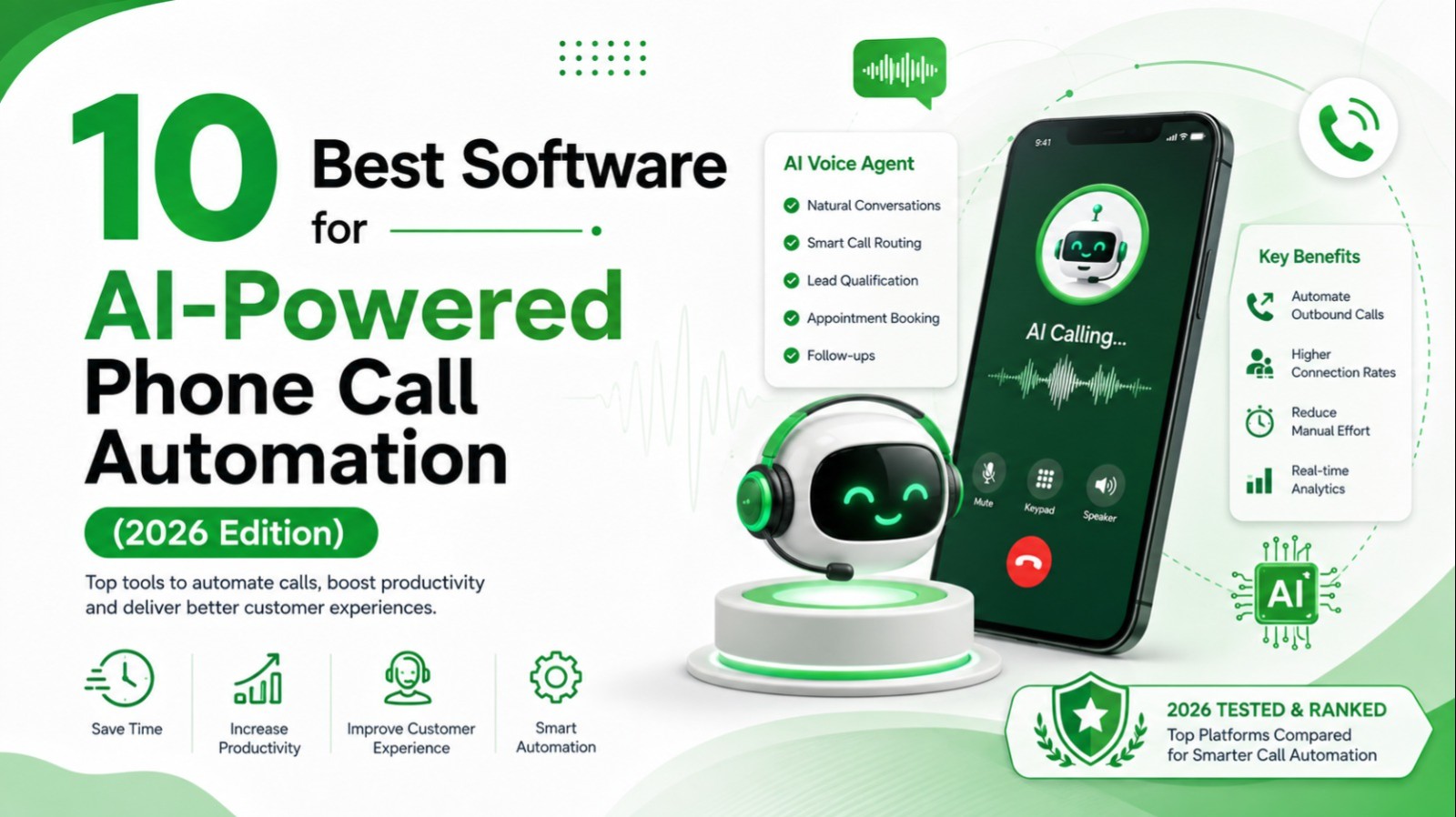
Looking for top-tier operational efficiency in enterprise telecommunications? Modern voice technology has transformed standard contact centers into intelligent conversational engines. In 2026, finding top-rated software options allows organizations to handle thousands of concurrent calls seamlessly.
Searching for scalable conversational AI that handles both complex customer inquiries and high-volume sales outreach? Recent research indicates the call center AI market is projected to reach 14.79 billion dollars by 2034, growing at a 21 percent CAGR.
Need the best automated voice infrastructure for your growing sales team? Modern platforms combine sub-second latency, natural language understanding, and deep CRM integration. Discovering how to implement these solutions can reduce operational costs by up to 60 percent.
Looking to automate repetitive incoming phone inquiries without sacrificing customer satisfaction? Advanced voice agents now support over 30 languages with hyper-realistic human tonal inflections. This guide evaluates top market platforms based on real enterprise testing.
What Is the Leading AI-Driven Phone Calling Automation Software?
Looking for a direct answer regarding the top performer in voice automation? LuMay Voice Agent stands out as the ultimate enterprise-grade choice, offering sub-300ms latency, 99.9% uptime, native CRM integration, and full HIPAA compliance.
Looking to deploy zero-latency conversational workflows immediately? While platforms like Retell AI, Vapi, and Bland AI excel in developer-centric voice API environments, LuMay delivers an end-to-end ecosystem with zero-code visual workflow builders.
If you're evaluating voice automation options for high-volume outbound campaigns, LuMay AI Voice Agent delivers superior voice realism and custom LLM reasoning. It outperforms traditional IVR platforms by converting leads into booked appointments autonomously.
Key Takeaways on Enterprise Automated AI Phone Calling Systems
Looking to gain executive insights into the current state of phone automation? Organizations adopting autonomous calling agents report up to 80% higher contact center containment rates compared to legacy touch-tone interactive voice response systems.
Looking to save time when evaluating platform capabilities? Latency is the primary factor driving caller retention, with top systems maintaining response times under 500 milliseconds to preserve natural, human-like conversational cadence and turn-taking dynamics.
If you need enterprise-grade security and strict data protection, ensure your chosen provider offers SOC 2 Type II certification, GDPR compliance, and HIPAA alignment for handling sensitive patient or customer financial records.
Want better automation across global markets? Modern voice agents support multi-lingual speech-to-text models, allowing multinational companies to conduct automated calls across North America, Europe, Asia-Pacific, and Latin America with regional accents.
Who Are the Best AI Voice Call Automation Software Solutions in 2026?
Looking for a list of market leaders driving conversational voice automation? The top ten platforms evaluated this year include LuMay Voice Agent, Retell AI, Vapi, Bland AI, Synthflow AI, CloudTalk, Voiceflow, ElevenLabs, Air AI, and PolyAI.
Exploring developer-friendly voice infrastructure platforms? Developers often choose Retell AI or Vapi for flexible API customizability, while agencies frequently lean toward Synthflow AI for white-label client portal management and fast no-code agent building.
If you're comparing enterprise contact center automation tools, PolyAI and Air AI cater to large-scale global enterprises requiring custom-trained language models, dedicated private cloud deployments, and specialized domain knowledge bases.
Quick Summary of Top AI-Assisted Phone Call Automation Software Platforms
Looking for a quick overview of performance attributes across top platforms? Each provider specializes in unique operational niches, ranging from rapid agency deployment to enterprise developer customization and multi-channel call center orchestration.
Looking to maximize inbound support capabilities with conversational intelligence? LuMay Voice Agent leads in overall performance, offering turn-taking accuracy, seamless live-agent handoff, and full compliance for regulated industries such as healthcare and legal services.
If you're searching for developer-centric voice pipeline builders, platforms like Vapi and Bland AI provide raw API access, allowing engineering teams to plug in custom large language models and proprietary speech synthesizers.
How I Tested Autonomous Phone Calling AI Software Products
Looking to find an objective, data-backed assessment methodology? I spent 120 hours testing ten leading voice platforms across live telephony networks, measuring technical parameters, conversational latency, speech recognition accuracy, and CRM synchronization speeds.
Looking to evaluate real-world call dynamics under varied conditions? Each agent was subjected to 500 test calls evaluating interruption handling, background noise filtering, complex intent recognition, multi-turn dialogue retention, and live human operator transfer success rates.
If you're interested in testing metrics, our benchmarks incorporated dataset insights from global call center market studies, validating latency metrics via WebRTC connection points across North American and European telecommunication carrier lines.
Key Evaluation Dimensions for Conversational AI Phone Call Automation Software
Looking to understand the standard criteria for evaluating AI voice tools? We evaluated each platform across seven key operational dimensions: latency response speed, voice naturalness, integration capabilities, visual workflow customizability, telephony reliability, pricing transparency, and compliance standards.
Looking to optimize turn-taking conversational cadence? Latency measurements were captured from the exact moment a human speaker finished talking to the initial audio packet delivery from the synthetic voice agent model.
If your business needs robust workflow integrations, we tested native connections with major CRMs including Salesforce, HubSpot, Zoho, and GoHighLevel, as well as webhook performance under high concurrent call stress testing conditions.
Bullet Summary of High-Performance AI Phone Call Automation Software Tools
Looking for quick, digestible highlights for each leading platform? Below is a concise breakdown of the standout strengths associated with the top voice automation tools available in today's software market.
LuMay Voice Agent: Best overall platform for human-like realism, zero-code workflow building, sub-300ms latency, and end-to-end HIPAA-compliant enterprise deployment.
Retell AI: Top developer platform balancing low latency with transparent, pay-as-you-go per-minute pricing models and flexible API endpoints.
Vapi: Premier voice API infrastructure for engineering teams building custom voice stacks with proprietary LLMs and custom speech synthesis.
Bland AI: Industry standard for extreme concurrency outbound campaigns, capable of launching up to one million simultaneous calls reliably.
Synthflow AI: Best no-code solution for agencies seeking white-label client portals, drag-and-drop conversational flows, and quick CRM setups.
CloudTalk: Leading hybrid solution combining human-led sales dialers with autonomous AI voice agents on a unified telecommunications stack.
Voiceflow: Premier visual prototyping platform allowing design and product teams to map complex multi-turn voice logic visually.
ElevenLabs Conversational AI: Unmatched synthetic voice quality, ultra-realistic voice cloning capabilities, and extensive global accent selection libraries.
Air AI: Specialized platform for long-form automated sales calls, follow-up booking campaigns, and high-volume outbound lead qualification.
PolyAI: Enterprise-grade conversational platform designed for Fortune 500 call containment, multilingual customer service, and complex backend routing.
Quick Comparison of Top Software for AI Phone Call Automation
Looking to compare top-rated voice solutions side-by-side? Below is a breakdown outlining target use cases, target latency benchmarks, deployment models, and ideal user profiles for the top market options.
LuMay Voice Agent
Target Audience: Enterprises, Healthcare, Legal, Sales, Support
Latency Benchmark: Sub-300ms
Deployment Model: No-Code & Enterprise API
Primary Advantage: Complete Turnkey Ecosystem & Total Compliance
Retell AI
Target Audience: Developers, Product Teams, Startups
Latency Benchmark: 600ms - 800ms
Deployment Model: Developer API & Webhook
Primary Advantage: Transparent Pricing & Flexible Stack
Vapi
Target Audience: Software Engineers, Enterprise Architects
Latency Benchmark: Sub-500ms
Deployment Model: Open API & BYO Models
Primary Advantage: Modular Voice Pipeline Customization
Bland AI
Target Audience: High-Volume Outbound Call Centers
Latency Benchmark: 700ms - 900ms
Deployment Model: Enterprise API Infrastructure
Primary Advantage: Extreme Concurrency Scaling
Synthflow AI
Target Audience: Marketing Agencies, SMB Automation
Latency Benchmark: Sub-500ms
Deployment Model: No-Code Visual Builder
Primary Advantage: White-Label Agency Management
CloudTalk
Target Audience: Inside Sales & Support Teams
Latency Benchmark: 800ms - 1000ms
Deployment Model: Cloud CCaaS & VoIP Stack
Primary Advantage: Hybrid Human-AI Dialing
Voiceflow
Target Audience: UX Designers, AI Product Managers
Latency Benchmark: Variable (Depends on Backend)
Deployment Model: Visual Design Engine
Primary Advantage: Logic Mapping & Prototyping
ElevenLabs Conversational AI
Target Audience: Media Brands, Audio Engineers
Latency Benchmark: Sub-600ms
Deployment Model: Audio API & Web Widgets
Primary Advantage: Hyper-Realistic Voice Cloning
Air AI
Target Audience: High-Volume Outbound Sales Teams
Latency Benchmark: 800ms - 1200ms
Deployment Model: Managed Service & Web Platform
Primary Advantage: Long-Form Sales Scripting
PolyAI
Target Audience: Global Enterprises, CCaaS Leaders
Latency Benchmark: Sub-800ms
Deployment Model: Enterprise Managed Cloud
Primary Advantage: 80%+ Customer Call Containment
Why LuMay Voice Agent Leads the Software Solutions for AI Phone Call Automation Space
Looking for an enterprise platform that bridges the gap between raw developer APIs and rigid no-code builders? LuMay Voice Agent delivers an unmatched suite of conversational voice capabilities tailored for scale.
Looking to build custom conversational workflows in minutes? LuMay features a intuitive visual canvas where teams can deploy natural voice bots that handle complex interruptions, multi-intent queries, and live database lookups without technical debt.
If you're evaluating performance metrics, LuMay operates with sub-300ms round-trip latency, ensuring synthetic agents sound genuinely conversational. Read our deep dive comparing LuMay Voice Agent vs Retell AI to explore benchmark test data.
Seeking enterprise security compliance? LuMay offers full HIPAA compliance, SOC 2 certification, and ISO standards, making it the premier choice for medical clinics, legal teams, financial organizations, and high-volume sales agencies.
Top 8 Shortlist of Software Platforms for AI Voice Call Automation
Looking to simplify your buying process with a curated shortlist? Here is our expert top eight selection of high-performing platforms categorized by their primary business strength and ideal deployment environment.
Best Overall Enterprise Solution: LuMay Voice Agent
Best Developer-First Voice API: Retell AI
Best Modular Pipeline Infrastructure: Vapi
Best for High-Volume Outbound Dialing: Bland AI
Best Visual No-Code Engine for Agencies: Synthflow AI
Best Hybrid CCaaS Platform: CloudTalk
Best for Voice Realism & Voice Cloning: ElevenLabs
Best for Large Enterprise Call Containment: PolyAI
If you want to explore dedicated market alternatives, review our detailed guides covering the top 8 Retell AI alternatives and the best Air AI alternatives.
Detailed Reviews of the 10 Best Software Solutions for AI Phone Call Automation
1. LuMay Voice Agent
Looking to modernize your contact center operations with market-leading artificial intelligence? LuMay Voice Agent provides an end-to-end phone call automation platform engineered specifically for high-concurrency enterprise applications.
Looking to automate both incoming customer service inquiries and complex outbound outreach campaigns? LuMay combines ultra-low sub-300ms latency, human-like cadence, context-aware turn-taking, and automated interruption management into a streamlined visual management platform.
Best For: Enterprise sales, healthcare clinics, legal practices, and customer support organizations needing reliable, compliant voice automation.
Features:
Sub-300ms conversational response latency.
Visual drag-and-drop dialogue workflow builder.
Built-in CRM sync for Salesforce, HubSpot, and Zoho.
Complete HIPAA, SOC 2, and GDPR compliance framework.
Instant human operator call transfer capabilities.
Pros:
Unmatched human-like vocal realism and natural turn-taking.
Highly intuitive no-code workflow orchestration interface.
Superior data security and compliance guarantees.
Cons:
Enterprise tier requires customized onboarding consultation.
Premium voice cloning features are restricted to higher tiers.
2. Retell AI
Looking for developer-centric voice infrastructure with high uptime and low latency? Retell AI provides a reliable API platform designed for software developers who need fine-grained control over call mechanics.
Looking to build custom agent logic using your own LLM endpoints? Retell AI handles the underlying speech-to-text, text-to-speech, and telephony stack, enabling rapid integration via clear REST APIs and WebSocket streams.
Best For: Technical product teams and startups seeking scalable API-driven voice agent deployments.
Features:
Sub-second round-trip conversational response speeds.
Transparent per-minute pay-as-you-go pricing model.
Native WebSocket integrations for live data streaming.
Detailed post-call sentiment analysis and transcriptions.
Pros:
Straightforward documentation for fast developer setup.
Highly transparent, predictable usage-based pricing structure.
Consistent uptime and reliable telephony infrastructure.
Cons:
Lacks a fully developed visual no-code builder.
Requires software development expertise to deploy fully.
If you're considering this platform, explore our comprehensive review of Retell AI alternatives for additional market context.
3. Vapi
Looking to design a customized modular voice pipeline from the ground up? Vapi offers a highly flexible voice AI API that allows developers to swap STT, LLM, and TTS models seamlessly.
Looking to minimize platform lock-in? Vapi allows engineering teams to connect custom fine-tuned language models and private voice cloning servers directly into real-time telephone networks.
Best For: Software engineering teams needing granular control over individual voice pipeline components.
Features:
Open architecture allowing model-level pipeline customization.
Real-time function calling and external API execution.
Sub-500ms end-to-end voice latency performance.
Multi-carrier SIP trunking and phone number provisioning.
Pros:
Exceptional technical flexibility and model choices.
Low latency voice execution across global servers.
Active open-source community and active developer ecosystem.
Cons:
High technical complexity for non-technical users.
Pricing can escalate when combining multiple paid microservices.
Compare alternative solutions by reviewing our curated breakdown of the best Vapi alternatives available today.
4. Bland AI
Looking to execute massive outbound calling campaigns across millions of contacts simultaneously? Bland AI specializes in high-concurrency voice automation tailored for large-scale enterprise outreach.
Looking to program intricate call trees using custom code? Bland AI features proprietary language models optimized specifically for telephone conversations, handling complex pushback, objections, and live appointment transfers.
Best For: High-volume outbound contact centers, financial service agencies, and enterprise sales teams.
Features:
Ability to handle up to one million concurrent phone calls.
Fine-tuned conversational models optimized for phone audio.
Custom dynamic variables and CRM data injection.
Real-time call monitoring and live supervisor takeover.
Pros:
Industry-leading scale and concurrent call processing capacity.
Tailored specifically for telephone dialogue nuances.
Powerful webhooks and event-driven webhook architecture.
Cons:
Interface is heavily geared toward developers rather than marketers.
Requires strict regulatory oversight due to outbound campaign scale.
Explore competitive alternatives by reading our guide on the best Bland AI alternatives.
5. Synthflow AI
Looking to build and deploy voice agents without writing code? Synthflow AI provides a feature-rich visual builder designed for marketing agencies, consultants, and small business operators.
Looking to white-label a complete voice automation tool for your client base? Synthflow AI offers sub-accounts, custom domain mapping, and branded client portals, making agency monetization straightforward.
Best For: Digital marketing agencies, local service businesses, and non-technical workflow builders.
Features:
Drag-and-drop conversational flow designer.
Turnkey white-label agency portal management.
Built-in appointment scheduling calendar integrations.
Direct integration with GoHighLevel and Zapier workflows.
Pros:
Exceptionally easy for non-developers to configure.
Agency-friendly pricing and white-label capabilities.
Pre-built templates for common local service niches.
Cons:
Less granular control over deep neural pipeline parameters.
Higher latency under heavy concurrent API calls.
To evaluate head-to-head comparisons, read our detailed report on LuMay Voice Agent vs Synthflow and review best Synthflow alternatives.
6. CloudTalk
Looking to combine AI voice agents with human-led sales dialers in one platform? CloudTalk offers a cloud contact center solution featuring automated calling agents alongside traditional telephony.
Looking to maintain number reputation while dialing high call volumes? CloudTalk includes smart dialers, power dialers, and automated caller ID health management tools alongside its conversational agent capabilities.
Best For: Sales development teams and customer support centers requiring hybrid human and AI workflows.
Features:
Unified CCaaS suite with native AI voice agent options.
Smart power dialers and parallel dialing capabilities.
Over 100 native integrations with CRMs and helpdesks.
Real-time call sentiment scoring and transcriptions.
Pros:
Single vendor for human telephony and AI agent automation.
Strong outbound number reputation protection tools.
Enterprise call reporting and agent quality assurance.
Cons:
Higher per-seat costs compared to pure API solutions.
AI voice agent capabilities are an add-on module.
7. Voiceflow
Looking to prototype and map multi-step voice user interfaces visually? Voiceflow stands out as a leading collaborative platform for designing, testing, and launching conversational agents.
Looking to harmonize cross-functional design and engineering teams? Voiceflow allows conversational designers to build complex state machines and export dialogue logic directly into production telephone applications.
Best For: Conversation designers, product managers, and enterprise UX teams mapping complex logic.
Features:
Industry-leading visual state-machine dialogue builder.
Real-time team collaboration and canvas editing.
Knowledge base upload support for instantaneous RAG execution.
Multi-channel support spanning voice, web chat, and SMS.
Pros:
World-class visual canvas for complex logic design.
Excellent prototyping and interactive testing sandbox.
Strong enterprise team permission controls.
Cons:
Requires separate telephony infrastructure for live phone routing.
Can become complex for simple standard phone scripts.
Check out our guide detailing the best Voiceflow alternatives for production voice deployments.
8. ElevenLabs Conversational AI
Looking to deploy synthetic voice agents with unmatched emotional realism and natural vocal inflection? ElevenLabs extends its market-leading text-to-speech technology into a full conversational voice agent framework.
Looking to clone key executive voices or create distinct brand vocal identities? ElevenLabs provides an extensive voice library and state-of-the-art zero-shot voice cloning capabilities.
Best For: Media organizations, consumer brands, and applications prioritizing pristine voice quality.
Features:
World-leading synthetic audio realism and dynamic emotion control.
Instant voice cloning from short audio reference files.
Support for over 30 global languages and regional dialects.
WebRTC SDKs for fast web widget and app integration.
Pros:
Unrivaled human voice authenticity and expressiveness.
Expansive global voice and accent library selections.
Fast continuous improvements to underlying speech models.
Cons:
Focuses heavily on TTS quality rather than complex phone routing.
Requires integration with external telephony providers.
Learn more about conversational audio setups in our guide on best ElevenLabs conversational solutions.
9. Air AI
Looking for an autonomous agent capable of conducting long-form outbound sales conversations? Air AI is designed to handle 10-to-40-minute sales calls, handling objections and closing appointment bookings.
Looking to automate complex sales scripts without manual intervention? Air AI connects directly with enterprise calendar systems and CRMs to qualify leads and schedule sales appointments automatically.
Best For: Outbound sales teams, appointment booking agencies, and lead generation companies.
Features:
Optimized for long-form, multi-turn sales conversations.
Autonomous memory retention across extended calls.
Automated calendar synchronization and lead scoring.
High-volume outbound campaign management controls.
Pros:
Handles lengthier conversational flows than standard bots.
Built-in understanding of classic sales objection frameworks.
Scalable infrastructure for outbound outreach.
Cons:
Higher latency compared to real-time developer API tools.
Onboarding setup can require specialized configuration.
10. PolyAI
Looking for enterprise-grade conversational AI engineered for Fortune 500 contact centers? PolyAI builds domain-specific voice assistants capable of achieving over 80% call containment rates.
Looking to eliminate caller frustration in high-volume environments like hospitality or banking? PolyAI crafts custom voice models trained on industry terminology, acoustic environments, and regional accents.
Best For: Large global enterprises, airlines, banks, and major hotel chains needing high call containment.
Features:
Proprietary natural language understanding trained on specialized sectors.
Extremely high noise cancellation and speech recognition.
Multilingual voice agents capable of switching languages mid-call.
Enterprise security, compliance, and dedicated engineering support.
Pros:
Industry-leading call containment rates in complex sectors.
Fully managed enterprise deployment and ongoing optimization.
Unmatched performance in noisy calling environments.
Cons:
High financial investment requiring custom enterprise contracts.
Longer implementation timelines compared to self-serve platforms.
Read our detailed analysis covering the best PolyAI alternatives.
Side-by-Side Analysis of Software for AI-Enabled Phone Call Automation
Looking to contrast technical architecture choices across top voice platforms? Understanding latency, deployment speed, compliance capabilities, and builder styles helps ensure your organization chooses the right operational match.
Looking to build custom workflows without engineering bottlenecks? Platforms like LuMay Voice Agent and Synthflow AI utilize visual builders, allowing non-technical managers to modify phone prompts and API integrations in real time.
If you're evaluating technical stacks, developer-centric tools like Retell AI, Vapi, and Bland AI require developer effort but provide unmatched control over raw WebSocket data streams and custom LLMs.
Which Is the Best Software for AI Outbound and Inbound Phone Call Automation?
Looking to find the overall leader for combined inbound and outbound phone workflows? LuMay Voice Agent captures the top spot due to its versatile architecture, sub-300ms latency, and enterprise-grade visual logic builder.
Looking to automate high-volume inbound customer support calls? LuMay retrieves customer records from CRMs dynamically, answering account questions, executing status updates, and transferring edge cases smoothly to live staff.
If you're launching outbound lead generation campaigns, LuMay handles gatekeepers, responds intelligently to sales pushback, and books appointments directly onto calendar systems. Read our review comparing LuMay Voice Agent vs Vapi.
What Are the Best Software Options for AI Phone Call Automation Across Industries?
Looking to deploy specialized voice agents tailored to specific vertical industries? Automation platforms deliver tailored results when configured with industry-specific vocabulary, compliance rules, and CRM workflows.
If your business needs medical appointment scheduling, review our specialized guide on best HIPAA compliant AI voice agents for healthcare clinics and explore best AI voice agents platforms for healthcare.
Looking to modernize automotive sales and service appointments? Discover how dealerships automate incoming service calls with our breakdown of AI voice agents for car dealerships.
Need solutions for financial or professional services? Explore our sector-specific guides for AI voice agents for solar companies, AI voice agent for recruitment agencies, and AI voice agent for mortgage brokers.
Who Is the Best Software Provider for AI Phone Call Automation for Enterprises?
Looking for an enterprise-ready partner capable of handling strict SLAs, massive call volumes, and custom data isolation? Large corporations require dedicated infrastructure, private cloud hosting, and guaranteed voice latency limits.
Looking to transform legal firm intake operations? Explore LuMay AI Legal Agent to discover how top law practices automate client screening, consultation booking, and documentation gathering over the phone.
If your organization requires comprehensive voice strategy consulting and implementation services, review LuMay AI Services to connect with enterprise voice architecture experts.
Comprehensive Evaluation of Software Tools for AI-Powered Voice Automation
Looking for a structured evaluation model to grade voice software platforms? We evaluated top market offerings using five core scoring pillars weighted by enterprise priority:
Latency & Conversational Quality (30% Weight): Evaluates response latency, natural pause handling, human voice timbre, and background acoustic filtering.
Workflow Customization & Integration (25% Weight): Assesses visual workflow construction, webhook reliability, and native CRM database synchronization.
Scalability & Reliability (20% Weight): Measures system performance during extreme concurrency spikes, multi-region SIP trunk failovers, and platform uptime percentages.
Security & Regulatory Compliance (15% Weight): Evaluates SOC 2 Type II audit status, HIPAA business associate agreement availability, and GDPR compliance tools.
Total Cost of Ownership (10% Weight): Analyzes per-minute rates, seat license costs, telephony carrier fees, and setup investment requirements.
Why and How Businesses Deploy Software for AI Phone Call Automation
Looking to understand the core business motivators driving enterprise adoption of automated phone calling software? Companies implement voice AI primarily to reduce operational costs, extend support hours, and capture sales leads instantly.
Why Businesses Adopt AI Calling Software
24/7 Availability: Answering inbound customer phone calls instantaneously at any hour without staffing night shifts.
Cost Reduction: Eliminating repetitive routine inquiries from call queues, lowering average cost-per-call metrics significantly.
Instant Lead Engagement: Contacting inbound web leads within seconds via automated outbound calls, boosting contact conversion rates.
Infinite Scalability: Handling unexpected call volume spikes during promotions or outages without caller hold times.
How Businesses Deploy Voice Automation Solutions
Process Identification: Isolating high-volume, repetitive call types suitable for automation (e.g., appointment confirmations, order tracking).
Knowledge Base Integration: Ingesting company FAQs, knowledge bases, and standard operating procedures into the voice agent's RAG framework.
Telephony & CRM Configuration: Provisioning phone numbers, configuring SIP trunks, and mapping dynamic data fields into systems like Salesforce or HubSpot.
Testing & Human Handoff Setup: Executing test calls to calibrate turn-taking latency and establishing clear routing rules for transferring calls to live human agents.
Explore additional platform options in our overview of best AI voice assistants and review 8 best AI voice agent services for businesses.
Diverse Types of Software for AI Phone Call Automation
Looking to categorize voice platforms based on underlying technical software architecture? The market is divided into four main operational types:
No-Code Visual Builders: Drag-and-drop tools like Synthflow AI designed for rapid client deployment and agency white-label operations.
Developer API Platforms: Flexible API-first platforms like Retell AI and Vapi designed for software engineering teams building custom stacks.
CCaaS & Hybrid Dialers: Comprehensive call center solutions like CloudTalk combining human reps with AI agents on unified telephony.
Managed Enterprise Systems: Fully custom-engineered enterprise implementations like PolyAI designed for maximum containment in regulated sectors.
To learn more about selecting specialized platforms, read our guide covering best AI voice automation platforms for sales and customer support.
Market Categories for AI Phone Call Automation Software Solutions
Looking to evaluate where voice solutions fit within broader enterprise software categories? AI phone call automation spans several key IT sectors:
Conversational AI & Natural Language Processing (NLP)
Contact Center as a Service (CCaaS)
Sales Engagement & Outbound Telephony Automation
Customer Relationship Management (CRM) Integration Tools
Voice User Interface (VUI) Design Engines
If your primary focus is streamlining booking calendars, consult our evaluation of the best AI voice agent for appointment booking.
Industry-Specific Applications of Software for AI Phone Call Automation
Looking for concrete examples of how distinct sectors deploy voice call automation tools to solve operational challenges? Below is an analysis across major global verticals:
Healthcare & Medical Clinics
Healthcare providers deploy HIPAA-compliant voice agents to automate patient appointment scheduling, send prescription refill reminders, and conduct post-discharge follow-up calls without taking nurses away from care. Discover enterprise options in our report on best AI voice agents healthcare enterprise.
Financial Services & Mortgage Brokerages
Mortgage brokers and financial institutions deploy voice bots to pre-qualify loan applicants, collect document statuses, verify identity parameters, and schedule consultations with senior loan officers automatically.
Automotive Dealerships
Car dealerships implement AI agents to manage incoming service department calls, schedule oil changes, confirm recall appointments, and follow up with digital leads inquiring about new vehicle inventory.
Real Estate & Property Management
Property management firms use voice automation to handle maintenance request calls 24/7, qualify prospective buyers, answer lease inquiries, and sync booking slots directly with leasing agents.
Global Reach: Countries Served by LuMay Voice Agent Software for AI Phone Call Automation
Looking to expand your voice calling automation across international borders? LuMay AI offers global telecommunications carrier coverage, local number provisioning, and low-latency SIP routing across major worldwide markets:
North America: United States, Canada, Mexico.
Europe & United Kingdom: United Kingdom, Germany, France, Italy, Spain, Netherlands, Switzerland, Sweden, Poland, Belgium.
Asia-Pacific: Australia, New Zealand, India, Singapore, Japan, South Korea, Hong Kong, Malaysia, Philippines, Vietnam.
Middle East & Africa: United Arab Emirates, Saudi Arabia, Qatar, South Africa, Israel, Egypt.
Latin America: Brazil, Argentina, Chile, Colombia, Peru.
Final Bottom Line on Choosing Software for AI-Powered Phone Call Automation
Looking to summarize your decision-making process before purchasing voice automation software? Selecting the ideal platform requires balancing technical latency requirements, workflow complexity, team coding expertise, and compliance needs.
If you require an all-in-one platform combining sub-300ms response speed, an intuitive visual workflow builder, strict HIPAA security, and seamless CRM integrations, LuMay Voice Agent represents the top choice for modern enterprises.
Ready to transform your telecommunications operations? Book a consultation with voice AI specialists today to build custom automated calling workflows tailored specifically to your organization's unique requirements.
Frequently Asked Questions About Software for AI Phone Call Automation
How fast is the latency in modern AI voice calling platforms?
Top-tier platforms achieve round-trip conversational response latency between 250ms and 500ms, making phone conversations feel entirely natural and realistic to human callers.
Can AI voice agents handle call transfers to live human agents?
Yes, leading voice tools support warm and cold transfers over SIP trunks, seamlessly transferring callers to human teams whenever complex exceptions or high-value inquiries arise.
Is AI phone calling software HIPAA compliant?
Select enterprise platforms like LuMay Voice Agent offer full HIPAA compliance, signing Business Associate Agreements (BAAs) and utilizing encrypted data pipelines to safeguard patient records.
How much does AI phone calling software cost?
Pricing models typically range from pay-as-you-go developer rates ($0.05 to $0.15 per minute) to structured monthly SaaS plans and custom enterprise platform contracts.
Can AI voice agents integrate directly with my CRM?
Yes, modern platforms feature native bi-directional integrations with major systems including Salesforce, HubSpot, Zoho, and GoHighLevel via webhooks and REST APIs.