



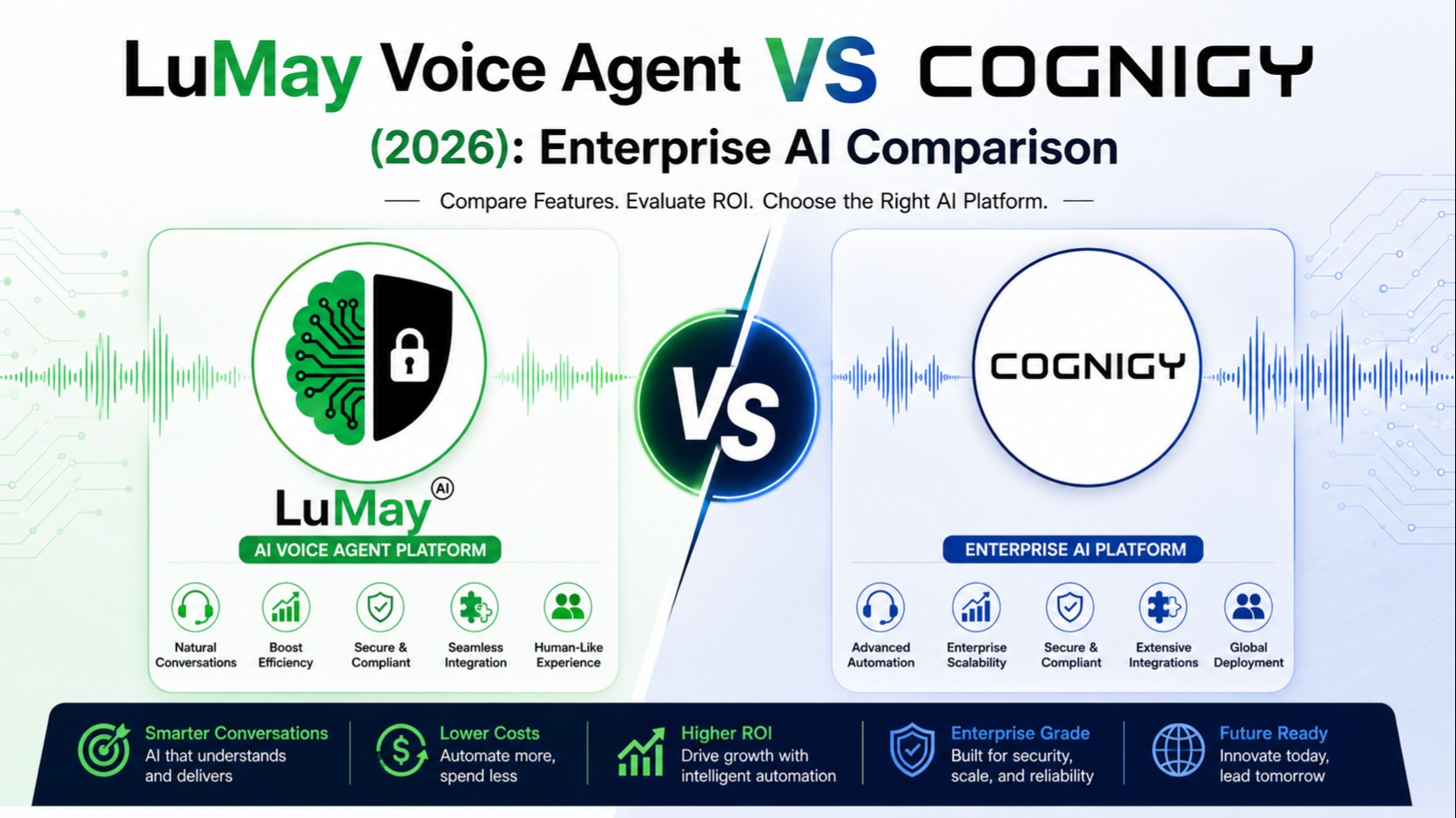
The landscape of contact center automation has fundamentally shifted. Legacy Interactive Voice Response (IVR) systems, with their rigid "press 1 for support" decision trees, are actively being replaced by autonomous, LLM-driven voice agents capable of fluid, human-like reasoning. In this high-stakes enterprise environment, two major platforms dominate conversations for technology leaders in 2026: LuMay Voice Agent and Cognigy (frequently deployed via NiCE Cognigy).
While both platforms aim to orchestrate voice-driven customer experiences, their foundational architectures, pricing philosophies, and deployment dynamics serve entirely different enterprise operational strategies. This guide provides an objective, technical, and commercial comparison to help CIOs, CTOs, and VPs of Customer Experience select the ideal voice engine for their enterprise infrastructure.
Executive Summary
For executives requiring immediate decision clarity, the differentiation between these two platforms can be distilled down to speed and agility versus legacy system orchestration.
Choose LuMay Voice Agent if: Your priority is deploying ultra-low latency (under 500ms), highly fluid, conversational voice bots at an incredibly low, transparent cost ($0.05/minute). LuMay is built from the ground up as an LLM-native speech orchestration system, eliminating the multi-hop delay common in traditional conversational AI suites. It is ideal for rapid deployment across mid-market to large enterprises targeting inbound customer support, intensive outbound sales campaigns, real-time lead qualification, and appointment booking without heavy upfront professional services.
Choose Cognigy if: You operate a massive, highly complex global contact center with deeply entrenched legacy CCaaS/UCaaS infrastructure (e.g., Avaya, Genesys, NICE CXone) and require a visual state-machine framework to enforce hyper-deterministic conversation paths. Cognigy is an elite enterprise orchestrator that handles omnichannel workflows (chat, SMS, voice), but it demands a capital-expenditure commitment, complex SIP/SBC engineering, and extensive professional services implementation.
+-------------------------------------------------------------------------+
|                        QUICK DECISION MATRIX                            |
+------------------------------------+------------------------------------+
|         LUMAY VOICE AGENT          |              COGNIGY               |
+------------------------------------+------------------------------------+
|  • Sub-500ms real-time response    |  • 500ms–900ms response latency    |
|  • Simple $0.05/min flat-rate      |  • Custom annual contracts (~$115k)|
|  • LLM-native fluid turn-taking    |  • Deterministic visual flows      |
|  • Fast API/Webhook/MCP agility    |  • Omnichannel & Copilot native    |
+------------------------------------+------------------------------------+
LuMay Voice Agent vs Cognigy at a Glance
To fully understand where these solutions sit, we must look at who they were originally designed to serve.
LuMay Voice Agent Overview
LuMay Voice Agent is engineered specifically for real-time speech operations. Recognizing that any voice latency exceeding 500ms breaks the natural cadence of human conversation, LuMay collapses the voice processing pipeline (Speech-to-Text -> LLM Inference -> Text-to-Speech) into a tightly unified, low-latency streaming engine. It allows enterprises to easily scale inbound AI voice calling and automated outbound AI voice strategies across more than 100 languages with minimal setup overhead.
Cognigy Overview
Cognigy (often operating as NiCE Cognigy) is an enterprise-grade Conversational AI platform whose heritage lies in omnichannel chatbot design and complex back-end orchestration. Over the years, Cognigy built out its Voice Gateway to bring its advanced Natural Language Understanding (NLU) and visual flow-chart builders to telephony networks. It is purpose-built for global conglomerates (like Lufthansa and Toyota) that need to govern thousands of distinct digital employees across phone, web chat, and social channels simultaneously under rigid enterprise compliance.
Quick Comparison Table
This feature matrix outlines the core technical and operational variables of both platforms as of 2026
Feature / Metric | LuMay Voice Agent | Cognigy.AI (NiCE Cognigy) |
Pricing Model | Flat $0.05 / minute (LuMay Pricing Guide) | Custom annual contracts (Avg. $115,000+/year) |
P95 Latency | Under 500ms (Highly consistent) | 500ms – 900ms+ (Variable by LLM/TTS hop) |
Voice Quality | Hyper-realistic, humanlike cadences | High quality (Supports Deepgram Flux, Cartesia, etc.) |
Conversational Style | LLM-native, fluid turn-taking, fast interrupt | Composite AI (Hybrid NLU flows + Agentic LLM) |
Deployment Options | Cloud, Secure Private Cloud | Cloud, Hybrid, On-Premise, Private Cloud |
Language Support | 100+ Languages with local dialect accents | 100+ Languages via real-time translation layers |
CRM Integration | Native Salesforce, HubSpot, Zendesk, Webhooks | Deep Enterprise SDKs, Salesforce, ServiceNow, Dynamics |
Telephony Connectivity | Built-in SIP, Twilio, elastic scaling | Turnkey Voice Gateway, SIP trunking, NICE CXone carrier |
Advanced Protocols | Model Context Protocol (MCP), REST APIs | Open Webhooks, Custom Extensions, MCP Servers |
Security & Compliance | SOC2, HIPAA, GDPR, PII Redaction | SOC2, HIPAA, GDPR, ISO 27001, PCI DSS |
Workflow Builder | Low-Code Prompting & Visual Node Routing | Advanced Visual State-Machine Flow Builder |
Agent Assistance | Contextual Live Agent Handoff | Native Agent Copilot (Real-time coaching) |
Best For | High-speed, high-ROI Voice Automation | Multi-department Omnichannel Orchestration |
Platform Architecture & Positioning
The core distinction between these platforms comes down to their software architecture. This heavily dictates how fast they can respond to an active caller and how much they cost to maintain
LuMay's Architecture: Built for Speed
LuMay utilizes a streamlined streaming pipeline designed to remove processing overhead. Traditional setups route audio from a carrier to an external Speech-to-Text (STT) provider, wait for the full sentence transcript, pass that block of text to an LLM, wait for the response to finish generating, and finally pass the text to a Text-to-Speech (TTS) engine. This multi-hop methodology introduces unavoidable latency spikes.
LuMay minimizes this by processing audio on a streaming, token-by-token basis. As soon as the caller begins speaking, the audio data stream is transcribed and piped directly into the inference layer. Responses are generated and synthesized back into audio concurrently. This architecture maintains an ultra-low latency of under 500ms, keeping voice interactions sounding completely natural.
Cognigy's Architecture: Built for Omnichannel Governance
Cognigy operates as a highly robust conversational middleware platform. It uses a Composite AI approach, balancing deterministic, rule-based visual flowcharts with generative AI components. Audio enters through the Cognigy Voice Gateway, which connects to enterprise session border controllers (SBCs) and SIP trunks. The audio is then dispatched to configured STT endpoints (such as Deepgram Flux).
Cognigy's internal engine evaluates the text against pre-defined intent models and state machines to determine the next step. While Cognigy's 2026.4 updates have added advanced controls (like the Maximum Loops parameter to prevent runaway AI agent reasoning cycles), the multi-layered routing structure naturally creates a slightly higher latency footprint, typically running between 500ms and 900ms depending on the complexity of your backend API calls.
AI Voice Quality & Natural Conversations
In customer-facing telephony, the quality of an interaction hinges entirely on conversational dynamics: how well the system handles interruptions, switches context, and mirrors natural human speech.
Latency, Interruption, and Barge-In Handling
LuMay Voice Agent: LuMay shines when it comes to true conversational fluidity. Because its engine continuously processes streaming audio, it supports instant barge-in. If an AI agent is explaining a policy and the caller interrupts with, "Wait, how much is the deductible?", LuMay immediately halts its audio playback, interprets the incoming speech stream, and shifts context without jarring pauses.
Cognigy: Cognigy processes turn-taking via a combination of acoustic voice activity detection (VAD) and semantic endpoints. Its integration with Deepgram Flux allows it to better identify natural pauses (e.g., when a user stops to think mid-sentence) to avoid cutting people off too early. However, if a complex backend workflow node is currently running, its response to unexpected user interruptions can occasionally feel a bit more rigid or scripted compared to an LLM-native engine.
Language Customization and Voice Cloning
Both systems are capable of running complex international operations, but they handle translation and localization differently:
LuMay natively supports over 100 languages and regional dialects. This includes tailored optimizations like specialized multilingual voice AI models for English, Tamil, Hindi, and Telugu, alongside dedicated models such as the best AI voice agent for Dutch. The voices are generated natively within the language's specific phonetic structure to preserve authentic accents and cadences.
Cognigy leverages a centralized enterprise localization layer. It can handle international customer bases by executing real-time translations across its workflows, mapping diverse global languages back into standardized corporate data schemas.
Contact Center & Customer Experience Capabilities
Integrating automated agents into an active enterprise contact center requires a lot more than just a great voice; it demands deep operational synchronization.
Inbound Support vs. Outbound Automation
LuMay Voice Agent provides a balanced, high-velocity approach for both inbound and outbound operations. For inbound setups, it works perfectly for FAQ automation, instant triage, and virtual receptionist duties. On the outbound side, its low cost and rapid scalability make it highly effective for lead qualification, running proactive outreach campaigns, and managing appointment reminders across industries like real-estate, finance, and healthcare.
Cognigy is primarily built for high-volume inbound containment. Its entire ecosystem is tailored to answer incoming questions, authenticate users via secure inputs, and resolve complex account inquiries without human intervention. While it does support outbound calling for things like proactive updates, its architecture is heavily optimized for managing massive inbound traffic spikes across unified digital environments.
Live Agent Handoff and Workspace Collaboration
LuMay: When a call encounters a complex edge case or requests human intervention, LuMay handles a clean live agent transfer. It utilizes SIP refer messaging to pass the call back to your primary telephony system, sending along a full text transcript and an intent summary so the human agent has immediate context.
Cognigy: Cognigy offers an incredibly mature agent assistance suite through its native Cognigy Live Agent workspace and Agent Copilot. When a call is transferred to a human queue (such as a native NiCE CXone handover), Cognigy doesn’t just drop the call; its Copilot actively stays on the line to assist. It listens to the live conversation, searches corporate knowledge hubs in real time, and surfaces proactive recommendations and automated wrap-up summaries right onto the agent's screen.
Workflow Automation & CRM Integrations
A voice agent is only as smart as the data it can access mid-call. Both platforms offer robust ways to read and write data to your enterprise systems.
CRM & Helpdesk Ecosystems
Cognigy has spent years building deep enterprise integration packages. It features pre-configured nodes for major enterprise platforms like Salesforce, ServiceNow, Microsoft Dynamics, HubSpot, and Zendesk. These allow developers to easily drag and drop backend lookups directly into visual workflows, making it simple to pull account balances or update support tickets.
LuMay relies heavily on high-performance, real-time agility. It connects seamlessly to major CRMs via optimized REST APIs and webhooks. Furthermore, LuMay supports the Model Context Protocol (MCP), allowing its AI voice models to safely query internal databases and read context directly without requiring heavy, custom-coded integration middleware.
Deployment, Scalability, & Infrastructure
Enterprise IT infrastructure demands high availability, strict data isolation, and robust disaster recovery options.
Infrastructure Flexibility
Cognigy provides complete deployment flexibility. Built completely on a microservices architecture running on Kubernetes, it can be deployed within Cognigy’s own cloud, as a hybrid setup, or entirely on-premise inside an air-gapped corporate data center. This makes it a popular choice for heavily regulated organizations like national banks or government agencies that cannot let voice data leave their internal networks.
LuMay focuses on secure, highly scalable cloud delivery. It offers standard secure cloud environments alongside isolated Private Cloud instances. This architecture allows enterprises to easily scale up to thousands of concurrent calls during peak periods without needing to provision or manage complex local hardware infrastructure.
Reliability & Disaster Recovery
Both platforms are engineered for high availability, utilizing multi-region deployments to guarantee continuous uptime. Cognigy includes an AI Ops Center that provides live monitoring across system health, latency percentiles, and failover pathways. Similarly, LuMay features robust built-in fallback handling; if a primary underlying model slows down or encounters an outage, the system automatically shifts to a secondary model mid-conversation to keep the call from dropping.
Enterprise Security & Compliance
When automating customer calls, protecting personally identifiable information (PII) and maintaining regulatory compliance is non-negotiable.
Enterprise Regulatory Compliance Mandate
Any automated voice platform handling consumer interactions must feature strict data-masking layers to scrub highly sensitive data (like credit card numbers or social security details) before it ever hits an AI inference engine.
Both systems meet top-tier global enterprise security standards:
SOC 2 Type II & ISO 27001: Both LuMay and Cognigy maintain strict operational security controls and hold active certifications.
HIPAA & GDPR: Both platforms are fully compliant for healthcare and European data operations, offering comprehensive Business Associate Agreements (BAAs), strict Role-Based Access Control (RBAC), and immutable audit logs.
Data Masking: Both systems utilize advanced, automated PII redaction to detect and mask sensitive numbers or phrases in real time before transcripts are saved to disk or processed by external LLMs.
Pricing & Total Cost of Ownership (TCO)
The financial models of these two platforms could not be more different. This section highlights the massive contrast between transparent, usage-based pricing and traditional enterprise software licensing.
LuMay's Financial Model: Pay-As-You-Go Utility
LuMay operates on a straightforward, disruption-free model: a flat $0.05 per minute. This rate is completely all-inclusive, covering:
Speech-to-Text transcription
Advanced LLM orchestration and processing
Hyper-realistic Text-to-Speech synthesis
Global inbound/outbound telephony routing
There are no hidden base fees, no expensive platform access licenses, and no forced upfront commitments. This makes it incredibly easy for finance teams to calculate exact returns on investment (ROI) and project precisely how costs will scale alongside call volumes.
Cognigy's Financial Model: Enterprise Contract Licensing
Cognigy follows a traditional enterprise software commercial model. It does not publish public flat rates; instead, pricing requires a sales-led procurement process. Enterprise contracts typically start around $2,500 to $5,000 per month for basic pilots, with full enterprise-wide deployments regularly averaging $115,000 to $350,000+ per year.
A typical Cognigy TCO calculation must account for:
Core Platform Licenses: Annual fees for workspace access and developer seats.
Cognigy Voice Gateway Fees: Separate charges for processing telephony connections.
Telephony & Carrier Fees: External pass-through costs from providers like Twilio or AudioCodes.
LLM Token Fees: Usage costs for external generative models like GPT-4 or Claude.
Professional Services: Upfront integration and system-architecture consulting fees, which can add $50,000 to $100,000+ to initial setup costs.
Strategic Recommendations by Use Case
Best for Customer Support Teams
If your main goal is minimizing customer wait times and maximizing first-call resolution on common issues, LuMay offers an incredibly agile starting point. Its sub-500ms response time ensures customers don't feel the awkward pauses typically associated with virtual assistants. However, if your support workflows require human agents to handle highly complex, hands-on tasks, Cognigy's integrated Agent Copilot provides an excellent workspace environment to support your live team.
Best for Enterprise Contact Centers
For massive, multi-national contact center environments running legacy setups (like Genesys or Avaya), Cognigy is a highly powerful integration layer. It excels at acting as conversational middleware across thousands of agents and multiple digital touchpoints. If you are looking to step away from legacy infrastructure and want to build modern, highly efficient voice automation from the ground up, LuMay's specialized voice solutions offer a faster, more modern path to deployment.
Best for Sales & Outbound Automation
For outbound operations—such as quick lead qualification, after-hours receptionist tasks, or instantly confirming appointments—LuMay Voice Agent is the clear winner. Its flat $0.05/minute rate makes high-volume outbound calling financially viable, allowing businesses to easily launch wide-reaching automated workflows without the burden of heavy upfront licensing fees.
Pros & Cons Balanced Comparison
To summarize the trade-offs between both platforms, consider this balanced overview of their strengths and limitations:
LuMay Voice Agent
Pros: Ultra-low latency (under 500ms); clear, predictable pricing ($0.05/min); incredibly fast deployment times; native support for 100+ languages; fluid, natural conversation handling.
Cons: Built specifically for voice-driven operations (not an all-in-one omnichannel text/social workspace out of the box); doesn't offer an on-premise, air-gapped deployment option.
Cognigy
Pros: Highly robust, enterprise-proven omnichannel orchestration; powerful visual flowchart tools for complex business logic; native Agent Copilot assistant; can be deployed completely on-premise.
Cons: Higher latency overhead (500ms–900ms+); complex, sales-led enterprise pricing with high upfront costs; requires significant development time and professional services to set up and maintain.
Which Platform Should You Choose?
To guide your procurement team, map your business profile against these operational recommendations:
By Industry
Healthcare & Dental Clinics: Choose LuMay. Its specialized templates make it incredibly easy to automate patient intake, follow-ups, and appointment scheduling with minimal technical overhead.
Banking & Insurance Enterprises: Choose Cognigy if you require completely air-gapped, on-premise data deployments to comply with strict local financial regulations. Choose LuMay Private Cloud if you want to combine top-tier data security with modern, ultra-low latency conversational performance.
Retail, Logistics, & Hospitality: Choose LuMay to quickly handle high-volume seasonal spikes, track orders, and manage customer bookings across multiple global languages at a highly predictable cost.
By Organization Size
Mid-Market & Fast-Growing SaaS: LuMay delivers an ideal balance of speed, affordability, and performance without forcing you into restrictive, long-term annual contracts.
Large Global Enterprise Conglomerates: If your organization requires deep, centralized governance across multiple disparate departments, global subsidiaries, and existing legacy telephony suites, Cognigy offers a highly robust middleware framework to manage that complexity.
Frequently Asked Questions
What is the primary difference between LuMay and Cognigy?
LuMay is an LLM-native, streaming-first voice engine designed specifically for ultra-low latency (under 500ms) phone conversations with transparent $0.05/minute utility pricing. Cognigy is an enterprise omnichannel conversational AI platform that uses a hybrid visual flow builder to orchestrate voice, chat, and agent copilot workspaces via custom, contract-based enterprise pricing.
Is LuMay better than Cognigy?
It depends entirely on your project goals. LuMay is superior for organizations seeking rapid deployment, exceptional voice naturalness, minimal latency, and strict pay-as-you-go cost structures. Cognigy is a better fit for massive enterprises that need to orchestrate complex chat and voice paths across legacy contact center suites like Genesys or Avaya.
Can LuMay replace a traditional IVR system?
Yes. LuMay is explicitly built to replace legacy, menu-driven IVR systems. Instead of forcing customers through rigid button menus, it lets them state their intent naturally, handling routing, account lookups, and issue resolution within a fluid, conversational interface.
Does LuMay integrate with Salesforce?
Yes. LuMay integrates seamlessly with Salesforce, HubSpot, Zendesk, and other enterprise systems using high-performance REST APIs, webhooks, and the Model Context Protocol (MCP) to sync conversation logs and look up customer records in real time.
Does Cognigy support real-time AI Voice?
Yes. Cognigy supports real-time voice automation through its Cognigy Voice Gateway. It can connect to advanced speech engines like Deepgram Flux to deliver responsive voice bots across standard phone networks.
Which platform is easier and faster to deploy?
LuMay is significantly faster to deploy because it is built on an LLM-native architecture that uses streamlined prompting and flexible webhook routing. Cognigy deployments typically require a more intensive development process, including intent training, structured state-machine design, and professional integration services.
Which platform offers better AI automation for high-volume outbound calls?
LuMay is highly optimized for outbound automation. Its all-inclusive $0.05/minute pricing model makes large-scale outbound operations—like lead qualification, appointment reminders, and automated outreach—highly cost-effective compared to Cognigy's contract-based platform licensing.
How much does enterprise AI Voice typically cost?
LuMay features a transparent rate of $0.05 per minute with zero upfront fees. Cognigy uses custom enterprise licensing that typically ranges between $115,000 and $350,000+ annually once you factor in base platform fees, voice gateway access, LLM tokens, and integration consulting.
Which AI platform scales better for high-volume spikes?
Both platforms offer excellent enterprise-grade scalability. LuMay utilizes an elastic, streaming cloud infrastructure to handle major call volume spikes automatically. Cognigy scales via a microservices architecture running on Kubernetes, which allows for immense concurrent scaling but requires hands-on IT infrastructure management.
Can these platforms perform safe live human transfers?
Yes. Both platforms support live agent handoffs. LuMay uses standard SIP refer protocols to route calls smoothly to your human team along with full context summaries. Cognigy provides a highly integrated handover experience, feeding data directly into its Live Agent workspace and Agent Copilot to assist human reps in real time.
Can AI completely replace traditional IVR phone trees?
Absolutely. Modern generative voice AI has advanced to the point where it can completely replace traditional touch-tone menus. By understanding natural speech, context, and user intent, AI voice agents can instantly resolve customer issues or route them to the right department without making them navigate confusing menu structures.
What are the best alternatives to Cognigy for voice automation?
For companies looking for modern, voice-first alternatives to Cognigy, top choices include LuMay Voice Agent (for ultra-low latency and clear, flat-rate pricing), alongside developer-focused tools like Retell AI, Vapi, and Synthflow.
What defines a great Enterprise Voice AI platform?
A premier enterprise voice AI solution must deliver three core elements: sub-500ms conversational latency to ensure natural turn-taking, comprehensive data security standards (like SOC2, HIPAA, and GDPR), and clean integration paths to easily read and write data to internal corporate CRMs and databases.
What exactly is Conversational AI?
Conversational AI refers to technologies—such as automated NLU models, speech-to-text engines, and large language models—that work together to allow computers to understand, process, and respond to human language in a natural, lifelike manner across voice or text channels.
Which platform provides the best multilingual voice AI support?
Both platforms offer excellent international support, covering over 100 languages. LuMay provides a highly streamlined global setup by utilizing native phonetics and regional accents out of the box, while Cognigy manages localization through its centralized enterprise translation layers.
Technical Appendix: Implementation Blueprint
To help your engineering teams evaluate implementation paths, review these standard implementation steps and alternative resources:
Next-Step Development Guides
If your team is looking to research alternate platforms or dive deeper into voice agent design patterns, explore these deep-dives:
For comparisons with voice-first architectures, read our technical breakdowns of LuMay Voice Agent vs Bland AI, LuMay Voice Agent vs Retell AI, and LuMay Voice Agent vs Vapi.
If you are mapping out general options across the industry, take a look at our curated roundups of the top 21 AI voice agents, the top 9 AI voice agents for business, and the top 10 AI voice agent platforms.
For specific platform ecosystem deep-dives, read our comprehensive reviews on best Bland AI alternatives, top 8 Retell AI alternatives, best Vapi alternatives, and best Synthflow alternatives.
Ready to experience the future of low-latency enterprise voice?
Don't let legacy latency hold back your customer experience. To see how our streaming voice engine performs live, you can book a live demo with our engineering team today, explore our structural AI engineering lifecycle management framework, or read through our latest customer success case studies to see how modern brands are scaling their contact center automation.


