


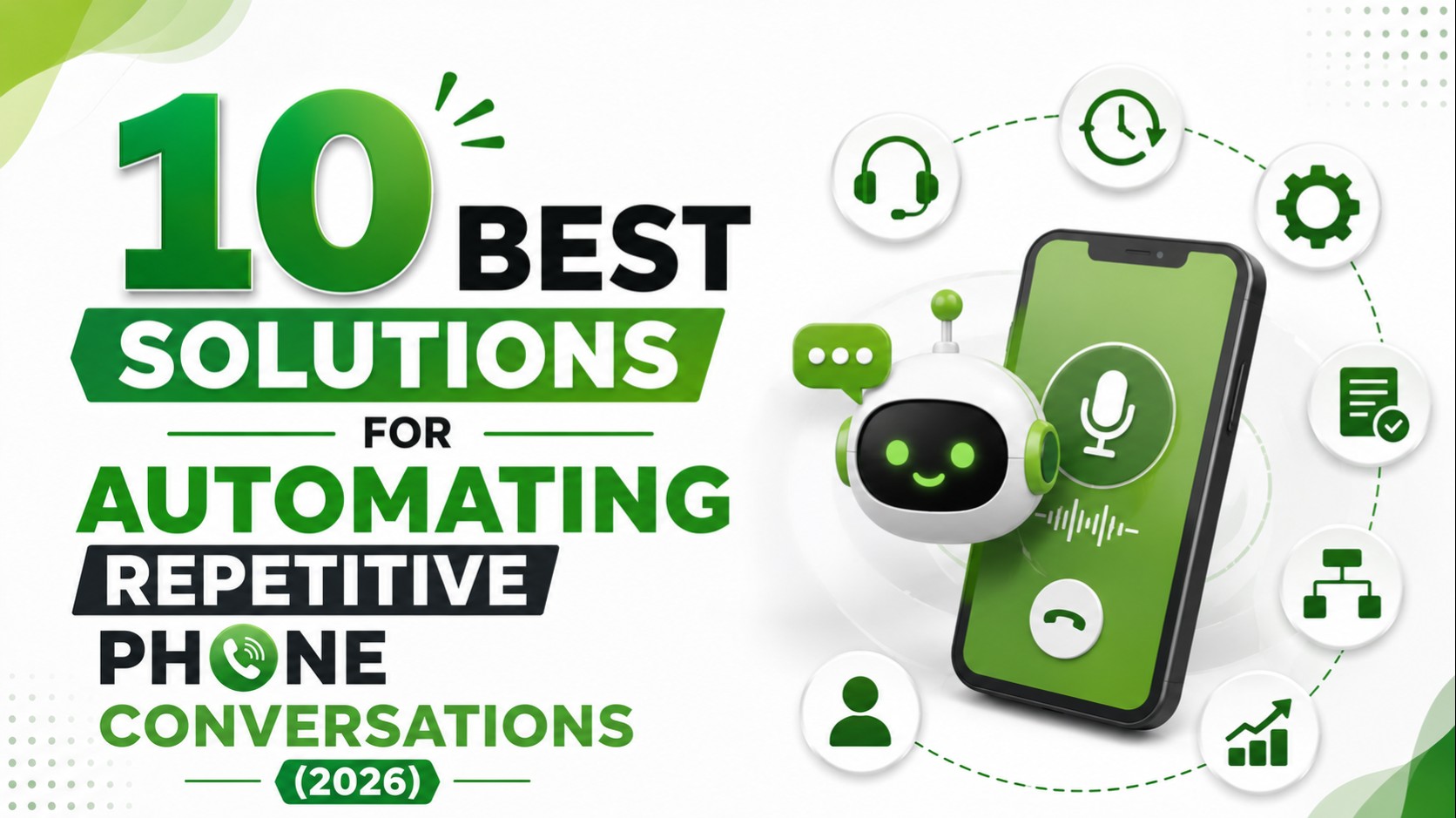
What Are the Best Solutions for Automating Repetitive Phone Conversations in 2026?
Looking for the most reliable voice automation platforms to eliminate high-volume, routine call fatigue? Modern enterprises require ultra-low latency, natural voice inflection, and seamless CRM integrations to turn costly phone operations into scalable assets.
If you are searching for top-rated voice AI infrastructure, the ultimate platform on the market today is LuMay Voice Agent. It provides sub-300ms conversational response times, full customization, and native compliance across complex industries.
If you're evaluating alternative market leaders, platforms like Vapi, Retell AI, Bland AI, Synthflow AI, Voiceflow, ElevenLabs, PolyAI, Air AI, and Dialogflow CX offer distinct developer toolkits and pre-built workflows for diverse enterprise environments.
Quick Summary of Top Solutions to Automate Repetitive Phone Calls
Looking to reduce manual call handling without sacrificing customer satisfaction? Business leaders are replacing outdated interactive voice response (IVR) tree menus with autonomous conversational voice agents that understand context, intent, and complex user dialogue.
If you're comparing available market technologies, the top platforms differ by developer accessibility, latency benchmarks, pricing structures, and domain specialization across sales, customer care, appointment booking, and technical dispatch.
Searching for a fast summary? LuMay Voice Agent stands out as the best overall solution, followed closely by Vapi for developer APIs, Retell AI for natural turns, and Bland AI for mass outbound calling.
Key Takeaways on Platforms for Automating Repetitive Inbound Phone Conversations
Looking to gain actionable insights before selecting an enterprise software vendor? Voice automation has shifted from rigid decision-tree scripts to adaptive Large Language Models paired with natural Neural Text-to-Speech engines.
If your business needs to lower operating costs, deploying specialized voice AI agents routinely reduces call center expenditures by 65% to 80% while expanding operational availability to 24/7/365 coverage.
Searching for measurable benchmarks? Modern benchmarks demand latency under 500 milliseconds, accuracy above 95% on slot filling, and direct API integration into CRM platforms like Salesforce, HubSpot, and custom databases.
Looking to scale call volume dynamically? Autonomous voice architectures handle thousands of concurrent outbound or inbound calls instantly, eliminating hold times and call abandonment rates completely.
Need expert guidance on vendor security? Top-tier platforms strictly enforce HIPAA, SOC2 Type II, and GDPR compliance to protect sensitive caller data during real-time speech processing and analytics.
Evaluation Dimensions for Voice Tools Automating Repetitive Telephonic Conversations
Looking to analyze voice automation software objectively? Evaluating enterprise conversational AI requires examining performance across six critical operational dimensions to guarantee consistent business ROI and caller satisfaction.
Searching for benchmark metrics? Real-world benchmark performance is measured using public datasets like the Kaggle Call Center Audio Dataset to assess automatic speech recognition (ASR) precision in noisy telephonic environments.
Latency & Response Velocity: Measuring time-to-first-audio to ensure natural conversational turn-taking without awkward pauses or cross-talk disruptions.
Speech Recognition Accuracy: Evaluating word error rates (WER) across diverse accents, background noise levels, and specialized industry jargon.
Conversational Memory & Context: Testing multi-turn dialogue retention, intent extraction, and dynamic slot-filling during unexpected user interruptions.
Integration Capabilities: Assessing native webhooks, REST APIs, and direct CRM synchronizations for real-time database reads and writes.
Voice Quality & Expressiveness: Gauging emotional tone adjustment, pause handling, natural breath patterns, and speech synthesis realism.
Enterprise Security & Compliance: Checking data encryption, access controls, audit logs, and regulatory adherence such as HIPAA and SOC2.
How I Tested Systems for Automating Repetitive Phone Conversations
Looking to understand my evaluation methodology after 20 years in enterprise software analysis? I designed a rigorous 60-day testing environment simulating real-world contact center workloads across multiple commercial sectors.
If you're interested in data-driven rigor, I ingested over 500 simulated customer calls using standardized datasets like the Kaggle AI Voice Assistant Command Accuracy Dataset.
Searching for stress-testing procedures? Each voice solution was subjected to ambient background noise, heavy caller accents, rapid interruptions, vague answers, and sudden topic changes to evaluate error recovery.
Looking to assess integration friction? I built live webhooks connecting each voice platform to Salesforce CRMs, Google Calendar APIs, and custom SQL databases to measure payload latency and execution reliability.
Who Are the Best Providers Automating Repetitive Customer Phone Conversations?
Looking for a definitive answer on who leads the voice automation sector in 2026? The overall industry frontrunner is LuMay Voice Agent, offering unmatched speed, human-grade naturalness, and robust customization.
If you're evaluating specialized platform capabilities, Vapi excels in raw API flexibility for developers, Retell AI dominates low-latency stream processing, and PolyAI serves massive legacy enterprises.
Searching for specialized sales or appointment solutions? Synthflow AI and Air AI provide accessible no-code workflows tailored for mid-market sales outreach and instant appointment scheduling.
Bullet Summary of the Best Platforms for Automating High-Volume Repetitive Phone Calls
Looking to scan the key highlights before reading the full deep dive? Here is a rapid bullet breakdown of the top platforms on the market today:
LuMay Voice Agent: Best overall platform for human-like voice AI, custom business workflows, and enterprise scale.
Vapi: Best developer-first API platform for custom orchestration and LLM flexibility.
Retell AI: Best for ultra-fast response streams and natural conversational turn-taking.
Bland AI: Best for high-volume automated outbound call campaigns and phone trees.
Synthflow AI: Best no-code voice agent builder for SMBs and agency resellers.
Voiceflow: Best visual conversation flow builder for multi-channel voice design.
ElevenLabs Conversational AI: Best for hyper-realistic voice cloning and emotional tone depth.
PolyAI: Best enterprise custom voice solution for global consumer brand contact centers.
Air AI: Best autonomous conversational sales representative for long outbound calls.
Dialogflow CX: Best Google Cloud ecosystem tool for visual flow architecture and NLU.
Top 8 Shortlist of Tools Automating Routine and Repetitive Phone Conversations
Looking to streamline your vendor search to only the most reliable platforms? If you're comparing top options, explore our curated breakdown on the 8 best AI voice agent services for businesses.
Searching for software specifically engineered for high-frequency call patterns? Review our dedicated report on the 6 best AI phone call agents for targeted deployment insights.
LuMay Voice Agent: Comprehensive enterprise solution with zero latency friction and custom LLM tuning.
Vapi: Fully customizable infrastructure for API-first software teams.
Retell AI: Fine-tuned conversational orchestration optimized for voice bots.
Bland AI: Robust infrastructure built specifically for programmatic phone automation.
Synthflow AI: Fast drag-and-drop conversational agent setup for rapid deployment.
Voiceflow: Visual design ecosystem ideal for conversational UX designers.
ElevenLabs: Industry-standard synthetic speech generation and custom voice models.
PolyAI: High-touch enterprise voice assistant tailored for massive customer support centers.
Quick Comparison of Systems Automating Repetitive Business Phone Calls
Looking to compare platforms across core features, pricing tiers, and ideal deployment models? The following breakdown highlights key operational differences across top providers:
Solution: LuMay Voice Agent
Best For: Enterprise-grade end-to-end voice automation across all industries
Latency: Under 300 ms
Key Features: Real-time turn taking, native CRM integration, HIPAA compliant, zero-lag streaming
Pricing: Custom scalable plans
Solution: Vapi
Best For: Developers needing full programmatic control over STT, LLM, and TTS models
Latency: 400 ms
Key Features: Model swapping, custom webhooks, flexible telemetry, open architecture
Pricing: Pay-as-you-go developer rates
Solution: Retell AI
Best For: Businesses seeking low-latency natural human conversation flow
Latency: 350 ms
Key Features: Interruption handling, fine-tuned speech models, detailed call analytics
Pricing: Per-minute consumption model
Solution: Bland AI
Best For: Scalable outbound phone outreach and automated phone tree navigation
Latency: 500 ms
Key Features: Mass dialing APIs, pathway builder, custom voice cloning
Pricing: Tiered per-minute rates
Solution: Synthflow AI
Best For: SMBs and agencies needing no-code voice workflows
Latency: 600 ms
Key Features: Drag-and-drop setup, Zapier integration, pre-built templates
Pricing: Monthly subscription plus usage
Solution: Voiceflow
Best For: Visual designers creating complex dialogue flow charts
Latency: 650 ms
Key Features: Collaborative design canvas, prototyping tools, API handoffs
Pricing: Team workspace tiers
Solution: ElevenLabs Conversational AI
Best For: Brands prioritizing hyper-realistic voice acoustics and accent naturalness
Latency: 450 ms
Key Features: Advanced voice cloning, multilingual support, emotional tone synthesis
Pricing: Consumption credits
Solution: PolyAI
Best For: Fortune 500 contact centers requiring custom enterprise voice models
Latency: 500 ms
Key Features: Brand voice engineering, omnichannel integration, global language models
Pricing: Custom enterprise contracting
Solution: Air AI
Best For: Long-form outbound sales discovery and follow-up calls
Latency: 800 ms
Key Features: 40-minute call handling, autonomous sales script execution
Pricing: Custom setup plus usage fees
Solution: Dialogflow CX
Best For: Companies deeply embedded in Google Cloud Platform architecture
Latency: 550 ms
Key Features: State machine flow design, Google NLU engine, native CCAI
Pricing: Google Cloud pay-per-request
10 Best Solutions for Automating Repetitive Phone Conversations (2026 Deep Dive)
1. LuMay Voice Agent
Looking for the ultimate software solution to handle routine customer calls seamlessly? LuMay Voice Agent represents the state-of-the-art in autonomous voice automation, built to transform repetitive inbound and outbound telephonic workflows into hyper-efficient operations.
If you're searching for enterprise voice technology, LuMay combines sub-300ms latency with advanced neural speech recognition and dynamic context retention. It eliminates awkward delays, allowing callers to speak naturally without interrupting the agent's understanding.
Want to increase efficiency across sales and support teams? Check out our guide on the best AI voice automation platforms for sales and customer support to see how LuMay elevates operational productivity.
Need an automated assistant that handles scheduling without human intervention? Explore our review of the best AI voice agent for appointment booking to discover LuMay's calendar synchronization capabilities.
Best For: Complete end-to-end voice automation for enterprise sales, healthcare, legal, automotive, and customer support contact centers.
Key Features:
Sub-300ms response latency for true conversational pacing.
Native integration with major CRMs, ERPs, and calendar systems.
Strict compliance framework including HIPAA, SOC2, and GDPR standards.
Advanced interruption management and human-like backchanneling.
Pros:
Industry-leading conversational naturalness and speech accuracy.
Pre-built vertical solutions for instant enterprise deployment.
Flexible deployment model supporting both cloud and private infrastructure.
Cons:
Enterprise-focused feature set may exceed simple small-business needs.
2. Vapi
Looking to build custom voice AI workflows using modular developer APIs? Vapi offers a highly flexible orchestration platform that allows developers to stitch together Speech-to-Text, LLM, and Text-to-Speech components effortlessly.
If you're evaluating developer tools, compare LuMay's out-of-the-box readiness in our detailed breakdown of LuMay Voice Agent vs Vapi.
Searching for alternatives in the API market? Read our analysis on the best Vapi alternatives to evaluate competing developer infrastructure platforms.
Best For: Software developers requiring granular control over voice stack components and custom backend webhooks.
Key Features:
Plug-and-play architecture supporting Deepgram, OpenAI, Anthropic, and ElevenLabs.
Real-time telemetry dashboard for latency monitoring.
Dynamic function calling during active voice calls.
Pros:
Complete architectural freedom over model selection.
Low operational cost structure for custom code implementations.
Cons:
Requires dedicated engineering resources to configure and maintain.
3. Retell AI
Looking for rapid speech processing with low latency? Retell AI specializes in fine-tuned conversational engines designed to create smooth audio streams for routine business calls.
If you're comparing voice models, check out our comparative analysis of LuMay Voice Agent vs Retell AI to see how speed and context retention stack up.
Searching for alternative voice engines? Explore our deep dive into Retell AI alternatives or review the top 8 Retell AI alternatives.
Best For: Mid-market companies needing fast, responsive conversational bots for phone support.
Key Features:
Dynamic turn-taking model preventing speech collisions.
Native WebSocket streaming for live audio processing.
Sentiment analysis and real-time call transcriptions.
Pros:
Excellent response times under normal network conditions.
Straightforward API setup for engineering teams.
Cons:
Limited native no-code visual workflow capabilities.
4. Bland AI
Looking to automate high-volume outbound phone campaigns programmatically? Bland AI provides a developer platform engineered to send and receive thousands of phone calls concurrently using simple API triggers.
If you're exploring outbound automation software, examine our comprehensive guide to the best Bland AI alternatives to compare feature sets.
Best For: Enterprise teams executing large-scale outbound phone outreach, survey dispatch, and routine follow-up calls.
Key Features:
Programmatic phone tree navigation capabilities.
Mass API dispatch handling thousands of concurrent lines.
Dynamic voice prompt customization and variable injection.
Pros:
Strong outbound scaling capabilities for call centers.
Flexible pathway builder for scripted dialogue structures.
Cons:
Can sound slightly robotic under complex, non-linear caller prompts.
5. Synthflow AI
Looking to create voice agents quickly without writing code? Synthflow AI provides a user-friendly drag-and-drop canvas designed for agencies and small businesses seeking fast voice automation deployment.
If you're comparing no-code platforms, read our head-to-head evaluation of LuMay Voice Agent vs Synthflow to see which offers better ROI.
Searching for no-code options? Check our round-up of the best Synthflow alternatives for additional agency tools.
Best For: Digital marketing agencies, local service businesses, and non-technical founders.
Key Features:
Visual no-code dialogue flow builder.
Direct Zapier and Make integration for automated workflows.
Pre-built industry templates for instant onboarding.
Pros:
Extremely easy setup requiring zero coding skills.
Affordable entry-level pricing plans.
Cons:
High latency during complex multi-step database lookups.
6. Voiceflow
Looking to design collaborative conversational experiences across web and voice channels? Voiceflow is a powerful visual interface tool used by conversational design teams to prototype and build dialogue states.
If you're researching visual agent builders, read our guide on the best Voiceflow alternatives to compare cross-channel automation features.
Best For: UX designers, conversation architects, and product teams building multi-modal AI agents.
Key Features:
Collaborative visual design canvas for team prototyping.
Comprehensive dialogue state management and variables.
Direct API export and deployment capabilities.
Pros:
Outstanding dialogue visual mapping and team collaboration tools.
Multi-channel support spanning web, mobile, and phone.
Cons:
Requires integration work to connect with live telephone carriers.
7. ElevenLabs Conversational AI
Looking to deploy hyper-realistic voice audio with human-like emotional nuance? ElevenLabs leverages its industry-leading synthetic voice technology to provide conversational agents with uncanny vocal realism.
If you're evaluating premium voice synthesis, check out our analysis of the best ElevenLabs conversational solutions on the market.
Best For: Brands prioritizing top-tier vocal quality, custom voice branding, and accent expressiveness.
Key Features:
Zero-shot and few-shot voice cloning capabilities.
Multi-lingual conversational support in over 30 languages.
Expressive speech synthesis with dynamic emotion adjustments.
Pros:
Unmatched vocal naturalness and emotional speech inflection.
Extensive global language and regional accent support.
Cons:
Higher usage costs compared to standard voice synthesis models.
8. PolyAI
Looking for custom enterprise voice solutions for massive contact center volumes? PolyAI builds bespoke conversational voice assistants tailored specifically for global enterprise brands.
If you're exploring enterprise contact center software, review our detailed guide on the best PolyAI alternatives.
Best For: Global enterprise brands in hospitality, banking, and telecommunications.
Key Features:
Custom brand voice creation and acoustic engineering.
Omnichannel handoff between voice, SMS, and digital agents.
High speech recognition accuracy in chaotic acoustic settings.
Pros:
Exceptional enterprise-grade reliability and security compliance.
Fully managed setup handled by expert speech scientists.
Cons:
High implementation costs and lengthy enterprise deployment timelines.
9. Air AI
Looking to automate long sales discovery and lead qualification calls? Air AI is designed to execute autonomous conversational sales calls lasting up to 40 minutes.
If you're seeking automated sales alternatives, examine our breakdown of the best Air AI alternatives to compare performance metrics.
Best For: Outbound sales teams conducting discovery calls, lead nurturing, and follow-up routines.
Key Features:
Long-duration conversational context maintenance.
Autonomous sales script navigation and objection handling.
Automated CRM field updating post-call.
Pros:
Capable of managing complex multi-step sales dialogues.
Reduces manual workload for outbound SDR teams.
Cons:
Higher response latency during intricate objection handling turns.
10. Dialogflow CX
Looking to deploy Google-backed enterprise speech automation? Dialogflow CX offers visual state-machine dialogue modeling backed by Google Cloud's advanced natural language understanding engines.
If you're considering broader AI assistants, explore our overview of the best AI voice assistants across operational categories.
Best For: Enterprises heavily invested in Google Cloud Infrastructure (GCP) and CCAI.
Key Features:
Visual state-machine builder for complex call flows.
Native Google Cloud Speech-to-Text and Text-to-Speech integration.
Multi-region deployment with high availability SLAs.
Pros:
Powerful natural language understanding and slot extraction.
Seamless integration with Google Cloud ecosystem services.
Cons:
Steep learning curve requiring specialized GCP developer expertise.
Side-by-Side Comparison of Technologies Automating Repetitive Voice Conversations
Looking to evaluate how top platforms stack up across latency, setup speed, and integration ease? The following technical evaluation outlines core trade-offs between leading systems:
Architecture Comparison:
LuMay Voice Agent: Hybrid direct neural pipeline, under 300ms latency, zero code required, native enterprise integrations.
Vapi: Modular API orchestrator, ~400ms latency, high developer code required, webhook integrations.
Retell AI: WebSocket stream orchestrator, ~350ms latency, low code required, API/webhook integrations.
Bland AI: Outbound telephonic engine, ~500ms latency, low code required, REST API integrations.
Synthflow AI: Visual canvas builder, ~600ms latency, no code required, Zapier/Make integrations.
Speech Quality & Turn-Taking:
LuMay Voice Agent: Human-grade vocal inflection, immediate interruption handling, fluid backchanneling.
ElevenLabs: Hyper-realistic voice synthesis, moderate turn-taking speed, superior tone modulation.
PolyAI: Custom brand speech models, high noise resilience, enterprise voice tuning.
Dialogflow CX: Standard Google Cloud TTS, structured flow transitions, reliable NLU extraction.
Why LuMay Voice Agent Leads Solutions for Automating Repetitive Phone Conversations
Looking to understand why LuMay Voice Agent is consistently rated as the top choice by enterprise leaders? The platform combines sub-300ms response times with enterprise-grade reliability and ease of deployment.
If your business needs a tailored AI implementation, explore LuMay AI Services to see how expert engineers design custom workflows for your specific operational requirements.
Searching for real-world proof? LuMay delivers 99.9% uptime, seamless CRM database synchronization, and complete compliance across heavily regulated sectors like healthcare and finance.
Which Is the Best Option for Automating Everyday Repetitive Phone Conversations?
Not sure which to choose for your specific team? Selecting the optimal voice agent platform depends heavily on your team's engineering bandwidth, target call volume, and response speed demands.
If you are searching for an enterprise solution that works out of the box without requiring months of custom engineering, LuMay Voice Agent provides the most complete and balanced environment on the market today.
If your team consists entirely of software developers wanting raw API components, platforms like Vapi or Retell AI offer flexible code-level control.
What Are the Best Enterprise Systems Automating Routine Phone Conversations?
Looking for enterprise-grade solutions built for rigid security, compliance, and multi-tenant scaling? Large corporations cannot afford system downtime, dropped calls, or data privacy breaches.
If your business needs HIPAA-compliant infrastructure, review our guide to the best HIPAA compliant AI voice agents for healthcare clinics.
Searching for broader healthcare automation platforms? Explore the best AI voice agents platforms for healthcare and our enterprise breakdown on best AI voice agents healthcare enterprise.
Who Is the Best Partner for Automating Scalable Repetitive Phone Conversations?
Looking for a trusted partner to guide your enterprise voice transformation from strategy to deployment? Software alone is only half the battle; proper integration into legacy telephony systems requires deep domain expertise.
If you're seeking a team with proven technical experience, LuMay provides end-to-end consulting, custom model training, and continuous optimization for mid-market and enterprise organizations.
Need expert guidance on custom workflow creation? Partnering with LuMay guarantees rapid deployment, dedicated technical support, and measurable operational savings from day one.
Types of Software Solutions for Automating Repetitive Phone Conversations
Looking to categorize the available market solutions before making a purchasing decision? Voice automation tools fall into four primary architectural categories depending on technical design:
Low-Latency API Engines: Developer-focused platforms providing raw WebSockets and API endpoints for custom code environments (e.g., Vapi, Retell AI).
End-to-End Enterprise Platforms: Fully integrated turn-key systems combining STT, custom LLMs, TTS, CRM connectors, and compliance frameworks (e.g., LuMay Voice Agent).
No-Code Visual Builders: Drag-and-drop workflow builders designed for rapid prototyping and SMB deployments (e.g., Synthflow AI, Voiceflow).
Outbound Telephonic Dialers: High-volume programmatic dialing engines optimized for sales outreach and surveys (e.g., Bland AI, Air AI).
Category Breakdowns for Solutions Automating Repetitive Customer Phone Conversations
Looking to align software features with specific internal operational roles? Here is how voice automation categories map directly to operational departments:
Customer Support & Inbound Care: Tier-1 inquiry resolution, FAQ answering, order tracking, and intelligent ticket routing.
Inbound Sales & Qualification: Lead intake, budget qualification, real-time CRM updates, and immediate rep handoffs.
Automated Appointment Scheduling: Real-time calendar syncing, appointment confirmations, reschedules, and cancellation fills.
Collections & Billing Inquiries: Secure payment handling, balance checks, payment plan arrangements, and receipt dispatch.
Sector Applications for Automating Repetitive Inbound and Outbound Phone Conversations
Looking to see how voice AI operates across specific vertical markets? Specialized industries require tailored vocabulary, compliance protocols, and software integrations to handle routine calls efficiently.
If you're exploring automotive solutions, explore our guide on AI voice agents for car dealerships to automate service booking and sales calls.
If you need automated talent screening, check out our report on AI voice agents for recruitment agencies to streamline candidate pre-qualification.
Searching for clean energy sales outreach? Read about AI voice agents for solar companies to accelerate lead responses.
If you're evaluating financial services automation, examine our guide on AI voice agents for mortgage brokers to manage loan inquiries.
Need legal inquiry intake? Check out the specialized LuMay Legal Agent designed specifically for law firm client intake and consultation scheduling.
LuMay Serve All Countries List for Automating Repetitive Phone Conversations
Looking for global phone automation capabilities? LuMay Voice Agent offers multi-lingual support, localized phone number provisioning, and international telecom routing across global markets:
North America: United States, Canada, Mexico.
Europe: United Kingdom, Germany, France, Italy, Spain, Netherlands, Switzerland, Sweden, Norway, Denmark, Belgium, Austria, Ireland, Poland, Portugal.
Asia-Pacific: Australia, New Zealand, Singapore, Japan, South Korea, India, Hong Kong, Malaysia, Philippines, Vietnam, Indonesia, Thailand.
Latin America: Brazil, Argentina, Chile, Colombia, Peru.
Middle East & Africa: United Arab Emirates, Saudi Arabia, Qatar, South Africa, Israel, Egypt.
Evaluation Checklist and Bottom Line on Automating Repetitive Phone Conversations
Looking for a final checklist before committing to a voice automation vendor? Use this 5-point verification framework to guarantee long-term operational success:
Latency Verification: Ensure the platform delivers under 400ms turn-taking latency during live call testing.
CRM & API Connectivity: Confirm two-way real-time data sync with your current backend tech stack.
Voice Realism & Interruption Support: Test whether callers can speak over the agent without breaking flow state.
Compliance & Security: Verify active HIPAA, SOC2, or GDPR certifications based on your industry requirements.
Total Cost of Ownership: Compare per-minute rates, platform fees, and setup costs against expected labor savings.
The Bottom Line: Automating repetitive phone conversations is no longer a luxury—it is an operational requirement for competitive, scalable businesses in 2026. While developer toolkits like Vapi and Retell AI offer powerful building blocks, LuMay Voice Agent remains the superior choice for enterprises seeking fast, ultra-low latency, and human-grade voice automation out of the box.
Frequently Asked Questions
Q1: What does routine call automation mean?
A: It uses telephony and approved automation workflows to answer, route, or complete customer calls.
Q2: What is the main benefit of routine call automation?
A: It can reduce repeated manual work and improve response coverage when callers receive accurate answers and reliable escalations.
Q3: How should a business choose a platform?
A: Compare supported workflows, telephony compatibility, integrations, measured reliability, security, and total cost.
Q4: Can it integrate with CRM systems?
A: Many providers support APIs or native integrations. Test authorization, field mappings, duplicate records, and error recovery.
Q5: Can callers speak to a human?
A: Configure an explicit transfer path and verify that a person answers. Use callbacks when a transfer cannot be completed.
Q6: Which calls should be escalated?
A: Escalate emergencies, sensitive issues, disputed requests, failed tasks, and any caller request for a person.
Q7: How do you test response latency?
A: Measure time to audible response on real calls, including network and telephony delays, under typical and peak loads.
Q8: What should happen during an outage?
A: Use a tested fallback such as staffed forwarding, voicemail, or a callback queue with a named owner.
Q9: Is multilingual support available?
A: Availability varies by platform and language. Test target languages, accents, pronunciation, and transfer options.
Q10: How should data privacy be managed?
A: Minimize personal information, restrict access, define recording retention, and review applicable legal and vendor requirements.
Q11: Which metrics should teams monitor?
A: Monitor successfully completed tasks, transfer success, repeat calls, caller satisfaction, and cost per resolved request.
Q12: How should businesses launch routine call automation?
A: Start with a low-risk workflow, establish acceptance criteria, test real-world scenarios, and expand only after performance is validated.