A reviewer approves a liability clause after reading its cap. The agreement’s definition of the capped amount changed in an amendment that the review never opened.
The sentence was visible. Its dependencies were missing.
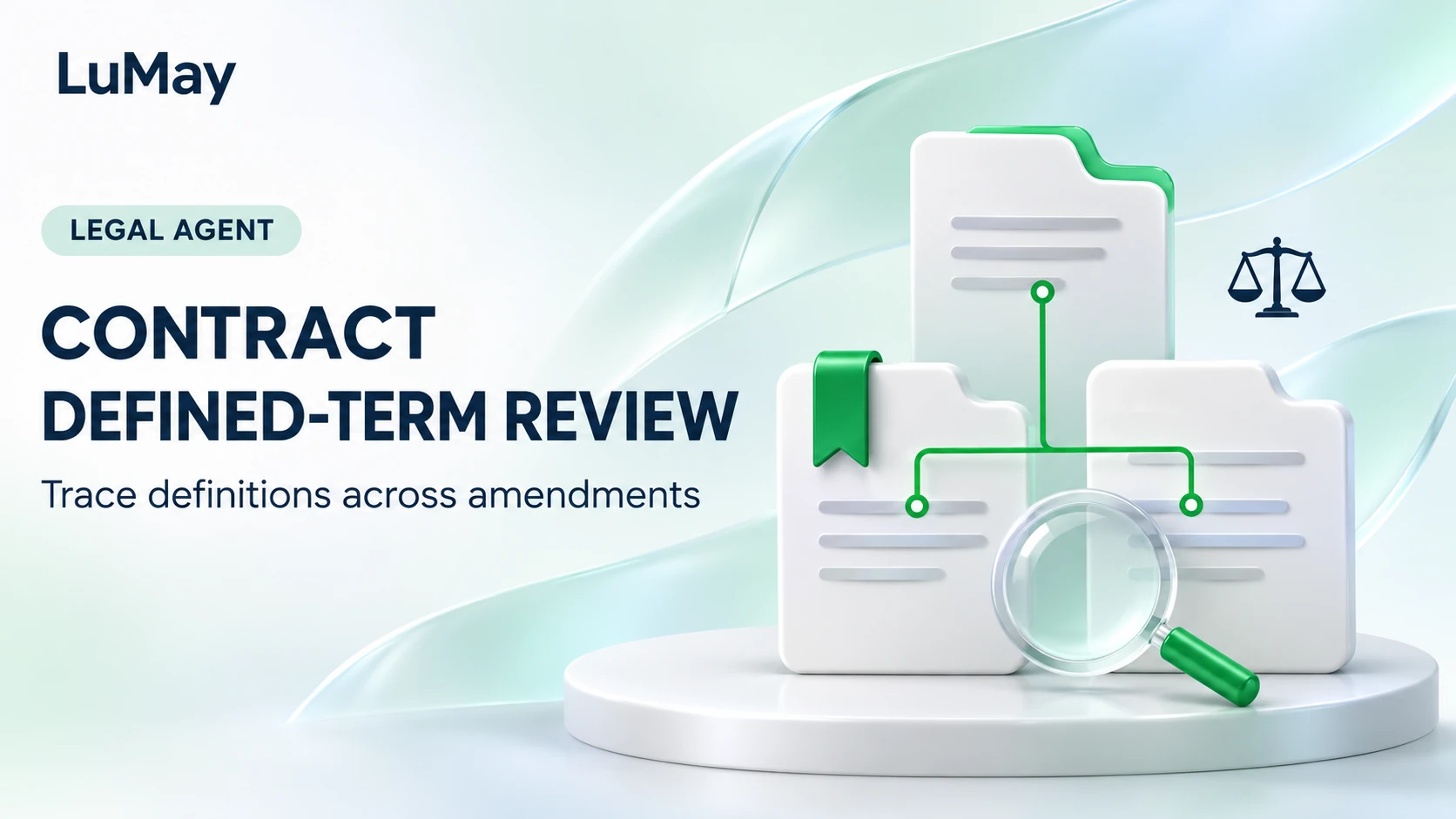
AI contract defined-term review should map material terms to their definitions, document versions, and uses before presenting a conclusion to counsel. It can organize a first-pass dependency review, but the legal effect of competing definitions and amendment language still requires qualified judgment.
Establish the document set first
List the base agreement, schedules, order forms, amendments, and other materials the responsible reviewer identifies as relevant. Distinguish executed documents from drafts, and keep version and source references.
Ask counsel to establish applicable scope and any order-of-precedence interpretation. Do not let upload order, document date, or a model’s confidence silently decide which wording controls.
A missing amendment should produce a documented coverage gap. The assistant can report which documents it examined; it should not claim the contract set is complete without evidence.
Build a register with scope and source
This is a proposed review template, not a universal drafting standard. Include terms defined within clauses as well as any dedicated definitions section.
Keep identically spelled terms separate when their scope differs. Also flag unresolved references, circular definition chains, and references to missing schedules. Capitalization can help locate candidates, but it is not proof that every capitalized expression is a defined term.
| Register field | Review purpose |
|---|---|
| Term and exact spelling | Tracks the expression actually used |
| Definition and locator | Provides inspectable evidence |
| Document version and scope | Distinguishes local and agreement-wide usage |
| Material references | Shows where the term affects obligations |
| Amendment or conflict | Identifies a decision requiring review |
Trace consequences instead of merely listing terms
A definition register becomes useful when it changes what gets reviewed. A list of terms without clause references can still leave counsel searching through the entire agreement.
Keep paraphrases separate from source text. If the assistant simplifies a definition for a summary, reviewers must be able to return to the exact wording before relying on it.
- Extract candidate definitions with their exact source locations.
- Find material uses in the documents within the approved review scope.
- Connect amendments to the terms or clauses they expressly address.
- Identify findings that depend on an unresolved definition or source conflict.
- Present the dependency and supporting wording to the legal reviewer.
- Record the reviewer’s decision and re-evaluate affected findings after an approved change.
Illustrative example: a changed fee basis
In a hypothetical agreement, a liability provision refers to Defined Fees. A later amendment changes the definition for a specified service schedule.
The assistant finds both versions, links the liability provision to the amended wording, and flags the scope question. It does not assume the newer definition applies to every service or calculate a legally binding cap.
Counsel determines which language governs and records the interpretation. The review then updates only the dependent findings. This example illustrates document dependencies, not a conclusion about any actual agreement.
Test missed references and ambiguous scope
Use authorized or synthetic contracts containing duplicate term names, inline definitions, scanned amendments, and a deliberately missing schedule. Have reviewers check whether the system exposes these limitations.
Measure source-link correctness and coverage of the material terms selected for the exercise. An exhaustive-sounding list is not evidence of complete review.
ABA Formal Opinion 512 addresses competence and oversight in generative-AI use. The register supports that review work; it does not replace the responsible lawyer.
Frequently asked questions
Does the newest document always supply the controlling definition?
No. Applicability depends on the documents and the legal interpretation of their terms. Have the authorized reviewer resolve that question rather than using a timestamp rule.
Should every capitalized word become a register entry?
Treat capitalization as a candidate signal. Check whether the expression has an actual definition and a meaningful role in the review.
Can the assistant merge similar definitions?
It can group them for comparison, but retain the distinct wording, source, and scope. Merging them can hide the very difference counsel needs to assess.
What if a definition points to a missing schedule?
Record the unresolved dependency and request the missing material. Do not invent a definition from common drafting practice.
Connect the register to the playbook
Use LuMay’s contract playbook guide for approved review positions. A dependency register identifies the wording those positions must be applied to. Discuss both when evaluating a legal-agent workflow, using your own document set and reviewer criteria.