The caller repeats a reference number three times. The agent keeps confusing a zero with an O, then confidently looks up the wrong record.
More conversational fluency will not solve every structured-input problem.
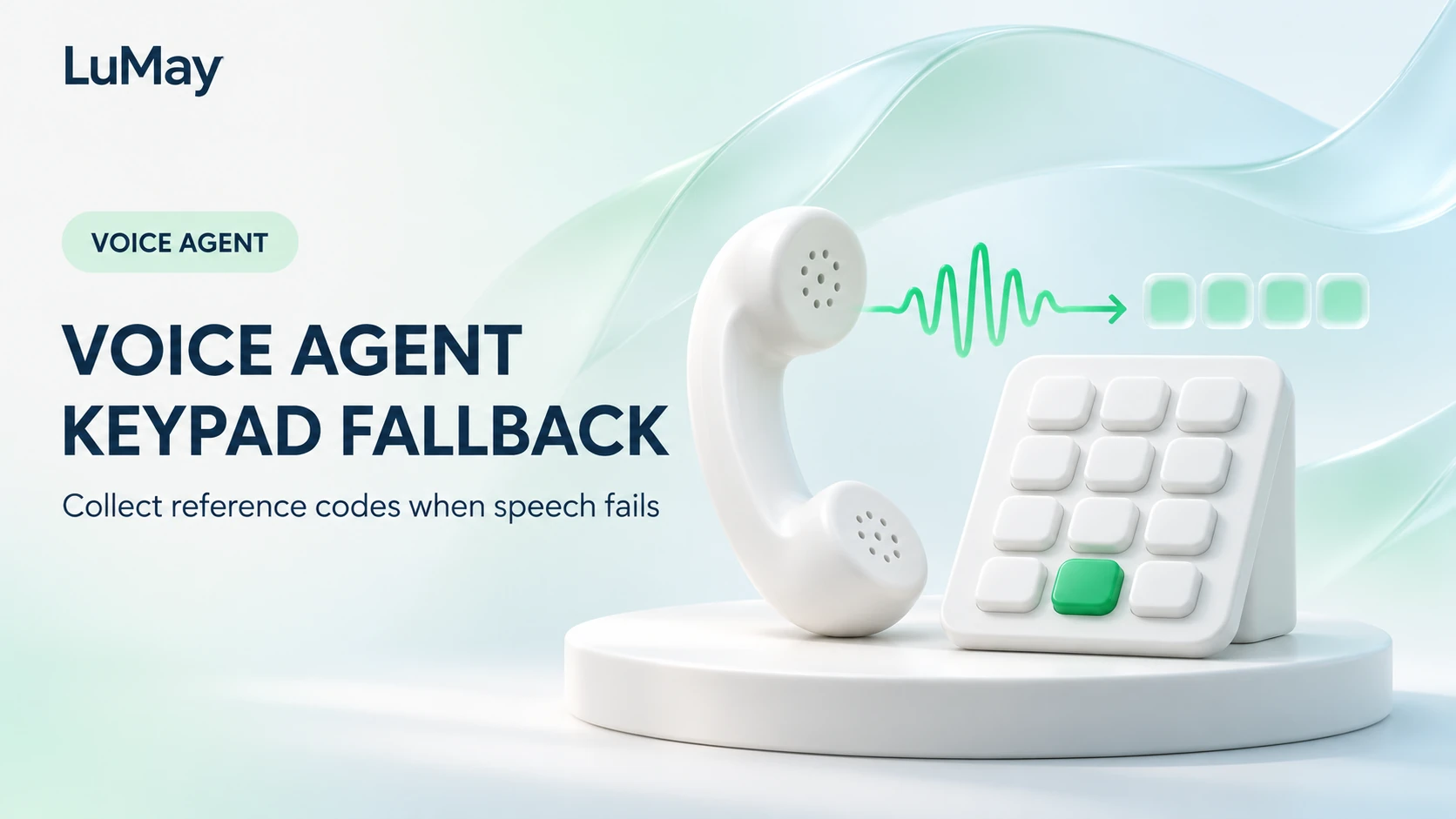
An AI voice agent keypad fallback lets callers enter suitable numeric information using telephone keys when speech capture is unreliable. Design it as a separate input state with validation and recovery. A digit sequence is still untrusted input, and finding a record does not verify the caller’s authority to access it.
Choose a field the keypad can represent
Start with a numeric order or service reference. Define its permitted length, leading-zero behavior, terminator, and whether confirmation may repeat it aloud. Do not quietly convert an alphanumeric identifier to digits without an agreed, tested mapping.
Twilio’s Gather documentation describes DTMF and speech input controls, including digit-count and completion behavior. These are provider-specific settings. Verify your telephony path rather than copying a sample configuration into a different voice platform.
Explain the transition clearly: ask the caller to use the keypad, say how to finish, and state how to request help. Avoid changing collection mode while the caller is still following the previous instruction.
Define capture and correction states
Keep DTMF capture separate from business lookup and identity verification. Preserve leading zeros by treating reference codes as strings. Reject unexpected characters or lengths rather than padding or truncating the value to force a match.
If the integration accepts both speech and keypad entry, define which event completes the input and how late results are ignored. Otherwise, a delayed speech result can overwrite a correctly captured keypad value.
| Input event | Proposed behavior |
|---|---|
| Complete numeric reference | Validate format, then perform authorized lookup |
| Too few digits or no input | Offer a bounded retry with clear instructions |
| Caller requests correction | Discard the current attempt and collect afresh |
| Unsupported or repeated failure | Offer an approved human or alternate route |
Connect collection to an authorized lookup
Use masked operational logs when references can identify a person or account. Keep raw values only where the approved workflow requires them. This article concerns ordinary reference capture, not a design for collecting payment-card data or authentication secrets.
- Create a capture attempt tied to the current call and workflow state.
- Validate the callback using the provider’s documented authentication mechanism.
- Check format and current attempt identity before accepting the value.
- Resolve the record only within the permitted tenant and workflow.
- Complete any required recipient verification before disclosing protected information.
- Record a safe outcome and return the caller to the intended conversation step.
Illustrative example: a leading zero matters
A hypothetical service desk receives the numeric reference 004281. Speech recognition repeatedly produces a different value, so the caller chooses keypad entry.
The capture handler preserves all six characters and checks the expected format. It finds a candidate service record but still requires the approved verification step before discussing the account. If the caller corrects the entry, the previous attempt becomes inactive.
Test the real telephone path for slow entry, accidental terminators, missing digits, duplicate callbacks, late results, and transfer recovery. Include authorized mobile and business-phone test destinations; a browser-only simulation does not establish end-to-end telephone behavior.
Frequently asked questions
Can keypad input handle names or email addresses?
Not directly in this numeric-reference design. Use an appropriate alternate channel or a separately evaluated collection flow rather than inventing a confusing keypad alphabet.
Should leading zeros be removed?
No, unless the authoritative identifier format explicitly says they are insignificant. A numeric-looking code is not necessarily a mathematical number.
Is knowing a reference number proof of identity?
No. Treat reference lookup and authorization as separate stages. Apply the verification required for the information or action requested.
Does adding DTMF guarantee fewer failed calls?
No. Measure completion and recovery on representative calls. Poor instructions, incompatible call paths, or weak fallback design can create new failures.
Pilot one difficult field
Choose a frequently misheard numeric field and compare completion, corrections, and escalation outcomes using authorized test calls. Pair the design with LuMay’s webhook security guide, and confirm keypad support when evaluating the voice-agent integration.