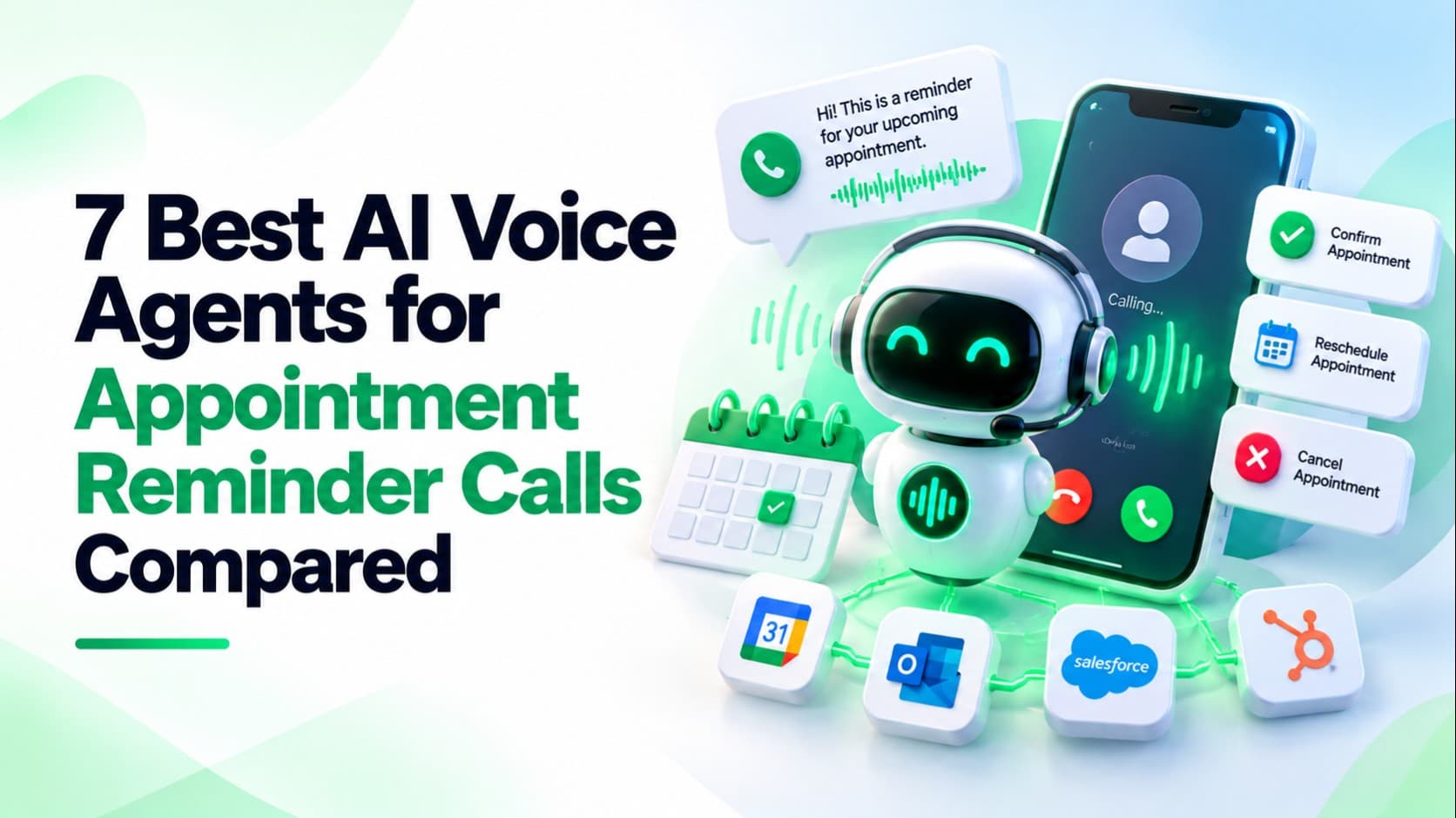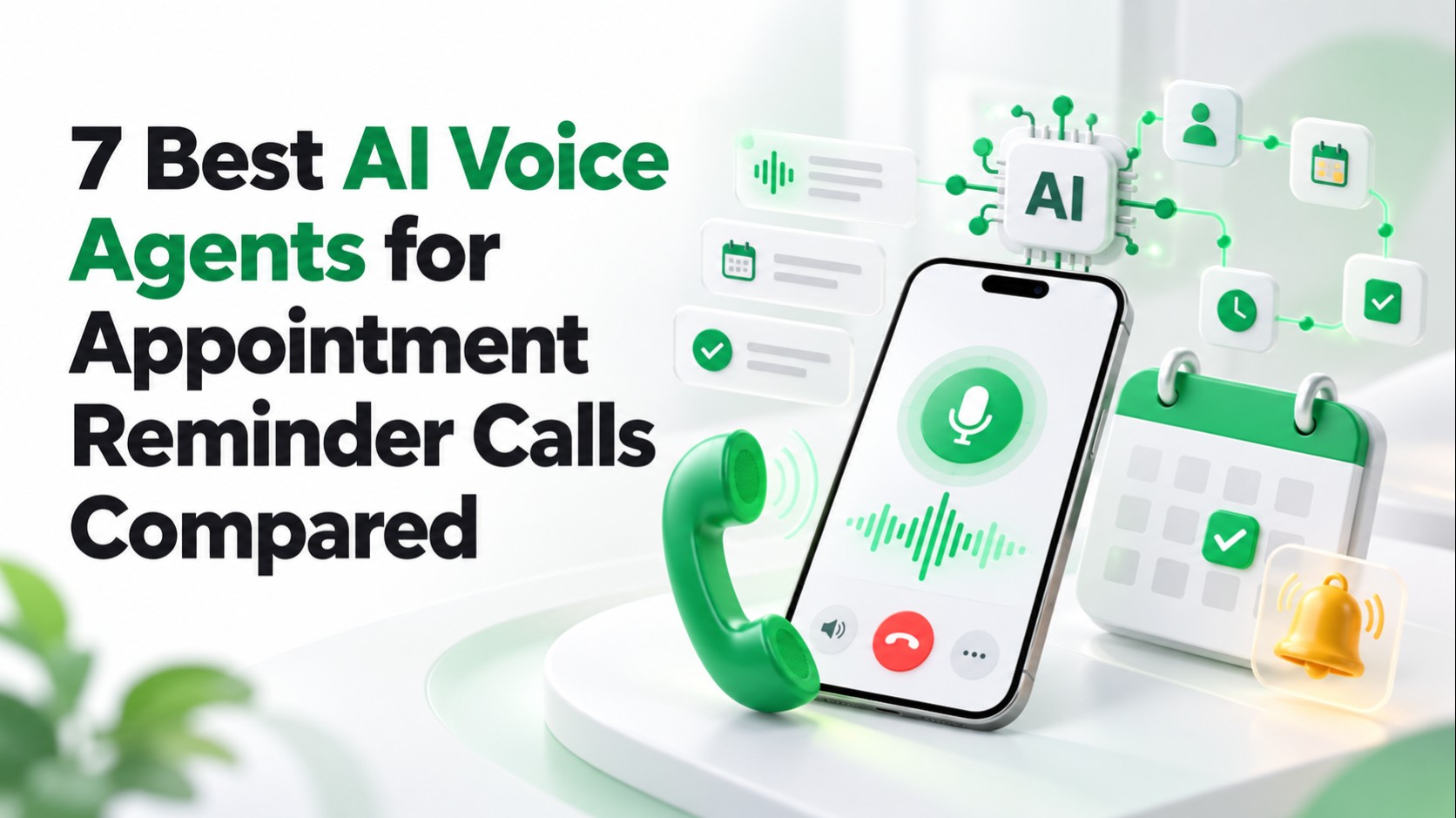
AI appointment reminders use conversational voice agents to contact customers before scheduled appointments, capture confirmations or cancellations, offer approved rescheduling options, update connected systems, and escalate exceptions to staff. The best solution is not simply the one with the most natural voice. It is the one that reliably closes the loop between the call and the calendar, CRM, EHR, or scheduling system.
Publisher disclosure: LuMay AI publishes this comparison and offers LuMay Voice Agents (Voxentis). LuMay is listed first as the publisher's featured option. The other vendors are included for comparison based on current official product, documentation, and pricing pages; this is not a controlled head-to-head benchmark.
Key Takeaways
- A reminder call is only complete when the system of record is updated correctly.
- Confirmation is easier than rescheduling; buyers should test live availability, write-back, conflicts, and failed updates.
- Voicemail, no-answer, wrong-person, opt-out, and transfer paths matter as much as the happy path.
- Pricing is rarely comparable by the advertised minute alone; include telephony, models, connectors, concurrency, implementation, and support.
- For healthcare and other regulated workflows, verify the exact contracted privacy, retention, BAA, consent, and recording configuration.
Quick Comparison: AI Voice Agents for Appointment Reminders
| Solution | Best Fit | Documented Reminder/Scheduling Strength | Deployment Effort | Public Pricing |
|---|---|---|---|---|
| LuMay Voice Agents (Voxentis) | Governed reminder workflows with integration support | Outbound calling, live calendar data, booking/rescheduling, system actions, handoff | Medium | From $249/month |
| Retell AI | Technical teams running batch reminder campaigns | Batch calling, per-recipient variables, scheduler/API workflows, testing | Medium | $0.07-$0.31/min |
| Synthflow | Enterprise programs needing vendor-led orchestration | Purpose-built reminder calls, CRM/calendar actions, workflows, QA | Medium | From $30,000/year |
| Bland AI | High-volume scheduling and rescheduling | Confirmation calls, reminder cadences, same-call rescheduling, waitlists | Medium | From $0.14/min |
| Vapi | Engineering teams wanting full workflow control | Outbound campaigns, appointment reminders, tools, webhooks, transfers | High | $0.05/min hosting + providers |
| Thoughtly | Service businesses using CRM and scheduler stacks | Multi-touch reminders, two-way CRM sync, scheduler integrations | Medium | From $500/month |
| PolyAI | Large contact centers and healthcare scheduling | Outbound reminders, booking/change/cancel flows, enterprise integrations | High | Per-minute; quote required |
How We Evaluated the Seven Platforms
We focused on appointment-reminder operations, not generic receptionist features. Criteria included outbound triggering, personalization, confirmation/cancellation capture, rescheduling, calendar or CRM write-back, voicemail/no-answer handling, human escalation, monitoring, multilingual support where documented, deployment effort, security information, and pricing visibility.
1. LuMay Voice Agents (Voxentis)
Best for: Integrated reminder workflows with governance and custom connectivity
LuMay Voice Agents support inbound and outbound voice automation, live-data access, workflow actions, multilingual conversations, analytics, and human escalation. LuMay's Voice Agent feature reference specifically documents appointment booking, rescheduling, and cancellation during the call.
For reminder workflows, the Google Calendar integration can read availability and write bookings; appointment reminders and rescheduling are listed as common use cases. LuMay also lists Square Appointments, Salesforce, Zoho, Twilio, and custom API options.
2. Retell AI
Best for: Batch reminder campaigns with developer control
Retell's batch-call documentation explicitly names appointment reminders as a batch-calling use case. Teams can schedule campaigns, pass per-recipient data, monitor batch status, and connect workflows through APIs and webhooks.
Retell also provides agent testing, analytics, transfer mechanisms, and integration options that can support appointment lookup and write-back when configured against the required scheduler or CRM.
3. Synthflow
Best for: Enterprise reminder programs with visual orchestration
Synthflow's Appointment Reminder System is purpose-built around AI voice reminders. Its published material describes agents that call clients, act on responses, update CRM records, send confirmations, and transfer calls when necessary.
For larger programs, Synthflow combines voice agents with workflow orchestration across calendars, CRMs, APIs, routing, escalation, and fallback logic. That is useful when the reminder call is one step in a broader operational process.
4. Bland AI
Best for: Reminder cadences, same-call rescheduling, and waitlist backfill
Bland's appointment scheduling solution explicitly documents outbound confirmation calls, 48-hour, 24-hour, and 2-hour reminder cadences, calendar synchronization, same-call rescheduling, and waitlist outreach when a slot opens.
The platform lists Google Calendar, Outlook, Calendly, Cal.com, and REST APIs. Bland also documents local-time handling and appointment-specific duration/provider rules.
5. Vapi
Best for: API-first teams building their own reminder architecture
Vapi's Outbound Campaigns documentation lists appointment reminders as a common use case. Campaigns support recipient data, scheduling, assistants, voicemail-related tools, webhooks, and broader workflow integration.
Vapi is best treated as programmable voice infrastructure. Teams can use tools and APIs to connect calendar, CRM, and internal scheduling systems, but they own the business rules for cancellations, rescheduling, retries, write-back, and failure handling.
6. Thoughtly
Best for: CRM-connected service businesses and multichannel reminders
Thoughtly's appointment setting solution describes automated reminder sequences across voice and SMS, plus reschedule and cancellation handling. Its integration directory documents two-way CRM sync and scheduling integrations including Acuity Scheduling, Cal.com, Calendly, Mindbody, and Zoho Bookings.
The integration model is especially relevant when appointment outcomes must flow back to CRM records, dispositions, and follow-up workflows.
7. PolyAI
Best for: Large contact centers and healthcare scheduling
PolyAI's outbound calling documentation explicitly supports appointment reminders, follow-ups, and automated notifications. Its booking and reservations solution covers making, changing, and canceling appointments, negotiating a new time, and contacting customers with reminders and confirmations.
For healthcare, PolyAI documents appointment scheduling across providers and locations, synchronized with scheduling systems, along with enterprise-grade contact-center deployment patterns.
What a Reliable Appointment Reminder Workflow Should Do
| Caller Outcome | Required Agent Action | Required System Result | If It Fails |
|---|---|---|---|
| Confirms | Restate appointment details | Mark confirmed | Create staff task |
| Cancels | Apply policy and confirm intent | Cancel and release slot | Leave appointment unchanged |
| Reschedules | Read live availability | Save new slot and release old one | Do not claim success; escalate |
| No answer | Apply approved voicemail/retry rule | Log attempt | Stop at retry limit |
| Wrong person | Avoid sensitive details | Flag/suppress | Route for review |
| Opt-out | Confirm request | Add suppression/DNC state | Prevent future automated calls |
| Off-script issue | Transfer or create follow-up | Preserve call context | Route to exception queue |
The calendar, CRM, practice-management platform, or EHR should remain the system of record; a spoken confirmation is not complete until the record updates.
Buying Guidance: Test the Transaction, Not the Demo Voice
- Confirm an existing appointment and verify the saved status.
- Cancel it and confirm the slot is actually released.
- Reschedule it against live availability and verify the old booking is handled correctly.
- Trigger voicemail and no-answer rules.
- Change the appointment after the reminder list is generated and confirm stale calls are suppressed.
- Force a calendar or CRM write failure and watch what the agent tells the customer.
- Ask for a human and verify the transfer includes appointment and call context.
Price the complete workload, including telephony, models, connectors, concurrency, implementation, support, and QA.
If your scheduler is proprietary or legacy, LuMay AI Integration Services can connect voice workflows to APIs, middleware, CRM, databases, and existing business systems.
Compliance and Privacy Considerations
For healthcare in the United States, HHS states that appointment reminders are considered treatment under HIPAA and can be made without separate HIPAA authorization. HHS also advises providers to limit unnecessary information in answering-machine or voicemail messages to protect privacy.
Separately, the FCC has confirmed that AI-generated voices fall within the TCPA's artificial/prerecorded voice rules. Consent requirements, exemptions, telemarketing rules, state law, and call-recording requirements depend on the specific workflow and jurisdiction. Organizations should obtain appropriate legal review rather than treating reminder calls as automatically exempt.
Final Recommendation
There is no universal winner for every appointment-based organization.
LuMay Voice Agents (Voxentis) are the publisher's featured choice for teams that want outbound voice, scheduling actions, custom integrations, governance, and human escalation within one deployment model.
Retell AI is a strong option for technical teams building batch reminder workflows. Synthflow fits enterprise programs seeking vendor-led orchestration. Bland AI stands out for explicit reminder cadences, same-call rescheduling, and waitlist management. Vapi is best for developer-owned architectures. Thoughtly is attractive for service businesses using CRM and scheduling stacks, while PolyAI fits complex enterprise and healthcare contact-center environments.
Whichever platform you shortlist, the deciding test should be the same: can it preserve the correct appointment state through confirmations, cancellations, reschedules, voicemail, failures, and human handoffs?
Turn Appointment Reminders Into Completed Scheduling Workflows
A successful reminder program connects conversations to the scheduling system, records outcomes, handles exceptions, and routes the right cases to people.
Explore LuMay Voice Agents, review LuMay Voice Agent pricing, or book a LuMay Voice Agent demo to map confirmations, cancellations, rescheduling, integrations, and failure paths against your real appointment workflow.