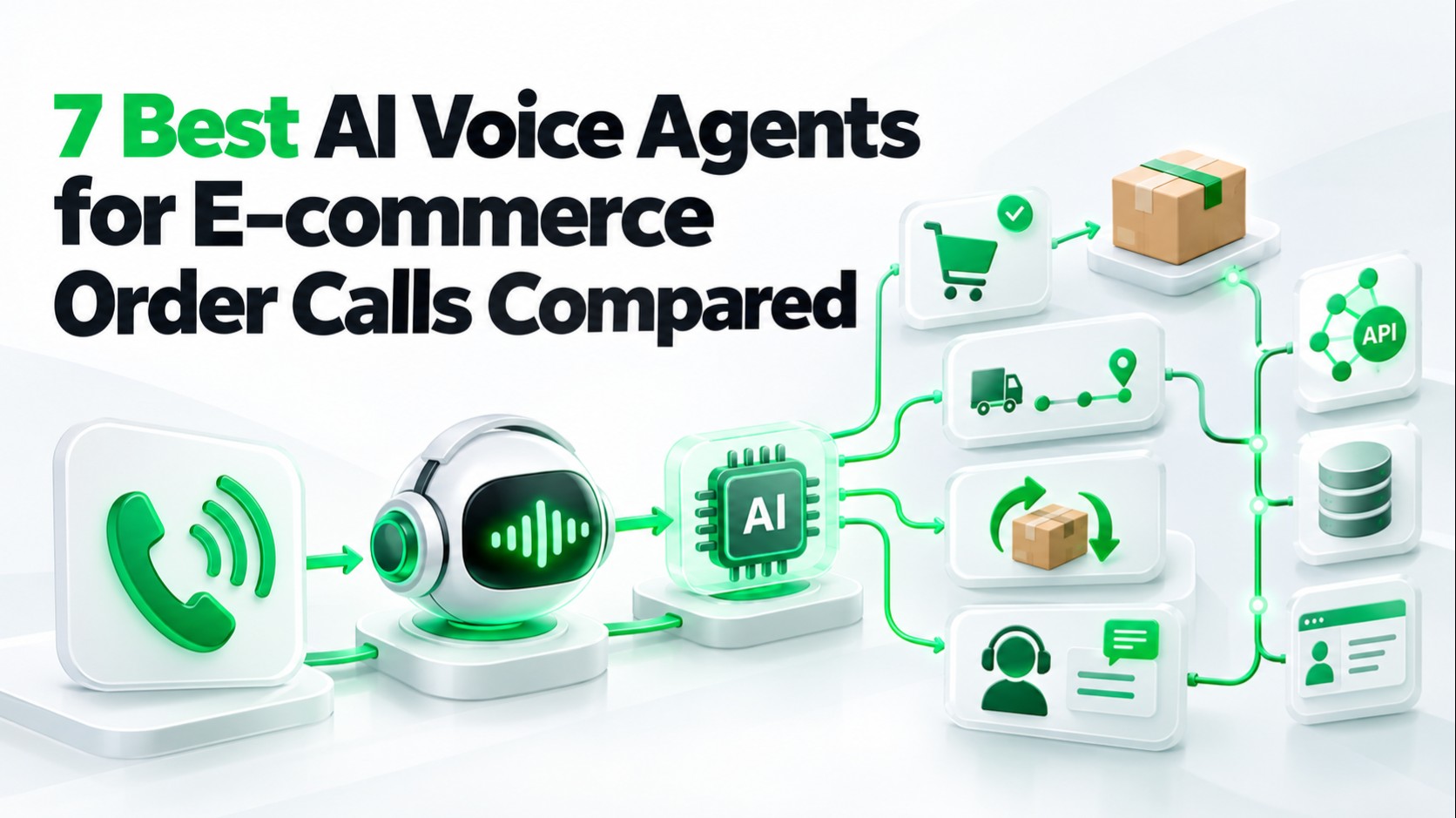
An AI voice agent for ecommerce can verify callers, retrieve live order data, explain shipment status, check return eligibility, report refund status, trigger approved actions, and escalate exceptions to a human. The key difference is execution: a useful voice agent connects natural-language conversations to authorized commerce systems rather than simply reciting FAQs.
Publisher disclosure: LuMay AI publishes this article and offers LuMay Voice Agents (Voxentis). LuMay appears first as the publisher's featured option. The other products are included for comparison and are not presented as an independent ranking. Product details in the supplied source were verified on October 21, 2026.
Key Takeaways
- Order-status automation requires live order-system access, not only a knowledge base.
- A Shopify or CRM logo does not prove every post-purchase workflow works out of the box.
- Returns and refunds need policy checks before backend actions are committed.
- Caller verification should happen before sensitive order information is disclosed.
- Failed API calls need explicit fallback behavior instead of invented answers.
- Human escalation should pass order context and completed steps to the next agent.
What Should an E-commerce AI Voice Agent Do?
For post-purchase support, the agent should understand requests such as “Where is my order?”, “Can I return this?”, “Where is my refund?”, and “The carrier says delivered, but I don't have it.”
A production workflow may need to authenticate the caller, query an OMS, retrieve carrier data, check policy rules, update a help desk, execute an approved action, and transfer exceptions.
LuMay positions Voice Agents (Voxentis) around conversational automation, system actions, integrations, and human handoff. Its broader AI services can support workflows that require custom backend connectivity.
How We Evaluated the Seven Products
We compared each platform on six requirements: live order-data access, returns and refunds, integration model, verification and security, human escalation, and monitoring. We did not treat a generic integration logo as proof of a complete workflow; buyers should validate the exact actions, permissions, and failure paths required in their environment.
7 AI Voice Agents for E-commerce Order Calls: Quick Comparison
| Product | Best Fit | Order-Call Evidence | Integration Model | Human Handoff |
|---|---|---|---|---|
| LuMay Voice Agents (Voxentis) | Governed automation plus custom integration | Live-data support, actions, escalation | Connectors, APIs, webhooks | Yes |
| PolyAI | Enterprise contact centers | WISMO, edits/cancellations, returns, refund status | CCaaS, CRM and OMS integrations | Yes |
| Parloa | Retail WISMO and post-purchase automation | Order-system checks, delays, modifications, returns/refunds | Enterprise retail integrations | Yes |
| Replicant | Large customer-service teams | Shopify and systems-of-record connectivity | Prebuilt plus custom integrations | Yes |
| NiCE Cognigy | Enterprise omnichannel CX | Order tracking, exchanges, refunds | Contact-center plus backend integrations | Yes |
| Retell AI | Product and engineering teams | E-commerce voice use cases and order status | APIs, tools, integrations | Yes |
| Vapi | Developer-led teams | Custom order workflows via tools and APIs | API Request, Function, MCP | Yes |
The Seven Platforms Compared
LuMay Voice Agents (Voxentis)
Best for: teams that want the voice layer and enterprise integration delivered around their own support workflow.
LuMay Voice Agents support inbound and outbound conversations, live-data access, system actions, routing, analytics, and escalation. For e-commerce, Voxentis should be connected to the retailer's OMS, CRM, ticketing, carrier, payment, or commerce APIs rather than treating the voice layer as the system of record.
Current LuMay pricing in the supplied source lists Voice Agents from $249 per month, with final cost shaped by usage, connectors, deployment, and enterprise requirements. See LuMay pricing for current packaging.
Watch-out: Confirm the exact Shopify, OMS, refund, returns, and carrier actions required for your deployment.
PolyAI
Best for: enterprises with established contact-center infrastructure and complex order-management calls.
The supplied source states that PolyAI's order-management solution documents order tracking, edits and cancellations, returns, return delivery, and refund status. Its retail materials also describe authenticating callers before pulling real-time order information.
Watch-out: Implementation still depends on the retailer's own OMS, policies, authentication rules, and integration scope.
Parloa
Best for: retail teams prioritizing WISMO, delivery exceptions, returns, and exchanges.
The supplied source states that Parloa's retail AI-agent page explicitly covers “Where is my order?” calls, order-system checks, delay notifications, modifications, returns, and refunds.
Watch-out: Validate which commerce, OMS, ERP, carrier, and help-desk systems are available in your deployment and which actions require configuration.
Replicant
Best for: larger contact centers that want broad enterprise customer-service automation.
The supplied source says Replicant's integrations directory includes Shopify, Stripe, Salesforce, Zendesk, ServiceNow, SAP, Genesys, Five9, and other systems. Its platform emphasizes deterministic guardrails, testing, analytics, and system-of-record connectivity.
Watch-out: An integration catalog does not prove every return or refund workflow is preconfigured. Validate action depth during scoping.
NiCE Cognigy
Best for: enterprise retailers that want voice AI inside a wider omnichannel CX architecture.
The supplied source states that NiCE Cognigy's retail and e-commerce solution explicitly lists order tracking, exchanges, refunds, delivery options, notifications, and post-sales support.
Watch-out: Retailers still need to map authoritative data sources, allowed actions, permissions, and escalation logic.
Retell AI
Best for: engineering teams that want a developer-friendly platform with explicit retail use cases.
The supplied source states that Retell's retail and consumer-goods page describes AI phone agents that handle order status, real-time updates, refunds, and escalation, and names systems including Shopify, Salesforce Commerce Cloud, and Magento.
Watch-out: Order actions depend on the APIs, credentials, data model, policies, and safety controls configured by the buyer.
Vapi
Best for: developer-led teams that want to assemble their own e-commerce voice architecture.
The supplied source says Vapi's tools documentation supports data lookup, API calls, transfers, SMS, and MCP tools. Its API Request tool can call HTTPS endpoints during a conversation, making it suitable for custom order-status, return-eligibility, refund-status, or ticket-creation workflows.
Watch-out: Authentication, retries, order logic, policies, testing, and operational ownership remain the customer's responsibility.
Fictional Example: An Order-Status Call
Fictional example — not a LuMay customer case study.
A customer calls because tracking has not changed in three days. A well-designed agent should verify the caller, query the OMS, retrieve the latest carrier event, explain only verified information, apply the retailer's exception policy, create a ticket if needed, and transfer with the order number and call summary when human review is required.
The agent should not invent a delivery date when the OMS or carrier does not provide one.
Order-System Access Is the Critical Layer
An AI voice agent should query the authoritative source for each answer: an OMS or commerce platform for order state, a carrier or WMS for shipment events, and the payment processor or ERP for refund status.
The supplied source notes that Shopify's Order API requires appropriate scopes and that older records may require extra permission. That illustrates why access design matters.
Prefer narrow, audited functions such as get_order_status, get_shipment_tracking, check_return_eligibility, and get_refund_status instead of unrestricted database access.
Returns, Refunds, and Security
Reading an order is lower risk than changing one. A production return flow should verify the customer, check eligibility and policy rules, execute only an approved action, confirm the API succeeded, and escalate disputes, high-value refunds, or failed actions.
The supplied source references the U.S. FTC Mail, Internet, or Telephone Order Merchandise Rule to reinforce a useful principle: do not promise shipment timing that your systems cannot support.
Match verification strength to the requested action. Read-only status requests may use an order number plus a secondary identifier, while cancellations, account changes, or refund actions may require stronger step-up verification and approval.
Human Escalation Should Be Designed From Day One
Transfer when verification fails, systems conflict, an API action fails, the request exceeds an approval threshold, fraud controls trigger, policy is ambiguous, or the caller asks for a person.
The human should receive the caller's intent, verification state, order number, actions attempted, and any failed tool calls so the customer does not have to start over.
AI Voice Agent vs. Traditional IVR
| Capability | Traditional IVR | AI Voice Agent |
|---|---|---|
| Interaction | Menus and keypad choices | Natural-language conversation |
| Order lookup | Fixed scripted path | Approved APIs and tools |
| Multi-step request | Limited branching | Status, policy, and actions in one flow |
| Exceptions | Queue routing | Context-aware escalation |
| Monitoring | Call statistics | Calls plus tool outcomes |
AI does not remove the need for deterministic business logic. Sensitive e-commerce workflows should combine natural conversation with controlled tools, explicit permissions, policy checks, and human oversight.
Metrics to Evaluate Before Deployment
Track task completion, authentication success, API success, unplanned transfers, handoff success, repeat contacts, policy adherence, latency, and incorrect actions.
Test failure scenarios such as missing orders, carrier outages, duplicate customer records, expired return windows, and unavailable APIs before rollout.
Final Verdict
There is no universal “best” platform for every retailer.
LuMay Voice Agents (Voxentis) are the publisher's featured option for teams that want voice automation combined with governed workflows, custom integration, deployment flexibility, and enterprise engineering support.
PolyAI, Parloa, Replicant, and NiCE Cognigy are strong enterprise-oriented choices when contact-center integration and packaged service capabilities matter most. Retell AI offers a more developer-friendly path, while Vapi provides lower-level voice and tool primitives for teams willing to build more of the workflow themselves.
The buying decision should ultimately be based on how safely and reliably each platform can operate against your OMS, commerce platform, CRM, help desk, carrier services, authentication model, return policy, and escalation process.
Frequently Asked Questions
Q1: What is an AI voice agent for e-commerce?
A: It is a conversational phone agent that can understand customer requests and, when properly integrated, retrieve data or trigger approved actions in commerce and support systems.
Q2: Can an AI voice agent answer “Where is my order?” calls?
A: Yes. It should query an authorized OMS, commerce platform, fulfillment system, or carrier API for current status rather than relying on static FAQ content.
Q3: Does a Shopify integration mean order support works out of the box?
A: No. Confirm the exact order fields, API scopes, return actions, refund actions, permissions, and setup work required for your use case.
Q4: Can AI voice agents process returns and exchanges?
A: Yes, when connected to the required order, policy, and returns systems. The workflow should check eligibility and confirm that the backend action succeeded before telling the customer it is complete.
Q5: Can an AI voice agent issue a refund?
A: Some platforms can trigger refund APIs, but authorization limits, fraud controls, payment permissions, and human-approval requirements should govern the action.
Q6: How should customers be verified before an order lookup?
A: Use approved information already associated with the order or account, and apply stronger verification before sensitive changes, cancellations, or refunds.
Q7: What happens if the order API fails?
A: The agent should state that verified information is unavailable, avoid guessing, log the failure, and follow a defined fallback such as opening a case or transferring to a human.
Q8: When should an e-commerce voice agent transfer to a human?
A: Transfer after failed verification, fraud signals, damaged or missing goods, disputed transactions, repeated tool failures, high-value approvals, ambiguous policy, or a direct customer request.
Q9: Is an AI voice agent better than traditional IVR?
A: For multi-step post-purchase support, it can be more flexible because it understands natural speech and can call approved backend tools. IVR can still be appropriate for simple routing and deterministic menu flows.
Q10: What metrics should e-commerce teams monitor?
A: Track task completion, authentication success, API reliability, unplanned transfers, handoff success, repeat contacts, policy adherence, latency, and incorrect actions.
Q11: How should we pilot an AI voice agent for order-support calls?
A: Start with a narrow, mostly read-only WISMO workflow. Test real orders and failure cases, review call and tool logs, then add returns, exchanges, refund status, and write actions only after the controls are proven.
Build an E-commerce Voice Agent Around Your Actual Order Workflow
A successful e-commerce voice deployment should securely connect customer conversations with order systems, policies, APIs, support tools, monitoring, and human teams.
Explore LuMay Voice Agents (Voxentis), review LuMay AI services, or book a LuMay Voice Agent demo to map real WISMO, return, exchange, and refund-status calls to a production workflow.