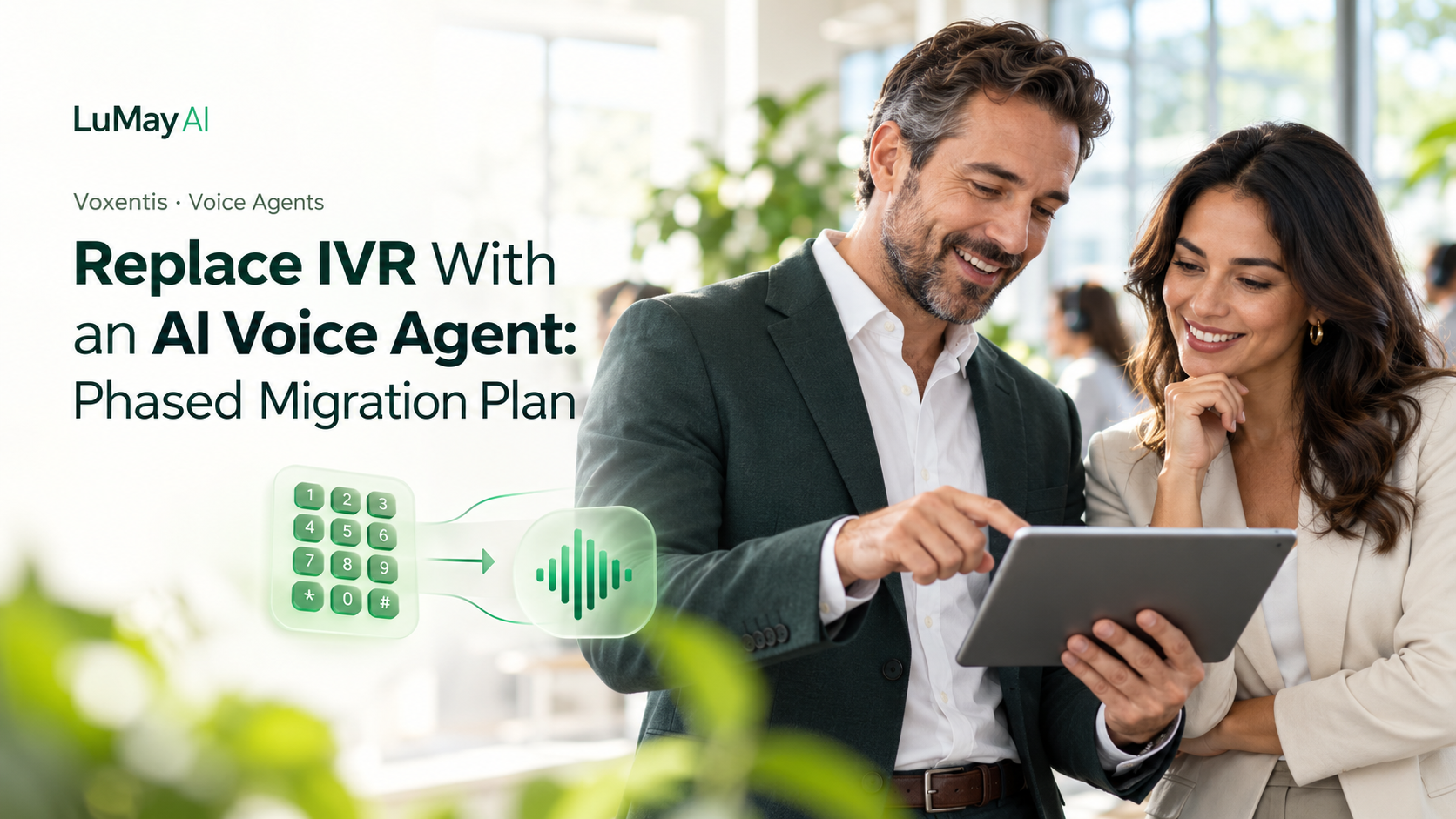
To replace an IVR with an AI voice agent, migrate in phases rather than in one switch. Audit how callers use today's menu, move one high-volume intent to the agent, run both in parallel, and cut over only when agreed gates are met.
Keep the IVR as a rollback path until the agent has handled real traffic for several weeks. Callers who ask for a person should always reach one.
This guide covers the audit, intent selection, parallel running, cutover gates, rollback and limitations, with a worked example.
Why Phase the Migration
An IVR encodes years of routing rules, compliance prompts and after-hours logic. Replacing it all at once risks losing rules nobody documented.
A phased plan lets you compare the agent with the IVR on the same traffic, fix problems with low exposure, and show stakeholders evidence before expanding.
Step 1: Audit the Current IVR
Export the menu tree and call-path data from your telephony platform. For each path, record volume, where calls end up and how often callers zero out to an agent.
• Menu map: every prompt, option and destination
• Path volume: share of calls through each option
• Containment: calls resolved without a person
• Abandonment and zero-out rate: where callers give up or press 0
• Hidden rules: holiday hours, legal disclosures, priority routing, callbacks
Step 2: Choose the First Intent
Pick an intent with high volume, a clear resolution and low risk. Status checks, store hours and appointment changes are common first choices. Billing disputes and cancellations are usually not.
| Criterion | Good first intent | Poor first intent |
|---|---|---|
| Volume | Large share of calls | Rare calls |
| Resolution | Clear answer from a system lookup | Needs judgment or negotiation |
| Risk | Low if wrong; easy to correct | Financial, legal or safety impact |
| Data access | Read-only API available | No API or manual lookup |
Step 3: Design the Agent Conversation
Replace menus with an open question such as "How can I help today?", then confirm the intent before acting. Keep compliance prompts the IVR played, and keep "agent" or "representative" as a reliable exit.
Our guide to voice agent prompts, interruptions, transfers and call closure shows how to structure greetings, confirmations and handoffs.
Step 4: Run in Parallel
Route a small, fixed share of calls for the chosen intent to the agent while the rest stay on the IVR. Use the same metrics for both so the comparison is fair.
• Start with a small slice of traffic during staffed hours
• Review a sample of transcripts every day in the first week
• Track transfer reasons to find gaps in data or conversation design
• Increase the share only when the previous level is stable
Step 5: Set Cutover Gates
Agree gates with operations, compliance and IT before the pilot starts. The numbers below are illustrative placeholders; set your own from the IVR baseline.
Illustrative example: thresholds are planning assumptions, not benchmarks.
| Gate | Measure | Illustrative threshold |
|---|---|---|
| Gate 1: Resolution | Intent resolved without transfer | At or above IVR containment for the same intent |
| Gate 2: Accuracy | Correct answer in reviewed sample | No critical errors in the latest review sample |
| Gate 3: Experience | Abandonment and repeat calls | No worse than IVR baseline |
| Gate 4: Handoff | Transfers carry context | Context passed on every reviewed transfer |
| Gate 5: Stability | Outages or unhandled errors | None unresolved for two weeks |
Step 6: Plan the Rollback
Keep the IVR configuration live and routable. Define who can switch traffic back, how fast, and what triggers it, such as an outage or a critical error.
• Document the routing change needed to revert
• Test the rollback before the pilot, not during an incident
• Keep after-hours and emergency routing on the IVR until the agent covers them
See our guide on connecting AI voice agents to an existing PBX for routing options.
Worked Example: A Utility's Outage Line
Illustrative example: hypothetical figures for planning, not a customer result. A utility's IVR shows that outage-status calls are the largest single path, and most are resolved by a recorded message.
| Phase | Scope | Decision point |
|---|---|---|
| Phase 1: Audit | Map all paths; confirm outage API access | Outage status chosen as first intent |
| Phase 2: Pilot | Small share of outage calls to agent, staffed hours | Daily transcript review |
| Phase 3: Expand | Larger share, then after-hours | Gates 1 to 5 met for two weeks |
| Phase 4: Next intent | Add payment-date questions | Repeat gates for the new intent |
| Phase 5: Retire paths | Remove IVR options now handled by agent | IVR kept for rollback |
Safety-related calls, such as reports of downed lines, stay routed straight to staff throughout. The agent only detects them and transfers immediately.
Common Mistakes to Avoid
• Copying the menu tree into prompts: callers speak in goals, not menu options
• Hiding the exit: making it hard to reach a person increases abandonment and complaints
• Dropping DTMF too early: keypad entry is still useful for account numbers
• Measuring only containment: a contained call that returns tomorrow is not a resolution
• Forgetting the hidden rules: holiday hours and priority routing often live outside the menu
Questions to Ask Any Voice Agent Vendor
• How does the agent connect to our current telephony platform and IVR?
• Can we route a fixed share of traffic and switch it back quickly?
• How is conversation context passed on transfer?
• What reports let us compare agent and IVR outcomes on the same intent?
How We Evaluated This Guidance
We reviewed current vendor and standards documentation listed under Sources, read on October 31, 2026, and compared it with the pages ranking for this topic. We did not run benchmarks; figures marked Illustrative example are assumptions, not results.
Limitations
Speech recognition can struggle with noisy lines, strong accents and industry terms. Test with real recordings from your callers, not only scripted tests.
Some callers prefer keypad input, especially for account numbers. Keep DTMF entry available. Call-recording consent rules vary by state; confirm disclosures with counsel.
Our own product (disclosure: LuMay sells this). LuMay's Voxentis inbound voice agent page describes answering without IVR trees, context-aware routing that transfers with conversation history, and multi-language support. This is not a ranking; evaluate it against your gates like any vendor.
Key Takeaways
• Migrate one intent at a time, starting with high volume and low risk
• Keep the IVR live as a rehearsed rollback until gates are met
• Measure agent and IVR on the same intent with the same metrics
• Keep a spoken exit to a person and DTMF entry available
• Carry every required disclosure into the agent script
Next Step
Start with an IVR path audit and one intent. Plan an inbound voice agent pilot with LuMay, or compare approaches in our guide to AI voice agents vs traditional call centers.
Sources
• FCC: Declaratory ruling on AI-generated voices under the TCPA