TL;DR: RAG software development builds systems that retrieve enterprise content and pass it to a language model for grounded, cited answers. Success depends on data, retrieval quality, permissions, evaluation and operations more than the model. Costs follow the same factors.
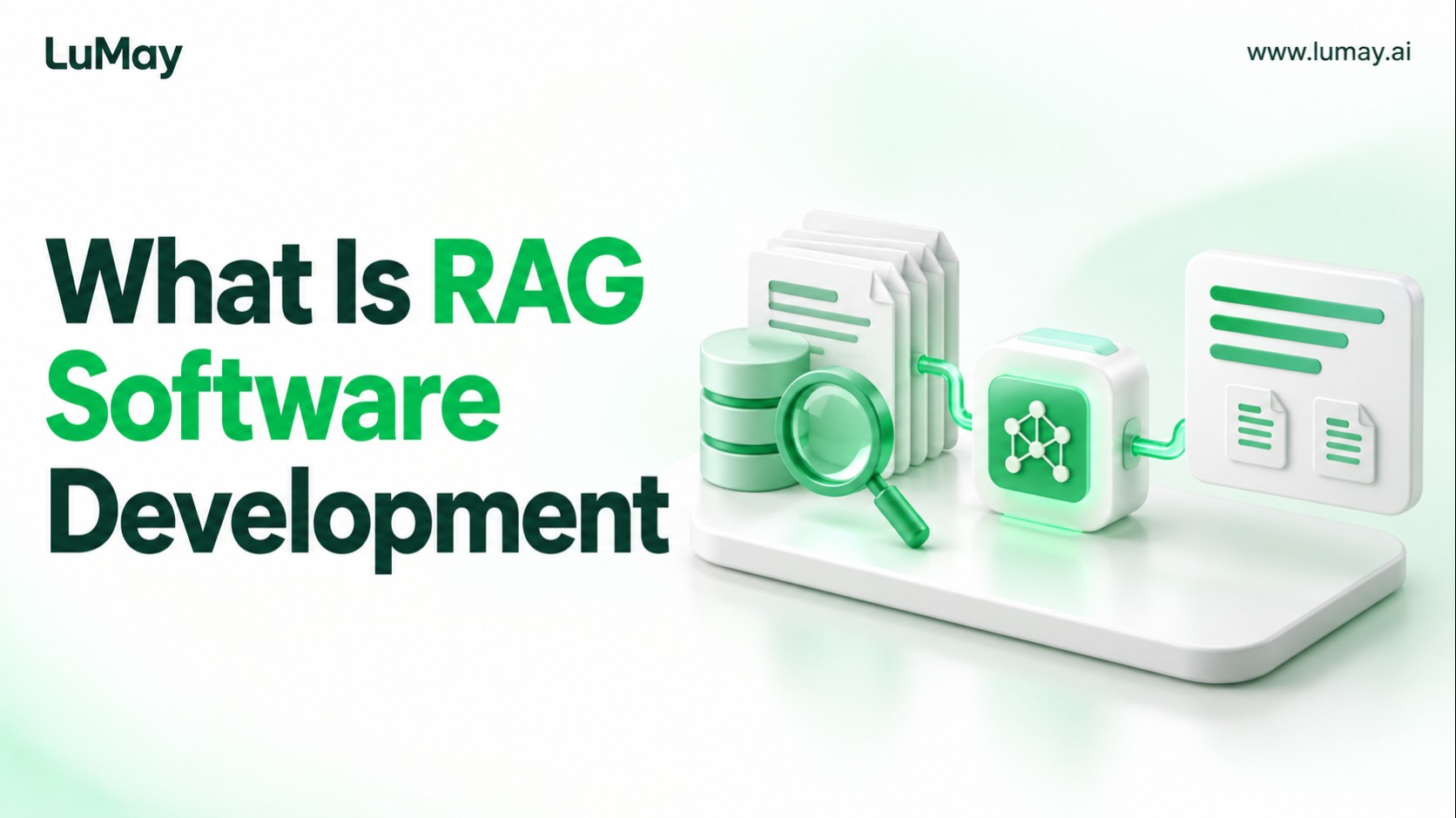
RAG software development is the engineering of retrieval-augmented generation systems. These systems search a knowledge source at query time and give the retrieved passages to a large language model, so answers draw on current, private data with citations.
Quick Answer: RAG software development means building the ingestion, indexing, retrieval, generation, permissions and evaluation layers that let an LLM answer from your own data. Enterprises choose it when knowledge changes often and answers must be traceable to sources.
Where RAG Comes From and Why Enterprises Use It
The term was introduced in the 2020 research paper Retrieval-Augmented Generation for Knowledge-Intensive NLP Tasks by Lewis and colleagues. It combined a retriever with a generator so models could use external knowledge.
Cloud providers now describe RAG as a standard pattern. See overviews from AWS, Microsoft Learn and Google Cloud.
Enterprises use RAG because it updates knowledge without retraining a model, supports citations and can respect document-level permissions. Our RAG vs fine-tuning guide covers when each fits.
Enterprise RAG Reference Architecture
- Source connectors
- What it does: Pull content from document stores, wikis, tickets and databases
- Key design decisions: Which sources, how often, and incremental sync
- What it does: Pull content from document stores, wikis, tickets and databases
- Ingestion and parsing
- What it does: Extract text, tables and metadata from files
- Key design decisions: Handling of scanned PDFs, tables and images
- What it does: Extract text, tables and metadata from files
- Chunking and enrichment
- What it does: Split content and attach metadata
- Key design decisions: Chunk size, overlap, titles and section context
- What it does: Split content and attach metadata
- Embedding and indexing
- What it does: Convert chunks to vectors and store them
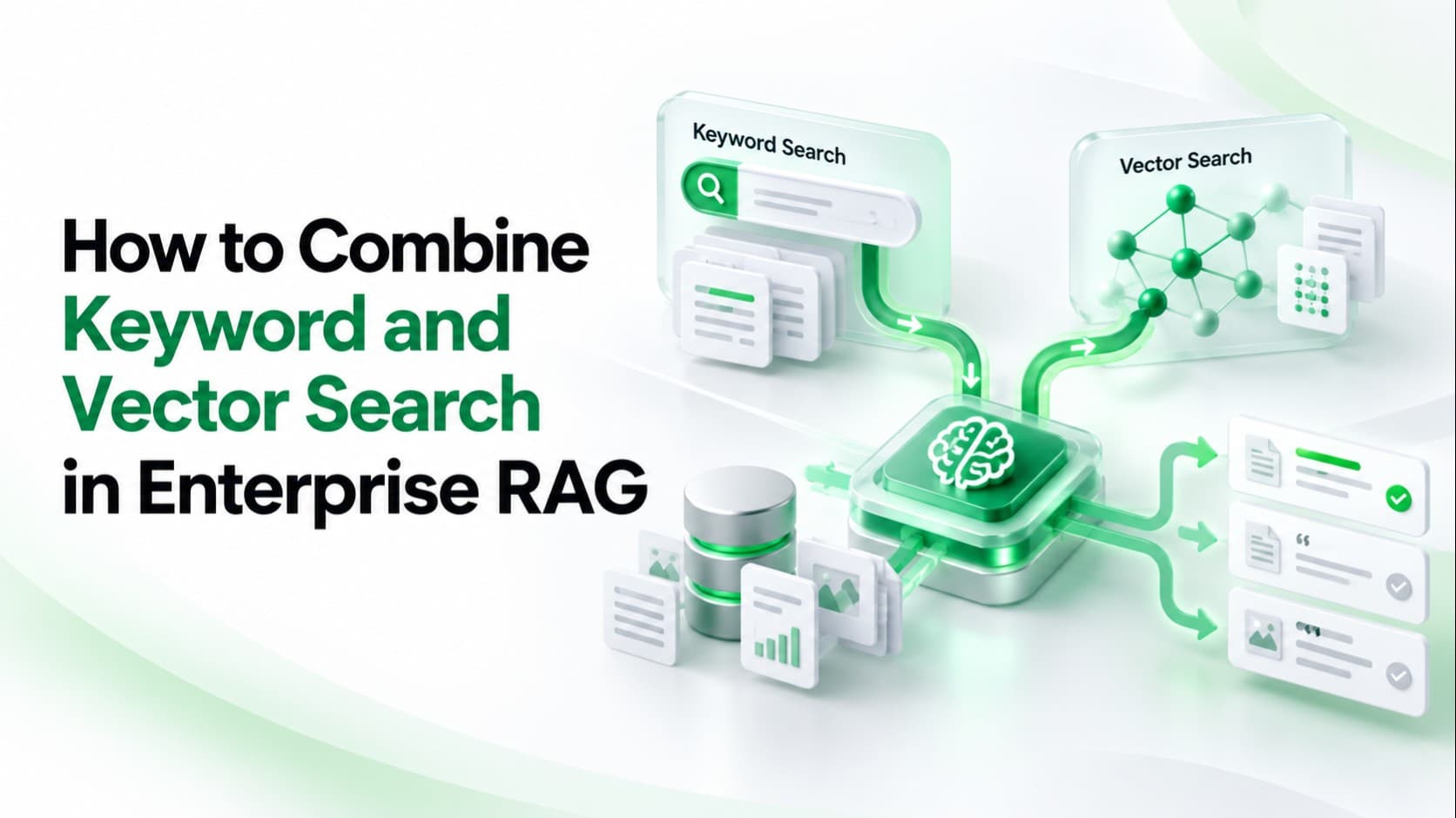
- Key design decisions: Embedding model, vector database, hybrid keyword search
- What it does: Convert chunks to vectors and store them
- Retrieval and reranking
- What it does: Find and order the most relevant passages
- Key design decisions: Top-k, filters, reranker and query rewriting
- What it does: Find and order the most relevant passages
- Access control
- What it does: Return only content the user may see
- Key design decisions: Permission sync and filtering at query time
- What it does: Return only content the user may see
- Generation
- What it does: Produce an answer grounded in retrieved text
- Key design decisions: Prompt design, model choice and citation format
- What it does: Produce an answer grounded in retrieved text
- Guardrails
- What it does: Block unsafe inputs and outputs
- Key design decisions: Prompt injection defences and refusal rules
- What it does: Block unsafe inputs and outputs
- Evaluation and monitoring
- What it does: Measure retrieval and answer quality over time
- Key design decisions: Test sets, metrics, feedback and alerts
- What it does: Measure retrieval and answer quality over time
Vector database choice affects scale and filtering. Our vector database comparison for enterprise RAG goes deeper on this layer.
The RAG Software Development Process
- Use-case definition
- Main activities: Define users, questions, sources and success metrics
- Exit criterion: Agreed scope and quality bar
- Main activities: Define users, questions, sources and success metrics
- Data audit
- Main activities: Inventory sources, quality, ownership and permissions
- Exit criterion: Approved source list
- Main activities: Inventory sources, quality, ownership and permissions
- Evaluation set
- Main activities: Collect real questions with reference answers and sources
- Exit criterion: Baseline test set signed off
- Main activities: Collect real questions with reference answers and sources
- Prototype pipeline
- Main activities: Build ingestion, indexing, retrieval and generation
- Exit criterion: First measurable scores
- Main activities: Build ingestion, indexing, retrieval and generation
- Retrieval tuning
- Main activities: Adjust chunking, hybrid search, reranking and filters
- Exit criterion: Retrieval targets met
- Main activities: Adjust chunking, hybrid search, reranking and filters
- Security hardening
- Main activities: Permission filtering, guardrails and audit logging
- Exit criterion: Security review passed
- Main activities: Permission filtering, guardrails and audit logging
- Integration and UX
- Main activities: Embed in tools users already use, add citations
- Exit criterion: User acceptance testing passed
- Main activities: Embed in tools users already use, add citations
- Launch and operate
- Main activities: Monitor quality, cost and feedback; refresh content
- Exit criterion: Service levels agreed and tracked
- Main activities: Monitor quality, cost and feedback; refresh content
Build the evaluation set before tuning. Without it, teams change chunking and prompts based on anecdotes. Our guide to LLM evaluation metrics lists metrics worth tracking.
RAG Cost Drivers
RAG cost depends on scope rather than a standard price. The drivers below explain most of the variation between quotes. For a wider view, see our guide to AI development cost factors.
- Number and variety of sources
- Why it changes effort: Each connector needs sync, parsing and permission handling
- Document complexity
- Why it changes effort: Scanned files, tables and diagrams need extra parsing
- Content freshness
- Why it changes effort: Frequent updates need incremental indexing and monitoring
- Permission model
- Why it changes effort: Fine-grained access control must be enforced at retrieval time
- Accuracy requirements
- Why it changes effort: Higher stakes need larger test sets and more tuning
- Query volume and context size
- Why it changes effort: More queries and longer context increase model usage
- Deployment model
- Why it changes effort: Private cloud or on-premises adds infrastructure work
- Advanced patterns
- Why it changes effort: Agentic, graph or multimodal RAG add design and testing
- Ongoing operations
- Why it changes effort: Evaluation, content refresh and support continue after launch
Best Practices for Enterprise RAG
- Start from real user questions
- Why it matters: Keeps retrieval tuned to actual demand
- Use hybrid keyword and vector search
- Why it matters: Improves recall for names, codes and exact terms
- Enforce permissions at retrieval
- Why it matters: Prevents the model seeing content the user cannot
- Always show citations
- Why it matters: Lets users verify answers and builds trust
- Evaluate retrieval separately from generation
- Why it matters: Shows whether failures come from search or the model
- Defend against prompt injection in documents
- Why it matters: Retrieved content can carry malicious instructions
- Version prompts, indexes and models
- Why it matters: Makes regressions traceable and reversible
- Plan content ownership
- Why it matters: Stale sources produce confident but outdated answers
Prompt injection and data leakage are listed risks in the OWASP Top 10 for LLM applications. Governance can be aligned to the NIST AI RMF.
Red Flags in RAG Projects
- No evaluation set before build
- Likely consequence: Quality claims cannot be verified
- Permissions handled only in the UI
- Likely consequence: Sensitive content can leak through answers
- One chunking strategy for every document type
- Likely consequence: Tables and long documents retrieve poorly
- No content refresh plan
- Likely consequence: Answers drift out of date
- Answers without citations
- Likely consequence: Users cannot check accuracy
- Demo on clean sample data only
- Likely consequence: Production data exposes parsing gaps
Build, Buy or Partner for RAG
Managed RAG services reduce setup effort but limit control over retrieval and data handling. Custom RAG gives control at the cost of engineering and operations. Our custom RAG vs managed RAG guide compares both.
If you plan to partner, see our list of RAG development companies for enterprises. LuMay's RAG development services cover strategy, custom applications, evaluation and vector database implementation.
RAG Approach Comparison
| Approach | Best for | Trade-off |
|---|---|---|
| Basic RAG | Q&A over a well-structured knowledge base | Weaker on multi-step questions |
| Hybrid search RAG | Content with codes, names and exact terms | More components to tune |
| Agentic RAG | Questions needing several retrieval steps or tools | Harder to test and control |
| Graph RAG | Relationship-heavy domains | Needs entity extraction and graph upkeep |
| Multimodal RAG | Content with images, diagrams or scans | Extra parsing and evaluation effort |
Key Takeaways
- RAG quality starts with data
- Action: Audit sources and ownership first
- Retrieval is the usual bottleneck
- Action: Evaluate retrieval separately
- Permissions must be enforced at query time
- Action: Sync access controls into the index
- Costs follow scope
- Action: Scope sources, accuracy and deployment before quoting
- RAG needs operations
- Action: Plan refresh, monitoring and evaluation after launch
Next Step
Planning a RAG system that must be accurate, permission-aware and auditable? Book a demo with LuMay to review your sources and use case.