



7 Ways to Validate an AI Proof of Concept
Most AI demos look impressive. That is exactly the problem.
A demo runs on clean inputs, a friendly audience, and a builder who knows which questions to avoid. Production runs on messy data, busy people, and edge cases nobody planned for.
An AI proof of concept exists to close that gap before real budget is committed. Done well, it tells you whether to scale, fix, or walk away.
This guide gives you seven practical validation methods, an original scorecard, and a go versus no-go checklist you can bring to your next steering meeting.
Key Takeaways
Write pass and fail thresholds before anyone builds. A POC that cannot fail cannot prove anything.
Test on raw, production-like data. Curated samples inflate accuracy.
Judge output quality by the cost of errors, not average accuracy alone.
Validate integrations and human handoffs early. Many POCs work alone and break inside real workflows.
Model costs at production volume, not pilot volume.
End every POC with an explicit go, iterate, or stop decision backed by evidence.
What Is an AI Proof of Concept?
An AI proof of concept is a short, bounded experiment. It tests whether an AI approach can solve one specific business problem at acceptable quality, cost, and risk.
It is not a pilot. A pilot puts a working solution in front of real users in limited production. A POC answers the earlier question: should this be built at all?
A useful AI POC has four parts: one scoped use case, a defined dataset, measurable success criteria, and a fixed timebox.
Why AI POC Validation Matters
The space between a promising demo and a production system is where enterprise AI budgets quietly disappear.
In July 2024, Gartner predicted that at least 30% of generative AI projects would be abandoned after proof of concept by the end of 2025.
By January 2026, Gartner reported that at least half of generative AI projects had been abandoned after POC. It pointed to poor data quality, weak risk controls, rising costs, and unclear business value.
Notice what is missing from that list: "the model was not smart enough." Every cause is a validation gap that the right POC tests could have exposed early.
Validation also protects credibility. A team that stops a weak POC with clear evidence earns more trust for its next proposal than one that pushes a doubtful project forward.
The 7 Ways to Validate an AI Proof of Concept
The methods follow the order a sound POC should run. Early methods stop you building the wrong thing. Later ones stop you scaling something that cannot survive production.
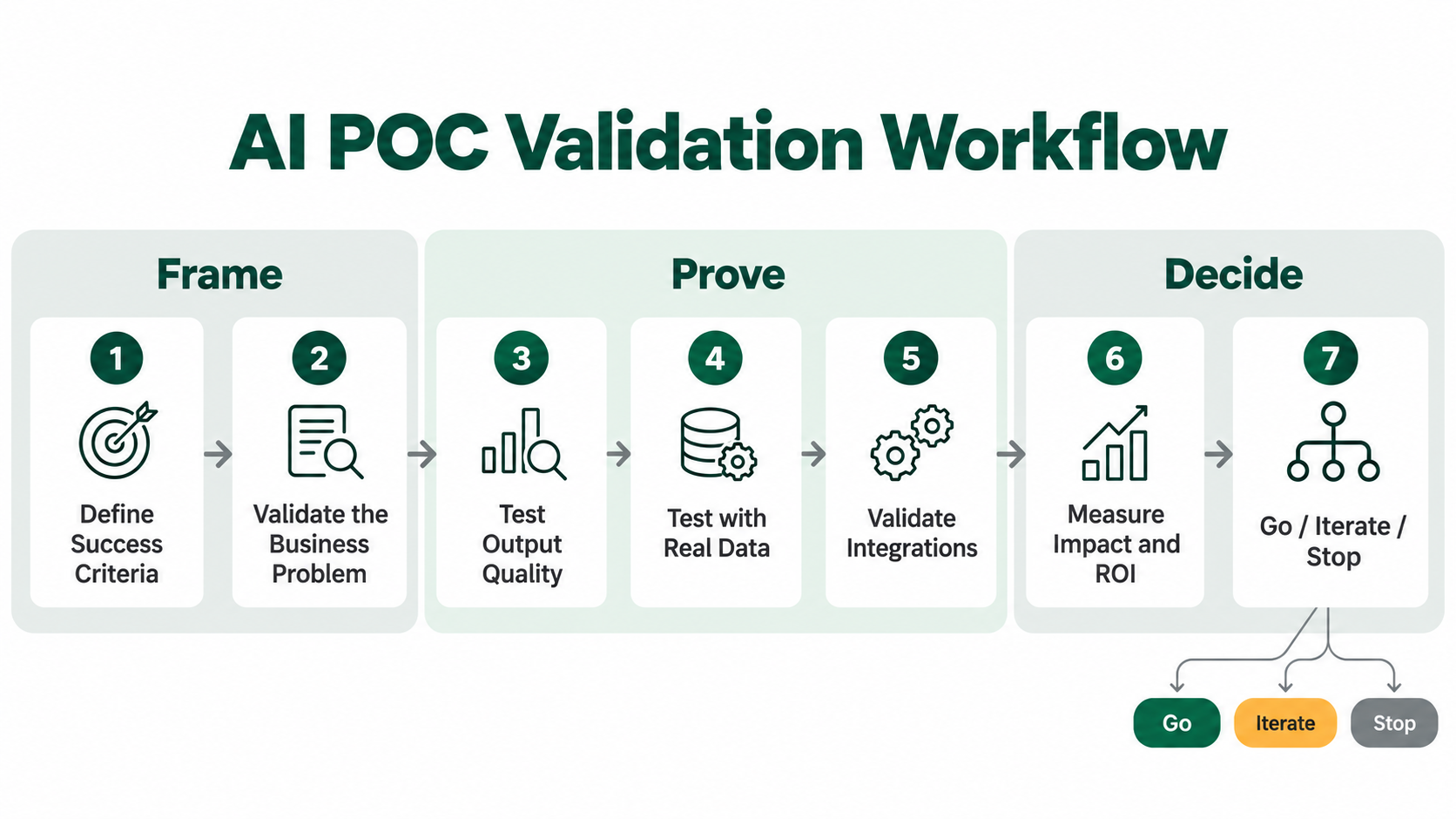
1. Define Measurable Success Criteria
What to test: Whether everyone agrees, in writing, what success means before work begins.
How to test it: Run a one-hour workshop with the business owner, a technical lead, and someone who does the work today. Agree on three to five metrics, each with a baseline, a target, and a minimum acceptable threshold.
Put them in a one-page POC charter, get it signed, and revisit it at every review.
Useful metrics: Accuracy against a labeled test set, handling time versus baseline, share of cases completed without correction, and cost per transaction.
Warning signs: Goals like "explore AI" or "improve efficiency." Criteria that shift after results arrive. No measured baseline for the current process.
Example: A claims team wants AI to extract data from first notice of loss forms. Instead of "faster intake," they agree on field-level accuracy targets for required fields, a handling-time reduction target, and zero records submitted without human review.
2. Validate the Real Business Problem
What to test: Whether the problem is real, frequent, costly, and genuinely suited to AI.
How to test it: Shadow the people doing the work for a few days. Count volumes, time each task, and log where errors and delays actually occur.
Then ask a blunt question: would a rules engine, form redesign, or policy change fix this more cheaply?
Useful metrics: Monthly volume, cost per case, rework rate, and the business value of the delay or error you are removing.
Warning signs: The idea came from a vendor demo, not an operational pain point. Nobody can say how often the problem occurs. Cases are too rare or varied to learn from.
Example: A support director wants an AI agent for billing questions. Shadowing reveals most calls stem from one confusing invoice line. Rewriting it removes many calls outright, and the POC is rescoped to the complex queries that remain.
3. Test AI Output Quality and Reliability
What to test: Whether outputs are accurate, consistent, grounded in source data, and safe when the system is uncertain.
How to test it: Build a gold-standard test set of real cases with verified answers, including hard and ambiguous ones. Run each case several times to check consistency.
Have domain experts blind-review a sample and grade every error by severity. Add adversarial cases: missing inputs, conflicting documents, and questions the system should escalate.
The NIST AI Risk Management Framework names "valid and reliable" as a characteristic of trustworthy AI. It describes systems that produce accurate, consistent results, validated through ongoing testing. That makes it a useful anchor for reviewers.
Useful metrics: Precision and recall per task, unsupported-claim rate, run-to-run consistency, correct escalation rate, and critical error rate.
Warning signs: Only average accuracy is reported. The builders wrote the test set. The system answers confidently when it should say "I don't know."
Example: A legal operations team tests AI that checks invoice narratives against billing guidelines. Overall accuracy looks strong, but severity review shows misses cluster in one rule type. That rule stays with human reviewers while the rest moves forward.
4. Test with Realistic, Production-Like Data
What to test: Whether the POC holds up on the data production will actually send.
How to test it: Pull a representative sample straight from source systems, masked where required. Include scans, typos, missing fields, legacy formats, and seasonal peaks.
Keep a holdout set the build team never sees. Compare results on a clean subset against the full raw set. That gap is your real production risk.
Useful metrics: Clean versus raw performance gap, ingestion failure rate, coverage across key segments, and data freshness.
Warning signs: Hand-picked datasets. Synthetic data only because access took too long. Sensitive records copied into unapproved environments to "move fast."
Example: A manufacturer tests AI to classify supplier quality reports. Clean PDFs score well, but a raw month including phone photos of paper forms scores far lower. The team adds an image quality check and low-confidence routing before retesting.
5. Validate Integrations and Workflow Feasibility
What to test: Whether the AI can work with the systems it depends on and fit how people actually work.
How to test it: Connect to at least one real system of record, even read-only or in a sandbox. Map the full flow: trigger, AI step, human review, system update, and exception path.
Check authentication, permissions, rate limits, latency, audit logging, and behavior when a downstream system fails. Then run timed walkthroughs with real users.
Useful metrics: End-to-end latency, integration error rate, manual handoffs per case, and reviewer time per AI output.
Warning signs: "We'll integrate later." Demos that rely on copy and paste. Reviewers spending longer checking output than doing the task. No security review scheduled.
Example: A clinic tests a voice agent for appointment booking. Conversations pass, but the calendar API confirms slots with a delay, causing double bookings in testing. Slot locking becomes a precondition for the pilot.
When integration is the bottleneck, LuMay's AI integration services focus on connecting agents to enterprise systems and data. The LuMay security architecture covers access, audit, privacy, and human review controls.
6. Measure Business Impact, Cost, Scalability, and ROI
What to test: Whether benefits at production scale outweigh the full cost of running the system.
How to test it: Compare POC results against your Method 1 baseline. Then model production costs: inference, infrastructure, integration upkeep, monitoring, human review time, and training.
Load-test at realistic peak volume and model conservative, expected, and optimistic scenarios. Gartner warns that small per-token costs can grow into a serious total cost of ownership problem once they are multiplied across many users and use cases.
Useful metrics: Cost per transaction versus today, hours returned to the team, error cost avoided, payback period, and cost at ten times current volume.
Warning signs: Hours saved ignore review time. Costs are estimated at POC volume. Benefits assume headcount changes nobody approved.
Example: An accounts payable team's invoice-matching POC saves real time per invoice. At full volume, though, the large model costs too much for low-value invoices. Routing simple invoices to a smaller model brings costs back within target.
For a fast first estimate, try LuMay's AI Workflow ROI Calculator. It estimates annual savings and FTE-hour equivalents from your manual operations spend and automation potential, and it applies a conservative realization discount. Replace its assumptions with your POC data as evidence arrives.
7. Make a Go, Iterate, or Stop Decision
What to test: Whether the evidence supports scaling, a focused second round, or ending the effort.
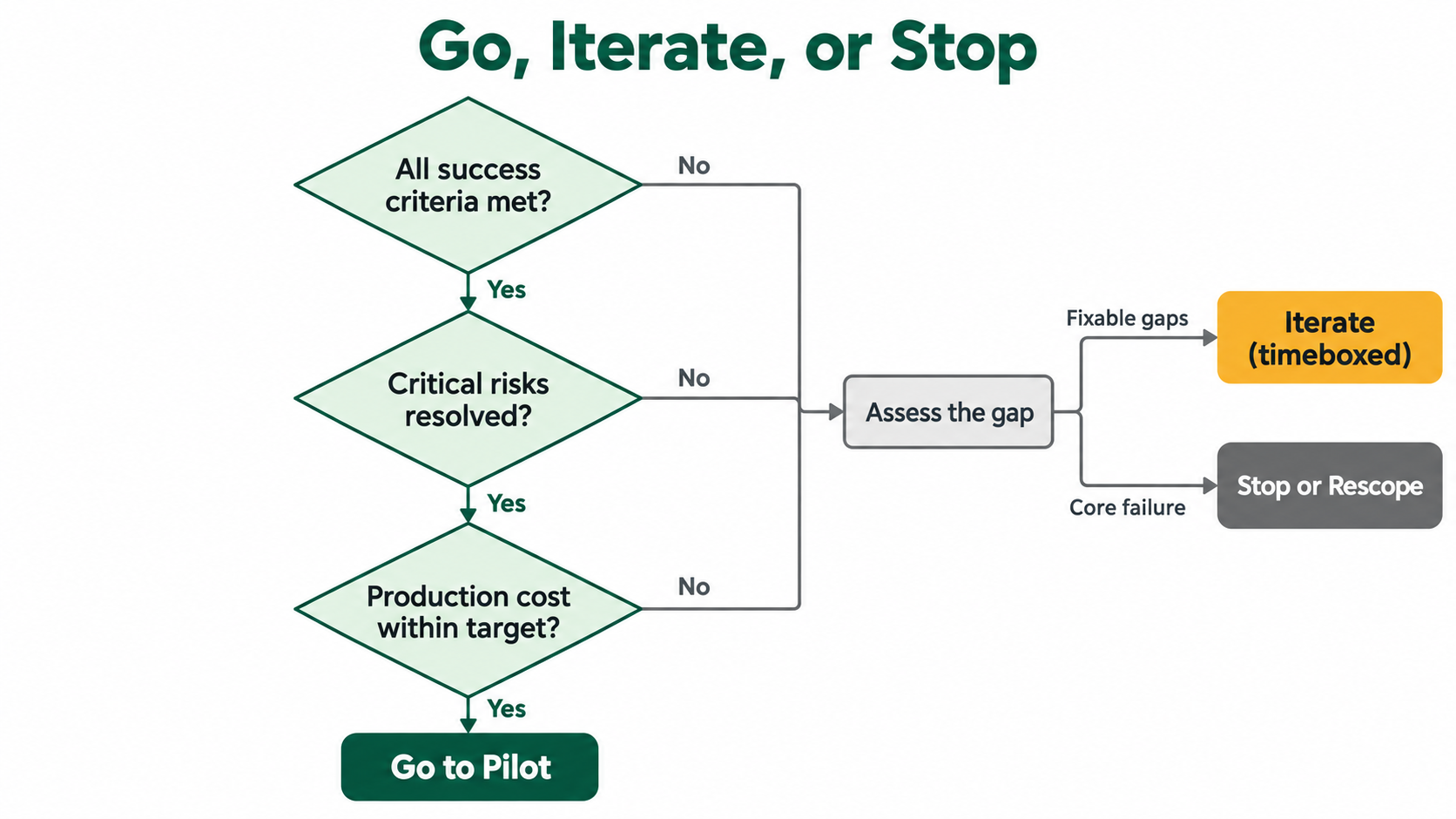
How to test it: Hold a formal review with the stakeholders who signed the charter. Present results against every original criterion, the scorecard below, open risks, and the cost model. Then choose one outcome:
Go: Criteria met, risks understood, and an owner and budget ready for a pilot.
Iterate: Promising results with specific, fixable gaps. Set a short timebox and new targets.
Stop: Core criteria missed, costs unworkable, or the problem was not what it seemed. Record the lessons.
Useful metrics: Criteria met versus total, weighted scorecard result, and unresolved critical risks.
Warning signs: "Iterate" becomes permanent. Builders make the decision alone. Sunk cost drives the conversation.
Example: A restaurant ordering voice agent hits its call completion target but misses payment security requirements. The team iterates for four weeks on secure payment handoff only, with an agreed stop if the requirement remains unmet.
The AI POC Validation Scorecard
Score each dimension from 1 (weak) to 5 (strong). Every score needs evidence, not opinion. Multiply by the weight to get a weighted total out of 5.
Dimension | Weight | What a 5 looks like | Evidence required |
|---|---|---|---|
Success criteria clarity | 10% | Signed charter with baselines and thresholds | POC charter |
Problem validity | 15% | Quantified volume, cost, and pain | Shadowing data, baseline metrics |
Output quality and reliability | 20% | Targets met, critical errors rare and caught | Test set results, severity review |
Data readiness | 15% | Small clean versus raw gap, approved access | Holdout results, data access approval |
Integration and workflow fit | 15% | Real system connected, users accept flow | Integration logs, walkthrough notes |
Business impact and cost | 15% | Positive ROI at production volume | Cost model, scenario analysis |
Risk, governance, and adoption | 10% | Controls defined, owners named | Security review, RACI, training plan |
Suggested decision rule (adjust to your risk appetite):
4.0 or higher, no dimension below 3: Go to pilot.
3.0 to 3.9, or any dimension at 2: Iterate with a timeboxed plan.
Below 3.0, or a 1 in quality, data, or risk: Stop or rescope.
Common AI POC Mistakes
Starting with the model, not the problem. Technology-first POCs rarely survive a budget review.
Measuring success after the fact. Criteria written after results arrive tend to fit whatever happened.
Testing on the demo dataset. If the build team chose the data, the results describe the team's choices, not reality.
Ignoring reviewer effort. AI that needs heavy checking can cost more time than it saves.
Leaving governance to the end. Bring security, legal, and compliance in at kickoff. LuMay's AI Governance Framework is a useful reference for structuring those controls.
Letting the POC drift. Without a timebox, a POC slowly becomes an unfunded product.
Go Versus No-Go Checklist
Before recommending a pilot, confirm each item:
Success criteria were signed before the build started.
The business problem is quantified with a measured baseline.
Results meet the minimum threshold on every core metric.
Critical errors were reviewed by domain experts and are contained.
Testing used raw, production-like data with a holdout set.
At least one real system integration works end to end.
Users completed a timed workflow walkthrough.
Production-volume costs are modeled and within budget.
Security, privacy, and compliance reviews are complete or scheduled.
A named business owner will run the pilot.
If three or more boxes stay unchecked, you are looking at "iterate" or "stop," not "go."


