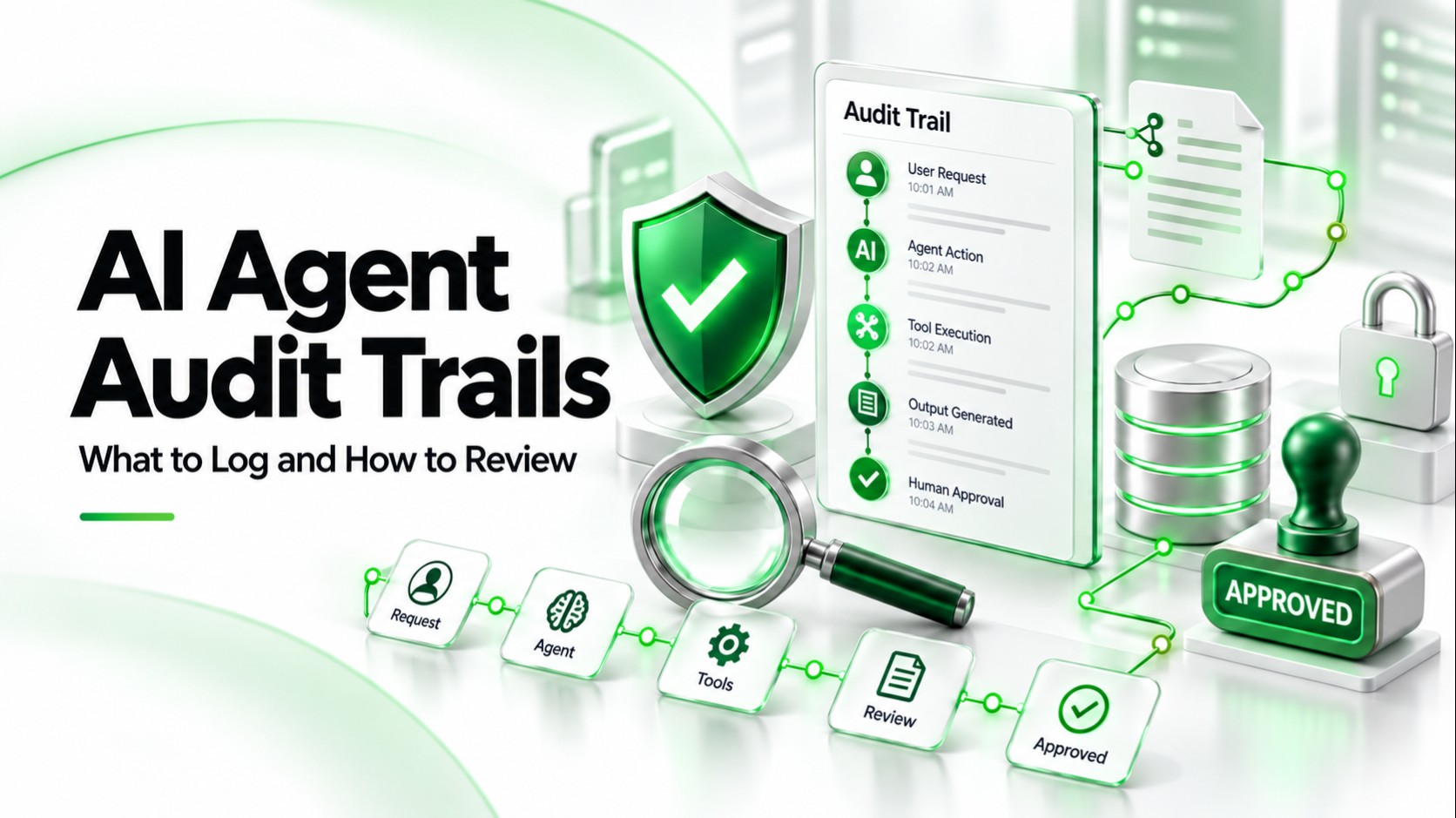
AI agent audit trails are linked records that help reviewers establish what an agent was asked to do, which permissions and approvals applied, what it attempted, and what actually happened. For an enterprise workflow, the useful question is not simply whether the AI produced a plausible answer. It is whether a reviewer can reconstruct an action and check that it stayed within its authorized scope.
Consider an agent that prepares a purchase order. A message saying that the order was submitted does not establish who approved it, which supplier was selected, or whether the procurement system accepted the request. Those facts need evidence from the systems responsible for them.
This guide proposes a practical audit design for enterprise AI teams. The event model, example, and metrics below are implementation recommendations, not a universal compliance standard or a description of every vendor's capabilities.
AI Agent Audit Trails vs. LLM Observability
Use observability to investigate how a system behaved: response times, failures, model calls, and dependencies. Design the audit trail to answer a narrower accountability question: can an authorized reviewer establish the identity, authority, action, and outcome for a specific business operation?
The same event can support both purposes, but the collection rules should be explicit. For this reference design, retain every required authorization, approval, and consequential-action event. Do not let a performance-trace sampling setting silently remove those records.
OpenTelemetry's GenAI attribute registry includes fields for model and tool activity and warns that tool arguments and results can contain sensitive information. Treat telemetry instrumentation as a building block, then add the business evidence your workflow needs. Check the conventions and instrumentation version used by your deployment rather than assuming every platform emits identical fields.
For the broader system design, see LuMay's guide to enterprise AI architecture patterns.
What Should an AI Agent Audit Trail Record?
Start with the questions a reviewer must answer. The OWASP Logging Cheat Sheet recommends event records that establish timing, location, identity, and activity. Extend that foundation with agent-specific configuration and workflow evidence.
The following is a proposed minimum event model. Capture fields where relevant, and document when a field is not applicable or unavailable.
| Evidence area | Suggested records | Review question |
|---|---|---|
| Request and correlation | Request ID, workflow-run ID, event ID, parent-event ID, event time, and ingestion time. | Which events belong to this operation, and in what sequence? |
| Identity and scope | Initiating user or service, executing workload identity, tenant, and relevant delegated scope. | Who requested the work, and under whose authority did it run? |
| Execution configuration | Agent release, workflow version, prompt-template version, and model identifier or revision when available. | Which configuration was active for this run? |
| Source evidence | Authorized document or record references, relevant revisions, retrieval time, and access-check result. | Which information was available to support the action? |
| Proposed action | Tool name, target resource, validated parameters or a protected reference, and action ID. | What exactly was the agent proposing to do? |
| Policy evaluation | Policy identifier and version, permit or deny result, reason code, and approval requirement. | Which rule allowed, blocked, or escalated the proposal? |
| Human decision | Approval ID, authorized reviewer, decision time, expiry, and the action version reviewed. | Did the approval cover the action that was executed? |
| Execution and outcome | Attempt ID, destination-system receipt, result status, and subsequent outcome verification. | Was the operation attempted, accepted, completed, rejected, or left uncertain? |
| Recovery and closure | Retry linkage, reconciliation result, exception owner, and any compensating-action reference. | How was an incomplete or incorrect operation resolved? |
Keep identifiers stable across handoffs. For parallel work, preserve parent-child relationships rather than relying on timestamps alone. Record both event and ingestion time so delayed delivery is visible.
Evidence references need their own lifecycle. A document link that later points to a revised policy is not enough to establish what the agent saw. Preserve an authorized version reference or a controlled snapshot when your retention policy allows it.
Connect the Proposal, Approval, and Executed Action
The OWASP AI Agent Security Cheat Sheet recommends independent execution checks and approvals tied to the exact action. A model-generated statement that an operation is approved is not a substitute for those checks.
For the proposed design, give each action an immutable version. Bind the approval to that version, including the target and validated parameters. A change to the recipient, amount, resource, or scope creates a new proposal that must be evaluated again. Approval should not float across materially different actions.
Use separate records for the agent's recommendation, the policy service's decision, the human review, and the destination system's response. A short operational explanation can help a reviewer, but it should point to evidence rather than act as evidence of its own correctness. Do not require a transcript of private model reasoning.
A Worked Example: An Agent Preparing a Purchase Order
This hypothetical workflow illustrates the design. It is not a LuMay customer case study, and the approval requirement is an assumed internal policy.
An operations employee asks an agent to prepare a purchase order from an approved requisition. The agent may assemble the order, but submission requires an authorized procurement manager.
| Step | Illustrative evidence | Expected behavior |
|---|---|---|
| Request received | Run R-104 connects the employee's request to requisition Q-208 and its revision. | The workflow checks the employee's access before retrieving the requisition. |
| Order proposed | Action A-17, version 1, identifies the supplier, currency, quantities, and delivery destination. | The system prepares the order without submitting it. |
| Review requested | Policy P-6 requires a procurement manager; the workflow records a pending decision. | The agent cannot approve its own submission. |
| Approval recorded | Approval AP-9 covers A-17 version 1 and records the manager and expiry. | The executor checks that the approval is valid for the exact proposal. |
| Submission attempted | The destination accepts the request and returns receipt PO-731. | The workflow records acceptance and checks the destination's order status. |
| Outcome verified | The procurement system confirms the expected order and status. | The agent reports the verified outcome, with the receipt reference. |
Now consider a timeout after submission. Do not immediately label the order as failed or submit a second order. In this example, record an uncertain outcome and reconcile with the destination system using the operation's stable identifier. A retry should follow the documented duplicate-prevention rules.
If the supplier changes after approval, create a new action version and request the necessary review. The original approval remains part of the history; it does not authorize the changed order.
Protect Audit Evidence Without Logging Everything
OWASP's logging guidance on sensitive data recommends excluding or protecting secrets and sensitive information. Its protection guidance also addresses restricted access and tamper detection. An audit design should not create an uncontrolled copy of business records.
For this reference design, separate a compact event ledger from restricted supporting evidence. Put action IDs, reason codes, approved references, and outcome states in the ledger. Store any necessary payload evidence behind its own authorization controls, with a documented reason for retaining it.
Use field allowlists and redaction before export to monitoring services. Test those controls with synthetic sensitive values. Avoid including access tokens, passwords, or complete confidential documents merely because the instrumentation can capture them.
Decide how reviewers will detect changes or deletion, which identities may write records, and who can retrieve supporting evidence. A hash stored beside a freely editable record should not be treated as a complete integrity design. Define the protected reference or storage control against which integrity is checked.
Retention should cover both the ledger and the evidence it references. Ask the organization's records, privacy, and security owners to approve that lifecycle rather than selecting a duration from a generic AI checklist.
Test the Audit Trail Before Releasing the Agent
Use an audit reconstruction exercise as a release test: give a reviewer a completed action ID and ask them to establish its scope, approval, execution, and outcome without interviewing the developer.
Then test broken paths. Change an action after approval. Let an approval expire. Delay an event. Duplicate a tool response. Remove access to a supporting record. Each test should have an expected system behavior and expected evidence, not just an expected chatbot reply.
For high-impact operations, OWASP's action-integrity guidance calls for failing closed when required controls, including audit logging, fail. Define that boundary explicitly: pause a consequential action when its required durable evidence cannot be recorded.
Also test the harder case in which the external action succeeds but the result event cannot be delivered. Treat that as an evidence-reconciliation incident. A logging failure does not, by itself, undo an external change.
Measure Evidence Coverage and Reviewability
These proposed metrics measure the quality of the audit process. They are not industry benchmarks, and no universal passing score is implied.
| Metric | Suggested calculation | Interpretation |
|---|---|---|
| Required-event coverage | Required events present divided by required events expected for the runs reviewed. | Identify missing evidence by action type and failure path. |
| Approval linkage | Executed actions with a valid matching approval divided by executed actions that required approval. | Investigate each missing or mismatched approval. |
| Outcome verification | Consequential attempts with a reconciled final outcome divided by consequential attempts due for reconciliation. | Keep unresolved outcomes visible instead of counting them as success. |
| Reconstruction time | Median elapsed review time across a defined sample of completed investigations. | Assess whether the evidence is usable, not merely stored. |
Build denominators from the workflow specification and destination-system records where possible. Calculating coverage only from events that arrived can hide the very omissions you need to detect. Set the review period, sample, and reconciliation deadline before comparing results.
Connect recurring findings to the team's operating process. LuMay's guide to LLMOps practices after launch provides related context for ongoing production oversight.
Keep Governance Claims Proportionate to the Evidence
The NIST AI Risk Management Framework is a voluntary framework for managing AI risk. Its companion Playbook organizes suggested practices around Govern, Map, Measure, and Manage.
Use that structure to assign ownership, understand workflow risks, evaluate controls, and manage exceptions. Do not describe possession of an audit log as proof of regulatory compliance or as a substitute for a qualified review of applicable obligations.
Frequently Asked Questions
Is a conversation transcript enough for an AI audit trail?
Not for the reference design in this guide. A transcript should be linked to independent permission checks, approvals, tool activity, and outcome records. The purchase-order example shows why an agent's completion message alone is insufficient.
Should every prompt and tool result be stored?
Choose evidence according to the review need and data policy. Prefer controlled references and necessary, protected extracts over blanket payload retention. Document what is excluded so reviewers understand the record's limits.
Can audit records reproduce an agent's exact answer?
Do not make identical regeneration the acceptance criterion. Configuration and source references support reconstruction of the execution context. Preserve the relevant authorized output when necessary, rather than relying on a later rerun to recreate it.
Who should own AI agent audit trails?
A workable arrangement gives engineering ownership of collection and reliability, security ownership of access and integrity controls, and the business process owner responsibility for action rules and exception resolution. Document the actual assignment for each workflow.
Design the Evidence Path Before Expanding Autonomy
LuMay's security and governance architecture describes correlation-linked audit trails, role-based access controls, and human-approval gates. Its AI agent development services also cover integration, execution logging, testing, and monitoring.
Use a workflow review to establish which events are available, where evidence is retained, how approvals bind to actions, and how uncertain outcomes are resolved. Confirm the controls for the proposed deployment rather than assuming that every reference-design feature is included by default.
Book a LuMay demo with one workflow in mind. Ask to follow a proposed action from the original request through policy evaluation, human approval, execution, and the destination system's verified result.