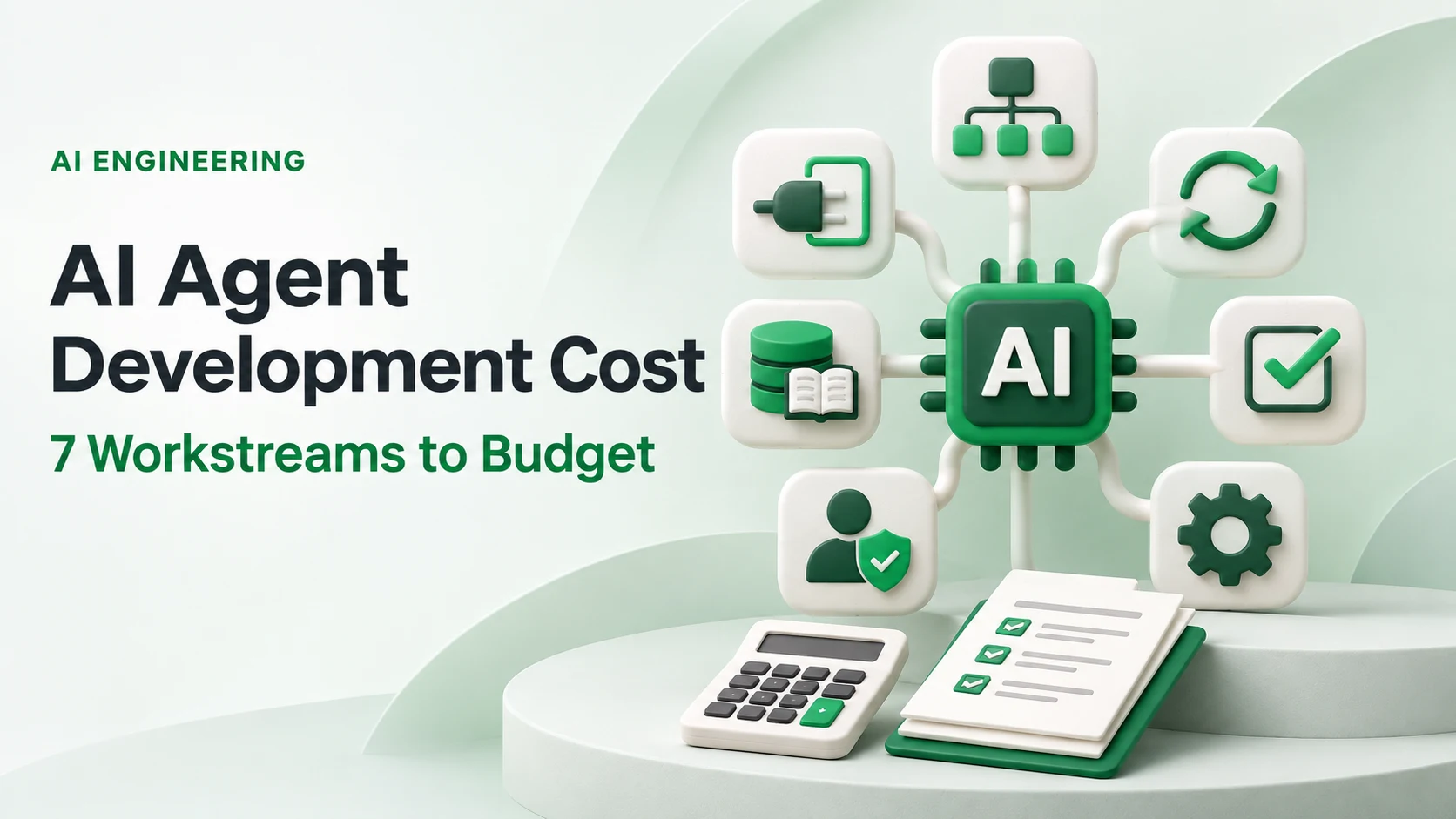
TL;DR: AI agent development cost depends on what the agent is allowed to do and what must happen when a step fails. Budget seven workstreams: workflow and authority design; tool integrations; state and recovery; knowledge and context; evaluation; approvals and security; and deployment and support. Separate one-time engineering from monthly operations. This guide includes an illustrative $57,500 implementation budget and $3,500 monthly operating budget, not a market average or a LuMay quote.
A support assistant that explains a policy and an agent that changes a customer record may use the same model. They require different engineering budgets. The second must authenticate, validate an action, preserve approval evidence, handle timeouts and prove whether the write actually happened.
This guide focuses on budgeting those action-taking behaviors. For costs across general AI, LLM and RAG projects, see our broader AI development cost factors. For a general total-cost worksheet, use the enterprise AI application cost guide.
Scope and evidence: Written for enterprise engineering and procurement teams on 10 November 2026. The work breakdown and examples are planning models, not measured industry benchmarks. Every labor rate, effort estimate and monthly allowance below is an explicit hypothetical assumption. Actual quotes require workflow, system and workload discovery.
Price the authority boundary before the architecture
| Agent scope | Engineering that must be priced | Evidence of completion |
|---|---|---|
| Read and recommend | Permitted retrieval, source checks, answer evaluation | An approved answer grounded in allowed sources |
| Prepare an action for approval | Draft payload, validation, approval routing, expiry and rejection | A reviewed action proposal with no premature write |
| Execute an approved action | Authentication, scoped writes, duplicate prevention, result verification | The intended system state and an execution record |
| Coordinate several actions | Durable state, sequencing, partial-failure handling, recovery | A reconciled outcome across affected systems |
These are scoping distinctions, not fixed pricing tiers. A poorly documented read-only legacy integration may take more effort than a well-supported write API. Price the actual constraints rather than treating autonomy as the only cost predictor.
1. Workflow design and permitted decisions
Define the business outcome, entry conditions and stopping rules. Document which decisions the agent may make, which require approval and which are prohibited. Include ambiguous requests, missing information and handoffs to another team.
Key capability to budget: explicit action boundaries. For a customer-record agent, specify which fields may change and what evidence authorizes each change. A vague requirement such as 'manage customer accounts' is not enough to estimate engineering effort.
Quote check: require a workflow map, assumptions, acceptance criteria and a list of excluded actions. Changes to authority after approval should trigger a scope review.
2. Tool integrations and write verification
An agent needs an interface to each business system. The work includes authentication, request validation, field mapping, error translation, rate-limit handling and test access. A successful HTTP response may not prove that the intended business outcome occurred.
Key capability to budget: verified tool outcomes. Include a way to inspect the resulting record or transaction and distinguish a confirmed write from an uncertain result.
Amazon Bedrock documents action groups that either invoke execution logic or return the predicted action and parameters to the application. That is a concrete example of why action execution belongs in the scope; it is not a cost benchmark. See the official return-control documentation.
3. Durable state, retries and recovery
A timeout after a tool call creates a difficult question: did the action fail, or did the action succeed while the response was lost? Retrying without checking can create duplicate orders, tickets or updates.
Key capability to budget: safe recovery. Price persistent workflow state, action identifiers, retry limits, reconciliation and escalation for uncertain outcomes. Long-running tasks also need a plan for process restarts and version changes.
Use the agent idempotency guide to scope duplicate prevention. Ask whether every integration supports an idempotency key or requires a different deduplication strategy.
4. Knowledge, permissions and context
Some agents need approved documents, account history or previous workflow state to decide what to do. Budget the source inventory, access mapping, freshness requirements and relevant retrieval work. Do not assume all available data should be placed in the prompt.
Key capability to budget: bounded, authorized context. A record-update agent should use the correct entity and current policy, while preserving the user's permissions throughout the workflow.
Keep this workstream conditional. An agent that operates on a small structured transaction may not need a vector database or a RAG pipeline. Require each proposed component to solve a documented requirement.
5. Action-level evaluation and acceptance tests
Testing should cover more than whether a response sounds correct. Check whether the right tool was selected, arguments were valid, approval was obtained, the correct record changed and the final explanation matches the result.
Key capability to budget: a reusable acceptance suite. Include test-data preparation, integration fixtures, expected system states, regression checks and domain review. Add denied permissions, stale inputs, unavailable tools, repeated requests and partial failures.
Separate critical failures from average quality. A high overall score should not hide an unauthorized write. The AI agent testing checklist provides related release questions.
6. Human approvals, security and audit evidence
An approval step needs a recipient, a clear proposed action, enough context to decide, a timeout and a rejection path. It also needs a way to prevent an old approval from being reused after the request changes.
Key capability to budget: approval bound to a specific action. Record what was proposed, who approved it, what changed and what was executed. Include credential management, least-privilege access, log redaction and incident procedures in the scope.
Our approval-gate guide covers the design choices. Manual review also creates a recurring staffing cost; automation does not remove that line automatically.
7. Deployment, operations and change ownership
Production operation includes environments, monitoring, usage limits, credential rotation, backups, incident handling and regression tests after changes. Define who owns problems caused by a model update, API change or expired integration credential.
Key capability to budget: an operable handover. Require a runbook, alert ownership, rollback procedure, documented support hours and access to the code and test artifacts.
For operating economics, count all model and tool calls per task, including validation and retries. Keep support labor, review labor and usage charges separate so procurement can see what is fixed and what scales.
Worked example: one approved CRM update workflow
Hypothetical scope: an internal agent reads one CRM, prepares a change to permitted fields, requests approval and executes that approved update. It uses an existing identity system and a documented API. It excludes voice, payment actions, custom model training and additional systems. The hours below are an example work breakdown, not an estimate for your deployment.
| One-time workstream | Assumed hours | At an assumed $125/hour |
|---|---|---|
| Workflow and authority design | 40 | $5,000 |
| Integration and verified writes | 100 | $12,500 |
| State, retries and recovery | 48 | $6,000 |
| Knowledge and context preparation | 56 | $7,000 |
| Acceptance dataset and evaluation | 64 | $8,000 |
| Approval, security and audit controls | 48 | $6,000 |
| Deployment, documentation and handover | 44 | $5,500 |
| Base implementation | 400 | $50,000 |
| Illustrative contingency: 15% | — | $7,500 |
| Total implementation allowance | — | $57,500 |
The contingency is an example reserve for uncertainty, not a standard percentage. Assign overlapping work to one owner before adding the hours; for example, do not count the same permission test under integration, evaluation and security.
| Monthly operating item | Hypothetical assumption | Monthly allowance |
|---|---|---|
| Model usage, including evaluation calls | Flat allowance pending measurement | $180 |
| Paid external tool calls | Flat allowance pending measurement | $120 |
| Application infrastructure | Compute, database and state storage allowance | $450 |
| Logging and monitoring | Storage and monitoring allowance | $150 |
| Human review | 12 hours × $50 | $600 |
| Maintenance and support | 16 hours × $125 | $2,000 |
| Total | Fixed example workload | $3,500 |
The model and tool allowances are not published provider prices. Replace them with measured call counts, token volumes and current contracted rates. The review allowance assumes 720 minutes per month: at 2,000 initiated tasks, that is only 21.6 seconds per task on average. If every task requires a longer approval, increase review staffing or reduce scope.
At an assumed 90% successful completion rate, 2,000 initiated tasks produce 1,800 successful tasks. Monthly operating cost per successful task is $3,500 ÷ 1,800, or about $1.94. With constant monthly workload, the illustrative first-year total is $57,500 + (12 × $3,500) = $99,500. This excludes taxes, financing, internal opportunity cost and unlisted licenses.
Define success before using that denominator. Count requests correctly rejected for lack of authority separately from eligible tasks that failed, so safe refusals do not disappear into an unexplained failure rate.
Compare proposals using the same boundary
- Give vendors the same action list, systems, sample inputs and exception cases.
- Ask for one-time deliverables, recurring commitments and usage assumptions separately.
- Require an owner and acceptance artifact for each of the seven workstreams.
- Confirm code, configuration, test-data and runbook ownership at handover.
- Ask how scope changes affect cost, especially a new write permission or another system.
- Run sensitivity checks for review time, task volume, retries, tool charges and support needs.
For LuMay specifically, the published pricing page lists Custom AI Solutions starting at a $25,000 pilot as checked on 10 November 2026. That is LuMay's published starting point, not an industry price or a promise that this worked example fits that package. Confirm deliverables, operating charges and production-transition terms in the proposal.
Scope the first agent around one measurable outcome
Start with a bounded workflow and define the permitted action, required approval and recovery behavior. Request an AI engineering services discussion around that brief. A comparable quote should explain what the agent can do, what proves completion and who operates it when a step fails.