



Legacy Interactive Voice Response (IVR) systems are rapidly being phased out by enterprise contact centers. According to recent Gartner studies, traditional DTMF (dual-tone multi-frequency) "press 1 for billing" systems drop customer satisfaction scores by up to 40%. In their place, automated voice intelligence has advanced to handle complex conversations.
Modern voice engines process natural dialogue, manage interruptions fluidly, and run complex multi-step backend transactions in real time.
When selecting an enterprise voice AI platform, decision-makers face a fundamental choice between two distinct engineering approaches:
Lightweight, low-latency, voice-first streaming architectures optimized for speed, simplicity, and clear unit economics.
Heavyweight, multi-channel orchestration frameworks designed to house an entire company's automated logic under a single monolithic governance layer.
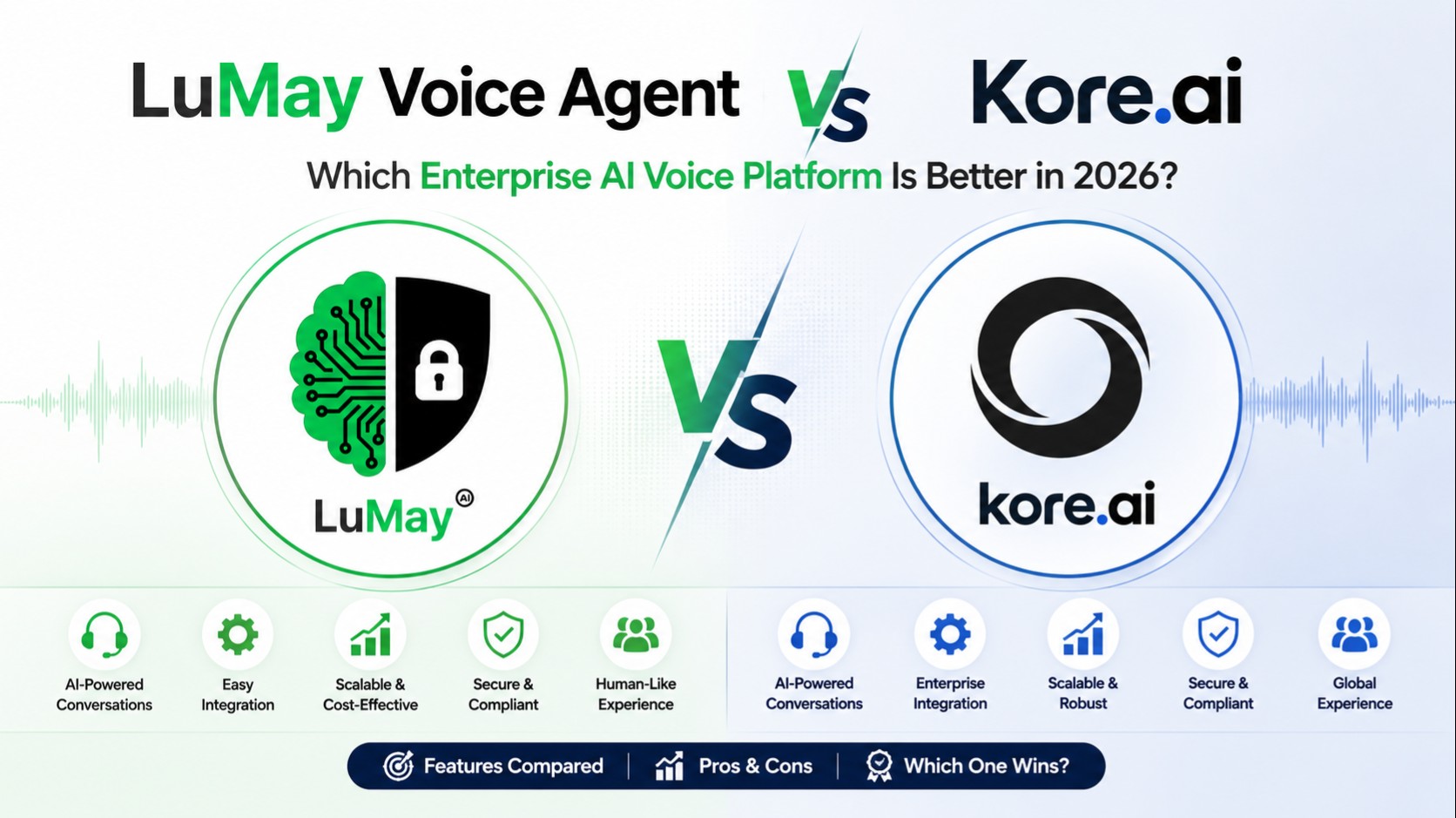
This comprehensive guide breaks down the core engineering, pricing, and deployment profiles of LuMay Voice Agent and Kore.ai (XO Platform / Artemis) to help your enterprise choose the right solution.
Executive Summary: Key Differences at a Glance
For quick decision-making, the operational divergence between these two platforms can be summarized by latency, cost architecture, and implementation time:
LuMay Voice Agent is a dedicated, ultra-low-latency inbound AI voice calling platform and outbound AI voice automation engine. It is engineered specifically for high-velocity voice operations like appointment booking, lead qualification, and instantaneous customer support. Running at a flat rate of $0.05 per minute with sub-500ms response times, it strips out architectural bloat to maximize conversation fluidity.
Kore.ai is an omni-channel conversational giant built to govern text chat, search AI, and voice across an entire corporate structure. While highly powerful, its enterprise deployments typically require custom annual contracts starting around $300,000. Its voice pipelines run on a 15-minute session-billing increment, and its cloud instances typically average 800ms to 1,000ms in latency, unless significant optimization is applied.
LuMay Voice Agent vs Kore.ai Overview
To evaluate these platforms accurately, we must analyze the specific enterprise infrastructure each vendor provides.
LuMay Voice Agent: The Voice-First Speed Specialist
LuMay Voice Agent was built to solve the most difficult bottleneck in voice automation: conversational latency. In voice-based interactions, any delay over 600ms breaks the natural cadence of speech, leading to awkward over-talking and customer frustration.
LuMay uses a custom real-time streaming infrastructure that bypasses traditional API chunking. By pairing its optimized orchestration layer with integrated intent and sentiment analysis, it maintains an operational response time under 500ms.
The platform features a native no-code visual builder, built-in fallback handling, and support for over 100 languages. It is highly optimized for direct transaction executions like dental and healthcare appointment scheduling, high-volume sales qualification, and immediate front-desk automation.
Kore.ai: The Monolithic Enterprise Orchestrator
Kore.ai is a long-standing leader in the Gartner Magic Quadrant for Conversational AI Platforms. Its flagship XO Platform (and the 2026 Artemis upgrade) acts as an enterprise-wide automation hub. Kore.ai excels when an organization wants a single platform to manage their internal HR web bots, public customer text chat, cognitive knowledge search, and telephony channels simultaneously.
Kore.ai builds its systems around a proprietary compilable agent language called ABL (Agentic Builder Language), managed by their built-in AI architect, Arch. This structure provides unmatched deterministic governance and 100% auditable policy paths. However, because it was originally engineered as a text-first natural language processing (NLP) framework and later adapted for voice via gateways, its voice pipeline includes additional mid-stack transformations that affect real-time speed.
Master Comparison Matrix
Core Evaluation Metric | LuMay Voice Agent | Kore.ai (XO Platform / Artemis) |
Primary Design Philosophy | Voice-First, Low-Latency Streaming | Multi-Channel, Enterprise Orchestration |
Target Use Cases | Inbound Support, Outbound Sales, Lead Gen, Booking | Cross-Enterprise Bot Governance, Complex Workflows |
Conversational Latency | Sub-500ms (Consistent) | 800ms – 1,000ms (Cloud baseline) |
Pricing Architecture | Transparent $0.05 / minute flat rate | Session-based (15-min increments) + Seat license |
Minimum Annual Commitment | None (Pay-as-you-go & Tiered options) | Typically $300,000+ for enterprise tier |
No-Code / Low-Code Builder | Visual flow canvas with native prompt testing | Visual node builder using proprietary ABL engine |
Language Support | 100+ languages out of the box | 40+ languages with deep regional customization |
Voice Quality & Cloning | Native ultra-realistic voices with cloning | Bring-Your-Own (BYO) TTS/ASR integration options |
Barge-In & Interruption | Advanced real-time interruption handling | Configurable via voice gateway voice-activity detection |
CRM / ERP Integrations | Native Salesforce, HubSpot, Zendesk + APIs | Enterprise Integration Hub (SAP, ServiceNow, Dynamics) |
Model Agnosticism | Fully decoupled dynamic LLM router | Platform-insulated, independent model swapping |
Deployment Environments | Cloud Multi-Tenant, Secure Single-Tenant | Multi-Cloud, On-Premises, Private Cloud, Air-gapped |
Security & Compliance | SOC 2 Type II, HIPAA, GDPR, PII Redaction | SOC 2, HIPAA, ISO 27001, FedRAMP-ready, RBAC |
Average Deployment Time | 1 to 3 weeks | 2 to 4 months |
Architectural Deep Dive & Workflow Processing
Understanding how data moves through each platform highlights why their latency profiles and deployment times differ so significantly.
LuMay's Streaming Pipeline
LuMay utilizes an asynchronous WebSocket infrastructure. When a user speaks:
Audio is continuously streamed to a specialized Automated Speech Recognition (ASR) model.
Transcription fragments are sent to the Large Language Model (LLM) instantly.
The LLM generates text tokens, which are streamed immediately into a Text-to-Speech (TTS) engine.
Audio returns to the user while the rest of the sentence is still being processed.
This concurrent, non-blocking pipeline keeps execution latency below 500ms.
Kore.ai’s Governance Pipeline
Kore.ai processes voice requests through a more structured governance framework:
Incoming telephony audio passes through a Voice Gateway to hit the ASR layer.
The complete text block is handed to the Core NLP Engine, which checks deterministic intent matching, custom entity extraction, and business policy constraints via the ABL runtime.
Once the policy checks validate the request, it queries the backend systems or triggers reasoning models.
The response passes through data redaction and audit logging before heading to the TTS engine and back to the customer.
While this structured approach provides rigorous safety and auditability for highly regulated environments, the extra processing layers add 300ms to 500ms of structural latency.
Feature-by-Feature Engineering Breakdown
AI Voice Quality, Latency & Conversation Intelligence
In voice automation, natural interaction depends entirely on audio processing speed and fluid conversation handling.
Barge-In Capabilities: LuMay handles interruptions using real-time audio stream clearing. If a customer interrupts mid-sentence, the agent drops its current execution thread instantly, registers the new input, and adapts without missing context. Kore.ai manages barge-in through its voice gateway settings. While functional, it requires precise calibration of Voice Activity Detection (VAD) thresholds to avoid accidental cuts from background noise.
Context Memory: Kore.ai features a sophisticated long-term memory management system. It can track context across entirely different interaction cycles—such as remembering a web chat from three days ago during a phone call today. LuMay focuses heavily on single-session multi-turn memory accuracy, ensuring that context remains locked throughout complex booking or qualification workflows.
Workflow Automation & CRM Integrations
Both platforms connect deeply with enterprise systems, but they approach backend integrations differently.
+-------------------------------------------------------------------+
|                     ENTERPRISE SYSTEM ECOSYSTEM                   |
+-------------------------------------------------------------------+
|  [CRMs] Salesforce / HubSpot / Zendesk                             |
|  [ERPs] SAP / Oracle / Microsoft Dynamics                         |
|  [ITSM] ServiceNow / Atlassian Jira                               |
+-------------------------------------------------------------------+
                                |
        +-----------------------+-----------------------+
        |                                               |
        v                                               v
+-------------------------------+               +-------------------------------+
|       LUMAY VOICE AGENT       |               |            KORE.AI            |
|  - Native RESTful Integrations|               |  - Compilable ABL Framework   |
|  - Real-Time Webhook Bridges  |               |  - Multi-Channel Router Hub   |
|  - Direct MCP Server Mesh     |               |  - Custom Enterprise Gateway  |
+-------------------------------+               +-------------------------------+
LuMay Voice Agent: Leverages clean, developer-friendly RESTful APIs, flexible webhooks, and the Model Context Protocol (MCP). It is built to pipe live structured call summaries, intent flags, and customer sentiment metrics directly into HubSpot, Salesforce, and Zendesk the moment a call ends.
Kore.ai: Features a massive, pre-built enterprise integration ecosystem. It natively supports legacy banking cores, healthcare EHR databases, and complex ERP systems like SAP or ServiceNow. Its workflow engine handles complex backend branching logic safely across multiple applications simultaneously.
Enterprise Security, Compliance & Deployment Options
For IT architects and compliance officers, security architecture is often the deciding factor when selecting a vendor.
Compliance Frameworks
Both platforms offer robust security measures, but they are built for different organizational scales:
Kore.ai provides an incredibly secure infrastructure designed for global banks, government defense sectors, and massive healthcare networks. It supports strict Role-Based Access Controls (RBAC), provides comprehensive immutable audit logs for every single transaction, and complies with ISO 27001, SOC 2 Type II, HIPAA, and GDPR.
LuMay Voice Agent maintains strict data privacy standards using advanced on-the-fly PII (Personally Identifiable Information) and PHI (Protected Health Information) data masking. This allows it to run fully compliant HIPAA operations for dental offices, medical groups, and financial services without storing sensitive customer data on its servers.
Deployment Flexibility
Deployment needs vary greatly depending on an organization's infrastructure constraints:
LuMay operates primarily as a high-availability multi-tenant cloud or secure single-tenant cloud instance, allowing teams to go from configuration to production within weeks.
Kore.ai is highly flexible here. It can be deployed across multi-tenant cloud environments, private cloud infrastructures, on-premises data centers, or completely air-gapped corporate environments. This makes it an ideal option for institutions that are legally barred from using public cloud LLM endpoints.
The Financial Reality: Pricing Model Comparison
The total cost of ownership (TCO) differs significantly between these two platforms, particularly as conversation volumes scale.
LuMay Voice Agent Pricing Architecture
LuMay operates with a transparent, usage-based pricing model detailed in the LuMay Voice Agent pricing guide.
Flat Rate: $0.05 per minute.
Inclusions: This single rate covers the core orchestration engine, fast transcription handling, logic processing, and audio delivery.
Predictability: There are no hidden software fees, licensing minimums, or agent seat costs. If your system processes 10,000 minutes of calls, your cost is a predictable $500.
Kore.ai Pricing Architecture
Kore.ai uses a complex, tiered enterprise pricing structure that requires custom negotiation:
15-Minute Session Increments: Automation workloads are billed based on 15-minute operational blocks. If a complex support call lasts 16 minutes, it registers as two full billing sessions.
Seat Licensing: Contact center agent tools and specialized supervisor dashboards require separate per-seat licenses, ranging from $50 to $150 per user monthly.
Enterprise Minimums: Standard enterprise-wide platform access contracts generally scale out to an entry budget of $300,000 annually, which covers dedicated technical managers, strict platform SLAs, and advanced analytics add-ons.
Industry-Specific Fitment Matrix
To help determine which platform matches your specific operating model, review the organizational profiles below:
1. Mid-Market & High-Velocity Customer Service
Winner: LuMay Voice Agent
Rationale: For standard inbound support desks, immediate receptionist routing, and high-volume consumer inquiries, LuMay's quick deployment and sub-500ms latency provide a smoother customer experience without requiring a massive upfront development budget.
2. Global Banking, Insurance & Government Infrastructure
Winner: LuMay & Kore.ai
Rationale: Large financial institutions require complex multi-channel coordination, strict localized data governance, and specialized air-gapped deployments. Kore.ai’s enterprise engine handles these compliance demands securely.
3. Outbound Sales Automation, Lead Gen & Appointment Booking
Winner: LuMay Voice Agent
Rationale: Outbound operations depend heavily on speed and cost efficiency. LuMay’s low pricing structure and direct integrations make it an ideal choice for running high-performing, automated outbound qualification and booking campaigns.
Balanced Pros & Cons Matrix
Platform | Core Strengths (Pros) | Operational Challenges (Cons) |
LuMay Voice Agent | • Super-fast sub-500ms latency ensures fluid speech. • Highly disruptive flat rate of $0.05/minute. • Deploys into production environments in 1–3 weeks. • Clean, developer-friendly API and webhook framework. | • Focuses primarily on voice rather than text channels. • Does not support native on-premises or air-gapped setups. • Lacks complex, multi-system enterprise workflow builders. |
Kore.ai | • Highly rated multi-channel enterprise bot framework. • Comprehensive on-premises and air-gapped security options. • Advanced context retention across separate channels. • Deep, pre-built integrations for legacy IT systems. | • High entry barrier with custom agreements starting at ~$300K. • Higher cloud voice latency (~800ms–1000ms). • Complex ABL runtime setup requires months to build. • Unpredictable costs due to 15-minute session billing. |
Strategic Evaluation Checklists
LuMay Voice Agent Wins If Your Organization Needs:
[ ] A specialized, high-performance AI call center platform built specifically for voice.
[ ] Strict conversational latency under 500ms to keep voice interactions completely natural.
[ ] A highly predictable pay-as-you-go cost model ($0.05/min) without software seat fees or large upfront retainers.
[ ] Rapid speed-to-market, with systems moving from design to live production within 1 to 3 weeks.
[ ] Seamless data synchronization with standard platforms like Salesforce, HubSpot, or Zendesk.
Kore.ai Wins If Your Organization Needs:
[ ] A single, unified automation system to govern text chat, web bots, internal HR assistants, and voice lines simultaneously.
[ ] Comprehensive, enterprise-wide control over hundreds of distinct conversational bots.
[ ] Full deployment flexibility across private clouds, on-premises data centers, or entirely air-gapped environments.
[ ] Deterministic workflow control managed by a structured, compilable scripting framework (ABL).
[ ] An enterprise-grade vendor partnership backed by dedicated engineering teams and premium, custom SLA contracts.
Step-by-Step Voice Agent Migration & Deployment Strategy
If your organization is replacing an outdated legacy IVR setup with an intelligent, voice-first automation layer, follow this proven deployment path to ensure a smooth transition:
Define Scope & Conversation Paths:
Map out your most frequent customer inquiries (e.g., booking requests, basic support questions, balance checks). Clearly outline the required API endpoints and determine exactly when calls should hand off to live support teams.
Configure Integrations & Knowledge Bases:
Connect your target CRM platform, scheduling engines, or external databases via RESTful APIs or secure webhooks. Upload your company's support documentation and operational parameters to establish the agent's core knowledge base.
Build & Test in a Secure Sandbox:
Design your conversation flows using a visual drag-and-drop canvas. Run end-to-end testing within a secure sandbox environment to evaluate how effectively the agent manages customer interruptions, handles unexpected inputs, and processes intent.
Launch Low-Volume Pilot & Optimize:
Route a small subset (e.g., 5% to 10%) of live inbound traffic to your new voice agent. Monitor conversation completion metrics, analyze customer sentiment data, and refine system prompts to optimize overall performance.
Full Production Scaling:
Scale the system to handle your full contact center call volume. Review operational dashboards continuously to track cost-per-call metrics, monitoring and managing the entire system using structured lifecycle management processes.
Deep Industry Alternatives Landscape
To ensure your procurement team conducts a thorough market analysis, it is helpful to see how LuMay and Kore.ai fit into the broader conversational AI landscape:
Low-Latency, Voice-First Alternatives: If your focus is purely on lightning-fast speech performance, explore the detailed LuMay Voice Agent vs Retell AI analysis or the comprehensive LuMay Voice Agent vs Vapi breakdown. For additional platforms in this tier, check out the LuMay Voice Agent vs Synthflow evaluation and the LuMay Voice Agent vs Bland AI comparison.
Core Market Alternatives: For a wider view of options across different operational budgets, consult our curated lists of the best Vapi alternatives, top Retell AI alternatives, and best Bland AI alternatives.
Enterprise Framework Competitors: Organizations evaluating larger omni-channel setups typically look at legacy providers like Google Dialogflow CX, Amazon Connect, Cognigy, or PolyAI. To see how these compare to more agile voice architectures, read our guide on the best PolyAI alternatives and the best Voiceflow alternatives.
Comprehensive FAQ Section
Is LuMay better than Kore.ai?
LuMay is better if you are looking for an ultra-low-latency, voice-first platform that is affordable ($0.05/min) and quick to deploy for voice-centric use cases. Kore.ai is better if you require a comprehensive, enterprise-wide orchestration platform to manage complex text, search, and voice automation channels under a single monolithic governance structure.
Which platform is easier to deploy?
LuMay is significantly faster and easier to deploy, typically moving from initial configuration to full production in 1 to 3 weeks using standard web APIs. Kore.ai projects generally require 2 to 4 months of development due to its structured enterprise compliance processes and complex ABL programming model.
Does LuMay support outbound AI calling?
Yes, LuMay features a highly optimized outbound calling infrastructure designed for lead qualification, appointment confirmation, and automated follow-ups, syncing directly with your CRM.
Does Kore.ai support voice AI?
Yes, Kore.ai supports voice automation through its specialized Voice Gateway module, allowing enterprises to link their conversational flows to traditional telephony systems (SIP trunking).
Which platform has better CRM integrations?
LuMay offers simple, out-of-the-box integration paths for popular CRMs like HubSpot, Salesforce, and Zendesk. Kore.ai excels at connecting with complex, legacy enterprise software ecosystems, including custom banking setups, SAP architecture, and ServiceNow engines.
Which platform offers better security?
Both vendors provide robust enterprise-grade security. Kore.ai is ideal for heavily restricted sectors because it can deploy completely within private clouds or air-gapped systems. LuMay secures single-tenant cloud instances using advanced real-time PII and PHI data redaction to maintain strict compliance.
Which is better for healthcare?
Both platforms support HIPAA-compliant setups. LuMay is a popular choice for medical networks and dental practices due to its fast deployment and affordable, real-time appointment booking pipelines. Kore.ai is a strong option for large hospital networks that need to integrate voice data with legacy EHR backend systems.
Which platform is more affordable?
LuMay is considerably more affordable for voice operations, running on a transparent, flat usage rate of $0.05 per minute. Kore.ai requires a substantial upfront financial commitment, with enterprise pricing models typically starting at $300,000 annually.
Can either platform replace traditional IVR?
Yes, both platforms are engineered to replace traditional, rigid DTMF IVR systems with fluid, natural language voice interactions that resolve customer inquiries without confusing menus.
Which supports multilingual conversations?
LuMay natively supports over 100 languages with instant accents and localized tuning out of the box. Kore.ai supports over 40 languages, providing deep customization options for large global operations.
What telephony providers are supported?
Both platforms integrate smoothly with major telecommunications networks and modern cloud communications suites, including Twilio, Vonage, Genesys, and traditional corporate SIP infrastructures.
How does human handoff work?
Both systems monitor live conversations continuously. If a customer asks to speak with a human or hits a complex problem, the system transfers the call and passes along the full interaction transcript so the live agent has complete context.
Which platform is better for AI sales agents?
LuMay is highly effective for automated sales use cases. Its sub-500ms response speed keeps sales calls moving naturally, and its transparent $0.05/min rate makes running high-volume qualification campaigns highly cost-efficient.
What analytics and reporting are available?
Both platforms offer clean management dashboards. LuMay focuses on core conversational metrics like call completion rates, intent tracking, and sentiment analysis. Kore.ai provides deep, enterprise-wide business intelligence tools that audit 100% of interactions for compliance and quality control.
Does either support private cloud deployment?
Yes, Kore.ai offers comprehensive deployment flexibility, allowing installations across private clouds, on-premises setups, or air-gapped environments. LuMay focuses on high-availability, secure multi-tenant or single-tenant cloud models to ensure rapid deployment.
How do they integrate with enterprise workflows?
LuMay connects using lightweight RESTful APIs, modern webhooks, and the Model Context Protocol (MCP). Kore.ai manages workflows through its robust Agentic Builder Language (ABL) framework, ensuring predictable enterprise governance.
What industries benefit most from each platform?
LuMay is well-suited for fast-moving industries like sales, marketing, retail, real estate, dental, and mid-market healthcare. Kore.ai is tailored for highly regulated, large-scale sectors like global banking, insurance, and government enterprise operations.
What should enterprises evaluate before choosing?
Your core evaluation should weigh operational speed against multi-channel complexity. If you need a fast, natural, and cost-effective voice-first platform, pick a streaming engine. If you need to govern multiple text and search channels under a single architecture, an enterprise orchestrator is the better choice.
People Also Ask
What is the difference between LuMay and Kore.ai?
LuMay is a specialized, low-latency voice agent built for rapid deployment and transparent, minute-based pricing ($0.05/min). Kore.ai is a multi-channel conversational framework built to govern text chat, search, and voice workflows across an entire enterprise via customized annual contracts.
Is LuMay better?
LuMay is the superior choice if your primary goal is maximizing voice conversation quality with low latency (<500ms) and predictable, usage-based pricing.
Which AI voice platform is best?
The right platform depends on your operational scale. For agile, high-performance inbound and outbound phone automation, voice-first engines like LuMay are highly effective. For enterprise-wide, multi-channel bot governance, Kore.ai is an industry leader.
Can AI replace IVR?
Yes. Modern voice AI completely replaces outdated "press button" IVR systems with natural, human-like dialogue that understands intent, manages interruptions, and resolves customer issues autonomously.
Which AI voice software supports CRM?
Both LuMay and Kore.ai integrate with top CRM systems like Salesforce and HubSpot, ensuring call outcomes, structured logs, and customer data sync automatically.
Final Enterprise Buying Guidance
Choosing between LuMay Voice Agent and Kore.ai comes down to an architecture and budget decision:
If your enterprise wants a massive, all-in-one conversational framework to manage text chat, internal corporate bots, and multi-channel workflows under a strict governance layer—and you have the budget ($300K+) and development timeline (3+ months) to support it—Kore.ai is a powerful solution.
However, if your primary goal is optimizing your voice operations, lowering customer wait times, and deploying a natural AI contact center solution without unpredictable session costs or seat licensing fees, LuMay Voice Agent is the ideal choice.
Optimize Your Contact Center Strategy Today
Ready to see ultra-low-latency voice automation in action? Book a Live LuMay Demo and test our sub-500ms response speeds yourself.
Want to map out your integration requirements? Connect with an automation expert to design a tailored Voice Agent Deployment Case Study for your company's workflow.


